Posts Tagged ‘Paracelsus’
“Alchemy. The link between the immemorial magic arts and modern science. Humankind’s first systematic effort to unlock the secrets of matter by reproducible experiment.”*…

As (AI/tech pro and writer) Dale Markowitz explains, for scientists of yore anything—from mermaids to alchemy—was on the table…
In 1936, the economist John Maynard Keynes purchased a trove of Isaac Newton’s unpublished notes. These included more than 100,000 words on the great physicist’s secret alchemical experiments. Keynes, shocked and awed, dubbed them “wholly magical and wholly devoid of scientific value.” This unexpected discovery, paired with things like Newton’s obsession with searching for encrypted messages in the Bible’s Book of David, showed that Newton “was not the first of the age of reason,” Keynes concluded. “He was the last of the magicians.”
When it came to fascination with the occult, Newton was hardly alone. Many contemporary scientists may cast aspersions on spells, mythical tales, and powers of divination. Not so for many of the early modern thinkers who laid the foundations of modern science. To them, the world teemed with the uncanny: witches, unicorns, mermaids, stars that foretold the future, base metals that could be coaxed into gold or distilled into elixirs of eternal life.
These fantastical beliefs were shared by the illiterate and educated elite alike—including many of the forebears of contemporary science, including chemist Robert Boyle, who gave us modern chemistry and Boyle’s law, and biologist Carl Linnaeus, who developed the taxonomic system by which scientists classify species today. Rather than stifling discovery, their now-arcane beliefs may have helped drive them and other scientists to endure hot smoky days in the bowels of alchemical laboratories or long frigid nights on the balconies of astronomical towers.
To understand the role of magic in spurring scientific progress, it helps to understand the state of learning in Europe in those times. Throughout the Middle Ages, many scholars were fixated on the idea that knowledge could only be gleaned from ancient texts. Universities taught from incomplete, often poorly translated copies of Aristotle, Ptolemy, and Galen. To stray from the giants was a crime: In 14th-century Oxford, scholars could be charged 5 shillings for contradicting Aristotle. Curiosity was considered a sin on par with lust. A powerful motivator was needed to shuck off ancient thinking.
One of the first influential thinkers to break with the old ways was the 16th-century Swiss-German physician Paracelsus. The father of toxicology, known for his pioneering use of chemicals in medicine, Paracelsus was among the first of his time to champion the importance of experimentation and observation—a philosophy which would set the foundations for the scientific method. Paracelsus showed the scholars what he thought of their old books by publicly burning his copies of Galen and Avicenna.
But what led him to this experiment-first approach? Perhaps it was because, to Paracelsus, experimentation was a kind of magic. His writing fuses scientific observation with the occult. To him, medicine, astrology, and alchemy were inextricably linked—different ways of unveiling sacred truths hidden in nature by God. Paracelsus considered himself a kind of magus, as he believed Moses and Solomon had been, as Newton would view himself 150 years later. Paracelsus believed, though, that divine knowledge could be gained not just by studying scripture, but also by studying nature. The alchemical workbench, the night sky—these were even surer routes to God than any dusty old textbook…
[Markowitz recounts the stories of Tycho Brahe [almanac entry here], his patron Holy Roman Emperor Rudolf II, Robert Boyle, William Harvey, and Linnaeus [here], who, in 1749, urged the Royal Swedish Academy of Sciences to launch a hunt for mermaids…]
… To our contemporary ears, most all of this may sound fairly ridiculous. But as Edward Donlick puts it in The Clockwork Universe, “The world was so full of marvels, in other words, that the truly scientific approach was to reserve judgment about what was possible and what wasn’t, and to observe and experiment instead.” To the 17th-century scientist, anything was on the table, so long as it could be experimentally studied.
Today, we know how the story ends: Belief in astrology, alchemy, and witchcraft declined in places where empiricism and skepticism became cornerstones of science. But perhaps early scientists’ fascination with the occult should remind us of other tenants of discovery: open-mindedness and curiosity. Witches, mermaids, and the philosopher’s stone may not have survived modern scrutiny, but it was curiosity about them that drove real progress and allowed early thinkers to stray from established norms. In this sense, curiosity is a kind of magic…
“How the Occult Gave Birth to Science,” from @dalequark.bsky.social in @nautil.us.
See also: “The importance of experimental proof, on the other hand, does not mean that without new experimental data we cannot make advances” and “Everyone knows Newton as the great scientist. Few remember that he spent half his life muddling with alchemy, looking for the philosopher’s stone. That was the pebble by the seashore he really wanted to find.”
###
As we think about transmutation, we might spare a thought for a rough contemporary (and fellow-traveler) of Newton’s, Rasmus Bartholin; he died on this date in 1698. A physician, mathematician, and physicist, he is best known for his discovery of the optical phenomenon of double refraction. In 1669, Bartholin observed that images seen through Icelandic feldspar (calcite) were doubled and that, when the crystal was rotated, one image remained stationary while the other rotated with the crystal. Such behaviour of light could not be explained using Newton’s optical theories of the time. Subsequently, this was explained as the effect of the polarisation of the light.
Bartholin also wrote a several mathematical works and made astronomical observations (including the comets of 1665). And he is famed for his medical work, in particular his introduction of quinine in the fight against malaria.
(Bartholin’s family was packed with pioneering scientists, 12 of whom became professors at the University of Copenhagen; perhaps most notable, his elder brother Thomas, who discovered the lymphatic system in humans and advanced the theory of “refrigeration anesthesia”(being the first to describe it scientifically).

“The recognition of oneself as a part of nature, and reliance on natural things, are disappearing for hundreds of millions of people who do not know that anything is being lost.”*…
The estimable Alan Jacobs on the (glorious) novels of Robertson Davies, and (what Jacobs suggests is) a central question running throughout them: What ways of Wisdom have been discarded by modern Knowledge?…
Long ago every village in England had a cunning man, or woman—an untrained but intuitive healer, a person with a good nose for other people’s troubles and a tactical shrewdness about how to handle them. If your problems were simple and obvious, if you needed a broken bone set or a bad tooth pulled, you’d go to the surgeon. Everyone knew that. But what if you weren’t quite sure what was wrong with you? What if your spirit was troubled but also your digestion, and you didn’t know which was causing which, or if they were separate miseries? Then you needed to consult the cunning ones.
The Cunning Man is the last novel by the great Canadian writer Robertson Davies, and its titular figure is a man of the late twentieth century named Jonathan Hullah, who grew up in a remote outpost in northern Ontario and got his first ideas about healing by hanging around with Elsie Smoke, an Ojibwa herbalist and healer, a “wise woman”—a cunning woman. Hullah ultimately becomes a doctor and a practitioner of what some now call “holistic medicine,” though that term is not used in the book by Hullah or anyone else. Hullah thinks of himself as a disciple of the great Renaissance physician Paracelsus— the first person to theorize that physical disease can be the product of what we now would call psychological distress. As Hullah comments, “The problem for a Paracelsian physician like me is that I see diseases as disguises in which people present me with their wretchedness.” It is a problem because people are happy to speak of their diseases but reluctant to acknowledge their wretchedness.
Hullah’s creator almost certainly learned about Paracelsus through reading Carl Jung, who was perhaps the most important guiding figure of Davies’s intellectual and religious life. From my point of view, which is that of a generally orthodox Christian, Davies’s embrace of Jungian ideas is a convenient way to get all the benefits of belief in transcendent order with none of the obligations of obedience to a personal God. Nevertheless, there is much in Davies’s picture of the cunning man—and in closely related ideas that he developed in the latter part of his career as a novelist—from which thinking Christians can and should learn. Above all, I think, we should adopt a kind of historically aware intellectual pluralism, a willingness to learn from and make use of the past, and especially those elements of the past that have been discarded by modernity as refuse and waste. The thoughtful Christian should be a cunning practitioner of filth therapy.
In Davies’s wicked and wonderful novel The Rebel Angels, a scholar named Clement Hollier—whom Davies refers to as a “paleo-psychologist,” a student of ancient and discarded ways of thinking—grows fascinated by what he calls “Filth Therapy.” He suspects that a scientific colleague is pursuing a similar path: “He works with human excrement—what is rejected, what is accounted of no worth to mankind—and in it I suppose he hopes to discover something that is of worth.”…
…
… In his many novels Davies returns over and over again to this theme. He portrays modernity as a world in which we love our crowns even as we despise and try to rip up our roots. The Rebel Angels is the first novel in what has come to be known as the Cornish Trilogy because it deals with the Cornish family, and in the novel that follows it, What’s Bred in the Bone, a young painter named Francis Cornish struggles with his love of Renaissance painting— struggles because he doesn’t just admire the Old Masters but wants to paint as they painted. And yet, he thinks, “surely one must paint in the manner of one’s day?” Anything else is “a kind of fakery, or a deliberate throw-back, like those PreRaphaelites.” And he has a very specific reason for believing that one must choose between “the manner of one’s own day” and a historically informed “fakery”: “Even if you are a believer, you cannot believe as the great men of the past believed.”
Cornish’s mentor, a brilliant restorer of art named Saraceni, disputes this, and constantly holds out to young Cornish the challenge of acquiring “the ability to work truly in the technique and also in the spirit of the past.” And Cornish achieves this ability, at least to Saraceni’s satisfaction; but when his masterful painting is discovered to be new rather than old, it is immediately and universally decried as a fake— even though Cornish never pretended that the painting was by anyone else. For artists and connoisseurs of our age, only the crown—the thought-world of the moment—can provide an authentic and valid mode of artistic (or religious) experience. To work from the root is necessarily to be inauthentic…
…
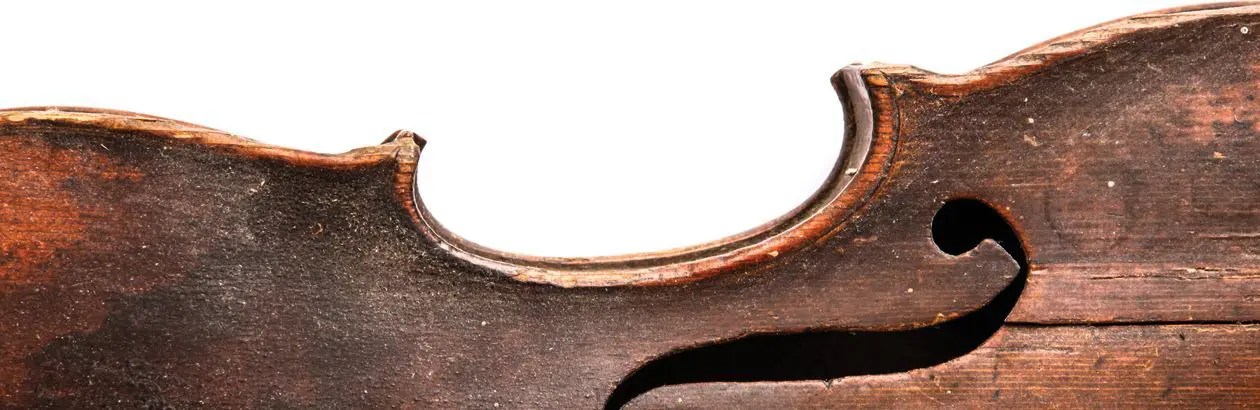
In a city in Paraguay you may find a curious assembly of musicians called La Orquesta de Instrumentos Reciclados de Cateura—the Recycled Instruments Orchestra of Cateura. But these instrumentos are not professionally designed and built objects that have been discovered and repaired: they have been made out of recycled materials. Violins are constructed from cans and bent forks, a discarded oil drum forms the body of a cello, a saxophone somehow emerges from a drainpipe and a few bent spoons. Most of the musicians are teenagers from Cateura, which is a slum, and a slum built on and around a landfill. They too are among the world’s discards, thought to be without value, people in whom society invests no hope. But Fabio Chavez, the creator and director of the orchestra, has invested in them. He has said, “People realize that we shouldn’t throw away trash carelessly. Well, we shouldn’t throw away people either.”
In The Rebel Angels Maria’s mother healed the souls of great instruments that had been damaged by time and use. This is a wondrous art and worthy of great praise.
But then what praise is appropriate for those who have taken the filth of the world and given it souls, souls capable of the loveliest utterance? And what wonder is adequate to the imaginative dedication of Fabio Chavez, whose name should be known throughout the world? “The world sends us garbage,” he says. “We send back music.”…
Eminently worth reading in full: “Filth Therapy: A Cunning Word.” Also eminently worth reading: every one of Robertson Davies’ novels.
This essay dates from 2017. Jacobs brought it back up in response to his reading of a fascinating new book: Cunning Folk: Life in the Era of Practical Magic, by Tabitha Stanmore. It’s on Google Books, here.
* Robertson Davies, The Rebel Angels
###
As we find treasure in trash, we might recall that it was in this date in 1953 that John Kraft (the younger brother of James Kraft, the founder of Kraft Cheese [later Kraft Foods]) received U.S. patent No. 2,641,545 for the manufacture of soft surface cured cheese. Just one year earlier, the company had introduced Cheez Whiz.

You must be logged in to post a comment.