Posts Tagged ‘innovation’
“People overestimate what they can do in one year and underestimate what they can do in 10 years”*…

This is especially true, argue Sam Butler-Sloss and Kingsmill Bond of the Rocky Mountain Institute, when it comes to assessing our progress in addressing the challenges of climate change with renewable energy solutions…
The renewable revolution is advancing at remarkable speed. In fact, the speed of the renewable revolution has defied many leading energy commentators who have continuously underestimated its true trajectory. They have suffered from what statisticians call a systematic bias, that is, an error that consistently skews in one direction. Noise, or a random error, is inherent to forecasting; bias, however, requires a deeper explanation.
So why do so many intelligent people undersell the pace and dynamism of the renewable revolution? Leaving aside the inherent bias of those seeking to prop up the fossil fuel system in order to enjoy the largesse of its annual $2 trillion in rents, we identify eight deadly sins of the energy transition.
Whether intentional or unwitting, these eight general errors of perspective are holding back understanding, wasting time and capital, and fueling unproductive climate pessimism…
The renewable revolution is plainly gaining speed and impact. Read on to learn why are so many analysts so wrong about the pace and scale of innovation: “The Eight Deadly Sins of Analyzing the Energy Transition,” from @SamButl3r and @KingsmillBond at @RockyMtnInst. (TotH to friend MZ)
See also: “When Idiot Savants Do Climate Economics.”
* Bill Gates
###
As we contemplate compounding, we might recall that it was on this date in 1896 that Nikola Tesla and Westinghouse Electric achieved the first long-distance transmission of hydroelectricity: from the Niagara Falls Power Company to Buffalo, N.Y., 26 miles away.

“I failed in some subjects in exams, but my friend passed in all. Now he is an engineer in Microsoft and I am the owner of Microsoft.”*…

And that, Yasheng Huang argues, is not something likely to happen in China, for a reason that dates back to the 6th century…
On 7 and 8 June 2023, close to 13 million high-school students in China sat for the world’s most gruelling college entrance exam. ‘Imagine,’ wrote a Singapore journalist, ‘the SAT, ACT, and all of your AP tests rolled into two days. That’s Gao Kao, or “higher education exam”.’ In 2023, almost 2.6 million applied to sit China’s civil service exam to compete for only 37,100 slots.
Gao Kao and China’s civil service exam trace their origin to, and are modelled on, an ancient Chinese institution, Keju, the imperial civil service exam established by the Sui Dynasty (581-618). It can be translated as ‘subject recommendation.’ Toward the end of its reign, the Qing dynasty (1644-1911) abolished it in 1905 as part of its effort to reform and modernize the Chinese system. Until then, Keju had been the principal recruitment route for imperial bureaucracy. Keju reached its apex during the Ming dynasty (1368-1644). All the prime ministers but one came through the Keju route and many of them were ranked at the very top in their exam cohort…
Much of the academic literature focuses on the meritocracy of Keju. The path-breaking book in this genre is Ping-ti Ho’s The Ladder of Success in Imperial China (1962). One of his observations is eye catching: more than half of those who obtained the Juren degree were first generation: ie, none of their ancestors had ever attained a Juren status. (Juren was, at the time, the first degree granted in the three-tiered hierarchy of Keju.) More recent literature demonstrates the political effects of Keju. In 1905, the Qing dynasty abolished Keju, dashing the aspirations of millions and sparking regional rebellions that eventually toppled China’s last imperial regime in 1911.
The political dimension of Keju goes far beyond its meritocracy and its connection to the 1911 republican revolution. For an institution that had such deep penetration, both cross-sectionally in society and across time in history, Keju was all encompassing, laying claims to the time, effort and cognitive investment of a significant swathe of the male Chinese population. It was a state institution designed to augment the state’s own power and capabilities. Directly, the state monopolised the very best human capital; indirectly, the state deprived society of access to talent and pre-empted organised religion, commerce and the intelligentsia. Keju anchored Chinese autocracy.
The impact of Keju is still felt today, not only in the form and practice of Gao Kao and the civil service exam but also because Keju incubated values and work ethics. Today, Chinese minds still bear its imprint. For one, Keju elevated the value of education and we see this effect today. A 2020 study shows that, for every doubling of successful Keju candidates per 10,000 of the population in the Ming-Qing period, there was a 6.9 per cent increase in years of schooling in 2010. The Keju exams loom as part of China’s human capital formation today, but they also cultivated and imposed the values of deference to authority and collectivism that the Chinese Communist Party has reaped richly for its rule and legitimacy…
An ultimate autocracy is one that reigns without society. Society shackles the state in many ways. One is ex ante: it checks and balances the actions of the state. The other is ex post. A strong society provides an outside option to those inside the state. Sometimes, this is derisively described as ‘a revolving door’, but it may also have the positive function of checking the power of the state. State functionaries can object to state actions by voting with their feet, as many US civil servants did during the Donald Trump administration, and thereby drain the state of the valuable human capital it needs to function and operate. A strong society raises the opportunity costs for the state to recruit human capital but such a receptor function of society has never existed at scale in imperial China nor today, thanks – in large part, I would argue – to Keju.
Keju was so precocious that it pre-empted and displaced an emergent society. Meritocracy empowered the Chinese state at a time when society was still at an embryonic stage. Massive resources and administrative manpower were poured into Keju such that it completely eclipsed all other channels of upward mobility that could have emerged. In that sense, the celebration by many of Keju’s meritocracy misses the bigger picture of Chinese history. It is a view of a tree rather than of a forest…
…Its impressive bureaucratic mobility demolished all other mobility channels and possibilities. Keju was an anti-mobility mobility channel. It packed all the upward mobility within one channel – that of the state. Society was crowded out, and over time, due to its deficient access to quality human capital, it atrophied. This is the root of the power of Chinese autocracy and, I would argue, it is a historical development that is unique to China and explains the awesome power of Chinese autocracy…
…
There was, however, a massive operational advantage to the Neo-Confucianist curriculum: it standardised everything. Standardisation abhors nuance and the evaluations became more straightforward as the baseline comparison was more clearly delineated. There was objectivity, even if the objectivity was a manufactured artefact. The Chinese invented the modern state and meritocracy, but above all the Chinese invented specialised standardised testing – the memorisation, cognitive inclination and frame of references of an exceedingly narrow ideology.
Ming standardised Keju further: it enforced a highly scripted essay format, known as the ‘eight-legged essay’, or baguwen in Chinese (八股文), to which every Keju candidate had to adhere. A ‘leg’ here refers to each section of an essay, with a Keju essay requiring eight sections: 1) breaking open the topic; 2) receiving the topic; 3) beginning the discussion; 4) the initial leg; 5) the transition leg; 6) the middle leg; 7) the later leg; and 8) conclusion. The eight-legged essay fixed more than the aggregate structure of exposition. The specifications were granular and detailed. For example, the number of phrases was specified in each of the sections and the entire essay required expressions in paired sentences – a minimum of six paired sentences, up to a maximum of 12. The key contribution of the eight-legged essay is that it packed information into a pre-set presentational format.
Standardisation was designed to scale the Keju system and it succeeded brilliantly in that regard, but it had a devastating effect on expositional freedom and human creativity. All elements of subjectivity and judgment were taken out. In his book Traditional Government in Imperial China (1982), the historian Ch’ien Mu describes the ‘eight-legged essay’ as ‘the greatest destroyer of human talent.’…
In his book The WEIRDest People in the World (2020), Joseph Henrich posited that the West prospered because of its early lead in literacy. Yet the substantial Keju literacy produced none of the liberalising effects on Chinese ideas, economy or society. The literacy that Henrich had in mind was a particular kind of literacy – Protestant literacy – and the contrast with Keju literacy could not have been sharper. Keju literacy was drilled and practised in classical and highly stratified Chinese, the language of the imperial court rather than the language of the masses, in sharp contrast to Protestant literacy. Protestant literacy empowered personal agency by embracing and spreading vernaculars of the masses. Henrich’s liberalising ‘WEIRD’ effect – Western, educated, industrialised, rich and democratic – was a byproduct of Protestant literacy. It is no accident that Keju literacy produced an opposite effect…
Not everyone sees the Western/WEIRD definition of creativity and innovation as the only important one (c.f., here and here), nor that China is as lacking in what Westerners call creativity and innovation (c.f., here— possible soft paywall, and here). Still, Huang’s essay on Keju, China’s incredibly difficult civil service test, and how it strengthened the state at the cost of freedom and creativity, is eminently worthy of reading full: “The exam that broke society,” from @YashengHuang in @aeonmag.
And for the amazing (and amusing) story of how the Keju was instrumental in the introduction of Catholicism into China, see Jonathan Spence’s wonderful The Memory Palace of Matteo Ricci.
* Bill Gates
###
As we study, we might recall that it was on this date in 4004 BCE that the Universe was created… as per calculations by Archbishop James Ussher in the mid-17th century.
When Clarence Darrow prepared his famous examination of William Jennings Bryan in the Scopes trial [see here], he chose to focus primarily on a chronology of Biblical events prepared by a seventeenth-century Irish bishop, James Ussher. American fundamentalists in 1925 found—and generally accepted as accurate—Ussher’s careful calculation of dates, going all the way back to Creation, in the margins of their family Bibles. (In fact, until the 1970s, the Bibles placed in nearly every hotel room by the Gideon Society carried his chronology.) The King James Version of the Bible introduced into evidence by the prosecution in Dayton contained Ussher’s famous chronology, and Bryan more than once would be forced to resort to the bishop’s dates as he tried to respond to Darrow’s questions.
“Bishop James Ussher Sets the Date for Creation”

“I have spread my dreams under your feet”*…

From Brian Potter, a fascinating look at the history of a technology, tunnel boring, the products of which we tend to take for granted…
Tunneling is an important technology for modern civilization, as a tunnel is often the only reasonable way to create a direct path between two points. When the Hoosac tunnel was completed in 1875, it turned a difficult, 20-mile railroad route along “precipitous grades” into a direct 5 mile route, connecting Boston with the Upper Hudson Valley. Large infrastructure projects such as hydroelectric dams often require tunnels to function. The Hoover Dam required more than 3 miles of tunnels 56 feet in diameter to divert the Colorado River around the construction site. And a tunnel can be used to create new land beneath dense urban areas, making it possible to build large-scale horizontal infrastructure like sewers or mass transit that wouldn’t be feasible to build above ground.
A common way of building a tunnel today is with a tunnel boring machine (TBM), particularly in urban areas where other construction methods such as drill-and-blast or cut-and-cover would be too disruptive. Of the 89 transit projects around the world that required tunneling in a dataset compiled by Britain Remade, 80 of them used TBMs. But tunnel boring machines are a comparatively modern construction technology. The first successful rock tunneling machines weren’t invented until the 1950s, and into the late 1960s most tunneling was done using other construction methods. But as TBMs have improved, they have increasingly been the method of choice for tunneling through a wider variety of ground conditions. And while many construction tasks have resisted automation and mechanization, tunneling machinery has steadily gotten more automated, to the point where a modern TBM is akin to a mobile factory that burrows through the earth and constructs a tunnel behind it.
…
Soft ground TBMs evolved from unmechanized tunnel shields. The first tunnel shield [see illustration above] was designed by Marc Brunel, father of famous engineer Isambard Kingdom Brunel and an accomplished engineer in his own right, and built by Henry Maudslay for tunneling under the Thames in 1825. Brunel’s shield, which was inspired by the action of shipworms boring through the wood hulls of ships, consisted of a large cast-iron structure, 38 feet wide by 22 feet tall, which was broken into 12 separate “frames,” each consisting of three individual compartments stacked on top of another. Within each compartment was a series of horizontal boards, called “poling boards,” that were placed against the face of the tunnel. A worker in the compartment would remove a board, dig out the earth behind it to a depth of around 6 inches, and then proceed to the next board. Once all the soil behind the boards in a frame had been dug out, that section of the shield would be advanced forward using screw jacks, and the process would repeat. Behind the shield, masons would construct the brick lining around the sides of the tunnel, which prevented the tunnel from collapsing and provided a structure for the shield to push off against.
When the Thames Tunnel was completed, it was the first tunnel under a body of water in the world. But the project proved to be incredibly difficult, encountering “almost overwhelming problems” (West p115). Excavation was slow, advancing at around 8 feet per week on average, and the tunnel flooded repeatedly. Gas occasionally filled the tunnel, which caused “collapse and blindness of the workmen” (West p109), and at one point the entire shield needed to be replaced. The tunnel wasn’t completed until 1843, 18 years after it was started, and it was never a commercial success, though it is still in use today. Tunneling via shield wasn’t tried again for over 25 years…
[But it was tried again… and again, and again, being improved and enhanced each time. Potter describes (and illustrates) the steady mechanization of the process– up to and including The Boring Company]
… The arc of tunnel boring machinery looks much more like the progression we see in other industrial areas, and that we don’t often see in construction. Construction operations often remain craft-based and labor intensive, and have been performed in similar ways for decades (or centuries). With tunnel boring machines, we see gradual automation and “factoryization,” where the work increasingly takes place in a highly mechanized, factory-like environment. New technology comes along and displaces the old technology, even in an environment of high risk aversion. And the process gradually converges on the “continuous flow,” where the machine continuously transforms solid ground into a lined tunnel, and continuously removes excavated material with the use of conveyors, the same sort of development we see in things like Ford’s assembly line, chemical process industries, and the Toyota production system.
“The Evolution of Tunnel Boring Machines,” from @_brianpotter.
* W. B. Yeats, “Aedh Wishes for the Cloths of Heaven”
###
As we go deep, we might recall that it was on this date in 2017 that work on the Ryfast Tunnel, connecting the Norwegian city of Stavenger with the the village of Tau on the other side of the fjord, entered its final stage. It became the longest undersea road tunnel in the world; its 8.9 mile length was greater than the Eysturoyartunnilin in the Faroe Islands (at 7.0 miles), the Tokyo Bay Tunnel in Japan (at 6.0 miles), and the Shanghai Yangtze River Tunnel (at 5.6 miles) in China. It is also currently the world’s deepest subsea tunnel, reaching a maximum depth of 958 ft below sea level.


“A finite game is played for the purpose of winning, an infinite game for the purpose of continuing the play”*…

We all know that our behavior has to change if we’re going to continue healthily and happily to inhabit the earth. And we all have a few ideas of changes we can make to make a difference. But they are mostly incremental and remedial. What might a society designed to have a healthy relationship to its environment look like? Spencer R. Scott has some guidelines…
Many see the Industrial Revolution as its own kind of Renaissance. Over the past 300 years it enabled an accumulation of wealth that the world has never before seen. Yet, industrialization and the fossil-fuels that aided its growth did not come without a price. As a recent report warns, six of nine planetary boundaries have been exceeded. This unprecedented material abundance is only enjoyed by some, yet has polluted and put at risk the whole world’s air, rivers, oceans, forests, and food, and has caused two of humanity’s largest crises: climate change and the biodiversity crisis. The era of the industrial civilization is foreclosing on itself, and many are now pointing to the need for an ecological civilization to take its place. This would be a true Renaissance, where human and ecological flourishing alike are at the center of everything we do.
Before industrialization, humanity existed in an agricultural civilization during which productivity was low and people were organized around meeting basic needs. The industrial civilization ushered in a new high-productivity era that inevitably affected peoples’ values, lifestyles, beliefs, and the institutions that governed them. An ecological civilization will similarly necessitate a major paradigm shift. As Jeremy Lent asserts in “What Does An Ecological Civilization Look Like?”, we need “a transformation in the way we make sense of the world, and a concomitant revolution in our values, goals, and collective behavior.”
From Latin, ecology means “knowledge of home” and ecological means the “applied knowledge of home.” While the old industrial system is characterized by an indifference to how life on this planet works, an ecological civilization operates with ecological principles at its core – with behaviors, values, goals, and institutions organized around the applied knowledge of life on Earth.
In her book, Biomimicry: Innovation Inspired by Nature, Janine Benyus outlines some of Life’s Principles here on Earth:
Life runs on sunlight. Life rewards cooperation. Life builds from the bottom up. Life banks on diversity. Life recycles everything. Life builds resilience through diversity, decentralization, and redundancy. Life optimizes rather than maximizes. Life selects for the good of the whole system. In short, life creates the conditions conducive to life.
Inspired by Benyus’ Life’s Principles and the work of sustainable development scholar, Jiahua Pan, I created 6 ingredients for an ecological civilization…
Six ingredients for a more resilient future: “An Ecological Civilization is the Renaissance We’ve Been Waiting For,” from @SpencerRScott.
* James Carse, Finite and Infinite Games
###
As we think systemically, we might spare a thought for Guillaume Amontons; he died on this date in 1705. A physicist who made formative contributions to the understanding of friction, he was also an accomplished designer of scientific instruments– perhaps most notably, the air thermometer, which relies on increase in volume of a gas (rather than a liquid) to measure temperature. His approach led to the emergence of the concept of “absolute zero” (long before the advent of cryogenics). These days, there’s more attention at the other end of the scale…


“Nothing is so painful to the human mind as a great and sudden change”*…
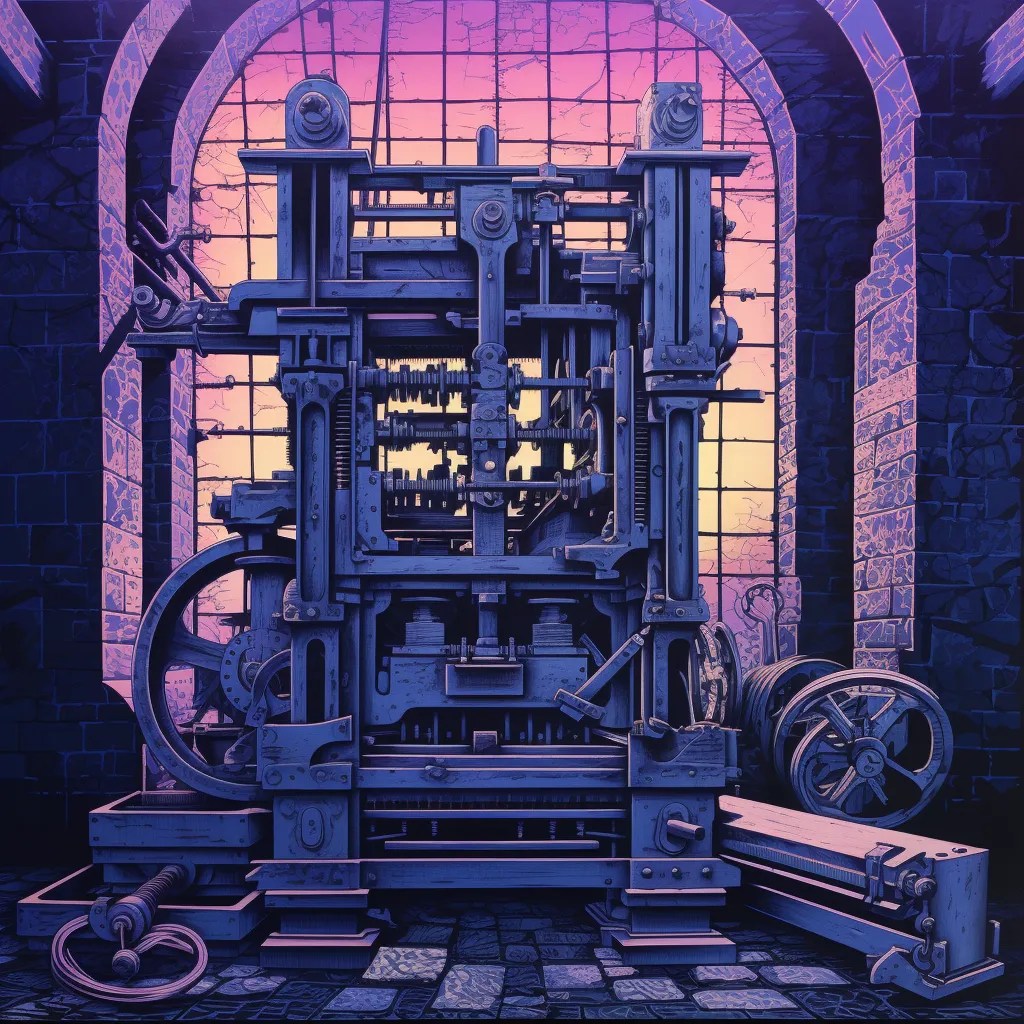
If an AI-infused web is the future, what can we learn from the past? Jeff Jarvis has some provocative thoughts…
The Gutenberg Parenthesis—the theory that inspired my book of the same name—holds that the era of print was a grand exception in the course of history. I ask what lessons we may learn from society’s development of print culture as we leave it for what follows the connected age of networks, data, and intelligent machines—and as we negotiate the fate of such institutions as copyright, the author, and mass media as they are challenged by developments such as generative AI.
Let’s start from the beginning…
In examining the half-millennium of print’s history, three moments in time struck me:
- After Johannes Gutenberg’s development of movable type in the 1450s in Europe (separate from its prior invention in China and Korea), it took a half-century for the book as we now know it to evolve out of its scribal roots—with titles, title pages, and page numbers. It took another century, until this side and that of 1600, before there arose tremendous innovation with print: the invention of the modern novel with Cervantes, the essay with Montaigne, a market for printed plays with Shakespeare, and the newspaper.
- It took another century before a business model for print at last emerged with copyright, which was enacted in Britain in 1710, not to protect authors but instead to transform literary works into tradable assets, primarily for the benefit of the still-developing industry of publishing.
- And it was one more century—after 1800—before major changes came to the technology of print: the steel press, stereotyping (to mold complete pages rather than resetting type with every edition), steam-powered presses, paper made from abundant wood pulp instead of scarce rags, and eventually the marvelous Linotype, eliminating the job of the typesetter. Before the mechanization and industrialization of print, the average circulation of a daily newspaper in America was 4,000 (the size of a healthy Substack newsletter these days). Afterwards, mass media, the mass market, and the idea of the mass were born alongside the advertising to support them.
One lesson in this timeline is that the change we experience today, which we think is moving fast, is likely only the beginning. We are only a quarter century past the introduction of the commercial web browser, which puts us at about 1480 in Gutenberg years. There could be much disruption and invention still ahead. Another lesson is that many of the institutions we assume are immutable—copyright, the concept of creativity as property, mass media and its scale, advertising and the attention economy—are not forever. That is to say that we can reconsider, reinvent, reject, or replace them as need and opportunity present…
Read on for his suggestion for a reinvention of copyright: “Gutenberg’s lessons in the era of AI,” from @jeffjarvis via @azeem in his valuable newsletter @ExponentialView.
* Mary Wollstonecraft Shelley, Frankenstein
###
As we contemplate change, we might spare a thought for Jan Hus. A Czech theologian and philosopher who became a Church reformer, he was burned at the stake as a heretic (for condemning indulgences and the Crusades) on this date in 1415. His teachings (which largely echoed those of Wycliffe) had a strong influence, over a century later, on Martin Luther, helping inspire the Reformation… which was fueled by Gutenberg’s technology, which had been developed and begun to spread in the meantime.

You must be logged in to post a comment.