Posts Tagged ‘innovation’
“The materials of city planning are: sky, space, trees, steel, and cement; in that order and that hierarchy”*…

… problematically, the last of those is among the biggest sources of CO2 emissions on earth– between 7 and 8% of the total. Now, Casey Crownheart reports, there may be a way to produce that essential building material in a low- or no-carbon way…
Cement hides in plain sight—it’s used to build everything from roads and buildings to dams and basement floors. But there’s a climate threat lurking in those ubiquitous gray slabs. Cement production accounts for more than 7% of global carbon dioxide emissions—more than sectors like aviation, shipping, or landfills.
Humans have been making cement, in one form or another, for thousands of years. Ancient Romans used volcanic ash, crushed lime, and seawater to build the aqueducts and iconic structures like the Pantheon. The modern version of hydraulic cement—the sort that hardens when mixed with water and allowed to dry—dates back to the early 19th century. Derived from widely available materials, it’s cheap and easy to make. Today, cement is one of the most-used materials on the planet, with about 4 billion metric tons produced annually.
Industrial-scale cement is a multifaceted climate conundrum. Making it is energy intensive: the inside of a traditional cement kiln is hotter than lava in an erupting volcano. Reaching those temperatures typically requires burning fossil fuels like coal. There’s also a specific set of chemical reactions needed to turn crushed-up minerals into cement—and those reactions release carbon dioxide, the most common greenhouse gas in the atmosphere.
One solution to this climate catastrophe might be coursing through the pipes at Sublime Systems. Founded by two MIT battery scientists, the startup is developing an entirely new way to make cement. Instead of heating crushed-up rocks in lava-hot kilns, Sublime’s technology zaps them in water with electricity, kicking off chemical reactions that form the main ingredients in its cement.
Over the course of the past several years, the startup has gone from making batches of cement that could fit in the palm of your hand to starting up a pilot facility that can produce around 100 tons each year. While it’s still tiny compared with traditional cement plants, which can churn out a million tons or more annually, the pilot line represents the first crucial step to proving that electrochemistry can stand up to the challenge of producing one of the world’s most important building materials.
By the end of the decade, Sublime plans to have a full-scale manufacturing facility up and running that’s capable of producing a million tons of material each year. But traditional large-scale cement plants can cost over a billion dollars to build and outfit. Competing with established industry players will require Sublime to scale fast while raising the additional funding it will need to support that growth. The end of 0% interest rates makes such a task increasingly difficult for any business, but especially for one producing a commodity like cement. And in a high-stakes, low-margin industry like construction, Sublime will need to persuade builders to use its material in the first place…
A start-up is working to drive down the carbon footprint of cement production: “How electricity could help tackle a surprising climate villain,” from @casey_crownhart in @techreview.
See also: “We are closing in on zero-carbon cement.”
* Le Corbusier
###
As we prioritize progress, we might note that it was on this date in 1942 that Henry Ford patented the Soybean car. Per Wikipedia:
… a concept car built with agricultural plastic. The New York Times in 1941 states the car body and fenders were made from a strong material derived from soy beans, wheat and corn. One article claims that they were made from a chemical formula that, among many other ingredients, included soy beans, wheat, hemp, flax and ramie; while the man who was instrumental in creating the car, Lowell E. Overly, claims it was “…soybean fiber in a phenolic resin with formaldehyde used in the impregnation” (Davis, 51). The body was lighter and therefore more fuel efficient than a normal metal body. It was made in Dearborn, Michigan and was introduced to public view on August 13, 1941. It was made, in part, as a hedge against the rationing of steel during World War II. It was designed to run on hemp fuel.


“Books make great gifts because they have whole worlds inside of them. And it’s much cheaper to buy somebody a book than it is to buy them the whole world!”*…
With this post (and all best wishes for the season), your correspondent begins his annual Holiday hiatus. Regular service should resume on or around the New Year… In the hope that it’s helpful to those still searching for last-minute gifts, this, from the marvelous Tom Gauld…

And as a bonus, this appreciation of Jean Shepherd, the man whose work inspired (and fueled) that yuletide staple, A Christmas Story— and so much more: “The Old Man at Christmas“…
… Most of Shepherd’s career, particularly his first three decades on the radio, relied on riffing and improvisation, which makes for a vast but fairly evanescent archive. People often rewatch classic movies, and sometimes rewatch beloved old TV shows, but they very rarely replay old radio shows. The real marker of twentieth-century success always lay in syndication, and it’s there, a little late in the game, and in a medium that had otherwise eluded him, that Shepherd secured his legacy. In the petty grievances and joys of Seinfeld and Curb Your Enthusiasm, in NPR-style storytelling, in everything that straddles the line between countercultural and popular representative of the monoculture, from Calvin and Hobbes to Steely Dan, echoes of his work can be found, so abundant and diffuse they can be easy to miss—but they’re everywhere you care to look…
Daniel M. Lavery in The New York Review of Books
* Neil Gaiman
###
As we read, we might recall that it was on this date in 1882 that an associate of Thomas Edison, Edward Hibberd Johnson (President of the Edison Electric Light Company, a predecessor of Con Edison) lit and displayed the first known electrically illuminated Christmas tree at his home in New York City.
He had Christmas tree bulbs especially made for him–80 red, white, and blue electric light bulbs the size of walnuts, hand-wired around the tree. From that point on, electrically-illuminated Christmas trees, indoors and outdoors, grew in popularity in the United States and elsewhere. In 1895, President Grover Cleveland sponsored the first electrically lit Christmas tree in the White House. And in 1901, the Edison General Electric Company advertised the first commercially-produced Christmas tree lamps (manufactured in strings of nine sockets).

“Today everything exists to end in a photograph”*…

Or so it seems. Indeed, as the ability- and the impulse– to take pictures becomes ubiquitous, we risk losing a sense of how rarefied, how special photos once were. By way of a reminder, from Her Moments, a collection of 35 photographic firsts…
If not for the invention of the camera, many of the greatest moments in human history would have been lost forever. What would the world be like without images of unforgettable moments like the flag being raised over Iwo Jima or the man facing down a tank in Tiananmen Square? Throughout the history of photography, there have been plenty of incredible milestones. These rare photographic firsts may be some of the most impactful pictures ever taken…

Many more at “35 Photography Firsts That Paint A Fascinating Portrait Of Human History.”
For an overlapping but different collection of photographic firsts, see “First images from atoms to the universe.”
And for more on three of the photos in the first collection, covered in earlier (R) D posts, see “First Takes” and “Time and tide wait for no man.”
* Susan Sontag
###
As we point and click, we might recall that it was on this date in 1982 that Def Leppard and their producer Mutt Lange completed production on “Photograph,” the lead single from their next album, Pyromania; the album and the single were released the following month. ”Photograph” reached No. 1 on the Billboard Top Tracks chart, where it stayed for six weeks.


“Follow the money”*…
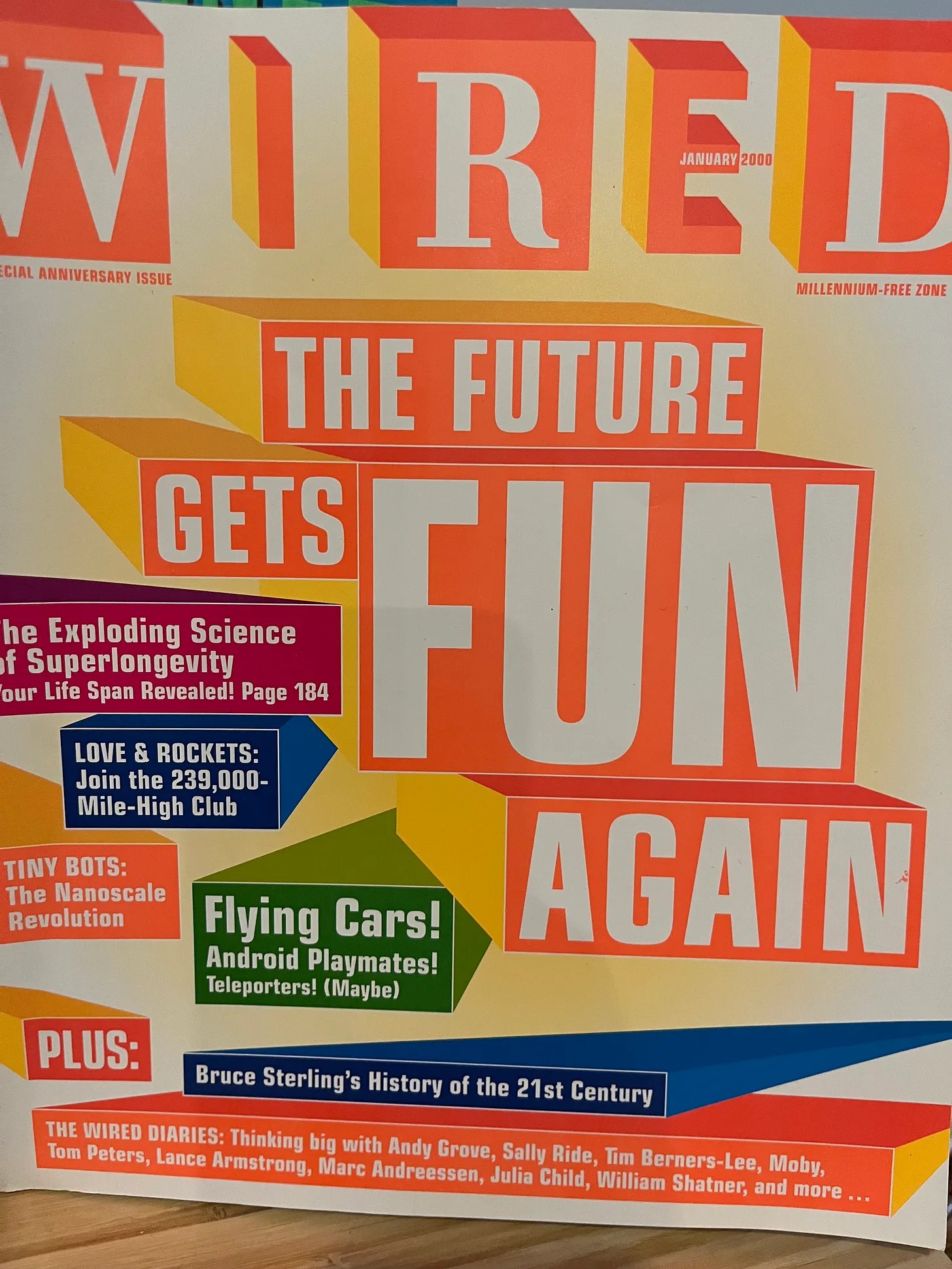
Professor and author Dave Karpf is re-reading the entire WIRED back catalog chronologically (for the second time) for a book project on the “history of the digital future.” A consideration of a 2000 issue devoted to the future has led him to a fascinating insight…
The January 2000 issue is themed around predictions. The magazine did the same thing in January 1999. They ask a ton of experts and celebrities to talk about what the future is going to be like. Some take it seriously, others make jokes. Some are prescient, others notsomuch. It’s a window into what the future looked like back then.
[Karpf reviews a number of the predictions, concluding with…]
…And then there’s this perfect Nathan Myrvhold quote “There won’t be TV per se in three decades. There will be video service over the Internet, but it will be as different from TV today as, say, MTV from the Milton Berle show of the 1950s or from radio plays of the 1940s.”
This is art. I want to frame Myrvhold’s quote and put it in a museum of lopsided tech futurist predictions.
The part that he gets right is the technological development curve. There he is, at the turn of the millennium, five years before the inception of YouTube, telling us that the future of television is going to be video service over the Internet. Yes, absolutely right!
But the part he gets wrong is the industrial, social, and economic impacts of this technological development. We’re seeing this right now, in 2023, as the various streaming services add advertising and strike content-sharing partnership deals with each other. We have these revolutionary new technological developments, and, for about a decade, they were supported by a stock market bonanza. But now that the stocks are no longer ridiculously overvalued, the companies driving these technological developments have settled on a vision of replacing old cable tv with new cable tv. (I wrote about this in July 2022, btw, back when this Substack had a much smaller readership. I think the piece holds up well.)
Technologically, it didn’t have to be this way. But, given all the existing incentive structures established by 21st century capitalism, it was all-but-certain that we would end up here.
I see this time and time again when reading predictions of social transformation from 90s- and 00s-era technologists [cough NicholasNegropontewasconstantlywrong cough]. And I see the same thing today, every time an artificial general intelligence true believer starts opining on the glorious future of education/entertainment/science/manufacturing/art.
I wrote about this phenomenon last year in The Atlantic, where I argued that we won’t be able to tell what the future of AI looks like until we have a sense of where the revenue streams come from. The trajectory of any emerging technology bends towards money.
…
I’m writing a whole book about the lopsided ways in which tech futurists always get their predictions wrong. And one major reason why is that they focus on what the technology could do, given time and mass adoption, rather than considering what capitalism will surely do to those technologies, unless we alter the incentives through regulations.
The trajectory of every emerging technology bends toward revenue streams. If you want to build a better future, you cannot ignore the shaping force of money…
A peek back at some tech predictions from January 2000: “From the WIRED archives: The trajectory of any emerging technology bends toward money,” by @davekarpf (referral account)
See also “The frantic battle over OpenAI shows that money triumphs in the end” (in which Robert Reich argues that, though the revenue streams aren’t yet obvious, protecting their emergence was at the core of the recent battle for control of what was, ostensibly, a not-for-profit) and the oddly apposite “Nerd culture is murdering intellectuals.”
And for more on Karpf’s march through WIRED’s history and what it can tell us about the ways that tech and our culture have changed, see “Notes from #WIRED30.”
* Deep Throat (as portrayed the film adaptation of All the President’s Men)
###
As we pay attention to the profit motive, we might recall that this is an important date in broadcast history. On this date in 1896, Guglielmo Marconi introduced “radio”: he amazed a group at Toynbee Hall in East London with a demonstration of wireless communication across a room. Every time Marconi hit a key beside him at the podium, a bell would ring from a box being carried around the room by William Henry Preece.
Then exactly five years later, on this date in 1901, Marconi confounded those who believed that the curvature of the earth would limit the effective range of radio waves when he broadcast a signal from Cornwall, England to Newfoundland, Canada– over 2,100 miles– and in so doing, demonstrated the viability of worldwide wireless communication.
In the earliest days of radio, when it was essentially a wireless telegraph, there were myriad predictions of what the technology might become– from an internet-like decentralized community of communicators to a provider of education, telemedicine, and other special services… in the event, of course, it followed the money.
“What we need is the celestial fire to change the flint into the transparent crystal, bright and clear”*…

… or so it used to be. Scientists at Google DeepMind and the Lawrence Berkeley National Laboratory have applied AI to the task– with encouraging results…
Modern technologies from computer chips and batteries to solar panels rely on inorganic crystals. To enable new technologies, crystals must be stable otherwise they can decompose, and behind each new, stable crystal can be months of painstaking experimentation.
… in a paper published in Nature, we share the discovery of 2.2 million new crystals – equivalent to nearly 800 years’ worth of knowledge. We introduce Graph Networks for Materials Exploration (GNoME), our new deep learning tool that dramatically increases the speed and efficiency of discovery by predicting the stability of new materials.
With GNoME, we’ve multiplied the number of technologically viable materials known to humanity. Of its 2.2 million predictions, 380,000 are the most stable, making them promising candidates for experimental synthesis. Among these candidates are materials that have the potential to develop future transformative technologies ranging from superconductors, powering supercomputers, and next-generation batteries to boost the efficiency of electric vehicles.
GNoME shows the potential of using AI to discover and develop new materials at scale. External researchers in labs around the world have independently created 736 of these new structures experimentally in concurrent work. In partnership with Google DeepMind, a team of researchers at the Lawrence Berkeley National Laboratory has also published a second paper in Nature that shows how our AI predictions can be leveraged for autonomous material synthesis.
We’ve made GNoME’s predictions available to the research community. We will be contributing 380,000 materials that we predict to be stable to the Materials Project, which is now processing the compounds and adding them into its online database. We hope these resources will drive forward research into inorganic crystals, and unlock the promise of machine learning tools as guides for experimentation…
GNoME suggests that materials science may be the next frontier to be turbocharged by artificial intelligence (see this earlier example from biotech): “Millions of new materials discovered with deep learning.”
* Henry Wadsworth Longfellow
###
As we drive discovery, we might recall that it was on this date in 1942 that a team of scientists led by Enrico Fermi, working inside an enormous tent on a squash court under the stands of the University of Chicago’s Stagg Field, achieved the first controlled nuclear fission chain reaction… laying the foundation for the atomic bomb and later, nuclear power generation– that’s to say, inaugurating the Atomic Age.
“…the Italian Navigator has just landed in the New World…”
– Coded telephone message confirming first self-sustaining nuclear chain reaction, December 2, 1942.

Indeed, exactly 15 years later, on this date in 1957, the world’s first full-scale atomic electric power plant devoted exclusively to peacetime uses, the Shippingport Atomic Power Station, reached criticality; the first power was produced 16 days later, after engineers integrated the generator into the distribution grid of Duquesne Light Company.

You must be logged in to post a comment.