Posts Tagged ‘cement’
“Though these developments were sometimes linked to the word progress, the usage was ironic: ‘progress’ unguided by humanism is not progress”*…
Further, in a fashion, to yesterday’s post: from Stewart Hicks, a story of unintended consequences…
How did a humble piece of metal quietly reshape the American suburbs—and with them, our expectations for modern homes? This video explores the history and impact of the gang-nail plate, a simple yet revolutionary invention that transformed residential construction and accelerated suburban growth.
Originally devised to combat hurricane damage in places like mid-century Miami, the gang-nail plate allowed builders to quickly and securely connect multiple pieces of lumber at virtually any angle. By enabling the mass production of roof trusses in off-site factories, it led to stronger, cheaper, and more efficient construction. This efficiency opened the door to spacious open floor plans, complex rooflines, cathedral ceilings, and the sprawling McMansion aesthetic, all of which have come to define much of American suburban architecture.
Yet, the influence of this unassuming invention isn’t entirely positive. While it helped streamline building processes and cut costs, it also encouraged rapid housing expansion and larger, more resource-intensive homes. The result was an architectural shift that contributed to suburban sprawl, increased energy demands, and homes increasingly treated as commodities rather than unique, handcrafted spaces. These changes reverberated through building codes, real estate markets, and even family life, influencing how we interact with our homes and one another…
Via Jason Kottke, who observes…
The story of gang-nail plate illustrates an inescapable reality of capitalist economics: companies tend not to pass cost savings from efficiency gains onto consumers…they just sell people more of it. And people mostly go along with it because who doesn’t want a bigger house for the same price as a smaller one 10 years ago or a 75” TV for far less than a 36” TV would have cost 8 years ago or a 1/4-lb burger for the same price as a regular burger a decade ago?…
“The Invention That Accidentally Made McMansions”
* Steven Pinker
###
As we practice restraint, we might spare a thought for Canvass White; he died on this date in 1834. An engineer and inventor, he worked as head assistant to chief engineer Benjamin Wright in the construction of the Erie Canal. Needy of a hydraulic cement to serve as mortar between the stones used to create the Canal’s locks, and unable to afford to import it from England, White developed and patented a locally-sourced waterproof cement– Rosendale cement— which was used to build the Erie Canal then host of major works in the US including the Delaware and Hudson Canal and Brooklyn Bridge. As Bill Bryson wrote (in At Home) “the great unsung Canvass White didn’t just make New York rich; more profoundly, he helped make America.”

“The materials of city planning are: sky, space, trees, steel, and cement; in that order and that hierarchy”*…
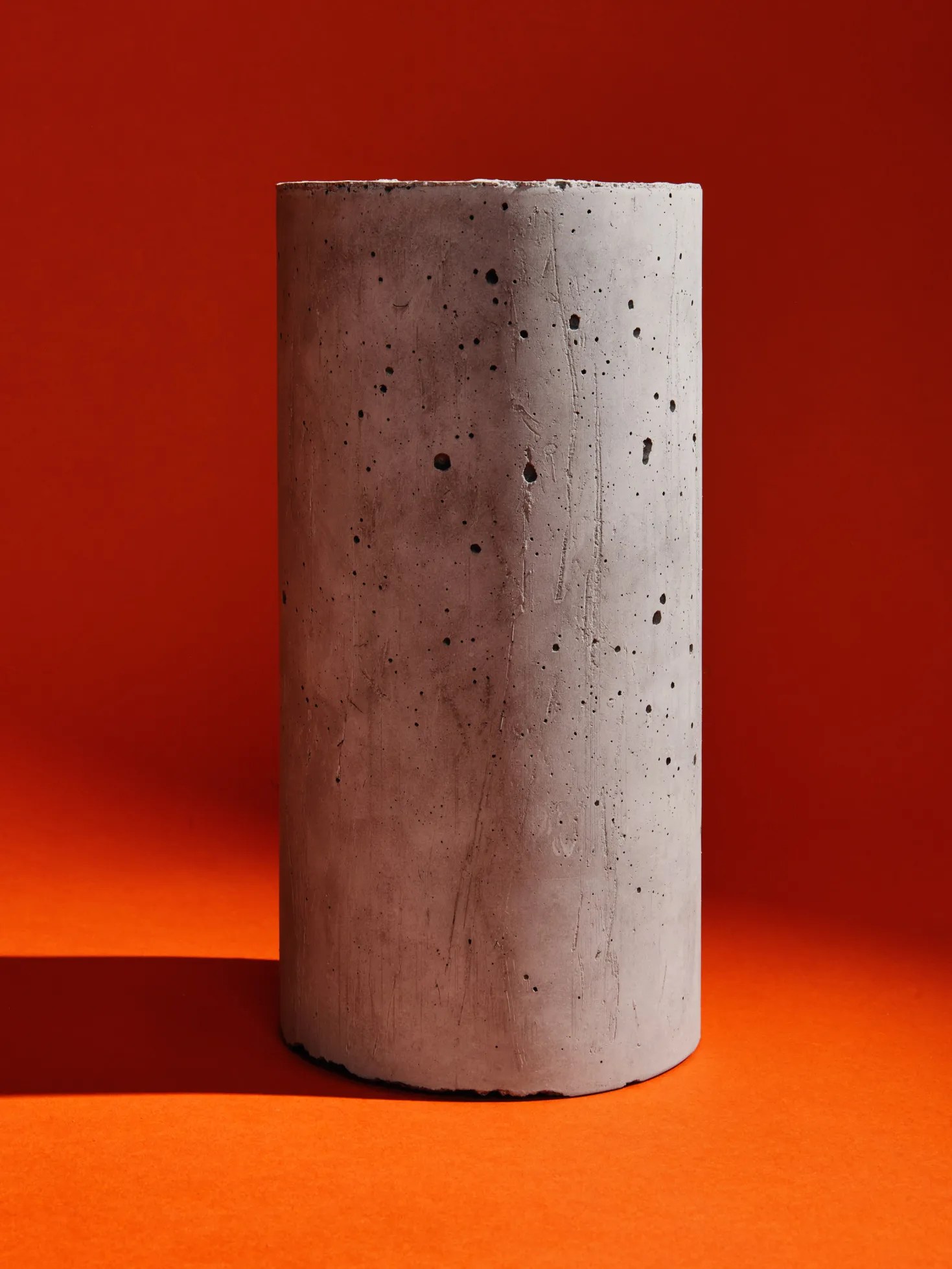
… problematically, the last of those is among the biggest sources of CO2 emissions on earth– between 7 and 8% of the total. Now, Casey Crownheart reports, there may be a way to produce that essential building material in a low- or no-carbon way…
Cement hides in plain sight—it’s used to build everything from roads and buildings to dams and basement floors. But there’s a climate threat lurking in those ubiquitous gray slabs. Cement production accounts for more than 7% of global carbon dioxide emissions—more than sectors like aviation, shipping, or landfills.
Humans have been making cement, in one form or another, for thousands of years. Ancient Romans used volcanic ash, crushed lime, and seawater to build the aqueducts and iconic structures like the Pantheon. The modern version of hydraulic cement—the sort that hardens when mixed with water and allowed to dry—dates back to the early 19th century. Derived from widely available materials, it’s cheap and easy to make. Today, cement is one of the most-used materials on the planet, with about 4 billion metric tons produced annually.
Industrial-scale cement is a multifaceted climate conundrum. Making it is energy intensive: the inside of a traditional cement kiln is hotter than lava in an erupting volcano. Reaching those temperatures typically requires burning fossil fuels like coal. There’s also a specific set of chemical reactions needed to turn crushed-up minerals into cement—and those reactions release carbon dioxide, the most common greenhouse gas in the atmosphere.
One solution to this climate catastrophe might be coursing through the pipes at Sublime Systems. Founded by two MIT battery scientists, the startup is developing an entirely new way to make cement. Instead of heating crushed-up rocks in lava-hot kilns, Sublime’s technology zaps them in water with electricity, kicking off chemical reactions that form the main ingredients in its cement.
Over the course of the past several years, the startup has gone from making batches of cement that could fit in the palm of your hand to starting up a pilot facility that can produce around 100 tons each year. While it’s still tiny compared with traditional cement plants, which can churn out a million tons or more annually, the pilot line represents the first crucial step to proving that electrochemistry can stand up to the challenge of producing one of the world’s most important building materials.
By the end of the decade, Sublime plans to have a full-scale manufacturing facility up and running that’s capable of producing a million tons of material each year. But traditional large-scale cement plants can cost over a billion dollars to build and outfit. Competing with established industry players will require Sublime to scale fast while raising the additional funding it will need to support that growth. The end of 0% interest rates makes such a task increasingly difficult for any business, but especially for one producing a commodity like cement. And in a high-stakes, low-margin industry like construction, Sublime will need to persuade builders to use its material in the first place…
A start-up is working to drive down the carbon footprint of cement production: “How electricity could help tackle a surprising climate villain,” from @casey_crownhart in @techreview.
See also: “We are closing in on zero-carbon cement.”
* Le Corbusier
###
As we prioritize progress, we might note that it was on this date in 1942 that Henry Ford patented the Soybean car. Per Wikipedia:
… a concept car built with agricultural plastic. The New York Times in 1941 states the car body and fenders were made from a strong material derived from soy beans, wheat and corn. One article claims that they were made from a chemical formula that, among many other ingredients, included soy beans, wheat, hemp, flax and ramie; while the man who was instrumental in creating the car, Lowell E. Overly, claims it was “…soybean fiber in a phenolic resin with formaldehyde used in the impregnation” (Davis, 51). The body was lighter and therefore more fuel efficient than a normal metal body. It was made in Dearborn, Michigan and was introduced to public view on August 13, 1941. It was made, in part, as a hedge against the rationing of steel during World War II. It was designed to run on hemp fuel.


“They swore by concrete. They built for eternity.”*…

The Three Gorges Dam on the Yangtze River, China– the largest concrete structure in the world
In the time it takes you to read this sentence, the global building industry will have poured more than 19,000 bathtubs of concrete. By the time you are halfway through this article, the volume would fill the Albert Hall and spill out into Hyde Park. In a day it would be almost the size of China’s Three Gorges Dam. In a single year, there is enough to patio over every hill, dale, nook and cranny in England.
After water, concrete is the most widely used substance on Earth. If the cement industry were a country, it would be the third largest carbon dioxide emitter in the world with up to 2.8bn tonnes, surpassed only by China and the US.
The material is the foundation of modern development, putting roofs over the heads of billions, fortifying our defences against natural disaster and providing a structure for healthcare, education, transport, energy and industry.
Concrete is how we try to tame nature. Our slabs protect us from the elements. They keep the rain from our heads, the cold from our bones and the mud from our feet. But they also entomb vast tracts of fertile soil, constipate rivers, choke habitats and – acting as a rock-hard second skin – desensitise us from what is happening outside our urban fortresses.
Our blue and green world is becoming greyer by the second. By one calculation, we may have already passed the point where concrete outweighs the combined carbon mass of every tree, bush and shrub on the planet. Our built environment is, in these terms, outgrowing the natural one. Unlike the natural world, however, it does not actually grow. Instead, its chief quality is to harden and then degrade, extremely slowly.
All the plastic produced over the past 60 years amounts to 8bn tonnes. The cement industry pumps out more than that every two years. But though the problem is bigger than plastic, it is generally seen as less severe. Concrete is not derived from fossil fuels. It is not being found in the stomachs of whales and seagulls. Doctors aren’t discovering traces of it in our blood. Nor do we see it tangled in oak trees or contributing to subterranean fatbergs. We know where we are with concrete. Or to be more precise, we know where it is going: nowhere. Which is exactly why we have come to rely on it…
Solidity is a particularly attractive quality at a time of disorientating change. But – like any good thing in excess – it can create more problems than it solves…
Another entry for the “any solution can become the next problem” file: Jonathan Watts on the many ways that concrete’s benefits can mask enormous dangers to the planet, to human health – and to culture itself: “Concrete: the most destructive material on Earth.”
* Gunter Grass
###
As we muse on materials, we might recall that it was on this date in 1844 that Linus Yale patented the “safe door lock” (U.S. patent no. 3,630), the first modern “pin tumbler lock.”

“Life is a highway”*…

In the beginning, the Lincoln Highway was more an idea than a highway. But it was a very powerful idea.
On its dedication—Halloween, 1913—the towns and cities along the 3,300-mile route erupted in what the San Francisco Chronicle called“spontaneous expressions of gratification”—a wave of municipal celebrations animated by “the spirit of the great national boulevard.” The governor of Wyoming declared a day of “old-time jollification … and general rejoicing” that included, in a town called Rawlings, the erection of an enormous pyramid of wool. In Cedar Rapids, Iowa, residents enjoyed a festive shower of locally made Quaker Oats.
The Lincoln Highway, which ran from Times Square in New York City to Lincoln Park in San Francisco, gets credit as the first transcontinental road of the automobile age, but it was no highway in the modern sense; when it was dedicated, it was more like a loosely affiliated collection of paved, gravel, stone, and dirt paths, some recently trailblazed through the trackless rural West. Its boosters—a collection of auto industry execs and ex-politicians led by an auto-parts entrepreneur named Carl Fisher—were gifted promoters, and they successfully sold America on the notion that a sea-to-shining-sea motorway could both unite the nation and sell a lot of cars…
Head on down the road with CityLab On The Road.
###
As we put the top down, we might spare a thought for Gebhard Jaeger; he died on this date in 1959. An inventor, engineer, and manufacturer, he designed and patented the first cement mixer in 1905, then went on to add other patents (including, in 1928, the mixer truck) and build a successful manufacturing company equipping the suppliers who served road builders and construction contractors through the road and building construction booms of the 20th century.

From American Builder (March 1925)
You must be logged in to post a comment.