Posts Tagged ‘facts’
“Any chart, no matter how well designed, will mislead us if we don’t pay attention to it. The world cannot be understood without numbers. And it cannot be understood with numbers alone.”*…
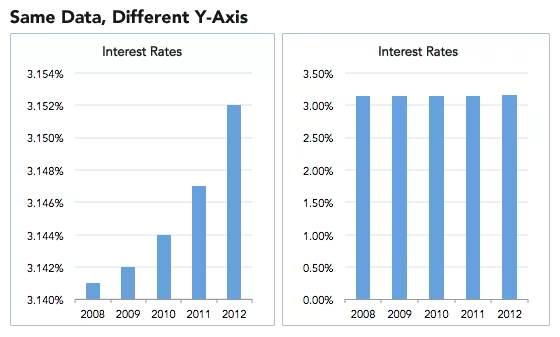
Spencer Greenberg on the critical importance of thinking critically about the charts and graphs that we constantly consume…
In 1994, the U.S. Congress passed the largest crime bill in U.S. history, called the Violent Crime Control and Law Enforcement Act. The bill allocated billions of dollars to build more prisons and hire 100,000 new police officers, among other things. In the years following the bill’s passage, violent crime rates in the U.S. dropped drastically, from around 750 offenses per 100,000 people in 1990 to under 400 in 2018.
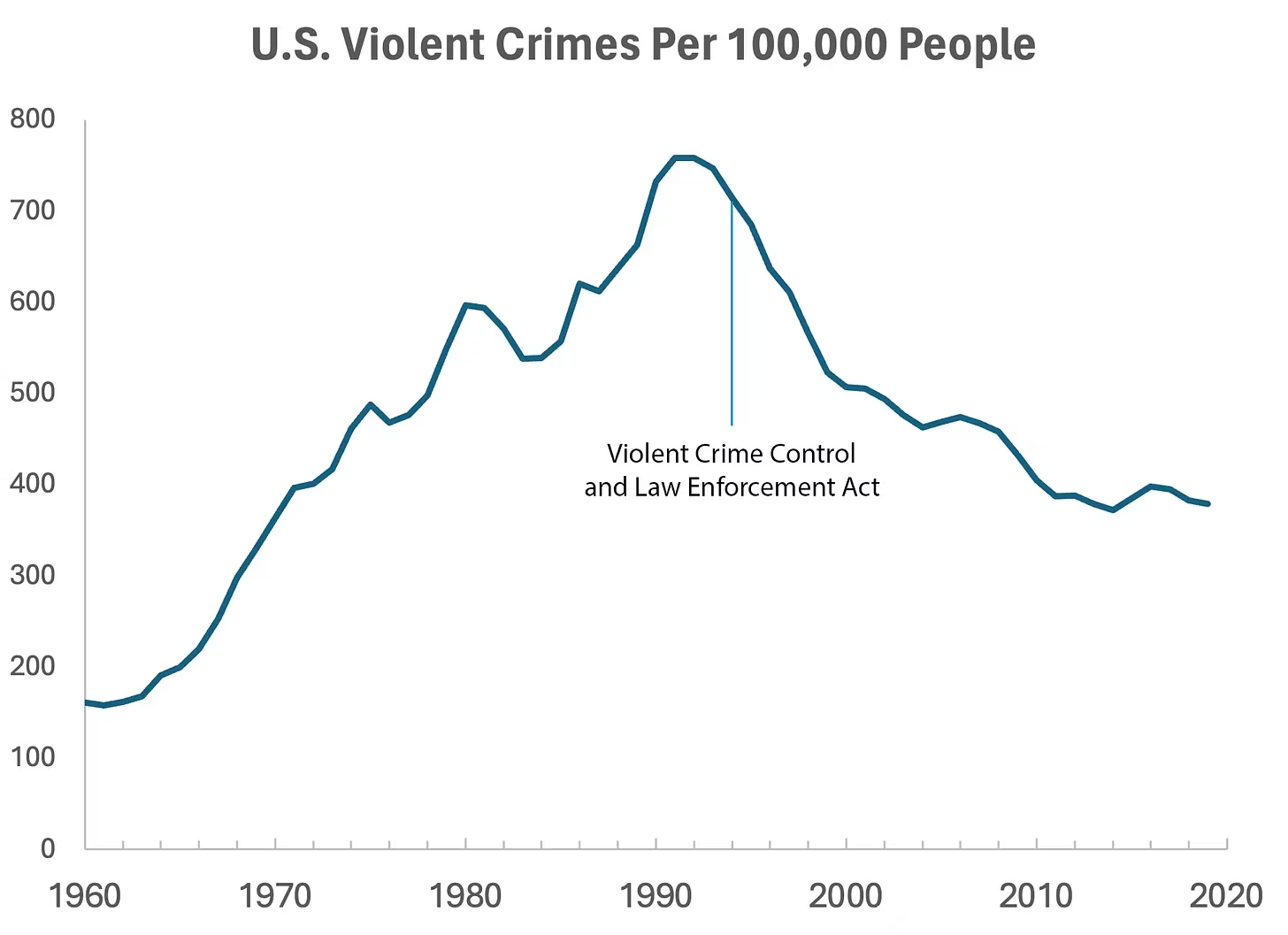
But can we infer, as this chart seems to ask us to, that the bill caused the drop in crime?
As it turns out, this chart wasn’t put together by sociologists or political scientists who’ve studied violent crime. Rather, we—a mathematician and a writer—devised it to make a point: Although charts seem to reflect reality, they often convey narratives that are misleading or entirely false.
Upon seeing that violent crime dipped after 1990, we looked up major events that happened right around that time—selecting one, the 1994 Crime Bill, and slapping it on the graph. There are other events we could have stuck on the graph just as easily that would likely have invited you to construct a completely different causal story. In other words, the bill and the data in the graph are real, but the story is manufactured.
Perhaps the 1994 Crime Bill really did cause the drop in violent crime, or perhaps the causality goes the other way: the spike in violent crime motivated politicians to pass the act in the first place. (Note that the act was passed slightly after the violent crime rate peaked!)
Charts are a concise way not only to show data but also to tell a story. Such stories, however, reflect the interpretations of a chart’s creators and are often accepted by the viewer without skepticism. As Noah Smith and many others have argued, charts contain hidden assumptions that can drastically change the story they tell.
This has important consequences for science, which, in its ideal form, attempts to report findings as objectively as possible. When a single chart can be the explanatory linchpin for years of scientific effort, unveiling a data visualization’s hidden assumptions becomes an essential skill for determining what’s really true. As physicist Richard Feynman once said: In science, “the first principle is that you must not fool yourself, and you are the easiest person to fool.”What we mean to say is—don’t be fooled by charts…
[Greenberg unpacks a couple of powerful examples…]
… to avoid producing a chart that misleads scientists, which misleads journalists, which misleads the public, and which then contributes to widespread confusion, you must think carefully about what you actually aim to measure. Which representation of the data best reflects the question being asked and relies on the sturdiest assumptions?
After all, scientific charts are a means to read data rather than an explanation of how that data is collected. The explanation comes from a careful reading of methods, parameters, definitions, and good epistemic practices like interrogating where data comes from and what could be motivating the researchers who produced it.
In the end, the story a chart tells is still just that—a story—and to be a discerning reader, you must reveal and interrogate the assumptions that steer those narratives…
Eminently worth reading in full: “How charts can inadvertently manipulate reality,” from @spencrgreenberg.bsky.social.
* Alberto Cairo, How Charts Lie: Getting Smarter about Visual Information
###
As we ferret out the facts, we might recall that it was on this date in 1874 that Florence Nightingale became the first female President of the Royal Statistical Society.
Famed for her work as a nurse in the Crimean War, she went on to found training facilities and nursing homes– pioneering both medical training for women and what is now known as Social Entrepreneuring. Less well-known are Nightingale’s contributions to epidemiology, statistics, and the visual communication of data in the field of public health. Always good at math, she pioneered the use of the polar area chart (the equivalent to a modern circular histogram or rose diagram) and popularized the pie chart (which had been developed in 1801 by William Playfair). Nightingale later became an honorary member of the American Statistical Association.

“Diagram of the causes of mortality in the army in the East” by Florence Nightingale, an example of the the polar area diagram (AKA, the Nightingale rose diagram) source

“Just the facts, ma’am”*…

It’s getting harder and harder to sift the wheat from the chaff– the truth from the misinformation, disinformation, and just plain noise. Here to help, Rocky Parker, with a collection of verification tools– aimed at journalists, but available to us all…
Presenting accurate information to readers is crucial to journalists maintaining trust with their readers. But despite journalists’ best efforts, trust in the media continues to be an issue. The latest American Views report from Gallup and the Knight Foundation found that more U.S. adults have no trust at all in the media (36%) than trust it a great deal or fair amount.
The explosion of AI-generated content on the internet has only added another layer and more complications as readers and journalists work to determine who (or what) created a piece of content and if it’s accurate. And if you’re sourcing story ideas from social media, the recent removals of fact-checking teams from several platforms will make your verification even more difficult.
In light of these challenges… we thought it’d be a good time to round up a few verification tools that journalists should bookmark…
“20 Helpful Verification Tools for Journalists” (and the rest of us).
* Stan Freberg’s parody of “Sgt. Joe Friday” (Jack Webb) on Dragnet
###
As we confirm, we might might recall that it was on this date in 1941 that Orson Welles’ first feature film, Citizen Kane, premiered at the Palace Theater in New York. A quasi-biography (based on the life of William Randolph Hearst, with elements of those of Joseph Pulitzer and Chicago tycoons Samuel Insull and Harold McCormick), it was nominated for Academy Awards in nine categories, winning Best Writing (Original Screenplay) for Herman Mankiewicz and Welles.
Considered by many critics and filmmakers to be the greatest film ever made, Citizen Kane was voted number 1 in five consecutive British Film Institute Sight & Sound polls of critics, and it topped the American Film Institute’s 100 Years … 100 Movies list in 1998, as well as its 2007 update.
Citizen Kane is particularly praised for Gregg Toland‘s cinematography, Robert Wise‘s editing, Bernard Herrmann‘s music, and its narrative structure, all of which were innovative and have been precedent-setting.
- Kane (in his role as owner of The Inquirer): Read the cable.
- Mr. Bernstein (Kane’s business manager): “Girls delightful in Cuba. Stop. Could send you prose poems about scenery, but don’t feel right spending your money. Stop. There is no war in Cuba, signed Wheeler.” Any answer?
- Kane: Yes. “Dear Wheeler: you provide the prose poems. I’ll provide the war.”

“The more that you read, the more things you will know. The more that you learn, the more places you’ll go.”*…
The end of the year approaches, and thoughts turn to retrospectives. In what has become a (Roughly) Daily tradition, today’s edition features a year-end recap from the estimable Tom Whitwell, who shares a full deck of fascinating things he learned in 2024. For example…
6. The London Underground has a distinct form of mosquito, Culex pipiens f. Molestus, genetically different from above-ground mosquitos, and present since at least the 1940s. [Katharine Byrne & Richard A Nichols]
7. Ozempic is a modified, synthetic version of a protein discovered in the venomous saliva of the Gila monster, a large, sluggish lizard native to the United States. [Scott Alexander]
22. In 2022, 55% of Macy’s income came from credit cards rather than retail sales. That’s fairly normal for US department stores. [Pan Kwan Yuk]
29. You can buy 200 real human molars for $900. [B for Bones, via Lauren]
32. In 1800, 1 in 3 people on earth were Chinese. Today, it’s less than 1 in 5. [Our World in Data, via Boyan Slat]
42. n the 2020s, over 16% of movies have colons in the title (Like Spider-Man: Homecoming), up almost 300% since the 1990s. [Daniel Parris]
46. Between the 1920s and 1950s, millions of ‘enemies of the people’ — often educated elites — were sent to prison camps in the Soviet Union. Today, the areas around those camps are more prosperous and productive than similar areas. [Toews & Vézina]
Many more fascinating factoids at: “52 things I learned in 2024,” from @TomWhitwell.
Previous lists: 2014 2015 2016 2017 2018 2019 2020 2021 2022 2023… and sprinkled throughout the December postings in (R)D over the years.
###
As we forage, we might recall that on this date in 1968 Marvin Gaye’s version of “I Heard It Through the Grapevine” was in the middle of its seven-week occupancy of the #1 spot on Billboard’s Hot 100.
A year earlier, Gladys Knight and the Pips had had a hit with the tune (#1 on the R&B chart; #2 on the Hot 100). Gaye’s version overtook its predecessor and became the biggest hit single on the Motown family of labels up to that point. The Gaye recording has since become an acclaimed soul classic. In 1998 the song was inducted into the Grammy Hall of Fame for “historical, artistic and significant” value.
“One thing I’ve learned over time is, if you hit a golf ball into water, it won’t float”*…

Happy New Year!
In the spirit of Tom Whitwell’s lists, Jason Kottke‘s collection of learnings from 2023-gone-by…
Purple Heart medals that were made for the planned (and then cancelled) invasion of Japan in 1945 are still being given out to wounded US military personnel.
The San Francisco subway system still runs on 5 1/4-inch floppies.
Bottled water has an expiration date — it’s the bottle not the water that expires.
Multicellular life developed on Earth more than 25 separate times.
Horseshoe crabs are older than Saturn’s rings.
Ernest Hemingway only used 59 exclamation points across his entire collection of works.
MLB broadcaster Vin Scully’s career lasted 67 seasons, during which he called a game managed by Connie Mack (born in 1862) and one Julio Urías (born in 1996) played in.
Almost 800,000 Maryland licence plates include a URL that now points to an online casino in the Philippines because someone let the domain registration lapse.
Dozens more at: “52 Interesting Things I Learned in 2023.”
* Arnold Palmer
###
As we live and learn, we might spare a thought for Grace Brewster Murray Hopper; she died on this date in 1992. A seminal computer scientist and Rear Admiral in the U.S. Navy, “Amazing Grace” (as she was known to many in her field) was one of the first programmers of the Harvard Mark I computer (in 1944), invented the first compiler for a computer programming language, and was one of the leaders in popularizing the concept of machine-independent programming languages– which led to the development of COBOL, one of the first high-level programming languages.
Hopper also (inadvertently) contributed one of the most ubiquitous metaphors in computer science: she found and documented the first computer “bug” (in 1947).
She has both a ship (the guided-missile destroyer USS Hopper) and a super-computer (the Cray XE6 “Hopper” at NERSC) named in her honor.

“Time is a great teacher, but unfortunately it kills all its pupils”*…

In a recent experiment, “a group of domesticated birds were taught to call one another on tablets and smartphones.” They enjoyed it and made new friendships. [Schuyler Velasco]
The US Defence Department earns $100m/year operating slot machines used by soldiers on their bases. [Gabby Means]
Some corrupt Mexican police are now using card terminals to make collecting bribes at traffic stops more convenient. [Daniela Dib]
Fashion models in China are cutting prices to compete with AI: “If designers using AI charge 800 yuan, I’ll do 600. If they charge 600, I’ll get down to 500. There’s no other way out. I’ll fight till the end.” [Andrew Deck]
Only 28 books sold more than 500,000 copies in the US in 2022. Eight of them were by romance novelist Colleen Hoover. [Jason Colvato]
The average US fridge uses 3–5 times more electricity than an entire human being consumes in Nigeria. [Daisy Dunne & Simon Evans]
Since 1986, Nepal’s timezone has been 5 hours and 45 minutes ahead of GMT. [Sam Enright]
A selection from Tom Whitwell’s always-illuminating annual list: “52 things I learned in 2023.”
* Hector Berlioz
###
As we live and learn, we might recall that on this date in 2013 Metallica played a concert in Antarctica, making them the first band to perform on all seven continents.
You must be logged in to post a comment.