Posts Tagged ‘education’
“Like everything metaphysical, the harmony between thought and reality is to be found in the grammar of the language”*…

Hunter Dukes in Public Domain Review, on how scholars and pedagogues in the U.S. began to illustrate the principles of grammar, more specifically, how they began to diagram sentences…
“Once you really know how to diagram a sentence, really know it, you know practically all you have to know about English grammar”, Gertrude Stein once claimed. “I really do not know that anything has ever been more exciting than diagramming sentences. . . I like the feeling the everlasting feeling of sentences as they diagram themselves.” While one student’s lexical excitement is surely another’s slow death by gerund, Stein cuts to the heart of the grammatical pull. Is grammar prescriptive and conventional, something one learns to impose on language through trial and error? Or do sentences, in a sense, diagram themselves, revealing an innate logic and latent structure in language and the mind? More than a century before Noam Chomsky popularized the idea of a universal grammar, linguists in the United States began diagramming sentences in an attempt to visualize the complex structure — of seemingly divine origins — at their mother tongue’s core.
The history of diagramming sentences in the United States begins with James Brown’s American Grammar (1831). “Language is an emanation from God”, he writes. “As a gift, it claims our servitude; as a science, it demands our highest attention.” Accordingly, the student of grammar can lift himself up (educationally, devotionally) by knuckling down. “The mind becomes a passenger; the body his chariot; ideas his baggage; the earth his inn; hope his food; and another world his destination.” It was in American Grammar that Brown debuted construing as a method for parsing sentences using a system of square and round brackets to isolate major and minor sections. Major sections are “mechanically independent”; minor sections are “mechanically dependent”. Brown called this form of analysis close reading, but construing was only one half of the system. “As construing is a critical examination of the constructive relation between the sections of a sentence, so scanning is a critical investigation of the constructive relation between the words of a section.” Scanning involves ranking minor sections in ascending numerical order based on their relational distance from the major section. Playing a kind of grammarian god, Brown uses John 1 to demonstrate how his system can cleave sentential flesh. (In the beginning) [was the word] (and the word was) (with God) (and the word was God)…

Dukes goes on to trace, with wonderful examples, those who followed Brown into the syntactical thicket; for example…


More mesmerizing examples at “American Grammar: Diagraming Sentences in the 19th Century,” from @hunterdukes in @PublicDomainRev, with links to the original texts at the invaluable Internet Archive (@internetarchive).
* Ludwig Wittgenstein
###
As we parse, we might spare a thought for a man whose sentences were eminently diagrammable, Kenneth Grahame; he died on this date in 1932. A career officer at the Bank of England–he retired as its Secretary– he is better remembered as the author of tales he created to delight his son Alastair, The Wind in the Willows and The Reluctant Dragon (both of which were made into films by Disney: The Adventures of Ichabod and Mr. Toad and The Reluctant Dragon).

“Say what you will about the ten commandments, you must always come back to the pleasant fact that there are only ten of them”*…

The Republican Governor of Louisiana, Jeff Landry, recently signed a law requiring state’s classrooms to display a copy of the Ten Commandments. The Onion explores the pros and cons of requiring religious doctrine in public schools…
- PRO: A good way to cover up the bullet holes.
- CON: Use of woke “Thou/Thy” pronouns.
- PRO: Great example of counting to 10 in the real world.
- CON: Just finished building golden calf.
- PRO: Least out-of-date thing in classroom.
- CON: True believers would display the entirety of the King James Bible.
- PRO: Distracts from how weird the Pledge of Allegiance is.
- CON: Not enough funding to print it out.
“Pros And Cons of Displaying The 10 Commandments in Every Classroom,” from @TheOnion.
* H. L. Mencken
###
As we ponder piety, we might recall that on this date in 1862, Charles Lutwidge Dodgson, a young Oxford mathematics don, took the daughters of the Dean of Christ Church College– Alice Liddell and her sisters– on a boating picnic on the River Thames in Oxford. To amuse the children he told them the story of a little girl, bored by a riverbank, whose adventure begins when she tumbles down a rabbit hole into a topsy-turvy world called “Wonderland.” The story so captivated the 10-year-old Alice that she begged him to write it down. The result was Alice’s Adventures in Wonderland, published in 1865 under the pen name “Lewis Carroll,” with illustrations by John Tenniel.

“Why does a public discussion of economic policy so often show the abysmal ignorance of the participants?”*…

… It could, Walt Frick suggests, have to do with the way in which economics has been taught for decades, centering zombie ideas from before economics began to become an empirical disciple. Happily, he suggests, that may be changing…
What happens to the job market when the government raises the minimum wage? For decades, higher education in the United States has taught economics students to answer this question by reasoning from first principles. When the price of something rises, people tend to buy less of it. Therefore, if the price of labour rises, businesses will choose to ‘buy’ less of it – meaning they’ll hire fewer people. Students learn that a higher minimum wage means fewer jobs.
But there’s another way to answer the question, and in the early 1990s the economists David Card and Alan Krueger tried it: they went out and looked. Card and Krueger collected data on fast-food jobs along the border between New Jersey and Pennsylvania, before and after New Jersey’s minimum wage increase. The fast-food restaurants on the New Jersey side of the border were similar to the ones on the Pennsylvania side in nearly every respect, except that they now had to pay higher wages. Would they hire fewer workers in response?
The prediction from conventional economic theory is unambiguous,’ Card and Krueger wrote. It was also wrong. Fast-food restaurants in New Jersey didn’t hire fewer workers – instead, Card and Krueger found that employment slightly increased. Their paper set off a hunt for other ‘natural experiments’ that could rigorously test economic theory and – alongside other research agendas like behavioural economics – transformed the field.
Over the past 30 years, PhD-level education in economics has become more empirical, more psychological, and more attuned to the many ways that markets can fail. Introductory economics courses, however, are not so easy to transform. Big, synoptic textbooks are hard to put together and, once they are adopted as the foundation of introductory courses, professors and institutions are slow to abandon them. So introductory economics textbooks have continued to teach that a higher minimum wage leads to fewer people working – usually as an example of how useful and relevant the simple model of competitive markets could be. As a result of this lag between what economists know and how introductory economics is taught, a gulf developed between the way students first encounter economics and how most leading economists practice it. Students learned about the virtues of markets, deduced from a few seemingly simple assumptions. Economists and their graduate students, meanwhile, catalogued more and more ways those assumptions could go wrong.
Today, 30 years after Card and Krueger’s paper, economics curriculums around the world continue to challenge the facile view that students used to learn, in which unfettered markets work wonders. These changes – like spending more time studying market failures or emphasising individuals’ capacity for altruism, not just selfishness – have a political valence since conservatives often hide behind the laissez-faire logic of introductory economics. But the evolution of Econ 101 is not as subversive as it may sound. Instead, it reflects the direction the wider discipline has taken toward empiricism and more varied models of economic behaviour. Econ 101 is not changing to reflect a particular ideology; it is finally catching up to the field it purports to represent….
[Frick describes the recent evolution– or revolution– in curricula…]
… It’s tempting to judge [open-source text project] CORE and even Harvard’s [recently-overhauled introductory economics course] Ec10 in ideological terms – as an overdue response or countermeasure to a laissez-faire approach. But the evolution of Econ 101 is about more than politics. (Despite its focus on traditionally more progressive topics, CORE has been criticised for being insufficiently ‘heterodox’, according to Stevens.) By elevating empiricism and by teaching multiple models of the economy, students in these new curriculums are learning how social sciences actually work.
“A model is just an allegory,” says the economist David Autor in his intermediate microeconomics course at MIT. For decades, Econ 101 taught one major allegory, in which markets worked well of their own accord, and buyers and sellers all emerged better off. Government, when it was mentioned at all, was frequently portrayed as an overzealous maintenance man – able to solve some problems but also meddling in markets that were fine on their own.
That is not how most contemporary economists think. Instead, they see the competitive market as one model among many. ‘The multiplicity of models is economics’ strength,’ writes the Harvard economist Dani Rodrik in Economics Rules (2015). ‘[W]e have a menu to choose from and need an empirical method for making that choice.’ As the Econ 101 curriculum catches up, economics students are finally getting a taste of the variety that the field has to offer.
As much of an improvement as the new curriculums are, they raise a puzzle. The traditional Econ 101 course was, for all its flaws, coherent and memorable. Students came away with a clear framework for thinking about the world. What does the new Econ 101 leave students with, other than an appreciation that the world is complicated, and that data is important?
[UCL economist and CORE co-creator Wendy] Carlin’s answer is that “the workhorse [of Econ 101] is that actors make decisions.” Modelling those decisions remains a central part of economics. What’s changed is the way decision-makers are represented: they can be selfish, but they can also be altruistic. They can be rational, but they can also be biased or blinkered. They are social and strategic, and they interact with one another not just with the faceless market. Models help approximate the most salient features of these interactions, and students learn several different ones to guide their understanding. They also learn that models must fit the facts, and that a crucial part of economics is leaving the armchair and observing what is going on in the world…
On the importance of recognizing the mutability of models and re-emphasizing learning in an essential discipline: “Economics 101,” from @wfrick in @aeonmag.
* economist (and Nobel Laureate) Robert Solow
###
As we revise, we might recall that it was on this date in 1963 that President John F. Kennedy signed the Equal Pay Act into law. Aimed at abolishing wage disparity based on sex, the legislation was part of Kennedy’s New Frontier Program. On the one hand, since it’s enactment, the wage gap has narrowed; on the other, it is still large: in 1963, women were on average paid about 60% of a man’s income for the same job; today, that figure is roughly 80%.
Opponents of the Act (including, of course, many economists) suggested that higher wages for women would discourage employers from hiring them; in fact, female participation in the workforce has grown– the gap between their participation and that of prime-age men has shrunk to less than one-third of its previous size. Some of those critics also argued that higher wages for women would a drag on economy; to observe the obvious, the economy has, by myriad measures, grown materially over the period– indeed, beyond the “no EPA” projections of those opponents.

“And these children that you spit on / “As they try to change their worlds / Are immune to your consultations. / They’re quite aware of what they’re going through.”*…

From our friends at The Pudding— specifically, from Alvin Chang— a thorough (and illuminating and bracing) look at how the conditions in which our young are raised have everything to do with how their lives unfold…
In this story, we’ll follow hundreds of teenagers for the next 24 years, when they’ll be in their late-30s. They’re among the thousands of kids who are part of the National Longitudinal Survey of Youth. This means researchers have followed them since their teenage years to the present day – and beyond.
As Matt Muir observes in his invaluable Web Curios…
… Very North America-centric in terms of the data it’s drawing on, but wherever you are in the world the themes that it speaks to will apply – drawing on data about the life experiences of young people tracked by US statisticians….
As you scroll you see visual representations of the proportion of kids in each agegroup coterie who will experience ‘significant’ life events, from crime to poverty and beyond, and how those life events will go on to impact their academic prospects and, eventually, their life prospects – none of this should be surprising, but it’s a hugely-effective way of communicating the long-term impacts of relatively small differences in early-stage life across a demographic swathe…
Data visualization at its best and most compelling: “This Is a Teenager,” from @alv9n in @puddingviz via @Matt_Muir.
* David Bowie, “Changes”
###
As we analyze adolescence, we might recall that it was on this date in 1961 that the Cleftones, a group of teens who had formed a vocal group a 3 years earlier in high school, released “Heart and Soul” (a rearrangement of the 1938 standard); it reached #18 on the pop chart and #10 on the R&B chart and was later used in the 1973 movie American Graffiti.
Then fifteen-year-old Duane Hitchings, who went on to win a Grammy award for his work on the Flashdance soundtrack in 1984, played keyboards on the track– his first professional gig. In an interview with Rock United, he recalls that the recording session was cut short when singer Pat Spann, who was dating drummer Panama Francis, was caught in a compromising position with the guitarist. “That ended the session. So the last track we recorded was the record.”
“All reality is a game”*…
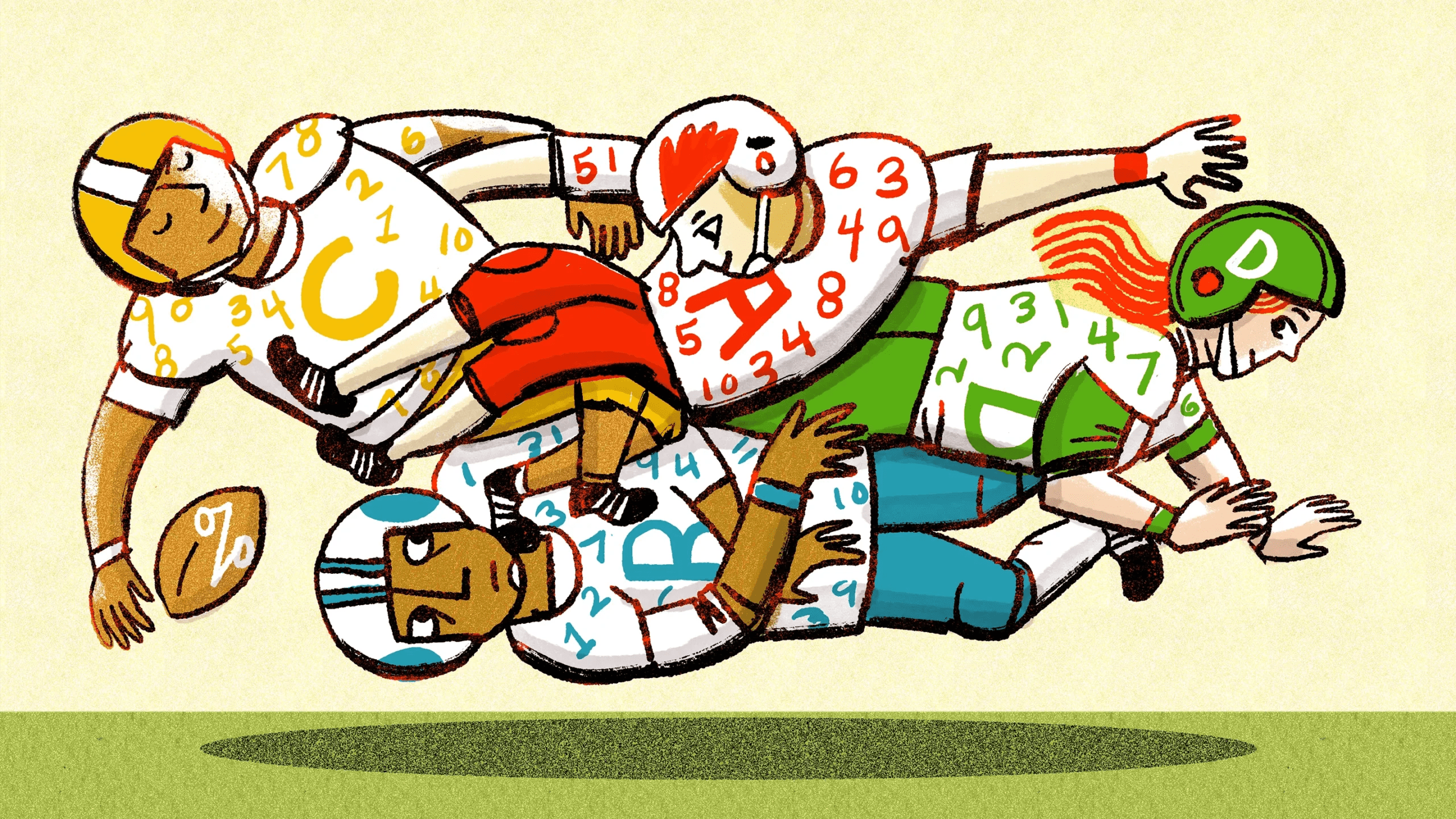
If Anna beats Benji in a game and Benji beats Carl, will Anna beat Carl? Patrick Honner unpacks the principle of transitivity…
It’s the championship game of the Imaginary Math League, where the Atlanta Algebras will face the Carolina Cross Products. The two teams haven’t played each other this season, but earlier in the year Atlanta defeated the Brooklyn Bisectors by a score of 10 to 5, and Brooklyn defeated Carolina by a score of 7 to 3. Does that give us any insight into who will take the title?
Well, here’s one line of thought. If Atlanta beat Brooklyn, then Atlanta is better than Brooklyn, and if Brooklyn beat Carolina, then Brooklyn is better than Carolina. So, if Atlanta is better than Brooklyn and Brooklyn is better than Carolina, then Atlanta should be better than Carolina and win the championship.
If you play competitive games or sports, you know that predicting the outcome of a match is never this straightforward. But from a purely mathematical standpoint, this argument has some appeal. It uses an important idea in mathematics known as transitivity, a familiar property that allows us to construct strings of comparisons across relationships. Transitivity is one of those mathematical properties that are so foundational you may not even notice it…
Read on: “The Surprisingly Simple Math Behind Puzzling Matchups,” from @MrHonner in @QuantaMagazine.
* Iain M. Banks, The Player of Games
###
As we tackle transitivity, we might spare a thought for Charlemagne; he died on this date in 814. A ruler who united the majority of western and central Europe (first as King of the Franks, then also King of the Lombards, finally adding Emperor of the Romans), he was the first recognized emperor to rule from western Europe since the fall of the Western Roman Empire three centuries earlier; the expanded Frankish state that he founded is called the Carolingian Empire, the predecessor to the Holy Roman Empire.
Committed to educational reform and extension, he began (in 789) the establishment of schools teaching the elements of mathematics, grammar, music, and ecclesiastic subjects; every monastery and abbey in his realm was expected to have a school for the education of the boys of the surrounding villages. The tradition of learning he initiated helped fuel the expansion of medieval scholarship in the 12th-century Renaissance.
Charlemagne is considered the father of modern Europe. At the same time, in accepting Pope Leo’s investiture, he set up ages of conflict: Charlemagne’s coronation as Emperor, though intended to represent the continuation of the unbroken line of Emperors from Augustus, had the effect of creating up two separate (and often opposing) Empires– the Roman and the Byzantine– with two separate claims to imperial authority. It led to war in 802, and for centuries to come, the Emperors of both West and East would make competing claims of sovereignty over the whole.

You must be logged in to post a comment.