Posts Tagged ‘business’
“Stand firmly in the present and focus on the future”*…

In a widely-cited article from May, Gillian Tett marks a fundamental shift– accelerated by the Trump administration, but underway beforehand:
… in the 20th century free-market intellectual framework — which is the one in which most western professionals built their careers — it was generally assumed that rational economic self interest ruled the roost, not grubby politics. Politics seemed to be derivative of economics — not the other way around.
No longer. The trade war unleashed by US President Donald Trump has shocked many investors, since it seems so irrational by the standards of neoliberal economics. But “rational” or not, it reflects a shift to a world where economics has taken second place to political games, not just in America, but many other places too…
…this phenomenon is not simply about one man (Trump), but rather marks a much bigger turning point in the intellectual zeitgeist — of a sort we have seen a few times before.
One such shift occurred just over a century ago, when the globalist, Imperialist vision of capitalism that reigned before the first world war was displaced by nationalist, protectionist policies. Another came after the second world war, when Keynesian economics took hold. Then, in the 1980s, free-market neoliberal ideas displaced Keynesianism.
The fact that the intellectual pendulum is now swinging again, towards more nationalist protectionism (with a dose of military Keynesianism), thus fits a historical pattern — although few predicted that the swing would take quite this form…
… one important facet of this zeitgeist shift is that governments are no longer “just” focused on their country’s absolute wellbeing, but on their relative positions too. This distinction might sound subtle. But it matters deeply, as a paper co-authored by Aaditya Mattoo, a World Bank economist, along with Michele Ruta and Robert Staige, spells out.
That is because an “absolute welfare” mentality supports trade co-operation, but unravels “if rivalry eclipses any consideration of own- country wellbeing,” the authors say. Trump’s angry rhetoric about America being “ripped off” by competitors, in other words, reflects a bigger mental shift… an (obvious) factor behind this rivalry is that China is now challenging America’s incumbent dominance…
It’s worth reading Tett’s piece in full (gift link)– and noting that the real-world evidence supporting her thesis is clear. Here, let us look more closely at China. Adam Tooze offers a primer– all-too-appropriate to Tett’s argument– on how to see China’s historic development through the veil of macroeconomics…
In the global economic conjuncture there are few if any factors more important than the state and future prospects of China’s economy. In purchasing power parity terms, it is the largest economy in the world, with a 20 percent share of global GDP. Measured in terms of current exchange rates, China comes second to the US.
China impacts the world economy as a huge market for exports from other countries. China’s imports range from raw materials, to Europe’s luxury brands. The share price of LVMH, Europe’s largest company by stock market valuation, bobs up and down in response to the spending patterns of Chinese women, the world’s most rapidly growing segment of luxury consumers.
China’s exports are a huge part of global markets. And when China’s domestic demand is less buoyant, there is a surge of anxiety about “excess capacity”, the pressure of exports increases and we start talking about “China shocks”.
In the macroeconomic balance, as discussed in World Economy Now of May, China’s huge surplus is the counterpart to the huge deficit of the USA.
China’s currency is pegged against a basket of other world currencies. This is backed up by some of the more effective capital account regulation in the world economy today. Funds cannot easily be transferred out of China on a large scale. So, there is structural uncertainty about what the exchange rate of the RMB should be. The trade account would suggest stronger. The scenario of mass capital flight in the event of a loosening of capital controls would suggest a much weaker currency, as happened during the crisis episode of 2015. A sudden adjustment in the Chinese exchange rate has the potential to destabilize the world economy as severely as Trump’s trade wars.
For all of these reasons, China is at the heart of global macroeconomics.
And there are a lot of news to be concerned about…
[Tooze reviews the decline in China’s growth rate…]
… But as useful as it is, this macroeconomic approach also minimizes the drama of history and qualitative transformation. China’s economy is huge because it encompasses the material destiny of one sixth of humanity. In the 1970s, China’s national income per head was less than that of Sudan and Zambia. It was not just the most populous country in the world but also one of the poorest. China’s ascent during the age of globalization is not just one economic story amongst many. It is the single most dramatic development in world economic history, bar none…
… Today, with a per capita GDP in purchasing power parity terms of $24,569, China is officially classed as an “upper middle-income” economy. It has far outstripped India (which in 1990 was still ahead of China). It has overtaken Indonesia. It has surpassed Brazil and caught up with Mexico. China is now on the cusp of being promoted to the ranks of the “high-income” countries…
… So here we have two images of China: One, as a big part of global macroeconomics, the other as a world historic development story. The trick is not to play these two accounts against each other, but to figure out how they interrelate and condition each other.
If we can sensibly discuss China today as just another big economy, rather than a country struggling with basic development issues, it is because it has actually undergone something truly exceptional, namely, utterly radical economic development in the space of less than two generations.
Pause for a second to consider this twist.
Dialectics offers us a way of imagining the process through which quantitative change turns into qualitative transformation. And there is plenty of that going on in the Chinese case. For example, it is one thing to be a big player in electric vehicles, it is quite another to entirely dominate every facet of the global supply chain. At that point market share measured in percentage points, a quantitative metric, turns into power, a statement of qualitative distinction.
But China also spectacularly illustrates the opposite process, through which qualitative change on a huge scale – “opening up” and “market reform” – transform a society’s entire mode of being so much that it becomes discussable as “just another really big piece of the world economy”, no different in macroeconomic terms than the Eurozone or the US economy. A history of radical qualitative change gives way to bland quantitative metrication.
Social theorists and market practitioners both use the same word to capture this dialectic of quality into quantity – commodification. When your distinctive, branded product with its specific qualities and associated narrative becomes commoditized, it widens the market, but also erases distinctions. In intellectual terms, rendering China’s utterly radical, world-changing development story as a question of “global growth”, is something akin to “commodification”.
Of course, quantitative comparison enabled by commodification has many uses. No less than commoditized goods. But both accept as a cost the erasure of specific qualities. In narrative terms, it involves a kind of blindness to history – how we got here – but also to the wider social and political meaning of current trends and the network of social, political, cultural and material forces that may drive future development. We do macroeconomics no injustice, if we call it heuristic and algorithmic in its approach. Its metier is not the in-depth search for historical meaning.
If we are to have both we need to learn to shuttle back and forth in our economic analysis from quality to quantity to quality to quantity etc.
Of course, you might object that all I am describing in rather highfalutin terms, are the methods of any good economic journalist. A good economics story weaves back and forth between the particular and the general, the experiential and the GDP numbers. That is true. It is a familiar narrative style. But there is a difference between an anecdote that merely serves as a “hook” and the effort to actually find a keyhole or opening that allows us to enter into the complexity of historical reality. As Stuart Hall once put it, the challenge is to find ways of “breaking in” to the historical conjuncture we are trying to decipher…
… How does the quality-quantity dialectic help us to better understand China’s economic situation and its relationship to the world economy in the summer of 2025?…
[Tooze uses that dialectic to unpack four key issues for China: real estate/urbanization, youth unemployment/generational shock, trade surplus/manufacturing power, and deflation (the “accumulation regime”)…]
… This essay had been a forced march, the aim of which is to connect four points of common concern about China’s macroeconomic situation – real estate, youth unemployment, the trade balance and deflation – with broader questions of China’s recent history and development. Doing justice to any of these themes would require far more space and far more expertise than I have my disposal. My aim here is simply to demonstrate the value of this kind of approach. My aim is to alert us to the moments when quality flattens into quantity – when “world-changing hundred-millionfold urbanization” is recharacterized as nothing more than a real estate boom – and to suggest the possibility of different narratives. The aim is to allow us to see through the bare bones of the macroeconomic schema, to the more historically specific and ultimately more powerful forces that are at play.
I’m not original in suggesting this. This is just what good history and good critical social analysis ought to do when it wrestles with the limitations of familiar macroeconomic concepts. In this particular case I am indebted to the work of Lan Xiaohuan of Fudan university, whose book How China Works: An Introduction to China’s State-led Economic Development offers a fascinating developmentalist perspective on recent Chinese economic history.
But not the least attraction of this approach is that it actually allows us to hear – as in really hear – how the Chinese describe their own situation. China insists on referring to itself as “developing” and “development” as the key objective of policy. The phrase 发展 (fāzhǎn) recurs in the titles of the National Development and Reform Commission, the de facto center of Chinese planning, and the Development Research Council of the State Council.
All too often the question of whether China should be counted as a “developing economy” is treated as a matter of cheap gamesmanship. Western critics, allege that China shirks its responsibilities by insisting on its status as a developing country. But triviality aside, as I have argued here, the question is actually a fundamental one. China is a huge and complex society with a powerful regime undergoing the most dramatic process of socio-economic change in world history. To describe this ongoing process as one of development is, if anything, an understatement.
Indeed, the question is why we don’t learn from the Chinese. Would it not behoove Western advanced economies to consider themselves, as well, as “developing”. Or does the difficulty of doing so betoken a telling blindspot? Development as a conception of economic change embodies a notion of comprehensiveness, qualitative change and deliberate purpose that is a challenge to policy in rich countries. In the US the bold vision of the Green New Deal was reduced to the Inflation Reduction Act. Trump’s tariffs and Big Beautiful Bill are a parody of economic nationalism. The best that the EU could manage was NextGen EU in 2020.
As Wang Yiwei of the Academy of Xi Jinping Thought at Renmin University remarked to The Economist:
Development is a permanent “political identity” … The party’s legitimacy depends in part on the riches yet to come. “Once you are ‘advanced’,” says Mr Wang, “you are declining.
The frankness is disarming. But does the West really have an answer?
Eminently worth reading in full: “Whither China? – World Economy Now, June 2025 Edition” from @adamtooze.bsky.social.
Pair with: “The Two Chinas.”
And for context, “Structure and Interpretation of the Chinese Economy.”
(Image above: source)
* ancient Chinese adage
###
As we synthesize, we might recall that it was on this date in 626 that Li Shimin ambushed and killed his rival brothers Li Yuanji and Li Jiancheng in the Xuanwu Gate Incident. Li Shimin went on to become Emperor Taizong of Tang– the second emperor of the Tang dynasty of China, ruling from 626 to 649. He is traditionally regarded as a co-founder of the dynasty for his role in encouraging his father Li Yuan (Emperor Gaozu) to rebel against the Sui dynasty in 617. Taizong subsequently played a pivotal role in defeating several of the dynasty’s most dangerous opponents and solidifying its rule over China proper.

“Sooner or later everyone sits down to a banquet of consequences”*…
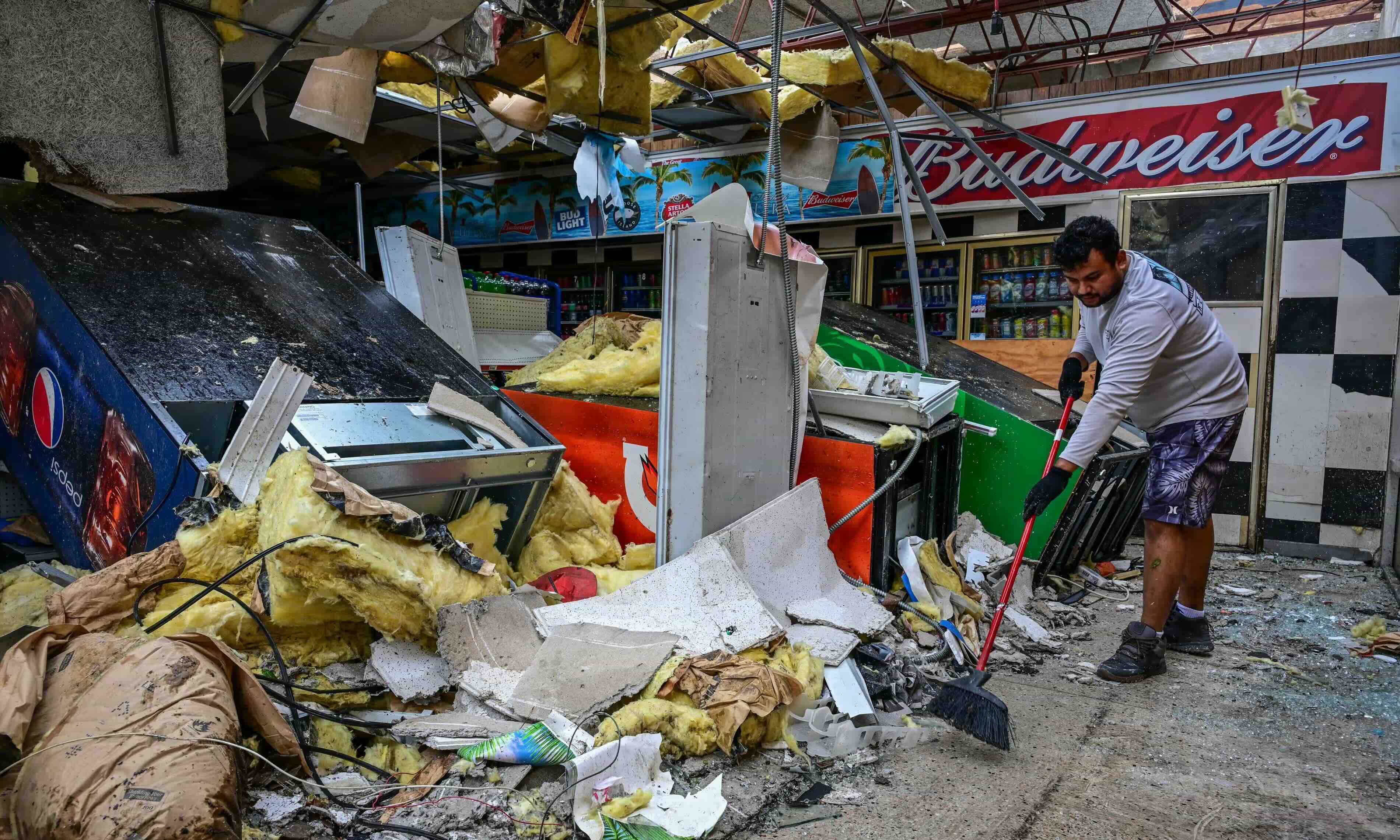
A report issued by International Chamber of Commerce late last year found that extreme weather cost $2tn globally over last decade; the U.S. suffered the greatest losses. As Damian Carrington reports, a leading insurance executive is warning that urgent action is needed to save the conditions under which markets – and civilization itself – can operate…
The climate crisis is on track to destroy capitalism, a top insurer has warned, with the vast cost of extreme weather impacts leaving the financial sector unable to operate.
The world is fast approaching temperature levels where insurers will no longer be able to offer cover for many climate risks, said Günther Thallinger, on the board of Allianz SE, one of the world’s biggest insurance companies. He said that without insurance, which is already being pulled in some places, many other financial services become unviable, from mortgages to investments.
Global carbon emissions are still rising and current policies will result in a rise in global temperature between 2.2C and 3.4C above pre-industrial levels. The damage at 3C will be so great that governments will be unable to provide financial bailouts and it will be impossible to adapt to many climate impacts, said Thallinger, who is also the chair of the German company’s investment board and was previously CEO of Allianz Investment Management.
The core business of the insurance industry is risk management and it has long taken the dangers of global heating very seriously. In recent reports, Aviva said extreme weather damages for the decade to 2023 hit $2tn, while GallagherRE said the figure was $400bn in 2024. Zurich said it was “essential” to hit net zero by 2050.
Thallinger said: “The good news is we already have the technologies to switch from fossil combustion to zero-emission energy. The only thing missing is speed and scale. This is about saving the conditions under which markets, finance, and civilisation itself can continue to operate.”
Nick Robins, the chair of the Just Transition Finance Lab at the London School of Economics, said: “This devastating analysis from a global insurance leader sets out not just the financial but also the civilisational threat posed by climate change. It needs to be the basis for renewed action, particularly in the countries of the global south.”
“The insurance sector is a canary in the coalmine when it comes to climate impacts,” said Janos Pasztor, former UN assistant secretary-general for climate change.
The argument set out by Thallinger in a LinkedIn post begins with the increasingly severe damage being caused by the climate crisis: “Heat and water destroy capital. Flooded homes lose value. Overheated cities become uninhabitable. Entire asset classes are degrading in real time.”
“We are fast approaching temperature levels – 1.5C, 2C, 3C – where insurers will no longer be able to offer coverage for many of these risks,” he said. “The math breaks down: the premiums required exceed what people or companies can pay. This is already happening. Entire regions are becoming uninsurable.” He cited companies ending home insurance in California due to wildfires.
Thallinger said it was a systemic risk “threatening the very foundation of the financial sector”, because a lack of insurance means other financial services become unavailable: “This is a climate-induced credit crunch.”
“This applies not only to housing, but to infrastructure, transportation, agriculture, and industry,” he said. “The economic value of entire regions – coastal, arid, wildfire-prone – will begin to vanish from financial ledgers. Markets will reprice, rapidly and brutally. This is what a climate-driven market failure looks like.”
No governments will realistically be able to cover the damage when multiple high-cost events happen in rapid succession, as climate models predict, Thallinger said. Australia’s disaster recovery spending has already increased sevenfold between 2017 and 2023, he noted.
The idea that billions of people can just adapt to worsening climate impacts is a “false comfort”, he said: “There is no way to ‘adapt’ to temperatures beyond human tolerance … Whole cities built on flood plains cannot simply pick up and move uphill.”
At 3C of global heating, climate damage cannot be insured against, covered by governments, or adapted to, Thallinger said: “That means no more mortgages, no new real estate development, no long-term investment, no financial stability. The financial sector as we know it ceases to function. And with it, capitalism as we know it ceases to be viable.”
The only solution was to cut fossil fuel burning, or capture the emissions, he said, with everything else being a delay or distraction. He said capitalism must solve the crisis, starting with putting its sustainability goals on the same level as financial goals.
Many financial institutions have moved away from climate action after the election of the US president, Donald Trump, who has called such action a “green scam”. Thallinger said in February: “The cost of inaction is higher than the cost of transformation and adaptation. If we succeed in our transition, we will enjoy a more efficient, competitive economy [and] a higher quality of life.”…
It’s time, if not past time, to act: “Climate crisis on track to destroy capitalism, warns top insurer,” from @dpcarrington.bsky.social in @theguardian.com.
Further to the point: “Get ready for several years of killer heat, top weather forecasters warn.”
See also: “Q&A: Kiley Bense on Climate Journalism in a New Information Environment.”
(Image above: source)
* Robert Louis Stevenson
###
As we contemplate craziness, we might recall that it was on this date in 2011 that the Wallow Fire started. A wildfire that started in the White Mountains near Alpine, Arizona, it was named for the Bear Wallow Wilderness area where the fire originated.
The fire eventually spread across the stateline into western New Mexico. By the time the fire was contained on July 8, it had consumed 538,049 acres of land, 522,642 acres in Arizona and 15,407 acres in New Mexico. It was the largest wildfire in Arizona history and did an estimated estimated cost was $109 million in damages. Smoke from the Wallow Fires and others in Arizona and New Mexico extended through Texas and Oklahoma up into the Great Lakes region, affecting air quality for large areas east of the Rocky Mountains.

“I seen my opportunities and I took em”*…

Since he kicked off his campaign, Trump’s business empire has landed billions of dollars of deals at home and abroad. Max Abelson and Annie Massa bring the receipts…
The way Donald Trump sees it, he’s the greatest businessman to campaign for the White House.
“I’m the most successful person ever to run,” he told an Iowa reporter in 2015. “I have a Gucci store that’s worth more than Romney.”
That might have been an exaggeration, but this isn’t: A decade later, no modern American president has positioned his family to make so much money while in the White House. Already, since the early days of his reelection campaign, he’s more than doubled his net worth to about $5.4 billion.
In that time, the Trump name has powered more than $10 billion of real estate projects, a multibillion-dollar valuation for his money-losing social-media company, more than $500 million in sales from just one of his crypto ventures and millions of dollars more from stakes in companies that offer financial services, guns and drone parts. Family members have also scored an array of corporate positions — at least seven new roles as an adviser or executive for his oldest son, Donald Trump Jr., alone.
Compared with the tumult of the presidency, the empire’s approach is consistent and clear: Sell the family name. In any other era, this scale of presidential moneymaking would threaten to be the story of the year, but political uproar has hogged most of the attention.
In his first months in power, Trump put tariffs on and took some off, blamed Ukraine for Russia’s attacks, sent immigrants to a foreign prison and teased a third term that the Constitution doesn’t allow. And as he’s hacked away at the government’s workforce and budget, he’s shrunk the agencies and offices that oversee his public company, crypto projects and even conflicts of interest.
Trump has loosened constraints on overseas dealmaking that were put in place in his last administration. (He also let Elon Musk, the billionaire leading an effort to slash government spending, police his own conflicts). This week, he’s scheduled to dine with his new memecoin’s top holders.
What makes this era even more remarkable is how close Trump came to ruin. His first term ended with a riot at the Capitol, later followed by a $454 million civil fraud judgment and his conviction for falsifying business records. Trump has appealed both.
Now, his assets are in a trust overseen by his oldest son. And despite talk of a recession, the clan stands to get richer than ever.
“President Trump has been the most transparent president in history in all respects, including when it comes to his finances,” said a White House spokesperson. “President Trump handed over his multibillion-dollar empire in order to serve our country, and he has sacrificed greatly. President Trump has disclosed his financial holdings through his annual financial disclosure report and he will continue to do so.”
Trump Jr. said he shouldn’t be expected to change his career on account of his dad’s power.
“I’m a private citizen who has been a businessman and serial investor my entire adult life,” he said in a statement. “It’s ridiculous to expect me to stop doing what I’ve always done to provide for my five children just because my dad was elected president.”
These are the corporate connections, crypto projects and licensing deals — all of them since the 2024 campaign began — that the Trumps are using to climb higher than ever…
The gory (and mind-boggling) details: “The Trump Family’s Money-Making Machine” (gift link) from @bloomberg.com.
Apposite: “A World of MAGA Liquor Is Exploding Online. But What If It’s Not Real?“
* “Everybody is talkin’ these days about Tammany men growin’ rich on graft, but nobody thinks of drawin’ the distinction between honest graft and dishonest graft. There’s an honest graft, and I’m an example of how it works. I might sum up the whole thing by sayin’: “I seen my opportunities and I took ’em.” — George Washington Plunkitt, New York State Senator and “Sage of Tammany Hall” (See also)
###
As we ponder probity (and its absence), we might spare a thought for Jonathan Wild; he died on this date in 1725. An English thief-taker and a major figure in the organization and growth of London’s criminal underworld, he was notable for operating on both sides of the law: posing as a public-spirited vigilante known as the “Thief-Taker General,” he simultaneously ran a significant criminal empire, and used his crimefighting role to remove rivals and launder the proceeds of his own crimes (fencing, but also selling goods he’d stolen back to their owners).

“The sacred moon overhead / Has taken a new phase”*…
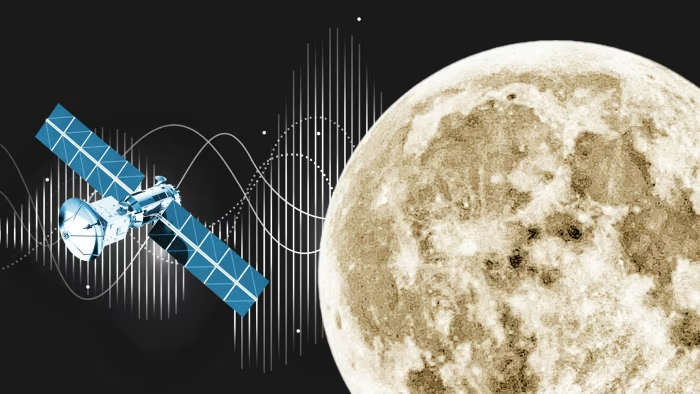
As Oliver Hawkins and Peggy Hollinger report, an analysis of commercial radio spectrum filings shows a growing number of players– government agencies, but increasingly private companies– bettting on the emergence of a lunar economy…
Private companies are staking claims to radio spectrum on the Moon with the aim of exploiting an emerging lunar economy, Financial Times research has found.
More than 50 applications have been filed with the International Telecommunication Union since 2010 to use spectrum, the invisible highway of electromagnetic waves that enable all wireless technology, on or from the Moon.
Last year the number of commercial filings to the global co-ordinating body for lunar spectrum outstripped those from space agencies and governments for the first time, according to FT research. The filings cover satellite systems as well as missions to land on the lunar surface.
“We will look back and see this as an important inflection point,” said Katherine Gizinski, chief executive of spectrum consultancy River Advisers, which has filed for lunar spectrum for three satellite systems on behalf of other companies since 2021.
Although total registrations were lower in 2024 than the previous year, the increased proportion of commercial filings reflects a race to build the infrastructure that will enable the “cislunar economy”, the area between the Earth and Moon…
More on the players and the game: “The race to claim the Moon’s airwaves” (gift article), from @financialtimes.com. See also:
* William Butler Yeats, “The Cat and the Moon”
###
As we linger over the lunar, we might recall that it was on this date in 1971 that NASA accomplished the third lunar EVA: Commander Alan B. Shepard and Lunar Module pilot Edgar D. Mitchell became the fifth and sixth men to walk on the Moon (in the lunar highlands near the crater Fra Mauro) as part of the Apollo 14 mission.
During this four-hour “activity,” they deployed the Apollo Lunar Surface Experiments Package (ALSEP)– scientific experiments that were left on the lunar surface and other scientific and sample collection apparatus. B efore lifting off on the next day, the astronauts went on another moonwalk almost to the rim of nearby Cone crater, collecting 42.9 kg of samples along the traverse. At the end of this 3.45 km walk, Shepard used a contingency sampler with a Wilson 6-iron connected to the end to hit two golf balls.
“It is mutual trust, even more than mutual interest, that holds human associations together”*…
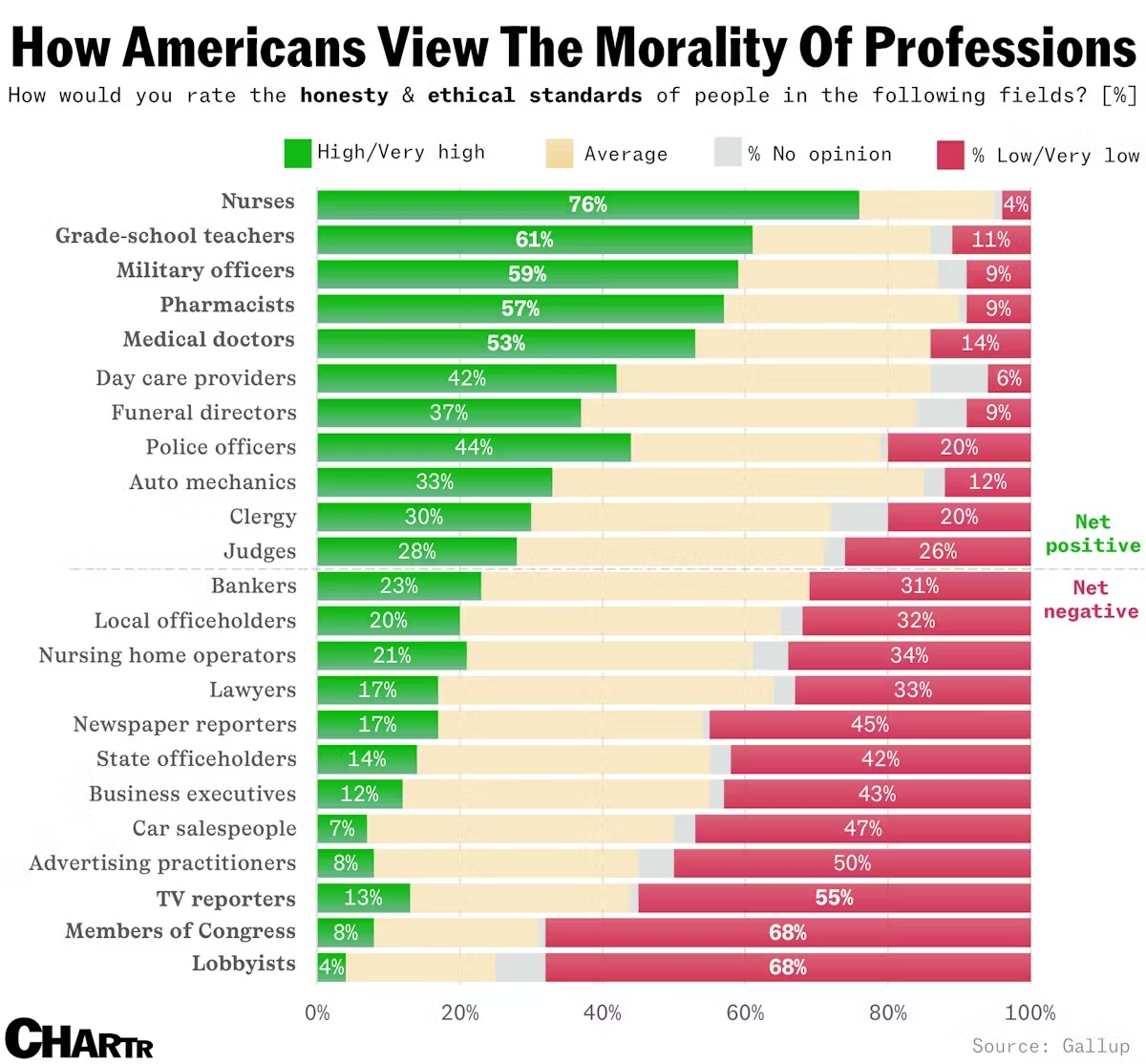
… and in its absence? Millie Giles on the state of trust in American professions…
When choosing a career, there are several (often contradictory) factors that determine people’s decisions: pay, of course; personal interests; work-life balance; location; public perception; and how a particular job might weigh on their conscience.
But which professions do Americans trust the most?
A recent Gallup poll, [published last Monday], found that 76% of US adults considered nurses to have high or very high honesty and ethical standards, with teachers, military officers, and pharmacists also scoring highly amongst those surveyed.
Conversely, Americans were skeptical about the ethical standards of TV reporters (55% considered low or very low), members of Congress (68%), and lobbyists (68%) — perhaps because the public perception of professionals in political and media-related fields is that many of them have ulterior motives, as is the case with stereotypically mercenary car salespeople and lawyers, which also ranked negatively overall.
Lloyd Blankfein, the former CEO of Goldman Sachs, infamously said in November 2009 — with the impacts of the global financial crisis still reverberating loudly — that he and his fellow bankers were “doing God’s work.” Ridiculed at the time, he might be pleased to see his once vilified profession ranked not far behind the clergy, per Gallup.
Zooming out: the average of high/very high ethical ratings across the core 11 professions sunk to just 30% in 2024, with trust in medical doctors in particular having dropped 14 percentage points since 2021…
“America’s most trusted professions,” from @sherwood.news @Gallup
* H. L. Mencken
###
As we contemplate confidence, we might recall that it was on this date in 1980 that news of the FBI’s Abscam operation, targeting corrupt Congress members and other elected officials, broke publicly. The two-year investigation had initially targeted trafficking in stolen property and illicit business people, but later evolved into a corruption investigation; it led to the convictions of six members of the United States House of Representatives and one member of the United States Senate, along with one member of the New Jersey State Senate, members of the Philadelphia City Council, the Mayor of Camden, New Jersey, and an inspector for the Immigration and Naturalization Service.
The Abscam operation wass dramatized in the 2013 feature film American Hustle, directed by David O. Russell, which received ten Academy Award nominations.

You must be logged in to post a comment.