A few months ago I had the fleeting thought to write a post about Stephen Biesty, the DK books cross-section legend. After learning he’d passed only just last year, I was disheartened to discover his personal website and galleries had gone offline, and there were no significant retrospectives of his career that I could find.
Now, after having looked through nearly every single work he produced and having read literally everything I could find online about him, I have come to find his quiet denouement rather touching. He certainly seemed to be private by design, offering only a handful of interviews in his lifetime. The longest profile I could find is weirdly condemning of his workmanlike ethos:
The artist himself is not quite as immediately engaging. Biesty is 35, with the smooth face and straight jeans of a Microsoft programmer. He lives in a Somerset cottage of grey-gold stone between a village church and a pair of wandering geese.
Biesty’s garden glows in the late-summer sun, yet he leads the way straight up to his studio and questions about his business. The room is almost bare of artist’s clutter, more an office with fax and easel and three paintbrushes laid parallel on a tissue to dry. ‘I don’t collect stuff,’ says Biesty.
He talks about his illustrating with a stern set to his chin, as if filling out a tricky detail. He doesn’t sketch – “There isn’t time to be doing reams of doodles” – but expands his work straight from thumbnail ideas to full-scale final pieces. These he completes, eyes close to the paper and hand in rhythm, layer by repetitive layer, between 7.30am and 5.30pm every weekday. “At lunchtime I go downstairs for half an hour and a sandwich.”
Biesty makes all this sound like mass production. “You’re employed to do one thing,” he says, straight as a factory manager. “Something that’s going to sell.” There are no posters of his pictures on his studio walls.
[…] Often, he answers with “we” rather than “I”.
I have to confess a great soft spot for all this. My great grandfather was studying technical illustration at Pratt before he was drafted into the war and lost at sea. His daughter became a graphic designer, as did her daughter — my mom. I appreciate that we all sat somewhere between art and science, heart and mind. Biesty’s seeming indifference towards an artistic identity gives his work more credibility for my tastes.
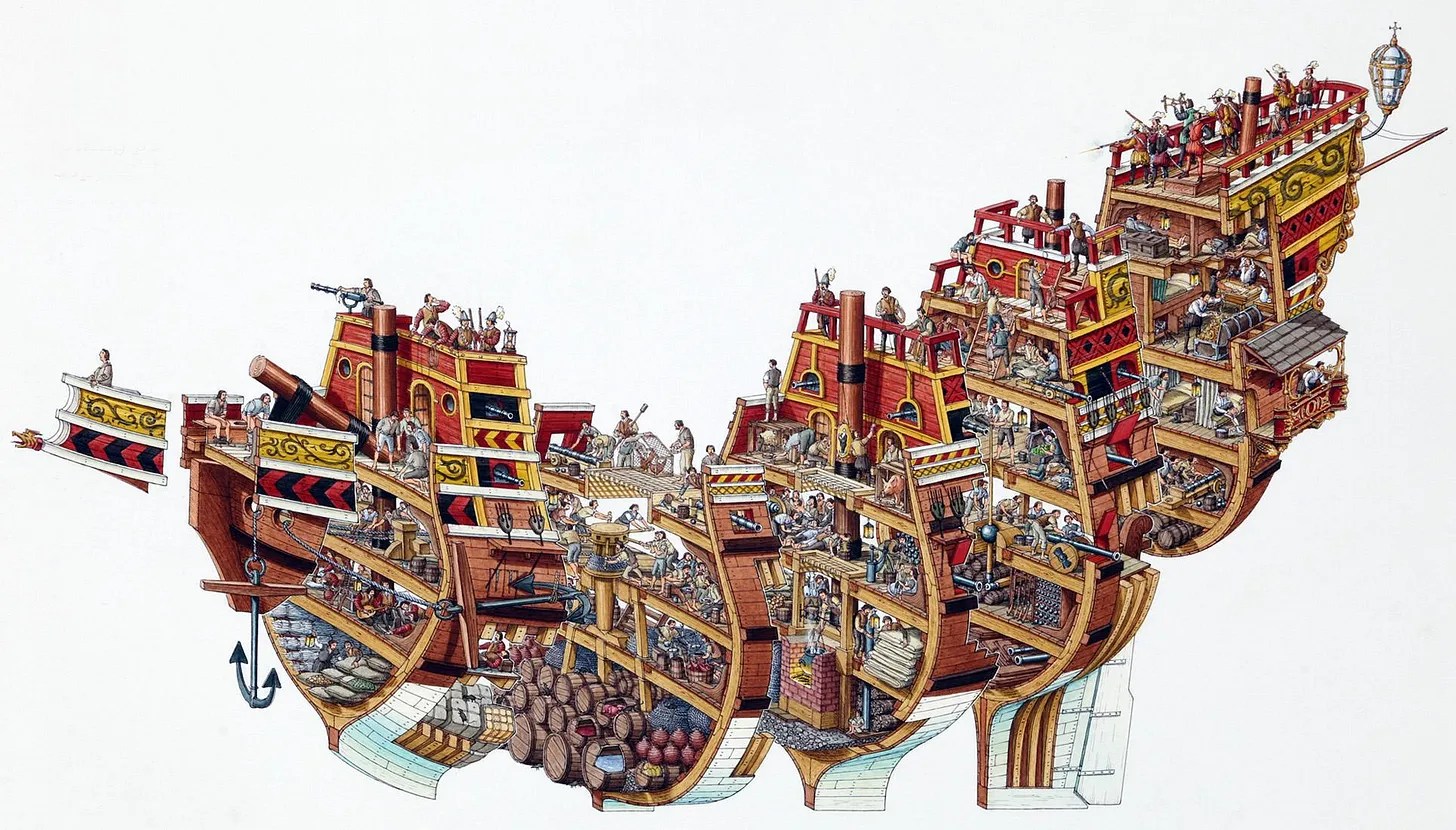
Biesty’s breakout moment came when the K of DK books asked Biesty to draw a steamboat in cross section. “I tried it lengthways and he said, ‘Fine. But try it the other way, like a loaf.’” And lo:
This became the centerpiece for his first book, Incredible Cross-Sections [here], and the seed for the rest of his career. Anyone around my age and above a certain threshold of autistic will have burned much library time on this amazing ‘90s run of DK books…
[Cole goes on to show and discuss other examples of Biesty’s work and to examine his influences…]
… Later in life, Biesty was able to admit some of the depth so evident in the work, as he accepted an award in 2011 for Into the Unknown [here]:
In a world where most information is stored and conveyed electronically, conventional non-fiction books for young people have taken a heavy hit. So is Into The Unknown a dinosaur, a final example of a Dying Breed? I believe not. In the years ahead, certainly fewer paper books will be produced. But those that are designed, written, and manufactured will be a bit like medieval manuscripts — special creations, works of art, unique, beautiful products to be collected and cherished. Into the Unknown, therefore, is not the end of a line but the beginning of a new, fresh and very beautiful one, and you have so kindly recognized that fact. Thank you all very much indeed…
* Robert J. Bezucha, The Art of the July Monarchy: France, 1830 to 1848
###
As we show (in addition to telling), we might spare a thought for an illustrator of a different ilk, William Steig; he died on this date in 2003. A cartoonist (most notably, in The New Yorker), and illustrator and writer of children’s books, he’s best known for Shrek!, which inspired the film series of the same name, as well as others that included Sylvester and the Magic Pebble (which won the Caldecott Medal), Abel’s Island, and Doctor De Soto. He was the U.S. nominee for the biennial and international Hans Christian Andersen Awards, as both a children’s book illustrator in 1982 and a writer in 1988.
When asked his opinion about the movie based on his picture book, Shrek!, William Steig responded: “It’s vulgar, it’s disgusting — and I loved it.” (With the release of Shrek 2 in 2004, Steig became the first sole-creator of an animated movie franchise that went on to generate over $1 billion from theatrical and ancillary markets after only one sequel.)
Your correspondent is headed off on the road, so (R)D will be in temporary hiatus. Regular service should resume on/around October 13. To keep you occupied until then, this tasty tidbit from Neal.fun (Neal Agarwal): “I’m not a robot.”
Ah, but “good”?… Past a certain level of quality, our definitions of “good”– that’s to say, the books that entertain and enlighten– vary for each of us. How to choose? Literature-Map is here to help…
The Literature-Map is part of Gnod, the Global Network of Discovery.
It is based on Gnooks, Gnod’s literature recommendation system. The more people like an author and another author, the closer together these two authors will move on the Literature-Map.
If you found a typo or a duplicate, please report it here.
Is an author missing on the map? Please vote for them here.
Want to jump to a random place on the map? Click here
* Henry David Thoreau, A Week on the Concord and Merrimack Rivers
###
As we turn the page, we might recall that this date in 1935 was a big one for the book business:
Allen Lane, Chairman of the London publisher The Bodley Head, was returning home after traveling with author Agatha Christie and her husband. At the train station, he browsed the kiosks looking for something to read on his way home. All he could find were magazines or low-quality paperback stories that he had no interest in reading. Then the thought occurred to him that people, like himself, might be more inclined to read good quality books [literature in paperback was then mainly poor quality lurid fiction] if they were more affordable. And since he was in the position to help build up lagging sales for his company, he ventured into printing previously hard-back books into a paperback format. The first was released on this day in 1935…
Penguin Books featured no photos and were priced about a fifteenth the price of a hardcover book. The traditional book trade initially resisted; but the purchase of 63,000 books by Woolworths paid for the project outright, confirmed its worth, and allowed Lane to establish Penguin as a separate business in 1936. Indeed, by March 1936, ten months after the company’s launch, one million Penguin books had been printed.
Dan Sinykin with a plea for reading– really reading…
In Sigrid Nunez’s 2018 novel The Friend, a famous writer kills himself. Not long before, he complains to the narrator about readers: “People talking about a book as if it were just another thing, like a dish, or a product like an electronic device or a pair of shoes, to be rated for customer satisfaction—that was just the goddamn trouble.” Students submit papers that say, “I hate Joyce, he’s so full of himself.” Online reviewers imply, “if a book didn’t affirm what the reader already felt—what they could identify with, what they could relate to—the author had no business writing the book at all.” The famous author quits teaching, quits writing. The state of the novel, its place in the world, is too depressing.
“But hasn’t it always been this way?” asks the narrator.
“No doubt,” says the famous writer. “But in the past the writer didn’t have to know, the problem wasn’t right there in your face.”
We know it’s been this way—or something like it—for more than a century, because that’s how long it’s been since I. A. Richards conducted his experiment. A young Cambridge professor in the 1920s, Richards printed poems with their authors redacted, sent them home with his students, and asked them to produce commentary. They did, and their commentary, from these otherwise good students, was riddled with errors. Without the context of who wrote the poems or when, the students failed to make out the plain sense. They connected poems to irrelevant memories, offered stock responses, indulged in sentimentality, and allowed preconceptions about what poetry is to skew what they saw on the page. At a time when literature professors either lectured grandly or lingered over the minutiae of history, Richards set out a new path; he wanted to provide support for “those who wish to discover for themselves what they think and feel about poetry.”
Reading, a skill easily taken for granted, is difficult—all the more so when reading literature that wields language as a medium for art. In the wake of Richards’ revelations, scholars in Britain and the United States developed a technique to address our failures. Eventually that technique took the name “close reading,” and it remains the principal methodology of literary studies.
Close reading is untimely. It bristles against today’s universities, which treat students as customers to please and as future workers to train rather than as people in pursuit of human flourishing. Jeff Bezos’ empire—Amazon; Goodreads; Kindle Direct Publishing, which dominates the perfervid world of self-publishing—encourages readers to “talk about a book as if it were just another thing, like a dish, or a product like an electronic device.” Social media compels us to attend to what we’re seeing for as long as it takes to scroll by. Every day, AI produces more of the words we come across, making it hard—maybe impossible—to care about reading them. I’m sure there were college courses this semester where students completed their work with AI and professors graded it with AI, cutting humans from the loop. It’s easy to see why close reading, which demands patience, openness to others, and slow, careful thought, is having a moment among academics.
In January, literary critic John Guillory, emeritus faculty at NYU, well known in the small world of literary studies, published a slim volume, On Close Reading, accompanied by an exhaustive annotated bibliography compiled by Rhodes College professor Scott Newstok that demonstrated that more people are writing about close reading now than ever. Jonathan Kramnick’s Criticism and Truth has garnered disproportionate attention, occasioning roundtables, special sections of journals, and many reviews. Much more, including a volume I co-edited, is forthcoming. After a spell of taking it for granted, academics are rediscovering the quiet excitement of close reading, a relief from the overheated corporate pablum routinely suffocating us.
But close reading is not just for academics, and it deserves a bigger audience. Not because it’s virtuous. Not because it makes us better people. (I know some great close readers who are real assholes.) But because it’s a thrilling way to think with others, to claw back some of the time taken from us daily by tech oligarchs (I have looked at Twitter impulsively several times while writing this pointedly long, difficult sentence), and relearn some of our capacity, atrophied into passivity by algorithms, for aesthetics, a term that arose in modernity to name a storehouse of values in dialectical opposition to those of capitalism: above all, treating texts as ends in themselves rather than as means to productive ends—treating them, that is, as art…
* “To call for close reading, in fact, is to do more than insist on due attentiveness to the text. It inescapably suggests an attention to this rather than to something else: to the ‘words on the page’ rather than to the contexts which produced and surround them. It implies a limiting as well as a focusing of concern – a limiting badly needed by literary talk which would ramble comfortably from the texture of Tennyson’s language to the length of his beard. [then, after a breath] But in dispelling such anecdotal irrelevancies, ‘close reading’ also held at bay a good deal else: it encouraged the illusion that any piece of language, ‘literary’ or not, can be adequately studied or even understood in isolation. It was the beginnings of a ‘reification’ of the literary work, the treatment of it as an object in itself, which was to be triumphantly consummated in the American New Criticism.” – Terry Eagleton, Literary Theory: An Introduction [Your correspondent understands Sinykin’s plea as an altogether timely call, not to abandon context, but to the swing the pendulum back.]
###
As we pay close attention, we might send gritty birthday greetings to a man who was a master of prose the repays close reading– Samuel Dashiell Hammett; he was born on this date in 1894. Hammett worked as an agent of the Pinkerton National Detective Agency from 1915-1922, when– disillusioned by the organization’s role in strike-breaking– he left to become a writer, providing copy in an ad agency until his fiction earned enough to support him. Hammett drew for his fiction on his experiences as a “Pinkerton Man,” and created an extraordinary series of characters– Sam Spade (The Maltese Falcon), Nick and Nora Charles (The Thin Man), The Continental Op (Red Harvest and The Dain Curse)– on the way to becoming, as the New York Times called him, “the dean of the… ‘hard-boiled’ school of detective fiction.”
In his book The Simple Art of Murder, Raymond Chandler, considered by many to be Hammett’s successor, observed,
Hammett was the ace performer… He is said to have lacked heart; yet the story he himself thought the most of The Glass Key is the record of a man’s devotion to a friend. He was spare, frugal, hard-boiled, but he did over and over again what only the best writers can ever do at all. He wrote scenes that seemed never to have been written before.
… Tech luminaries seem to opine endlessly about books and ideas, debating the merits and defects of different flavors of rationalism, of basic economic principles and of the strengths and weaknesses of democracy and corporate rule.
This fervor has yielded a recognizable “Silicon Valley canon.” And as Elon Musk and his shock troops descend on Washington with intentions of reengineering the government, it’s worth paying attention to the books the tech world reads — as well as the ones they don’t. Viewed through the canon, DOGE’s grand effort to cut government down to size is the latest manifestation of a longstanding Silicon Valley dream: to remake politics in its image.
Last August, Tanner Greer, a conservative writer with a large Silicon Valley readership, asked on X what the contents of the “vague tech canon” might be. He’d been provoked when the writer and technologist Jasmine Sun asked why James Scott’s Seeing Like a State, an anarchist denunciation of grand structures of government, had become a “Silicon Valley bookshelf fixture.” The promptled Patrick Collison, co-founder of Stripe and a leading thinker within Silicon Valley, to suggest a list of 43 sources, which he stressed were not those he thought “one ought to read” but those that “roughly cover[ed] the major ideas that are influential here.”
In a later response, Greer argued that the canon tied together a cohesive community, providing Silicon Valley leaders with a shared understanding of power and a definition of greatness. Greer, like Graham, spoke of the differences between cities. He described Washington, DC as an intellectually stultified warren of specialists without soul, arid technocrats who knew their own narrow area of policy but did not read outside of it. In contrast, Silicon Valley was a place of doers, who looked to books not for technical information, but for inspiration and advice. The Silicon Valley canon provided guideposts for how to change the world.
Said canon is not directly political. It includes websites, like LessWrong, the home of the rationalist movement, and Slate Star Codex/Astral Codex Ten, for members of the “grey tribe” who see themselves as neither conservative nor properly liberal. [Paul] Graham’s many essays are included, as are science fiction novels like Neal Stephenson’s The Diamond Age. Much of the canon is business advice on topics such as how to build a startup.
But such advice can have a political edge. Peter Thiel’s Zero to One, co-authored with his former student and failed Republican Senate candidate Blake Masters, not only tells startups that they need to aspire to monopoly power or be crushed, but describes Thiel’s early ambitions (along with other members of the so-called PayPal mafia) to create a global private currency that would crush the US dollar.
Then there are the Carlylian histories of “great men” (most of the subjects and authors were male) who sought to change the world. Older biographies described men like Robert Moses and Theodore Roosevelt, with grand flaws and grander ambitions, who broke with convention and overcame opposition to remake society.
Such stories, in Greer’s description, provided Silicon Valley’s leaders and aspiring leaders with “models of honor,” and examples of “the sort of deeds that brought glory or shame to the doer simply by being done.” The newer histories both explained Silicon Valley to itself, and tacitly wove its founders and small teams into this epic history of great deeds, suggesting that modern entrepreneurs like Elon Musk — whose biography was on the list — were the latest in a grand lineage that had remade America’s role in the world.
Putting Musk alongside Teddy Roosevelt didn’t simply reinforce Silicon Valley’s own mythologized self-image as the modern center of creative destruction. It implicitly welded it to politics, contrasting the politically creative energies of the technology industry, set on remaking the world for the better, to the Washington regulators who frustrated and thwarted entrepreneurial change. Mightn’t everything be better if visionary engineers had their way, replacing all the messy, squalid compromises of politics with radical innovation and purpose-engineered efficient systems?…
… We don’t know which parts of the canon Musk has read, or which ones influenced the young techies he’s hired into DOGE. But it’s not hard to imagine how his current gambit looks filtered through these ideas. From this vantage, DOGE’s grand effort to cut government down to size is the newest iteration of an epic narrative of change.
Musk, a heroic entrepreneur, will surely make history as his tiny team of engineers cuts the government Leviathan down to size. One DOGE recruiter framed the challenge as “a historic opportunity to build an efficient government, and to cut the federal budget by 1/3.” When a small team remakes government wholesale, the outcome will surely be simpler, cheaper and more effective. That, after all, fits with the story that Silicon Valley disruptors tell themselves.
From another perspective, hubris is about to get clobbered by nemesis. Jasmine Sun’s question about why so many people in tech read Seeing Like a State hints at the misunderstandings that trouble the Silicon Valley canon. Many tech elites read the book as a denunciation of government overreach. But Scott was an excoriating critic of the drive to efficiency that they themselves embody…
… Seeing Like a State, properly understood, is a warning not just to bureaucrats but to social engineers writ large. From Scott’s broader perspective, AI is not a solution, but a swift way to make the problem worse. It will replace the gross simplifications of bureaucracy with incomprehensible abstractions that have been filtered through the “hidden layers” of artificial neurons that allow it to work. DOGE’s artificial-intelligence-fueled vision of government is a vision from Franz Kafka, not Friedrich Hayek…
… Some of this revised canon might draw on Patrick Collison’s own bookshelves, which contain a far wider range of ideas than the canon itself. Collison’s reading interests tend toward classical liberalism, but writers who rub shoulders on his shelves, like Karl Popper and Elinor Ostrom, could be brought into debate with less well-known liberals like Ernest Gellner and contemporary left-liberals like Danielle Allen. All of these thinkers are deeply concerned with building and maintaining a genuinely plural society in which groups can get along despite their differences…
As we anguish over antecedents, we might recall that it was on this date in 1854 that the Republican Party was “organized” (In Ripon, Wisconsin). It held its first public meeting on March 20th and its first convention on July 6 of that same year.
The party grew out of opposition to the Kansas–Nebraska Act, which repealed the Missouri Compromise and opened the Kansas and Nebraska Territories to slavery and future admission as slave states, and was largely animated by anti-slavery advocates (including some ex-Whigs, and ex-Free Soilers).
The Kansas–Nebraska Act was authored by Democratic Senator Stephen A. Douglas and passed in 1854… the same Stephen Douglas that debated Abraham Lincoln in the 1858 Illinois Senate race. Douglas was re-elected by the Illinois General Assembly, 54–46. (Until 1913, when the 17th Amendment to the United States Constitution— which provides that senators shall be elected by the people of their states– was ratified, senators were elected by their respective state legislatures.) But the publicity made Lincoln a national figure and laid the groundwork for his 1860 presidential campaign.
… and so we endeavor to teach the alphabet to young children. Hunter Dukes on an amusing– and revealing– example from the 18th century…
It’s as easy as ABC!It’s as easy as pie! In an abecedarium titled The Tragical Death of a Apple-Pye, both idioms come true, as children learn an alphabet whose letters greedily gorge on pastry.
The edition featured here was published by John Evans, a major contender in late eighteenth- and early nineteenth-century children’s literature. His formula was simple: undercut the competition, including John Newbery’s firm, by selling unprecedentedly affordable books. He captured an emerging market: children’s books for hard up families who had managed, against the odds, to acquire literacy. And while his competitors targeted a middle-class audience, Evans “stayed true to the street literature tradition in which he had been brought up”, writes literary historian Jonathan Cooper, who gives 1793–1796 as the likely date for Apple-Pye. It was printed on a press at No. 41 Long Lane, West Smithfield, and sold for a halfpenny, like Evans’ other sixteen-page chapbooks — a tiny format, roughly measuring 3.5 inches tall by 2.25 inches wide.
The book is really three texts in one. First comes an ABC list in which the “life and death” of an apple pie plays out across the alphabet. “Apple Pye, Bit it, Cut it, Dealt it, Eat it . . . Took it, View’d it, Wanted it, X, Y, Z, and &, they all wish’d for a piece in hand.” With so many letters vying for a slice, they decide together on an equitable solution: “They all agreed to stand in order / Round the Apple Pye’s fine border / Take turn as they in hornbook stand, / From great A, down to &”.
Next we encounter “A Curious Discourse That Passed Between the Twenty Five Letters at Dinner-Time”. The abecedarian order repeats, but now the letters speak. “Says A, give me a good large slice. . . . Says I, I love the juice the best.” Finally, Evans includes some self-promotion — “if my little readers are pleased with what they have found in this book, they have nothing to do but to run to Mr. Evans’s” — and a woodcut picture of “the old woman who made the Apple Pye”, which transitions abruptly into Christian pedagogy: “Grace before meat”, “Grace after meat”, “The Lord’s Prayer”. Like in other eighteenth-century children’s books, such as The Renowned History of Giles Gingerbread, learning here is figured as a kind of gustatory consumption: children eat up the alphabet lesson, while its glyphic personifications wolf down their slices. (The link between sweets and syllabaries is more ancient still: Horace recorded teachers bribing pupils with letter-shaped biscuits to encourage their alphabetical uptake.)
Evans’ edition was published in the late eighteenth century — reworking a primer by Richard Marshall from the 1760s — but The Tragical Death of a Apple Pye is perhaps an even older story, first published, according to some scholars, in 1671. For a modern reader, it preserves English paleography as it existed in an earlier state: across the sections, U and V are used interchangeably, like I and J, and “&” is the ultimate letter, after Z. In an attempt to offset the ampersand’s semiotic difference, teachers well into the nineteenth century instructed students to pronounce the final letters of the alphabet as “x, y, z, and per se &”, hiving off the ampersand with the Latin by itself…
More on (and many more illustrations, including the image at the top, from) TTDoaAPhere, via “The Gentle Author.”
* Victor Hugo
###
As we learn our letters, we might send instuctive birthday greetings to a woman still hoeing this row: Denise Fleming; she was born on this date in 1950. An award-winning illustrator and creator of children’s books, she has written dozens of volumes for the very young, among which was her contribution to the tradition of which Evans was a part…




You must be logged in to post a comment.