A few months ago I had the fleeting thought to write a post about Stephen Biesty, the DK books cross-section legend. After learning he’d passed only just last year, I was disheartened to discover his personal website and galleries had gone offline, and there were no significant retrospectives of his career that I could find.
Now, after having looked through nearly every single work he produced and having read literally everything I could find online about him, I have come to find his quiet denouement rather touching. He certainly seemed to be private by design, offering only a handful of interviews in his lifetime. The longest profile I could find is weirdly condemning of his workmanlike ethos:
The artist himself is not quite as immediately engaging. Biesty is 35, with the smooth face and straight jeans of a Microsoft programmer. He lives in a Somerset cottage of grey-gold stone between a village church and a pair of wandering geese.
Biesty’s garden glows in the late-summer sun, yet he leads the way straight up to his studio and questions about his business. The room is almost bare of artist’s clutter, more an office with fax and easel and three paintbrushes laid parallel on a tissue to dry. ‘I don’t collect stuff,’ says Biesty.
He talks about his illustrating with a stern set to his chin, as if filling out a tricky detail. He doesn’t sketch – “There isn’t time to be doing reams of doodles” – but expands his work straight from thumbnail ideas to full-scale final pieces. These he completes, eyes close to the paper and hand in rhythm, layer by repetitive layer, between 7.30am and 5.30pm every weekday. “At lunchtime I go downstairs for half an hour and a sandwich.”
Biesty makes all this sound like mass production. “You’re employed to do one thing,” he says, straight as a factory manager. “Something that’s going to sell.” There are no posters of his pictures on his studio walls.
[…] Often, he answers with “we” rather than “I”.
I have to confess a great soft spot for all this. My great grandfather was studying technical illustration at Pratt before he was drafted into the war and lost at sea. His daughter became a graphic designer, as did her daughter — my mom. I appreciate that we all sat somewhere between art and science, heart and mind. Biesty’s seeming indifference towards an artistic identity gives his work more credibility for my tastes.
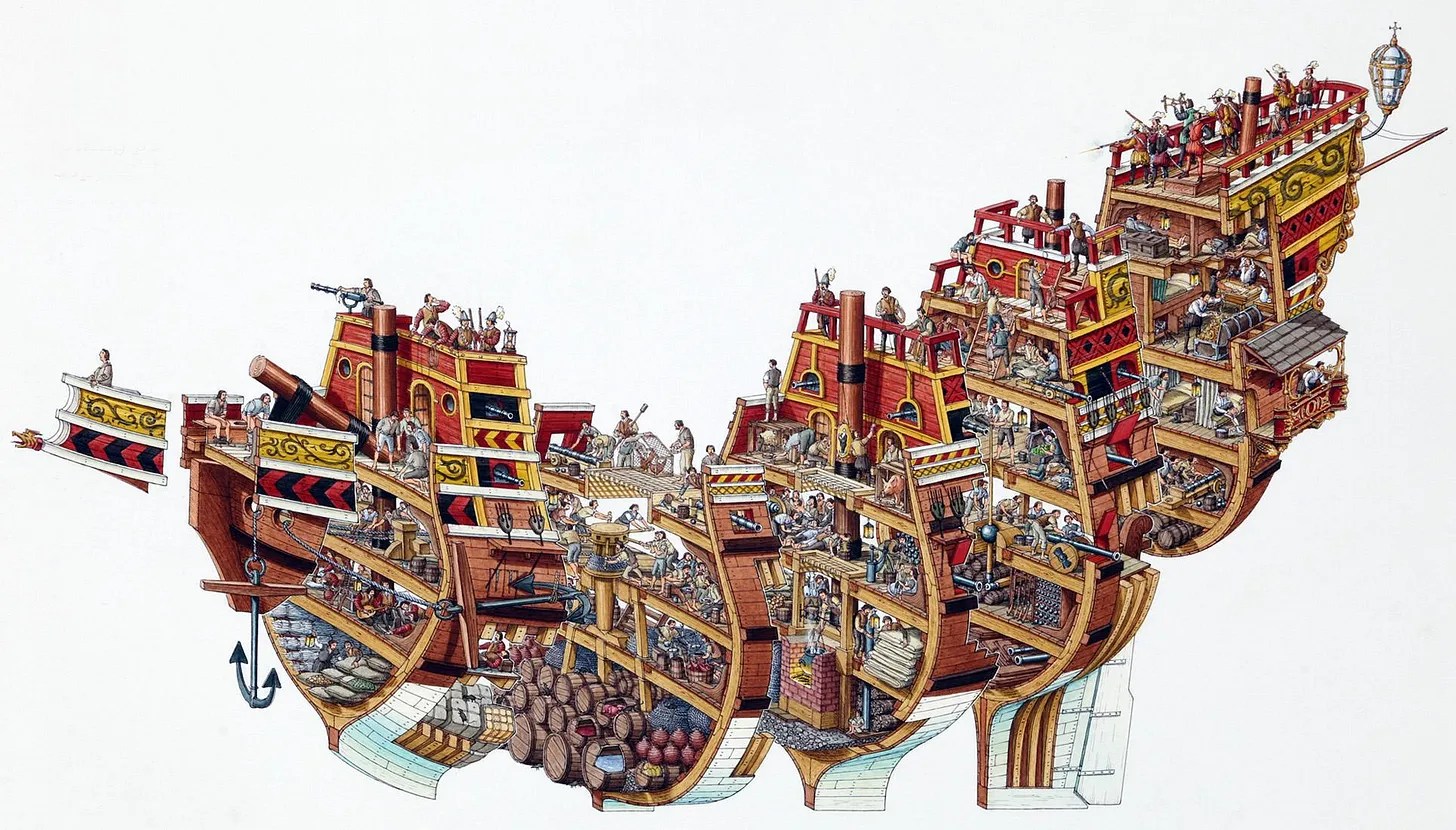
Biesty’s breakout moment came when the K of DK books asked Biesty to draw a steamboat in cross section. “I tried it lengthways and he said, ‘Fine. But try it the other way, like a loaf.’” And lo:
This became the centerpiece for his first book, Incredible Cross-Sections [here], and the seed for the rest of his career. Anyone around my age and above a certain threshold of autistic will have burned much library time on this amazing ‘90s run of DK books…
[Cole goes on to show and discuss other examples of Biesty’s work and to examine his influences…]
… Later in life, Biesty was able to admit some of the depth so evident in the work, as he accepted an award in 2011 for Into the Unknown [here]:
In a world where most information is stored and conveyed electronically, conventional non-fiction books for young people have taken a heavy hit. So is Into The Unknown a dinosaur, a final example of a Dying Breed? I believe not. In the years ahead, certainly fewer paper books will be produced. But those that are designed, written, and manufactured will be a bit like medieval manuscripts — special creations, works of art, unique, beautiful products to be collected and cherished. Into the Unknown, therefore, is not the end of a line but the beginning of a new, fresh and very beautiful one, and you have so kindly recognized that fact. Thank you all very much indeed…
* Robert J. Bezucha, The Art of the July Monarchy: France, 1830 to 1848
###
As we show (in addition to telling), we might spare a thought for an illustrator of a different ilk, William Steig; he died on this date in 2003. A cartoonist (most notably, in The New Yorker), and illustrator and writer of children’s books, he’s best known for Shrek!, which inspired the film series of the same name, as well as others that included Sylvester and the Magic Pebble (which won the Caldecott Medal), Abel’s Island, and Doctor De Soto. He was the U.S. nominee for the biennial and international Hans Christian Andersen Awards, as both a children’s book illustrator in 1982 and a writer in 1988.
When asked his opinion about the movie based on his picture book, Shrek!, William Steig responded: “It’s vulgar, it’s disgusting — and I loved it.” (With the release of Shrek 2 in 2004, Steig became the first sole-creator of an animated movie franchise that went on to generate over $1 billion from theatrical and ancillary markets after only one sequel.)
Your correspondent is headed off on the road, so (R)D will be in temporary hiatus. Regular service should resume on/around October 13. To keep you occupied until then, this tasty tidbit from Neal.fun (Neal Agarwal): “I’m not a robot.”
… and so we endeavor to teach the alphabet to young children. Hunter Dukes on an amusing– and revealing– example from the 18th century…
It’s as easy as ABC!It’s as easy as pie! In an abecedarium titled The Tragical Death of a Apple-Pye, both idioms come true, as children learn an alphabet whose letters greedily gorge on pastry.
The edition featured here was published by John Evans, a major contender in late eighteenth- and early nineteenth-century children’s literature. His formula was simple: undercut the competition, including John Newbery’s firm, by selling unprecedentedly affordable books. He captured an emerging market: children’s books for hard up families who had managed, against the odds, to acquire literacy. And while his competitors targeted a middle-class audience, Evans “stayed true to the street literature tradition in which he had been brought up”, writes literary historian Jonathan Cooper, who gives 1793–1796 as the likely date for Apple-Pye. It was printed on a press at No. 41 Long Lane, West Smithfield, and sold for a halfpenny, like Evans’ other sixteen-page chapbooks — a tiny format, roughly measuring 3.5 inches tall by 2.25 inches wide.
The book is really three texts in one. First comes an ABC list in which the “life and death” of an apple pie plays out across the alphabet. “Apple Pye, Bit it, Cut it, Dealt it, Eat it . . . Took it, View’d it, Wanted it, X, Y, Z, and &, they all wish’d for a piece in hand.” With so many letters vying for a slice, they decide together on an equitable solution: “They all agreed to stand in order / Round the Apple Pye’s fine border / Take turn as they in hornbook stand, / From great A, down to &”.
Next we encounter “A Curious Discourse That Passed Between the Twenty Five Letters at Dinner-Time”. The abecedarian order repeats, but now the letters speak. “Says A, give me a good large slice. . . . Says I, I love the juice the best.” Finally, Evans includes some self-promotion — “if my little readers are pleased with what they have found in this book, they have nothing to do but to run to Mr. Evans’s” — and a woodcut picture of “the old woman who made the Apple Pye”, which transitions abruptly into Christian pedagogy: “Grace before meat”, “Grace after meat”, “The Lord’s Prayer”. Like in other eighteenth-century children’s books, such as The Renowned History of Giles Gingerbread, learning here is figured as a kind of gustatory consumption: children eat up the alphabet lesson, while its glyphic personifications wolf down their slices. (The link between sweets and syllabaries is more ancient still: Horace recorded teachers bribing pupils with letter-shaped biscuits to encourage their alphabetical uptake.)
Evans’ edition was published in the late eighteenth century — reworking a primer by Richard Marshall from the 1760s — but The Tragical Death of a Apple Pye is perhaps an even older story, first published, according to some scholars, in 1671. For a modern reader, it preserves English paleography as it existed in an earlier state: across the sections, U and V are used interchangeably, like I and J, and “&” is the ultimate letter, after Z. In an attempt to offset the ampersand’s semiotic difference, teachers well into the nineteenth century instructed students to pronounce the final letters of the alphabet as “x, y, z, and per se &”, hiving off the ampersand with the Latin by itself…
More on (and many more illustrations, including the image at the top, from) TTDoaAPhere, via “The Gentle Author.”
* Victor Hugo
###
As we learn our letters, we might send instuctive birthday greetings to a woman still hoeing this row: Denise Fleming; she was born on this date in 1950. An award-winning illustrator and creator of children’s books, she has written dozens of volumes for the very young, among which was her contribution to the tradition of which Evans was a part…
Why a classic is missing from the New York Public Library’s list of the 10 most-checked-out books of all time…
… the New York Public Library, celebrating its 125th anniversary, released a list of the 10 most-checked-out books in the library’s history. The list is headed by a children’s book—Ezra Jack Keats’ masterpiece The Snowy Day—and includes five other kids’ books. The list also includes a surprising addendum: One of the most beloved children’s books of all time didn’t make the list because for 25 years it was essentially banned from the New York Public Library. Goodnight Moon, by Margaret Wise Brown, would have made the Top 10 list and might have topped it, the library notes, but for the fact that “influential New York Public Library children’s librarian Anne Carroll Moore disliked the story so much when it was published in 1947 that the Library didn’t carry it … until 1972.” Who was Anne Carroll Moore, and what was her problem with the great Goodnight Moon?…
[There follows a fascinating story of self-assured curator who, even as she resisted a new wave in children’s literature, was a powerful force in making literature available to all of the kids of New York.]
… As [Betsy] Bird notes in a fascinating blog post, the legacy of Anne Carroll Moore is one that many children’s librarians struggle with. “She is the quintessential bun-in-the-hair shushing librarian,” says Bird. “She’s such an easy villain.” Her discriminating book recommendations delivered from on high represent the exact opposite of the credo pledged by most children’s librarians today: that the library’s role is to provide the widest possible array of titles and allow children to find the books they love. Yet Moore did more than anyone else in the first half of the 20th century to encourage children of all races and incomes to read. To adopt a 21st century rallying cry, Bird notes, Anne Carroll Moore “was all about diverse books waaaaaay before anyone else was.”…
As we head to bed, we might recall that it was on this date in 1934 that a female black bear named Winnie at the London Zoo passed away at the age of 20. A favorite of A.A. Milne’s son, Christopher Robin, Winnie was the namesake of Christopher Robin’s his own stuffed bear- and the inspiration for his father’s Winnie-the-Pooh stories.
Christopher Robin Milne and his teddy bear (source)


You must be logged in to post a comment.