Posts Tagged ‘automobiles’
“I would drive on streets that were one-way and think, ‘Why are they all honking at me?'”*…

Lachan Summers decodes the “language” of Mexico City’s streets…
Anyone who spends time in Mexico City will spend much of it in traffic. One of the most clogged cities in the world, residents will lose on average 158 hours per year to congestion on the road (Ortego et al 2021). In recent years, the city government has sought to limit the number of cars that take to the streets each day, but these efforts have largely targeted poorer people who travel from their homes in the city’s outskirts to their workplaces in the centre, rather than those who live and drive short distances in wealthy, congested regions (Guerra and Reyes 2022). So, gridlock continues apace…
Mexico City’s streets have a peculiarly large number of endemic sounds (Alba Vega and Rodríguez 2022). When I bring up street sounds with my friends, we invariably begin listing all we can, often reaching 15 or 20 unique sounds that can be heard on Mexico City’s streets on any given day. We can add to this the symphony of expressive honks that echo along the city’s brimming streets. With the thickening traffic, the sound of the street increases exponentially, each new car adding to the din while demanding auditory escalation from other motorists. Although the traffic might be stationary, its sound will still travel, overflowing the streets to amble through parks, markets, and the most buffered corners of the city’s apartments. Even if you’re not on Mexico City’s streets, you never really leave them.
Riding my bike through its traffic over the last five years, I’ve learned by force Mexico City’s wide vocabulary of horns. Being able to identify that different vehicles use different honks and toots, and knowing that these will vary according to infrastructure, conditions, weather, time of day, and part of the year, is what Steven Feld (1996) calls “acoustemology”: a portmanteau of “acoustic” and “epistemology” that names a sonic way of knowing the world. As sonic practices and expectations accumulate socially and historically, undifferentiated noise becomes differentiated sounds, and Mexico City’s streets transform from cacophony to systematic commotion. So, in the interest of systematic knowledge (and public safety), this essay tabulates the streets’ honks into a taxonomy of cláxones [horns], a “claxonomy” of Mexico City’s traffic.
Taxonomies are a peculiar form of knowledge production. Lorraine Daston (2004) shows in her history of botany that taxonomies often use holotypes, which combine the range of peculiarities a species might exhibit into an ideal specimen that has never existed. Concrete abstractions, this attention to minute detail is not only a catalogue of diversity but, as Foucault pointed out long ago, a mode of adjudicating difference that generates an overarching sense of order. By assuming the world to be rational, the taxonomic mind is deeply functionalist–famously, the Russian chemist Dmitry Mendeleev left gaps in his 1869 Periodic Table of Elements for the yet-unknown elements a coherent world would require (Neale, Phan, and Addison 2019).
In their pursuit of the world’s universal order, taxonomists seek a universal language that avoids the problem of synonymy–multiple names for the same thing–while their critics point to the hubris of believing that the world’s multitudes could be, in G.K. Chesterton’s (1904) words, represented by a “system of grunts and squeals”…
In the spirit of classical taxonomy, this essay arbitrarily selects a series of common honks to assert an overarching system of meaning shared by people on Mexico City’s streets. While it might sound cacophonous, that residents can distinguish the meaning of each horn shows we’re far from Babel; motorists’ improvisations are a vocabulary emergent from the demands made by a megacity that is, in Dean Chahim’s (2022) memorable phrasing, “governed beyond capacity”. As residents loudly fill the void left by the state with new apparatuses of meaning and management, convention replaces rule so people can keep moving…
Complete with illustrative sounds files: “A Claxonomy of Mexico City’s Traffic,” in @allegra_lab via @TheBrowser.
* Sandra Cisneros
###
As we tackle taxonomy, we might spare a thought for Errett Lobban “E. L.” Cord; he died on this date in 1974. A race car driver, mechanic, and car salesman, he was offered the opportunity to manage the dying Auburn Automobile Company in 1924. By 1928 he controlled Auburn, which by 1931 was the 13th largest seller of autos in the United States. The acquisitive Cord founded the Cord Corporation in 1929 as a holding company for over 150 companies he controlled, mostly in the field of transportation. The corporation controlled the Auburn Automobile Company, which built the Auburn and Cord automobiles; Lycoming Engines; Duesenberg Inc.; New York Shipbuilding; Checker Motors; Stinson Aircraft Company; and American Airways (later American Airlines), amongst other holdings.
After a 1937 investigation by the Securities and Exchange Commission into his dealings in Checker Cab stock, Cord sold the Cord Corporation to the Aviation Corporation and retired to Los Angeles… where he earned even more millions in real estate, and then in broadcasting: Cord owned several of the first radio and television stations in California and later Nevada, where he moved in the 1940s. In the call letters of his Los Angeles radio station, KFAC, the A.C. stands for Auburn Cord. In Reno, Cord established KCRL-TV and radio in the 1950s and operated it for more than 25 years. The ‘CRL’ in the station’s call letters stood for “Circle L”—a ranch Cord owned in the Nevada desert.


“Find a job you enjoy doing, and you will never have to work a day in your life”*…
Your correspondent is headed into another period of turbulence– travel, talk, meetings– this one, a little longer than the last; so (Roughly) Daily is about to go into another hiatus. Regular service should resume on or around October 8.

If only it were so easy… There is always a demand for more jobs. But what makes a job good? Tyler Re suggests that Kant has an answer…
Work is no longer working for us. Or, for most of us anyway. Citing lack of pay and promotion, more people are quitting their jobs now than at any time in the past 20 years. This is no surprise, considering that ‘real wages’ – the average hourly rate adjusted for inflation – for non-managers just three years ago was the same as it was in the early 1970s. At the same time, the increasing prominence of gig work has turned work from a steady ‘climb’ of the ladder into a precarious ‘hustle.’
…
The United States Department of Labor identifies a ‘good job’ as one with fair hiring practices, comprehensive benefits, formal equality of opportunity, job security and a culture in which workers are valued. In a similar UK report on the modern labour market called ‘Good Work’ (2017), Matthew Taylor and his colleagues emphasise workplace rights and fair treatment, opportunities for promotion, and ‘good reward schemes’. Finally, the UN’s Universal Declaration of Human Rights has two sections on work. They cite the free choice of employment and organization, fair and equal pay, and sufficient leisure time as rights of workers.
What all three of these accounts have in common is that they focus on features of jobs – the agreement you make with your boss to perform labour – rather than on the labour itself. The fairness of your boss, the length of your contract, the growth of your career – these specify nothing about the quality of the labour you perform. And yet it is the labour itself that we spend all day doing. The most tedious and unpleasant work could still pay a high salary, but we might not want to call such work ‘good’. (Only a brief mention is made in the Taylor report – which totals more than 100 pages – of the idea that workers ought to have some autonomy in how they perform their job, or that work ought not be tedious or repetitive.) This is not to say that the extrinsic aspects of work like pay and benefits are unimportant; of course, a good job is one that pays enough. But what about work’s intrinsic goods? Is there anything about the process of working itself that we ought to include in our list of criteria, or should we all be content with a life of high-paying drudgery?
Philosophers try to answer this question by giving a definition of work. Since definitions tell us what is essential or intrinsic to a thing, a definition of work would tell us whether there is anything intrinsic to work that we want our good jobs to promote. The most common definition of work in Western thought, found in nearly every period with recorded writing on the subject, is that work is inherently disagreeable and instrumentally valuable. It is disagreeable because it is an expenditure of energy (contrast this with leisure), and it is instrumentally valuable because we care only about the products of our labour, not the process of labouring itself. On this view, work has little to recommend it, and we would do better to minimise our time spent doing it. A theory of work based on this definition would probably say that good jobs pay a lot (in exchange for work’s disagreeableness) and are performed for as little time as possible.
But this is not the only definition at our disposal. Tucked away in two inconspicuous paragraphs of his book about beauty, the Critique of Judgment (1790), is Immanuel Kant’s definition of work. In a section called ‘On Art in General’, Kant gives a definition of art (Kunst in German) as a subset of our more general capacity for ‘skill’ or ‘craft’ (note that Kant’s definition should not be limited to the fine arts like poetry or painting, which is schöne Künste in German, which he addresses in the following section of the book). In other words, Kant defines art as a particular kind of skilled labour. Kant’s definition of art as skilled labour will direct us to the intrinsic features of work that we ought to include in our conception of good jobs…
Read on: “Freedom at Work,” in @aeonmag.
* Mark Twain
###
As we center satisfaction, we might recall that on this date in 1908, at the at the Ford Piquette Avenue Plant in Detroit, “Model T 001”– the first production Model T– rolled off the line. Generally regarded as the first mass-produced/mass-affordable automobile, it made car travel available to middle-class Americans– and became the avatar of assembly-line production and the type of jobs that it produces.
(On May 26, 1927, Henry Ford watched the 15 millionth Model T Ford roll off the assembly line at his factory in Highland Park, Michigan.)

“Some people can stay longer in an hour than others can in a week”*…
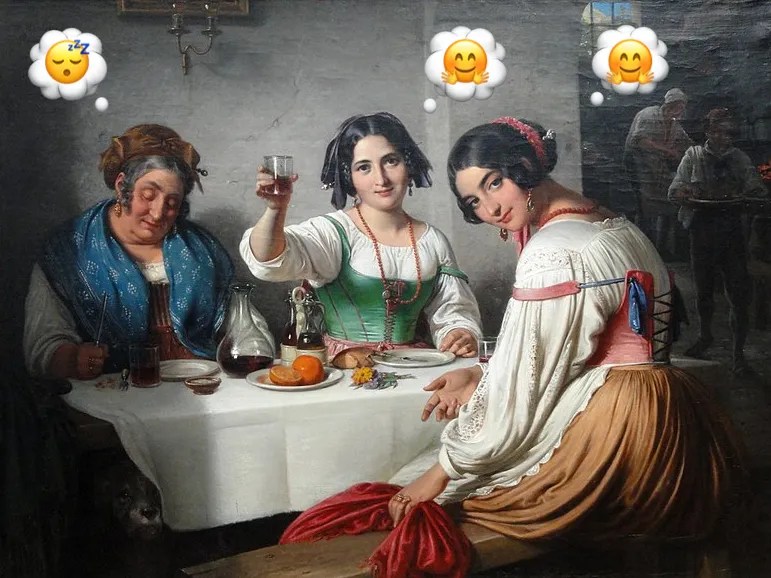
The ever-amusing Benjamin Errett on hospitality…
… The original word ghosti meant both guest and host specifically because of the deep connection between the two, “a mutual exchange relationship highly important to ancient Indo-European society.”…
That, as Beerbohm argues in his essay “Hosts and Guests,” is how we’ve evolved along with our words. There are natural hosts who keep a stocked drinks cart and jars of olives on hand. Obviously, it helps to have a generous olive budget. These people who arrange things just so are often bad guests.
A bad guest, Beerbohm writes, is either a parasite or a churl, the latter being someone like the freeloading poet Dante, who “received during his exile much hospitality from many hosts and repaid them by writing how bitter was the bread in their houses, and how steep the stairs were.” Poets!
To be perfectly positioned between parasitism and churlishness is to reciprocate the food and drink with good company, “radiating gratitude, but not too much of it; never intrusive, ever within call; full of dignity, yet all amenable; quiet, yet lively; never echoing, ever amplifying; never contradicting, but often lighting the way to truth; an ornament, an inspiration, anywhere.” If you’re particularly winning at this, you can save on room and board and no one will ever call you a mooch.
…
let’s reflect on how the who-would-you-invite-to-an-imaginary-dinner-party game is always less fun than it sounds. And yet the New York Times keeps asking authors in By the Book, despite the fact that Charlie Kaufman absolutely demolished the premise with this answer:
I see Oscar Wilde there, of course, Voltaire, Carol Saroyan Saroyan Matthau (wife of William Saroyan, William Saroyan, and Walter Matthau, and a writer in her own right), Hitler (not witty but quite a “get”), Edie Sitwell, Molière, Oscar Wilde (so witty I thought why not double him and place him on each end of the table so everyone could enjoy his witticisms?), Aristophanes, and Sir Kenneth Dover (to translate Aristophanes’ jokes for the other guests). That’s more than three, but one must assume there will be cancellations. Oh, and Jesus...
Be neither a parasite nor a churl- @benjaminerrett on hospitality: “The Wit’s Guide to Guests.”
* W. D. Howells
###
As we contemplate conviviality, we might consider the history of the visitor’s vehicle of choice, the automobile: it was on this date in 1903 that Ernest Pfennig, a Chicago dentist, became the first owner of a Ford automobile, a Model A. The two-(bench) seater weighed 1,240 lbs. and could reach a top speed of 28 mph. The Model A was the first car produced using pairs or trios of men working on each car; between 1903 and 1904, 1,750 cars were made.
Between 1903 and 1908, Ford produced the Models A, B, C, F, K, N, R, and S. Hundreds or a few thousand of most of these were sold per year. Then in 1908, Ford introduced the mass-produced Model T, which totaled millions sold over 18 years. While the Model T was famously available “in any color the customer wants, so long as it’s black,” the Model A was only sold in the color red.
(In 1927, Ford resurrected the “Model A” designation for the successor to its Model T; the revived Model A came in a variety of styles and colors…)

“Personally, I would like to renounce speech altogether and, like organic nature, communicate everything I have to say visually”*…

Driving across America, one encounters a wide variety of cultures, landscapes, people, and animals. But the one consistent thing that will stay the same from Maine to California are the signs one passes on the highway. That’s because, as Jon Keegan explains, America’s roads and highways have a big, fat style guide…
First published in 1935, the Federal Highway Administration’s (FHWA) “Manual on Uniform Traffic Control” (MUTCD), is a hefty tome consisting of close to 900 pages that contains the federal standards for all traffic safety signs, roadway markings and other “traffic control devices” that a driver on a road in the U.S. might encounter.
The MUTCD states that it “shall be recognized as the national standard for all traffic control devices installed on any street, highway, bikeway, or private road open to public travel”. Exact specifications for the font, size, spacing of letters, background colors, reflectivity, mounting location and orientation help ensure that traffic signs are consistently readable at a glance while driving anywhere in the U.S…

The remarkable– and enlightening– story: “The Style Guide for America’s Highways: The Manual on Uniform Traffic Control Devices,” from @jonkeegan. TotH to @kottke.
* Johann Wolfgang von Goethe
###
As we read the signs, we might send elegantly-designed birthday greetings to Walter de Silva; he was born on this date in 1951. A car designer and automotive executive, he began as a designer at Fiat in 1972, then went on to lead design at Alfa Romeo, SEAT, Audi, and finally Volkswagen Group– where, in 2007, he became Chairman.

“First study the science, and then practice the art which is born of that science”*…

In the wake of the collapse of FTX, the world of Decentralized Finance (DeFi) is in chaos; some wonder if crypto is dead (and here). But the underlying technology, the blockchain, still has much to offer, Dimitry Mihaylov argues– especially in the realm of science and innovation…
In the last few years, we have seen several use cases of the blockchain. From gaming to education, nothing has been off-limits for this revolutionary technology. Today, we see it emerging into more significant and nuanced fields across the spectrum. DeSci, or Decentralized Science, is one of the trends that has seen blockchain moving into the critical field of scientific research and development.
DeSci is an example of practical blockchain usage in order to establish a public infrastructure for creating, funding, crediting, reviewing, storing, and distributing scientific knowledge fairly and equitably. It’s an ecosystem where scientists and research contributors are incentivized for sharing their studies and knowledge. It then makes that knowledge publicly accessible to anyone across the Web.
DeSci is based on the fundamental ideology that scientific knowledge should be accessible and available to anyone, and the process of any scientific research should be transparent. It’s a rather revolutionary Web3 movement that can transform the legacy practices of scientific research and funding within academia. It also facilitates the work of innovative companies by providing them with direct contact with the best scientists.
…
The full acceptance of DeSci in the global scientific community can create a significant shift in research accessibility and funding – as knowledge will no longer be stored in private repositories. DeSci creates a sustainable model where scientists receive the true value and credit of their work, and knowledgeable data is available for anyone across the world.
His case in full: “How Decentralized Science (DeSci) lowers the Cost of Innovation and Implementation,” from @hackgernoon.
Apposite: “Decentralization.”
For the contra view: “The Underlying Technology Shibboleth” (“The only innovation we’ve seen from blockchain technology is for defrauding investors, facilitating capital destruction, and creating transient, unfair, chaotic dark markets for speculating on hot air”…)
* Leonardo da Vinci
###
As we look for wheat in the chaff, we might recall that it was on this date in 1895 that America’s first auto race, the Thanksgiving Day Chicago Times-Herald race, was held. There were six contestants, four cars and two motorcycles, competing on a cold and snowy day. Two of the competitors were electric, and quickly failed in the cold. The other four finished the 54 mile (to Evanston and back) circuit; it was won by Frank Duryea‘s Motorized Wagon… though motorcycles (which had appeared in the U.S. only two years earlier) were also winners after a fashion, as they received a great deal of publicity. Electric cars… not so much.

Frank Duryea’s Motorized Wagon (source)
You must be logged in to post a comment.