Posts Tagged ‘alchemy’
“You are an alchemist; make gold of that”*…

From Hugh Aldersey-Williams and Public Domain Review, a macabre morality tale for mid-May…
The man in the oval frame here is Georg Honauer. On the left, we see his unusual execution. A Latinized inscription gives his pretended noble alias, Lord of Brunhoff and Grobeschütz, along with the year 1597 and his age: twenty-four years old. Honauer is richly dressed in an embroidered tunic and is wearing an extravagant plumed hat. Two little devils repose on cushions beneath him.
Spectators cluster round the elaborate gallows. The tall iron construction, complete with finial balls and dangling chains, stands on a specially cut stone plinth. In a gory detail, blood drips down from the hanging figure. There is reason both for the fancy dress and the fancy construction.
Honauer was born in Olomouc, Moravia (now in the Czech Republic), in 1572. Passing himself off under his alias as a goldsmith and alchemist, in 1596 he entered the service of Friedrich I, Duke of Württemberg, in Stuttgart, claiming to be able to convert iron into precious metal using a process that combined alchemical transmutation with the bulk techniques of metal ore smelting.
Most ancient cultures with metallurgy have a version of alchemy, from the Chinese to the Egyptians. Alchemy flourished in medieval Europe, with its promise of divinely assisted immortality and its alluring sub-discipline, chrysopoeia, the transmutation of base metal into gold. It came with its own compelling logic that metals in the earth exist naturally in a constant state of evolution toward gold. Ores were near the start of the journey; easily smelted base metals such as lead a little further along. Alchemists believed that with the right chemical agents they could accelerate the process. But others doubted these claims, and during the centuries when some were pursuing alchemy in all seriousness, others — from Chaucer and Dante to Pieter Bruegel the Elder and Ben Jonson — made it a topic of derision and satire.
Alchemists nevertheless found patrons among men in urgent need of money, and the duke was certainly one of these. Before the end of the decade, Friedrich would raise the cash to persuade Rudolf II, the Holy Roman Emperor and Archduke of Austria, to release his duchy from Austrian control, and was pursuing expensive utopian projects, such as building the new city of Freudenstadt as a Protestant refuge.
So Honauer’s arrival in Stuttgart was well timed. Friedrich was already offering a reward to subjects who discovered promising ore deposits. Honauer claimed he could produce eight hundred ducats’ worth of “fine gold” from a hundred pounds of iron, and a friend said he had seen him using a tincture to draw gold from a lead bullet at a military camp in Hungary. The duke demanded a small-scale demonstration, which Honauer duly performed, and the metallic product passed an assay by the duke’s mining adviser; it was “at least as good as ducat-quality gold.”
Driven by fascination with the subject of alchemy as well as his avarice, Friedrich immediately directed that his Stuttgart summerhouse be converted into a laboratory for Honauer, and granted him further facilities at Kirchheim unter Teck, a short ride away from the city. He placed a large initial order for 200,000 ducats of gold, but Honauer said he did not have a sufficient quantity of the reagents necessary for such a large undertaking. They agreed on a monthly target of 36,000 ducats, to run indefinitely. The duke then arranged for thirty-six hundredweight and eighteen pounds (nearly two tons) of iron to be transported more than 150 miles from his armoury in Mömpelgard (now Montbéliard in France) to provide Honauer with the “raw material” he needed. Honauer’s order for additional chemicals necessary for the operation was equally impressive: 1030 pounds of saltpetre, 1852 pounds of lead, as well as similar quantities of “white copper” (cupronickel) and “mountain antimony”, and other reagents.
However, when he finally saw the scale of the task before him, Honauer lost his nerve and fled the city. Keen to get him back, believing that he had seen transmutation with his own eyes, the duke had his court painter produce “wanted posters” for the vanished alchemist, who was soon apprehended and brought back to attempt the transmutation again. When this failed, Friedrich had Honauer interrogated. Although the duke clearly wanted to believe Honauer could do as he had claimed, the fact that the alchemist had run away could only add to suspicions he was a cheat — a Betrüger, to use a word adopted at this time specifically to categorize alchemists who had been found unsuccessful, and who might or might not have been deliberately fraudulent.
The trial that followed was complicated by the fact that Honauer was indicted for impersonating a member of the nobility as well as the alchemical Betrug. He was quickly found guilty and, despite a personal appeal to the Holy Roman Emperor, sentenced to hang in a unique public spectacle. On Friedrich’s orders, all the iron that Honauer had been unable to convert into precious metal was converted instead into his gallows. The thirty-foot structure was then gilded in mockery of his claimed abilities and, on April 2, 1597, Honauer was dressed in robes woven with gold brocade to humiliate him still further, and led out to his death…
“The Gilded Gallows of Georg Honauer,” from @HoooAW in @PublicDomainRev.
* Shakespeare, Timon of Athens (Act 5, Scene 1)
###
As we tackle transmutation, we might note that today is the luckiest day of the year… or so suggests the alchemist’s cousin, the astrologer:
On May 18 at 2:36 p.m. EST, we will experience a once-a-year Jupiter cazimi.
Cazimi comes from the Arabic word kaṣmīmī, meaning “as if in the heart.” In astrological terms, a cazimi transpires when a planet is in close or exact conjunction with the sun, right in the infernal heart of it, if you will.
Also known as the “Day of Miracles,” a Jupiter cazimi occurs when the planet of good times, good luck, deep pockets, limitless potential, laughter, wisdom and diamonds on the soles of its proverbial shoes, is within one degree of the sun. A cazimi is something of a solar amplifier/purifier, where the inherent energy of a planet is hyped and heightened by its proximity to that show-boating death star.
On Saturday, the planet of growth, optimism, and abundance is getting a solar tongue kiss at 28 degrees and and we’re all primed to reap the benefits…
… It’s anyone’s guess what an unlucky ruler might do to punish an over-promising astrologer.

“In all chaos there is a cosmos, in all disorder a secret order”*…
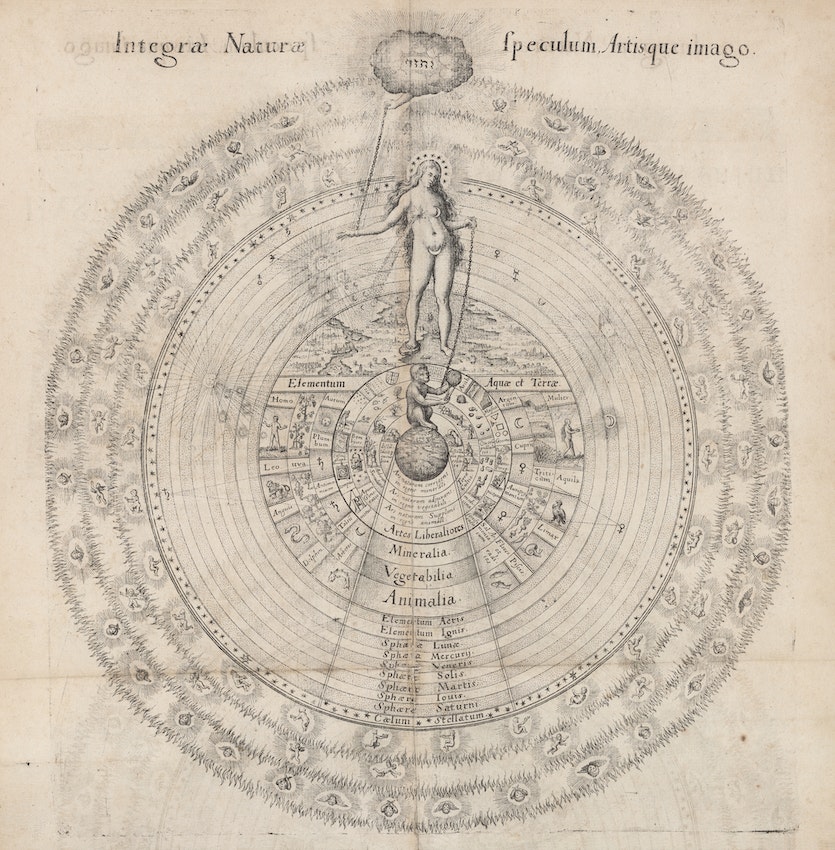
Between 1617 and 1621 the English physician and polymath Robert Fludd published his masterpiece Utriusque Cosmi . . . Historia, a two-volume work packed with over sixty intricate engravings. Urszula Szulakowska looks at the philosophical and theological ideas behind the extraordinary images found in the first volume, an exploration of the macrocosm of the universe and spiritual realm…
Robert Fludd was a respected English physician (of Welsh origins) employed at the court of King James I of England. He was a prolific writer of vast, multi-volume encyclopaedias in which he discussed a universal range of topics from magical practices — such as alchemy, astrology, kabbalism, and fortune-telling — to radical theological thinking concerning the interrelation of God with the natural and human worlds. However, he also proudly displayed his grasp of practical knowledge, such as mechanics, architecture, military fortifications, armaments, military manoeuvres, hydrology, musical theory and musical instruments, mathematics, geometry, optics, and the art of drawing, as well as chemistry and medicine. Fludd used the common metaphor for the arts as being the “ape of Nature”, a microcosmic form of how the universe itself functioned.
Fludd’s most famous work is the History of the Two Worlds (Utriusque Cosmi . . . Historia, 1617-21) published in two volumes by Theodore de Bry in Oppenheim. The two worlds under discussion are those of the Microcosm of human life on earth and the Macrocosm of the universe (which included the spiritual realm of the Divine).
Fludd himself was a staunch member of the Anglican Church. He was educated in the medical profession at St. John’s College in Oxford. At the turn of the seventeenth century, he set out for an extended period of travel on the continent. He spent a winter with some Jesuits, a Roman Catholic order deeply opposed to Protestantism who, nevertheless, tutored Fludd on magical practices. Fludd, however, always claimed to have worked out the theological and magical systems in his first volume of the Utriusque Cosmi . . . Historia (1617) during his undergraduate days at Oxford. In this work Fludd devised a lavishly illustrated cosmology based on the chemical theory of Paracelsus, in which the materials of the universe were separated out of chaos by God who acted in the manner of a laboratory alchemist…
All of Fludd’s treatises were lavishly illustrated with extraordinary engravings, unique in their form and subject matter, which have the visionary quality of a genuine spiritual seer and which exerted an influence on his contemporary occultists such as Michael Maier, Jacob Boehme, and Johannes Mylius. Fludd himself designed these images and they were engraved by the artisans employed at his publishers. (Some of his own original drawings still exist for the first volume of the Utriusque Cosmi . . . Historia, 1617)…

Read on for more explanation and many more mesmerizing images. A 17th century “theory of everything”: “Robert Fludd and His Images of The Divine,” in @PublicDomainRev.
* Carl Jung
###
As we think holistically, we might recall that it was on this date in 1859 that our perspective was shifted in a different kind of way: Charles Darwin published The Origin of the Species. Actually, on that day he published On the Origin of Species by Means of Natural Selection, or the Preservation of Favoured Races in the Struggle for Life; the title was shortened to the one we know with the sixth edition in 1872.

“The real alchemy consists in being able to turn gold back again into something else; and that’s the secret that most of your friends have lost.”*…
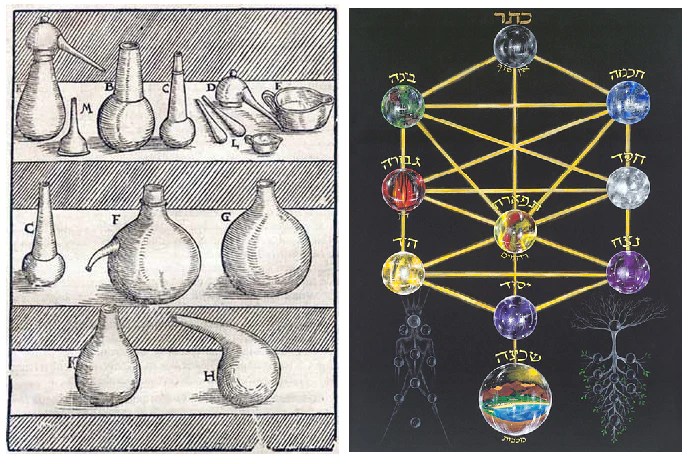
About a decade ago, the formidable Lawrence Weschler was a visiting scholar at the Getty Research Institute in Los Angeles, where he conceived a concept for an exhibit that, sadly, never materialized. Happily, he has shared the design in his wonderful newsletter, Wondercabinet…
Lead into Gold:
Proposal for a little jewel-box exhibit
surveying the Age-Old Quest
To Wrest Something from Nothing,
from the Philosopher’s Stone
through Subprime Loans
The boutique-sized (four-room) show would be called “Lead into Gold” and would track the alchemical passion—from its prehistory in the memory palaces of late antiquity through the Middle Ages

(those elaborate mnemonic techniques whereby monks and clerks stored astonishing amounts of details in their minds by placing them in ever-expanding imaginary structures, forebears, as it were, to the physical wondercabinets of the later medieval period—a sampling of manuscripts depicting the technique would grace a sort of foyer to the exhibition),

into its high classic phase (the show’s first long room) with alchemy as pre-chemistry (with maguses actually trying, that is, to turn physical lead into physical gold, all the beakers and flasks and retorts, etc.) to one side, and astrology as pre-astronomy (the whole deliriously marvelous sixteenth-into-seventeenth centuries) to the other, and Isaac Newton serving as a key leitmotif figure through the entire show (though starting out here), recast no longer in his role as the first of the moderns so much as “the Last of the Sumerians” (as an astonished John Maynard Keynes dubbed him, upon stumbling on a cache of thousands of pages of his Cambridge forebear’s detailed alchemical notes, not just from his early years before the Principia, but from throughout his entire life!).
The show would then branch off in two directions, in a sort of Y configuration. To one side:
1) The Golden Path, which is to say the growing conviction among maguses and their progeny during the later early-modern period that the point was allegorical, an inducement to soul-work, in which one was called upon to try to refine the leaden parts of oneself into ever more perfect golden forms, hence Faustus and Prospero through Jung, with those magi Leibniz and Newton riffing off Kabbalistic meditations on Infinity and stumbling instead onto the infinitesimal as they invent the Calculus, in turn eventually opening out (by way of Blake) onto all those Sixties versions, the dawning of the Age of Aquarius, etc., which set the stage for the Whole Earth Catalog and all those kid-maguses working in their garages (developing both hardware and software: fashioning the Calculus into material reality) and presently the Web itself (latter day version of those original memory palaces from back in the show’s foyer, writ large);
while, branching off to the other side, we would have:
2) The Leaden Path, in which moneychangers and presently bankers decided to cut to the chase, for, after all, who needed lead and who needed gold and for god’s sake who needed a more perfect soul when you could simply turn any old crap into money (!)—thus, for example, the South Sea Bubble, in which Newton lost the equivalent of a million dollars (whereupon he declared that he could understand the transit of stars but not the madness of men), tulipomania, etc., and thence onward to Freud (rather than Jung) and his conception of “filthy lucre” and George Soros (with his book, The Alchemy of Finance), with the Calculus showing up again across ever more elaborate permutations, leading on through Ponzi and Gecko (by way of Ayn Rand and Alan “The Wizard” Greenspan) to the whole derivatives bubble/tumor, as adumbrated in part by my own main man, the money artist JSG Boggs, and then on past that to the purest mechanism ever conceived for generating fast money out of crap: meth labs (which deploy exactly but exactly the same equipment as the original alchemists, beakers and flasks and retorts, to accomplish the literal-leaden version of what they were after, the turning of filth into lucre).
And I appended a xerox of that napkin sketch:

Eminently worth reading– and enjoying–in full. “The age-old human quest to turn nothing into something.”
* Edith Wharton
###
As we appreciate the abiding attraction of alchemy, we might recall that it was on this date in 1933 that President Franklin D. Roosevelt signed the act creating the Tennessee Valley Authority. A feature of the New Deal, the TVA was created to provide navigation, flood control, electricity generation, fertilizer manufacturing, regional planning, and economic development to the Tennessee Valley, a region (all of Tennessee, portions of Alabama, Mississippi, and Kentucky, and small areas of Georgia, North Carolina, and Virginia) which was particularly hard hit by the Great Depression relative to the rest of the nation. While owned by the federal government, TVA receives no taxpayer funding and operates similar to a private for-profit company.
The TVA has been criticized for its use of eminent domain, which resulted in the displacement of over 125,000 Tennessee Valley residents for the agency’s infrastructure projects. But on balance the TVA has been documented as a success in its efforts to modernize the Tennessee Valley and helping to recruit new employment opportunities to the region.

“Alchemy. The link between the immemorial magic arts and modern science. Humankind’s first systematic effort to unlock the secrets of matter by reproducible experiment.”*…

Science has entered a new era of alchemy, suggests Robbert Dijkgraaf, Director of the Institute for Advanced Study at Princeton– and, he argues, that’s a good thing…
Is artificial intelligence the new alchemy? That is, are the powerful algorithms that control so much of our lives — from internet searches to social media feeds — the modern equivalent of turning lead into gold? Moreover: Would that be such a bad thing?
According to the prominent AI researcher Ali Rahimi and others, today’s fashionable neural networks and deep learning techniques are based on a collection of tricks, topped with a good dash of optimism, rather than systematic analysis. Modern engineers, the thinking goes, assemble their codes with the same wishful thinking and misunderstanding that the ancient alchemists had when mixing their magic potions.
It’s true that we have little fundamental understanding of the inner workings of self-learning algorithms, or of the limits of their applications. These new forms of AI are very different from traditional computer codes that can be understood line by line. Instead, they operate within a black box, seemingly unknowable to humans and even to the machines themselves.
This discussion within the AI community has consequences for all the sciences. With deep learning impacting so many branches of current research — from drug discovery to the design of smart materials to the analysis of particle collisions — science itself may be at risk of being swallowed by a conceptual black box. It would be hard to have a computer program teach chemistry or physics classes. By deferring so much to machines, are we discarding the scientific method that has proved so successful, and reverting to the dark practices of alchemy?
Not so fast, says Yann LeCun, co-recipient of the 2018 Turing Award for his pioneering work on neural networks. He argues that the current state of AI research is nothing new in the history of science. It is just a necessary adolescent phase that many fields have experienced, characterized by trial and error, confusion, overconfidence and a lack of overall understanding. We have nothing to fear and much to gain from embracing this approach. It’s simply that we’re more familiar with its opposite.
After all, it’s easy to imagine knowledge flowing downstream, from the source of an abstract idea, through the twists and turns of experimentation, to a broad delta of practical applications. This is the famous “usefulness of useless knowledge,” advanced by Abraham Flexner in his seminal 1939 essay (itself a play on the very American concept of “useful knowledge” that emerged during the Enlightenment).
A canonical illustration of this flow is Albert Einstein’s general theory of relativity. It all began with the fundamental idea that the laws of physics should hold for all observers, independent of their movements. He then translated this concept into the mathematical language of curved space-time and applied it to the force of gravity and the evolution of the cosmos. Without Einstein’s theory, the GPS in our smartphones would drift off course by about 7 miles a day.
But maybe this paradigm of the usefulness of useless knowledge is what the Danish physicist Niels Bohr liked to call a “great truth” — a truth whose opposite is also a great truth. Maybe, as AI is demonstrating, knowledge can also flow uphill.
In the broad history of science, as LeCun suggested, we can spot many examples of this effect, which can perhaps be dubbed “the uselessness of useful knowledge.” An overarching and fundamentally important idea can emerge from a long series of step-by-step improvements and playful experimentation — say, from Fröbel to Nobel.
Perhaps the best illustration is the discovery of the laws of thermodynamics, a cornerstone of all branches of science. These elegant equations, describing the conservation of energy and increase of entropy, are laws of nature, obeyed by all physical phenomena. But these universal concepts only became apparent after a long, confusing period of experimentation, starting with the construction of the first steam engines in the 18th century and the gradual improvement of their design. Out of the thick mist of practical considerations, mathematical laws slowly emerged…
One could even argue that science itself has followed this uphill path. Until the birth of the methods and practices of modern research in the 17th century, scientific research consisted mostly of nonsystematic experimentation and theorizing. Long considered academic dead ends, these ancient practices have been reappraised in recent years: Alchemy is now considered to have been a useful and perhaps even necessary precursor to modern chemistry — more proto-science than hocus-pocus.
The appreciation of tinkering as a fruitful path toward grand theories and insights is particularly relevant for current research that combines advanced engineering and basic science in novel ways. Driven by breakthrough technologies, nanophysicists are tinkering away, building the modern equivalents of steam engines on the molecular level, manipulating individual atoms, electrons and photons. Genetic editing tools such as CRISPR allow us to cut and paste the code of life itself. With structures of unimaginable complexity, we are pushing nature into new corners of reality. With so many opportunities to explore new configurations of matter and information, we could enter a golden age of modern-day alchemy, in the best sense of the word.
However, we should never forget the hard-won cautionary lessons of history. Alchemy was not only a proto-science, but also a “hyper-science” that overpromised and underdelivered. Astrological predictions were taken so seriously that life had to adapt to theory, instead of the other way around. Unfortunately, modern society is not free from such magical thinking, putting too much confidence in omnipotent algorithms, without critically questioning their logical or ethical basis.
Science has always followed a natural rhythm of alternating phases of expansion and concentration. Times of unstructured exploration were followed by periods of consolidation, grounding new knowledge in fundamental concepts. We can only hope that the current period of creative tinkering in artificial intelligence, quantum devices and genetic editing, with its cornucopia of useful applications, will eventually lead to a deeper understanding of the world…
Today’s powerful but little-understood artificial intelligence breakthroughs echo past examples of unexpected scientific progress: “The Uselessness of Useful Knowledge,” from @RHDijkgraaf at @the_IAS.
Pair with: “Neuroscience’s Existential Crisis- we’re mapping the brain in amazing detail—but our brain can’t understand the picture” for a less optimistic view.
* John Ciardi
###
As we experiment, we might recall that it was on this date in 1993 that the Roman Catholic Church admitted that it had erred in condemning Galileo. For over 359 years, the Church had excoriated Galileo’s contentions (e.g., that the Earth revolves around the Sun) as anti-scriptural heresy. In 1633, at age 69, Galileo had been forced by the Roman Inquisition to repent, and spent the last eight years of his life under house arrest. After 13 years of inquiry, Pope John Paul II’s commission of historic, scientific and theological scholars brought the pontiff a “not guilty” finding for Galileo; the Pope himself met with the Pontifical Academy of Sciences to help correct the record.

“In every grain of sand there is the story of the earth”*…
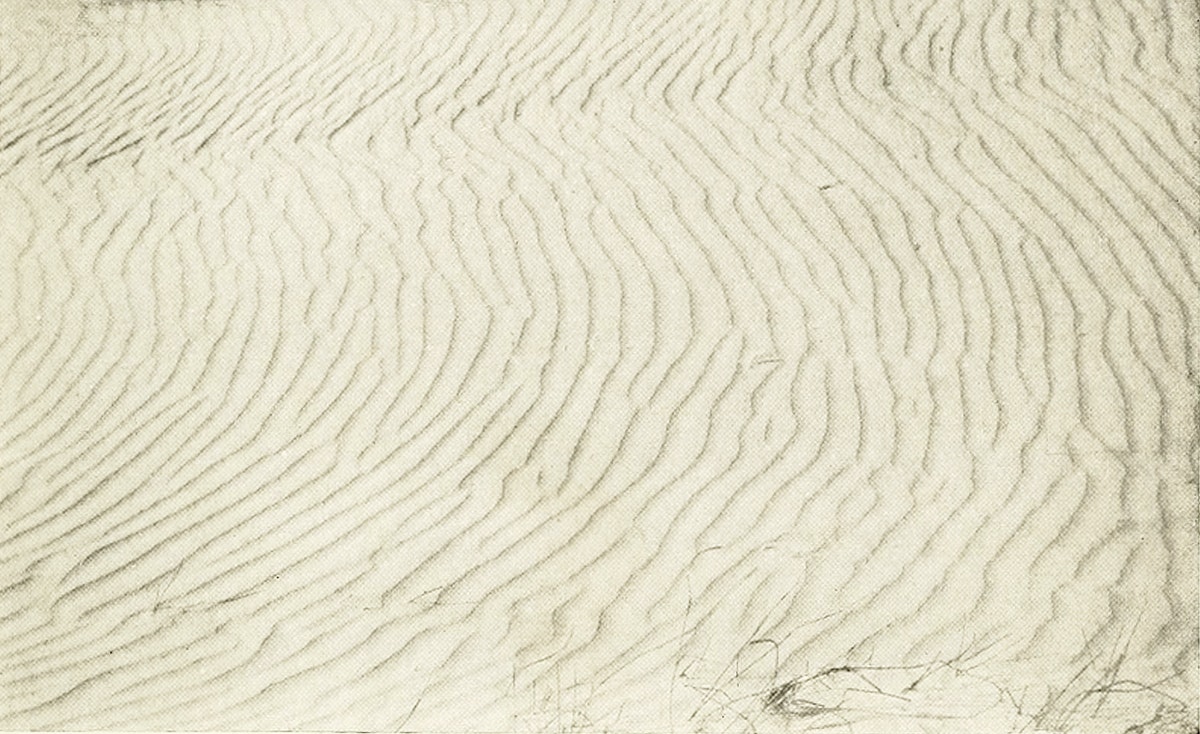
(Roughly) Daily has looked before (see here and here) at sand as a critical ingredient in the stuff of modern life. Today’s post features Steven Connor on the metaphorical power of sand…
Sand belongs to the great, diffuse class, undeclared, rarely described, but insistent and insinuating, of what may be called quasi-choate matters — among them mist, smoke, dust, snow, sugar, cinders, sleet, soap, syrup, mud, toffee, grit. Such pseudo-substances hover, drift, and ooze between consistency and dissolution, holding together even as they come apart from themselves. And, of all of these dishesive matters, sand is surely the most untrustworthy, the most shifting and shifty.
Nobody would seriously consider taking a stand on a cloud, but sand has betrayed many an architect and edifice. Sand is at once architectural and archiclastic. An eighteenth-century continuation of Baron Munchausen’s adventures describes how the Baron and his party survive a whirlwind of sand by scooping an igloo-style sand-chamber in which to shelter from the storm, and then digging a tunnel from their bunker back out into the light. Sand has the capacity to engulf and inundate, blearing contours, eroding and erasing every edge and eminence. As such it is the ultimate mockery of the permanence of stone, for it is no more than one of stone’s own moods, the manner in which stone, atomised, consumes itself. Shelley’s “Ozymandias” imagines the monumental statue of Rameses the Great dismembered on the Egyptian sands. The shattered chunks of head, legs, and pedestal portend a further, finer comminution, after the membra disjecta themselves will have been milled away into flatness: “Round the decay/Of that colossal wreck, boundless and bare,/The lone and level sands stretch far away.”
…
Sand is reversible. Only utter desiccation can attain to this pouring, milk-smooth liquefaction. Sand-baths were used in the ancient world both to draw out the damp ague of rheumatism and as a kind of sauna, to promote perspiration. Sand is the product of abrasion, but is also itself abrasive, used in sand-blasting to etch and burnish. Pliny tells us of the use of sand under a saw edge to make a clean cut in marble, and to polish it after it has been carved.
Sand signifies neutrality, indifference, and uniformity; yet it also has hairtrigger sensitivity and responsiveness. A grain of sand (in actual fact often a tiny parasite) is the irritant that provokes in the oyster the nacreous secretions that build into a pearl. Sand has a favoured relation to sound, putting a hoarse rattle in the throat of the wind, and is itself all ears. In 1787, the German physicist Ernst Chladni showed how drawing a violin bow over a metal plate could induce in the fine sand sprinkled on it hierophantic figurings of the sound, in quivering mandalas and ripple-fingered arpeggios. Though sand can disfigure and obliterate, it can also disclose the ghost wrist of wind and the perturbations of the earth. It is a detection and reception mechanism, forming ridged isobars, shivering musculature, oscilloscape of the air’s sculpting shoves and gusts.
Sand participates in dream and vision. The Sandman brings sleep by throwing or blowing sand into the eyes of children. But the sand does more than merely seal the eyes, for in many versions of this nursery tale, it is the very stuff that dreams are made on, the numb matter of sleep, swirling, particulate, that the sandman carries in his sack. The somnolence of sand is redoubled when in Top Hat (1935) Fred Astaire soothes Ginger Rogers to sleep in the hotel room below him by spreading sand on the floor and hush-dancing a susurrous soft-shoe shuffle. The origins of moon-walking are to be found in the novelty slides and scrapes across a sanded stage by music-hall acts like Wilson, Keppel and Betty. Specious it may be, but sand is also the secret stuff of omen and auspice, in the practice of divination through tossing and scrying handfuls of sand, known in Arabic as ilm al-raml, the science of the sand, or what might have been its Greek equivalent, psammomancy.
Sand is not only temporary, it is also the most temporised form of matter. It is the image or allegory of time, shifting, yet unshiftable. It seems a compiling of the minced, mounded years that go into its making, and grains of sand imitate the elementary atoms of time, moment upon pattering moment. Sand is featureless, without joints or divisions, even though it is nothing but division all the way down. Yet it is this very feature that makes it useful in the measurement of time, for, unlike other materials, sand will flow easily and regularly, even as its volume diminishes. Sand-glasses came into use in part because of the need to measure time at sea, far from any landmark; speed would be measured by counting the number of knots in a rope paid out from the back of the ship in the time it took for the sand to run through a half-minute glass. A half-hour period of watch, known as a “glass”, was also measured in this way. Grains of sand, in the form of quartz crystals, with their precise oscillations, still micro-regulate our time. In fact, the sand of hourglasses was often not quartz sand at all, but powdered marble, or eggshell. But we find it hard to give up the idea of the affinity of sand and the glass through which it runs, since silicates of sand are still the most important source of glass. George Herbert imagines this interfusion when he writes that “flesh is but the glasse, which holds the dust/That measures all our time; which also shall/Be crumbled into dust”, while for Gerard Manley Hopkins the soul itself is “soft sift/In an hourglass – at the wall/Fast, but mined with a motion, a drift,/And it crowds and it combs to the fall”…
From the mythical Sandman, through the grains in an hourglass, to an irritating mote lodged in the beachgoer’s eye, sand harbors unappreciated power: “The Dust That Measures All Our Time.”
###
As we muse on metaphor, we might send ideal birthday greetings to Marsilio Ficino; he was born on this date in 1433. An Italian scholar and Catholic priest, he was one of the most influential humanist philosophers of the early Italian Renaissance. The first translator of Plato’s complete extant works into Latin, he was important in the revival of Neoplatonism, and was in touch with every major academic thinker and writer of his day. His Florentine Academy was an attempt to revive Plato’s Academy, and influenced both the direction and the tenor of the Italian Renaissance and thus the development of European philosophy.
Ficino was also an astrologer, and is credited with having inspired the Tarot card deck– the Tarot of Marseilles– that was the pattern from which many subsequent tarot decks derive.

You must be logged in to post a comment.