Posts Tagged ‘Getty Museum’
“The real alchemy consists in being able to turn gold back again into something else; and that’s the secret that most of your friends have lost.”*…
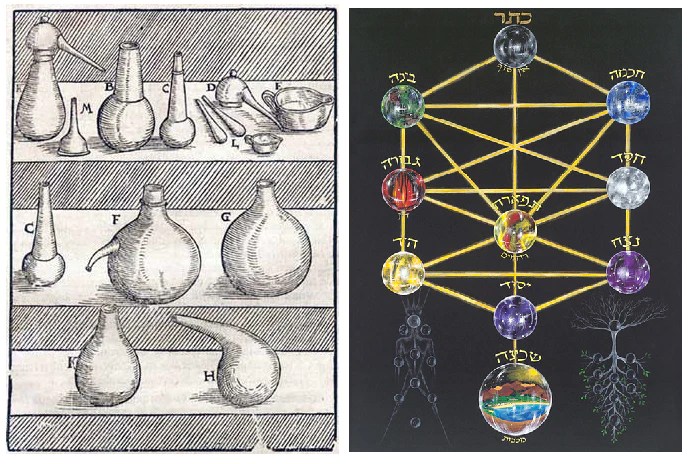
About a decade ago, the formidable Lawrence Weschler was a visiting scholar at the Getty Research Institute in Los Angeles, where he conceived a concept for an exhibit that, sadly, never materialized. Happily, he has shared the design in his wonderful newsletter, Wondercabinet…
Lead into Gold:
Proposal for a little jewel-box exhibit
surveying the Age-Old Quest
To Wrest Something from Nothing,
from the Philosopher’s Stone
through Subprime Loans
The boutique-sized (four-room) show would be called “Lead into Gold” and would track the alchemical passion—from its prehistory in the memory palaces of late antiquity through the Middle Ages

(those elaborate mnemonic techniques whereby monks and clerks stored astonishing amounts of details in their minds by placing them in ever-expanding imaginary structures, forebears, as it were, to the physical wondercabinets of the later medieval period—a sampling of manuscripts depicting the technique would grace a sort of foyer to the exhibition),

into its high classic phase (the show’s first long room) with alchemy as pre-chemistry (with maguses actually trying, that is, to turn physical lead into physical gold, all the beakers and flasks and retorts, etc.) to one side, and astrology as pre-astronomy (the whole deliriously marvelous sixteenth-into-seventeenth centuries) to the other, and Isaac Newton serving as a key leitmotif figure through the entire show (though starting out here), recast no longer in his role as the first of the moderns so much as “the Last of the Sumerians” (as an astonished John Maynard Keynes dubbed him, upon stumbling on a cache of thousands of pages of his Cambridge forebear’s detailed alchemical notes, not just from his early years before the Principia, but from throughout his entire life!).
The show would then branch off in two directions, in a sort of Y configuration. To one side:
1) The Golden Path, which is to say the growing conviction among maguses and their progeny during the later early-modern period that the point was allegorical, an inducement to soul-work, in which one was called upon to try to refine the leaden parts of oneself into ever more perfect golden forms, hence Faustus and Prospero through Jung, with those magi Leibniz and Newton riffing off Kabbalistic meditations on Infinity and stumbling instead onto the infinitesimal as they invent the Calculus, in turn eventually opening out (by way of Blake) onto all those Sixties versions, the dawning of the Age of Aquarius, etc., which set the stage for the Whole Earth Catalog and all those kid-maguses working in their garages (developing both hardware and software: fashioning the Calculus into material reality) and presently the Web itself (latter day version of those original memory palaces from back in the show’s foyer, writ large);
while, branching off to the other side, we would have:
2) The Leaden Path, in which moneychangers and presently bankers decided to cut to the chase, for, after all, who needed lead and who needed gold and for god’s sake who needed a more perfect soul when you could simply turn any old crap into money (!)—thus, for example, the South Sea Bubble, in which Newton lost the equivalent of a million dollars (whereupon he declared that he could understand the transit of stars but not the madness of men), tulipomania, etc., and thence onward to Freud (rather than Jung) and his conception of “filthy lucre” and George Soros (with his book, The Alchemy of Finance), with the Calculus showing up again across ever more elaborate permutations, leading on through Ponzi and Gecko (by way of Ayn Rand and Alan “The Wizard” Greenspan) to the whole derivatives bubble/tumor, as adumbrated in part by my own main man, the money artist JSG Boggs, and then on past that to the purest mechanism ever conceived for generating fast money out of crap: meth labs (which deploy exactly but exactly the same equipment as the original alchemists, beakers and flasks and retorts, to accomplish the literal-leaden version of what they were after, the turning of filth into lucre).
And I appended a xerox of that napkin sketch:

Eminently worth reading– and enjoying–in full. “The age-old human quest to turn nothing into something.”
* Edith Wharton
###
As we appreciate the abiding attraction of alchemy, we might recall that it was on this date in 1933 that President Franklin D. Roosevelt signed the act creating the Tennessee Valley Authority. A feature of the New Deal, the TVA was created to provide navigation, flood control, electricity generation, fertilizer manufacturing, regional planning, and economic development to the Tennessee Valley, a region (all of Tennessee, portions of Alabama, Mississippi, and Kentucky, and small areas of Georgia, North Carolina, and Virginia) which was particularly hard hit by the Great Depression relative to the rest of the nation. While owned by the federal government, TVA receives no taxpayer funding and operates similar to a private for-profit company.
The TVA has been criticized for its use of eminent domain, which resulted in the displacement of over 125,000 Tennessee Valley residents for the agency’s infrastructure projects. But on balance the TVA has been documented as a success in its efforts to modernize the Tennessee Valley and helping to recruit new employment opportunities to the region.

“Photography always acknowledged there were cameras before photography”*…

Bernardo Bellotto’s “The Demolition of the Ruins of the Kreuzkirche,” 1765
In an era when photographs are the de facto language of record keeping, memories of modern history before the camera can sometimes feel a tad distant. But people and places did exist before 1839. And in 18th century Europe, the need to produce visual accounts of events large and small was becoming increasingly important. Social and technological developments in the early modern era were buttressing a new sense of global connectivity heralded by the rise of mercantilism and early colonial contact with the New World. It was a period defined by travel and trade, and the lords of Europe must have seen their situation as pivotal enough to commemorate with oil on canvas. The urge to self document is a modern one. A contemporary recognition of history as something worth immortalizing on one’s own terms. In keeping with the technological progress of the time, less than a century later a new medium would be invented to supersede painting’s documentary role.
“Eyewitness Views: Making History in Eighteenth Century Europe,” now on view at the J. Paul Getty Museum in Los Angeles, gathers a series of such canvases by Italian-trained artists of the early modern era—painterly predecessors of breaking news photography. As a response to the increasing awareness of time as a commodity—an ephemeral something worth remembering—painters were commissioned to record the day’s most important spectacles and events. From political rallies and papal visits to public festivals and natural disasters, the images offer an expansive view of life at a time when the boundaries of time and space were opening up enormously—a sentiment reflected in their size and scope. Documentary paintings were one way for those in power to formalize the narrative, “making history” on their own terms and based on their own hierarchy of importance.
More at: “These 18th century painters made eyewitness news images at the dawn of globalization“; see the exhibition at the Getty through July 30.
* David Hockney
###
As we believe our eyes, we might send sharply-focused birthday greetings to Jennie Boddington; she was born on this date in 1922. After a successful career as a filmmaker, she became the first full-time curator of photography for the National Gallery of Victoria in Melbourne, Australia. She was the first such curator in Australia, and perhaps only the third in the world.

Art that wants to be free…

Alexander the Great in the Air; Unknown; Regensburg, Bavaria, Germany, Europe; about 1400 – 1410 with addition in 1487; Tempera colors, gold, silver paint, and ink on parchment
Early this month, The Getty Museum announced the launch of their Open Content Program, which makes over 4500 images from their collection (including the three examples here) available under an open license– meaning that anyone can share the images freely and without restriction.

Among The Tree Tops Calaveras Grove; Carleton Watkins, American, 1829 – 1916; California, United States, North America; negative about 1878; print 1880 – 1890; Albumen silver print

A Crocodile [as then imagined from reports]; Unknown; England, Europe; about 1250 – 1260; Pen-and-ink drawings tinted with body color and translucent washes on parchment
Visit the Getty’s site to begin exploring. [via Public Domain Review]
###
As we share and share alike, we might send acerbic birthday greetings to journalist, essayist, magazine editor, satirist, and critic Henry Louis “H. L.” Mencken; he was born on this date in 1880. Mencken is the author of the philological work The American Language, and is remembered for his journalism (e.g., his coverage of the Scopes Trial) and for his cultural criticism (and editorship of American Mercury– published by Alfred Knopf, also born on this date, but 12 years after Mencken ) in which he championed such writers as D.H. Lawrence, Ford Madox Ford, and Sherwood Anderson. But “H.L.” is probably most famous for the profusion of pointed one-liners and adages that leavened his work…
The difference between a moral man and a man of honor is that the latter regrets a discreditable act, even when it has worked and he has not been caught.
Civilization, in fact, grows more and more maudlin and hysterical; especially under democracy it tends to degenerate into a mere combat of crazes; the whole aim of practical politics is to keep the populace alarmed (and hence clamorous to be led to safety) by an endless series of hobgoblins, most of them imaginary.
I believe in only one thing and that thing is human liberty. If ever a man is to achieve anything like dignity, it can happen only if superior men are given absolute freedom to think what they want to think and say what they want to say. I am against any man and any organization which seeks to limit or deny that freedom. . . [and] the superior man can be sure of freedom only if it is given to all men.
Democracy is the theory that the common people know what they want, and deserve to get it good and hard.
Truth would quickly cease to be stranger than fiction, once we got as used to it.

1932 portrait by Carl Van Vechten
You must be logged in to post a comment.