Posts Tagged ‘agribusiness’
“The avocado is a food without rival among the fruits, the veritable fruit of paradise”*…

The story of a fabulous fruit and of the Californian who made it widely available…
The most nutritious known fruit, the avocado — a mostly evergreen member of the laurel family — is a ghost of evolution that should have grown extinct when the animals that fed on it and disseminated its enormous seeds did. Mercifully, it did not. Ample in Europe and North American during the Ice Age, it somehow managed to survive in Mexico and spread from there. But even more impressively, it managed to survive its own self-defeating sexual relations — the botanical equivalent of the human wire-crossing Eric Berne described in his revelatory 1964 classic Games People Play.
Bald of petals though the tree’s small greenish blossoms may be, they are an example of “perfect flowers” — the botanical term for bisexual blooming plants, which can typically self-pollinate. The avocado, however, is far from reproductively self-sufficient due to an astonishing internal clock, which comes in two mirror-image varieties.
In some cultivars — like the Hass, Pinkerton, and Reed avocados — the blossoms open up into reproductive receptivity in their female guise each morning, then close by that afternoon; the following afternoon, they open in their male guise. Other cultivars — the Fuerte, Zutano, and Bacon avocado among them — bloom on the opposite schedule: female in the afternoon, male by morning.
This presents a Pyramus and Thisbe problem across the wall of time — while both partners inhabit the space of a single tree, they can’t reach each other across the day-parts and need to be pollinated by trees on the opposite schedule…
Ever since humans have cultivated Earth’s most nutritious fruit, they have tried to help the helpless romancer with various intervention strategies — grafting, planting trees with opposite blooming schedules near each other, even manually pollinating blossoms of the same tree.
The world’s most beloved avocado — the Hass — is the consequence of human interference consecrated by happenstance in the hands of a California mailman in the 1920s.
[There follows the remarkable tale of Rudolph Hass, whose avocados bring in more than a billion dollars a year for growers, accounting for four fifths of the American avocado industry.]
Today, every single Hass avocado in every neighborhood market that ever was and ever will be can be traced to a single mother tree grown by a destitute California mailman in 1926 — tender evidence that every tree is in some sense immortal, and a living testament to how chance and choice converge to shape our lives…

“Chance, Choice, and the Avocado: The Strange Evolutionary and Creative History of Earth’s Most Nutritious Fruit,” from @brainpicker in @brainpickings.
See also: “Here too it’s masquerade.”
###
As we peel and pit, we might recall that it was on this date in 1837 that John Wheeley Lea and William Henry Perrins, a pair of successful Worcester chemists, began manufacturing Worcestershire sauce, a savory flavoring that capitalizes on umami. Their condiment, which was broadly available to the public the following year, faced down scores of imitators to become the dominant brand, which it remains.

“Mustard: Good only in Dijon”*…
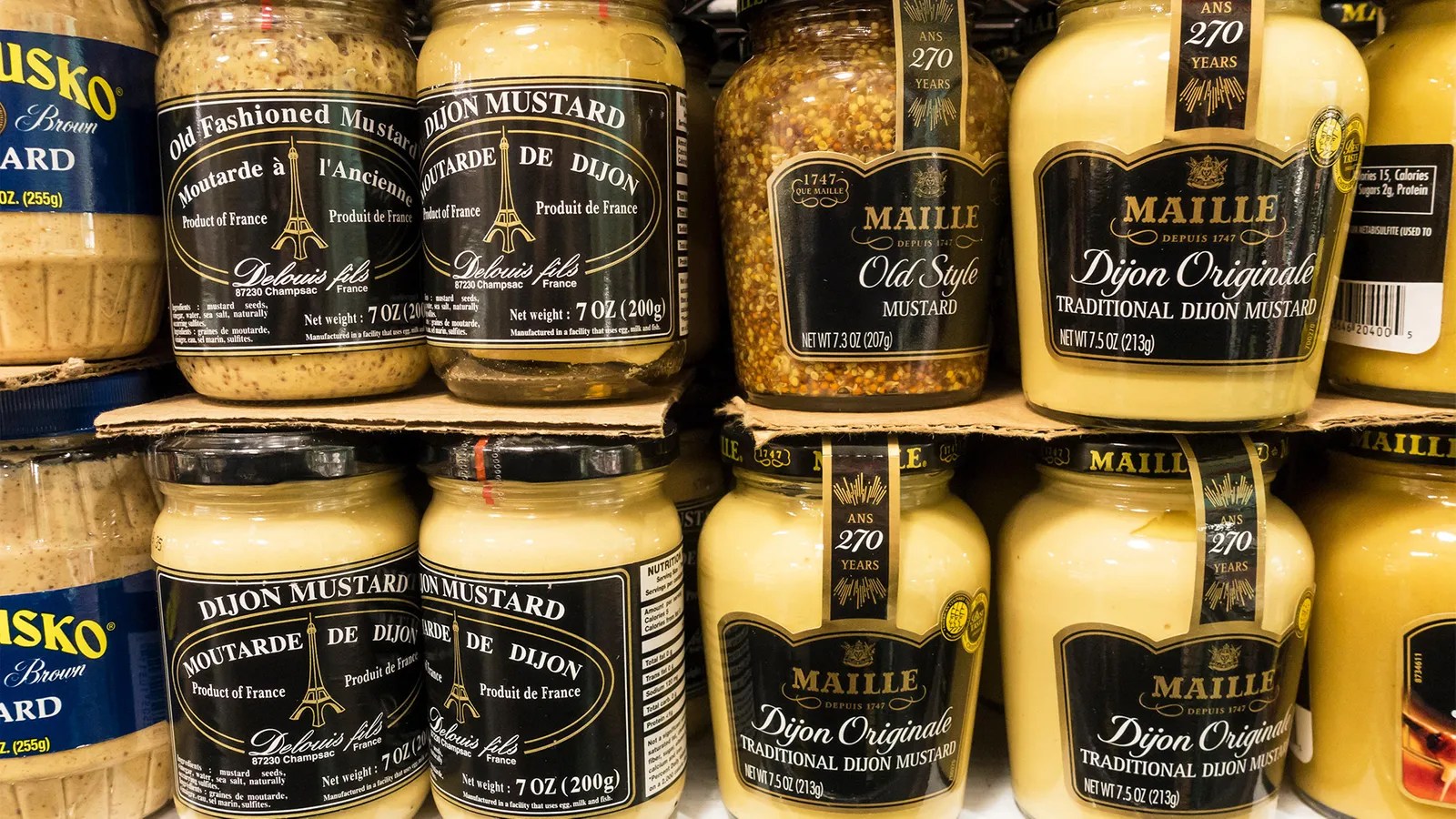
France is facing a widespread dearth of Dijon mustard; Emily Monaco explains…
Take a wander down any condiment aisle in France these days, and you’ll notice a pervasive absence between le mayo and le ketchup. Since this May, France has faced a widespread dearth of Dijon mustard, leading one French resident to advertise two jars for sale to the tune of €6,000 or about £5,000 (since revealed to be merely in jest). The shortage has incited expats (this author included) to not-at-all-jokingly smuggle squeeze bottles of Maille back into the country from places like the US to get their fix, while author and Paris resident David Lebovitz even resorted to hunting his jars down at a local gardening store, of all places.
While French news outlets wasted no time in attributing the shortage to the war in Ukraine, the real story is a whole lot spicier than that.
Omnipresent on French tables, Dijon mustard, made by combining brown mustard seeds with white wine, is a beloved condiment that provides a counterpoint to rich, hearty dishes thanks to its acidity and heat. It’s the perfect accompaniment to a slice of crisp-skinned roast chicken, the ideal way to jazz up a simple ham-and-butter sandwich and an essential ingredient in homemade mayonnaise.
That the condiment is so anchored in France’s Burgundy region – of which Dijon is the capital city – is thanks to the historical co-planting of brown mustard seeds with the region’s renowned grapevines, a practice introduced by the Ancient Romans to provide the vines with essential nutrients like phosphorous. Monks continued to cultivate mustard in this fashion for centuries, and, in 1752, the link between Dijon and mustard was cemented thanks to Dijon local Jean Naigeon, who married the seeds, not with vinegar, but with verjuice – the juice of unripe wine grapes historically used to add a pleasantly sour flavour to recipes in regions inhospitable to citrus…
But the truth is that despite its historical link the to the region, Dijon mustard has been delocalised for quite some time.
After Burgundian farmers largely abandoned mustard cultivation in favour of higher-paying crops decades ago, moutardiers (mustard makers) began looking further afield for the tiny seed at the root of the condiment that launched 1,000 “Pardon me, sir” jokes. Their mustard seed needs were chiefly met by Canada, which produces about 80% of the world’s supply. But this winter, Canadian-grown mustard also dried up, when, after several years of declining production had reduced stores, dry summer weather obliterated the Canadian crop, sending mustard seed prices skyrocketing threefold.
Though the shortage was not caused by the Russian invasion of Ukraine, it was exacerbated by it, impacting Dijon mustard makers “indirectly”, according to Luc Vandermaesen, CEO of mustard producer Reine de Dijon. Rather than the brown seeds required for Dijon, Ukraine predominantly produces the white variety used in yellow and English mustard. Given the conflict, producers less tied to specific mustard varieties turned to Canada’s already meagre supply, intensifying the shortage.
Inadvertently, this all shed new light on the discrepancy between the name “Dijon mustard” and where it’s made. After all, unlike Champagne or Roquefort, the “Dijon” in Dijon mustard refers to a specific recipe and not to a geographic region protected by an Appellation d’Origine Contrôlée (AOC) or Appellation d’Origine Protégée (AOP) designation, which regulate products like wine, cheese and even lentils with an iron fist…
A spicy tale: “Why there’s no ‘Dijon’ in Dijon mustard,” from @emily_in_france in @BBC_Travel.
* Gustave Flaubert
###
As we spread it thin, we might recall that it was on this date in 1795 that the Reverend Samuel Henshall was awarded the first patent for a corkscrew.
His idea was to incorporate a button between the shank & the worm. Its purpose was to compress and turn the cork once the worm was fully inserted, thus breaking any bond that might exist between cork and bottle.
Henshall’s improvement to the simple direct pull corkscrew was no doubt a winner. His design
Antique & Vintage Corkscrew Guide
was produced well into the 20th century in a vast array of different styles…


“On any given day… 5% of Americans will consume a fresh orange, 21% will consume orange juice.”*…

How concentrated and ready-to-pour orange juice– originally a dumping ground for extra oranges– conquered the morning menu…
The staid carton of orange juice has long sat next to tea and coffee at the breakfast table. It’s bright, but somewhat boring, and bears the dubious halo of being something good for you. Few of us give it much thought, other than to recall its oft-trumpeted Vitamin C content.
But processed orange juice as a daily drink, you might be surprised to learn, is a relatively recent arrival. Its present status as a global phenomenon is the creation of 20th-Century marketers, dealing with a whole lot of oranges and nowhere to put them…
“How orange juice took over the breakfast table,” from @BBC_Future. [TotH to friend MK.]
* USDA
###
As we get sweet, we might recall that it was on this date in 1821 that Spain formally transferred sovereignty over the territory we now know as Florida– the center of the orange juice industry– to the United States. (Spain had, of course, traded Florida to England [for Cuba] in 1763, but had regained it as a product of the Treaty of Versailles in 1783.)

“Poets have been mysteriously silent on the subject of cheese”*…

Unintended consequences…
The year was 1981, and President Ronald Reagan had a cheese problem. Specifically, the federal government had 560 million pounds of cheese, most of it stored in vast subterranean storage facilities. Decades of propping up the dairy industry—by buying up surplus milk and turning it into processed commodity cheese—had backfired, hard.
The Washington Post reported that the interest and storage costs for all that dairy was costing around $1 million a day. “We’ve looked and looked at ways to deal with this, but the distribution problems are incredible,” a USDA official was quoted as saying. “Probably the cheapest and most practical thing would be to dump it in the ocean.”
Instead, they decided to jettison 30 million pounds of it into welfare programs and school lunches through the Temporary Emergency Food Assistance Program. “At a time when American families are under increasing financial pressure, their Government cannot sit by and watch millions of pounds of food turn into waste,” Reagan said in a written statement. The New York Times declared that the bill would “give poor Americans a slice of the cheese surplus.”
But the surplus was growing so fast that 30 million pounds barely made a dent. By 1984, the U.S. storage facilities contained 1.2 billion pounds, or roughly five pounds of cheese for every American. “Government cheese,” as the orange blocks of commodity cheese came to be called, wasn’t exactly popular with all of its recipients…
The long, strange saga of ‘government cheese’: “Why Did the U.S. Government Amass More Than a Billion Pounds of Cheese?,” from @DianaHubbell in @atlasobscura.
See also: “How the US Ended Up With Warehouses Full of ‘Government Cheese’,” from @HISTORY (source of the image above).
* G.K. Chesterton
###
As we chew on it, we might recall that it was on this date in 1916 that Joseph L. Kraft was grated a United States patent for processed cheese… the very process used to create ‘government cheese.”
Kraft had become curious about an issue that plagued his industry: cheese went bad, very fast, especially in the summer. He hypothesized this was caused by the same bacteria that produced the cheese in the first place. He began experimenting with different heating techniques to destroy the bacteria while preserving the cheesy flavor and consistency; he perfected the process in 1914 and patented it two years later.
Though the cheese industry condemned Kraft’s creation as an abomination, by 1930, 40 percent of all cheese consumed in the United States was made by Kraft.

“When I give food to the poor, they call me a saint. When I ask why the poor have no food, they call me a communist.”*…
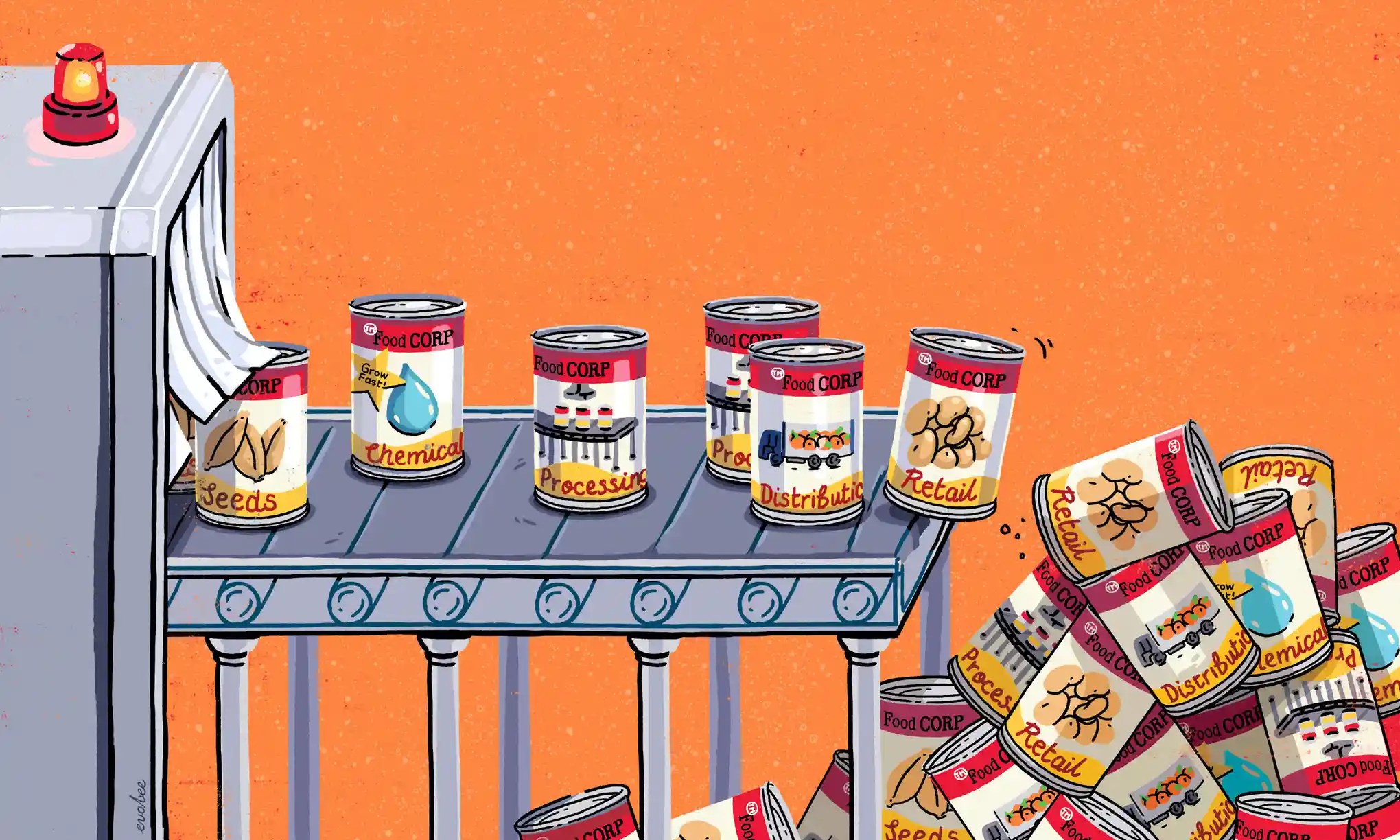
Staying yesterday’s agribusiness theme: George Monbiot on the extraordinary challenges facing the world’s food system…
For the past few years, scientists have been frantically sounding an alarm that governments refuse to hear: the global food system is beginning to look like the global financial system in the run-up to 2008.
While financial collapse would have been devastating to human welfare, food system collapse doesn’t bear thinking about. Yet the evidence that something is going badly wrong has been escalating rapidly. The current surge in food prices looks like the latest sign of systemic instability.
Many people assume that the food crisis was caused by a combination of the pandemic and the invasion of Ukraine. While these are important factors, they aggravate an underlying problem. For years, it looked as if hunger was heading for extinction. The number of undernourished people fell from 811 million in 2005 to 607 million in 2014. But in 2015, the trend began to turn. Hunger has been rising ever since: to 650 million in 2019, and back to 811 million in 2020. This year is likely to be much worse.
Now brace yourself for the really bad news: this has happened at a time of great abundance. Global food production has been rising steadily for more than half a century, comfortably beating population growth. Last year, the global wheat harvest was bigger than ever. Astoundingly, the number of undernourished people began to rise just as world food prices began to fall. In 2014, when fewer people were hungry than at any time since, the global food price index stood at 115 points. In 2015, it fell to 93, and remained below 100 until 2021.
Only in the past two years has it surged. The rise in food prices is now a major driver of inflation, which reached 9% in the UK last month. [Current estimates are that it will be 9% in the U.S. as well.] Food is becoming unaffordable even to many people in rich nations. The impact in poorer countries is much worse.
So what has been going on?…
Spoiler alert: massive food producers hold too much power – and regulators scarcely understand what is happening. Sound familiar? “The banks collapsed in 2008 – and our food system is about to do the same,” from @GeorgeMonbiot in @guardian. Eminently worth reading in full.
Then iris out and consider how agricultural land is used: “Half of the world’s habitable land is used for agriculture.”

… and consider the balance between agriculture aimed at producing food directly and agriculture aimed at producing feed and fuel: “Redefining agricultural yields: from tonnes to people nourished per hectare.”

###
As we secure sustenance, we might send carefully-observed birthday greetings to Dorothea Lange; she was born on this date in 1885. A photographer and photojournalist, she is best known for her Depression-era work for the Farm Security Administration (FSA). Lange’s photographs influenced the development of documentary photography and humanized the consequences of the Great Depression.


You must be logged in to post a comment.