Posts Tagged ‘agribusiness’
“As a work of art, I know few things more pleasing to the eye, or more capable of affording scope and gratification to a taste for the beautiful, than a well-situated, well cultivated farm”*…

That sentiment dates for the middle of the 19th century. The business of feeding humans (and our livestock) has changed a good bit since. George Steinmetz has traveled the globe documenting current practices. While (on the evidence of his remarkable photos) the process is still beautiful, it does raise some important questions…
Since the domestication of plants began some 11,000 years ago, humans have converted 40% of the earth’s surface into farmland. With the global population expected to reach 9.7 billion by the year 2050, combined with the rising standard of living in rapidly developing nations, it is estimated that we will have to increase the global food supply by 60%. The Feed the Planet project is an examination of how the world can meet the rapidly expanding challenge of feeding humanity without putting more natural lands under the plow. Most of us only come into contact with raw food in the supermarket, and are unaware of the methods used to raise it. In many cases, the food industry goes to significant lengths to prevent us from seeing how our food is produced. Access to this information is central to the personal decisions we make about what we eat, which cumulatively have huge environmental impact. This project seeks to show how our food is produced, so that we can make more informed decisions…


Many more striking photos, and their illuminating stories, at: “Feed the Planet.”
###
As we study sustenance, we might recall that it was on this date in 1825 that Ezra Daggett and Thomas Kensett of New York City were granted the first U.S. patent for food storage in tin cans. Canning had been practiced at an “industrial” scale in the U.S. since 1812 (when Kensett established the first U.S. canning facility for oysters, meats, fruits and vegetables in New York); Daggett and Kensett had been canning seafood since 1819.

“Aurora had but newly chased the night, / And purpled o’er the sky with blushing light”*…

The solar storms of late have made for some compelling nighttime sky-gazing. But these geomagnetic storms can have serious consequences, for example power grid irregularities, degradation of high-frequency communications, GPS outages, and satellite navigation issues. To that lattermost, consider agriculture: a 2023 report by the US Department of Agriculture noted that more than 50 percent of corn, cotton, rice, sorghum, soybeans, and winter wheat are planted and harvested with “automated guidance.” These systems, on which farmers depend, especially in the mid-May planting season, have been compromised…
The powerful geomagnetic storm that cast the northern lights’ vivid colors across the Northern Hemisphere over the weekend also caused some navigational systems in tractors and other farming equipment to break down at the height of planting season, suppliers and farmers said…
Farm equipment suppliers had warned that the storm would result in disruptions. And on Saturday, Landmark Implement, which sells John Deere farming equipment across parts of the Midwest, said that the accuracy of some of its systems had been “extremely compromised” because of the event [as has the equipment of other manufacturers].
The company said in a statement that it was searching for a “tool to help predict this in the future so that we can attempt to give our customers an alert that this issue may be coming.” It described the storm as a “historic event” rather than something it would have to “continue to battle frequently.”
Terry Griffin, an associate professor in agricultural economics at Kansas State University, said that while infrequent, such storms still posed a threat to farming in the United States, where the majority of crops are planted using modern guidance systems.
“This was the first time we’ve had geomagnetic storms that were so strong, and we were reliant upon GPS,” he said, noting that among the worst times for a storm like this to occur was during the planting season, when precision is crucial. Alternative technologies, including systems that use machine vision and artificial intelligence, or a more localized navigation system that would not collapse in a solar storm, are being developed, Dr. Griffin added…
The Northern lights are beautiful, but their cause is playing havoc with agriculture: “Solar Storm Crashes GPS Systems Used by Some Farmers, Stalling Planting” (gift article) from @nytimes.
See also: “Solar Storm Knocks Out Farmers’ Tractor GPS Systems During Peak Planting Season.”
* John Dryden
###
As we ruminate on radiation, we might spare a thought for Williamina Fleming; she died on this date in 1911. An astronomer and scholar of stars like our Sun, she was hired by the director of the Harvard College Observatory to help in the photographic classification of stellar spectra. She helped develop a common designation system for stars and cataloged more than ten thousand stars, 59 gaseous nebulae, over 310 variable stars, and 10 novae and other astronomical phenomena. Among several career achievements that advanced astronomy, Fleming is noted for her discovery of the Horsehead Nebula in 1888.

“In the last analysis civilization is based upon the food supply”*…

From the ever-illuminating Information is Beautiful, a look at the global food supply. Click through for a larger version of the diagram above and for illustrations of what’s being over/under consumed, and how much we really need… then ponder the fact that almost one-in-ten people in the world do not get enough to eat.
* Will Durant
###
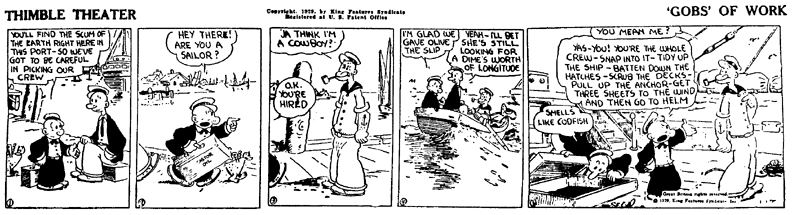
As we pick at our food, we might recall that it was on this date in 1926 that spinach-loving Popeye the Sailor, who made his first appearance in a strip (called “Thimble Theater,” along with Castor Oyle, father of Olive, who “meets” Popeye seven days later).
We might recall Popeye’s wise paraphrase of the old saw “you are what you eat”:
I yam what I yam and tha’s all what I yam.
“The most perfect political community is one in which the middle class is in control, and outnumbers both of the other classes”*…

For some, the prospect of further advances in AI and related tech (robotics, connectivity, et al.) conjures a future of existential risk, a Terminator-like dystopian future in which humans fight with “machines” for primacy. For others (among whom your correspondent numbers himself), AI (better understood as “augmented” than “artificial” intelligence) has real promise– but also dangers of a different (and very human) sort. Those technologies, dependent as they are on capital and specific/rare expertise, could fuel further concentration of wealth and power, could usher in an era of even greater inequality. Noah Smith is here to argue that my fears may be misplaced, that augmentation may narrow the skills gap and help reduce economic polarization…
On the app formerly known as Twitter, I’m known for occasionally going on rants about how it’s good to be normal and average and middle-class. To some degree this is because I believe that the only successful society is an egalitarian one where people don’t have to be exceptional in order to live good and comfortable and fulfilling lives. But some of it is also a reaction against the messages I was inundated with growing up. It seemed like every movie and book and TV show was telling me that nerds like me were special — that because we could do physics or program computers or even just play video games, we were destined to be exceptional. In the late 80s and 90s, it felt like we were on the cusp of a great shift, where the back-slapping jocks who had dominated American society in earlier times were on the verge of losing power and status to the bespectacled freaks and geeks. The Revenge of the Nerds was coming.
It wasn’t just fantasy, either. Over the next thirty years, the nerds really did win the economic competition. The U.S. shifted from manufacturing to knowledge industries like IT, finance, bio, and so on, effectively going from the world’s workshop to the world’s research park. This meant that simply being able to cut deals and manage large workforces were no longer the only important skills you needed to succeed at the highest levels of business. Bespectacled programmers and math nerds became our richest men. From the early 80s to the 2000s, the college earnings premium rose relentlessly, and a degree went from optional to almost mandatory for financial success.
The age of human capital was in full swing, and the general consensus was that “Average Is Over”. And with increased earnings came increased social status and personal confidence; by the time I moved out to San Francisco in 2016, tech people were clearly the masters of the Universe.
The widening gap in the performance of the nerds versus everyone else wasn’t the only cause of the rise in inequality in the U.S. — financialization, globalization, tax changes, the decline of unions, and other factors all probably played a role. But the increasing premium on human capital was impossible to ignore.
That trend lasted so long that most Americans can no longer remember anything else. We’ve become used to the idea that technology brings inequality, by delivering outsized benefits to the 20% of society who are smart and educated enough to take full advantage of it. It’s gotten to the point where we tacitly assume that this is just what technology does, period, so that when a new technology like generative AI comes along, people leap to predict that economic inequality will widen as a result of a new digital divide.
And it’s possible that will happen. I can’t rule it out. But I also have a more optimistic take here — I think it’s possible that the wave of new technologies now arriving in our economy will decrease much of the skills gap that opened up in the decades since 1980…
An optimistic take on technology and inequality: “Is it time for the Revenge of the Normies?” from @Noahpinion. Eminently worth reading in full.
* Aristotle
###
As we contemplate consequences, we might spare a thought for Joseph Glidden; he died on this date in 1906. An Illinois farmer, he developed and patented the design of the first commercially-feasible barbed wire in 1874 (an earlier, less successful patent preceded his)– a product that would transform the West. Before his innovation, settlers on the treeless plains had no easy way to fence livestock away from cropland, and ranchers had no way to prevent their herds from roaming far and wide. Glidden’s barbed wire opened the plains to large-scale farming, and closed the open range, bringing the era of the cowboy and the round-up to an end. With his partner, Isaac L. Ellwood, Glidden formed the Barb Fence Company of De Kalb, Illinois, and quickly became one of the wealthiest men in the nation.

“The public health, ecological, and social impacts of fish meal—which were a consequence of its cheapness as a feed ingredient—were largely invisible on the other side of the world”*…

… Those deleterious effects were largely missed in the mid-Twentieth Century, when fish meal became important to the rise of industrial-scale farming, and– as Ashley Braun explains– are still, as fish meal use is again growing…
The dirty yellow powder’s underwhelming appearance belies its influence. Fish meal—an unassuming yet protein-dense powder of dried, cooked, and pulverized fish—has fueled South American oligarchs, fostered slums, reshaped ecosystems, and fed Europe’s agricultural industrialization. Fish meal propelled the global production of meat and eggs, all while spurring public health crises, pollution, and unrest. The precipitous rise and fall of this humble commodity in the mid to late 20th century, writes medical and environmental historian Floor Haalboom, offers lessons for today as fish meal’s star rises again…
How cheap protein fueled the Global North’s agricultural expansion and destabilized the Global South: “Boom and Bust, All at Once: The Fraught Modern History of Fish Meal,” from @ashleybraun in @hakaimagazine. Eminently worth reading in full.
###
As we ponder pulverization, we might recall that it was on this date in 1837 that John Wheeley Lea and William Henry Perrins, a pair of successful Worcester chemists, began manufacturing Worcestershire sauce, a savory flavoring that capitalizes on umami. Their condiment, which was broadly available to the public the following year, faced down scores of imitators to become the dominant brand, which it remains.

You must be logged in to post a comment.