Posts Tagged ‘ranching’
“Make hay while the sun shines”*…
Hay, the foundation of the diet of grazing animals, is central to American agriculture. The USDA forecasts 2025 hay production at 123.5 million tons (grown on about 50 million acres countrywide), of which, about 3.24 tons are exported (generating over $1 Billion in revenue); the balance is consumed domestically.
Most of that hay is baled for storage and transport (in rectangular or round bales) using special (and increasingly expensive) equipment. But as Katie Hill reports, 115 years ago, before the advent of those motorized balers, a homegrown invention redefined stacking hay in the West. Some ranchers still see no reason to upgrade…
A scan of the horizon in Montana’s Big Hole Valley reveals plenty of examples of the land reclaiming what once belonged to it. Derelict jackleg fence. Log calving sheds with caving roofs. Rusting Chevrolets and spools of barbed wire. A giant compost pile of livestock carcasses, bones protruding from the mulch like seashells at low tide.
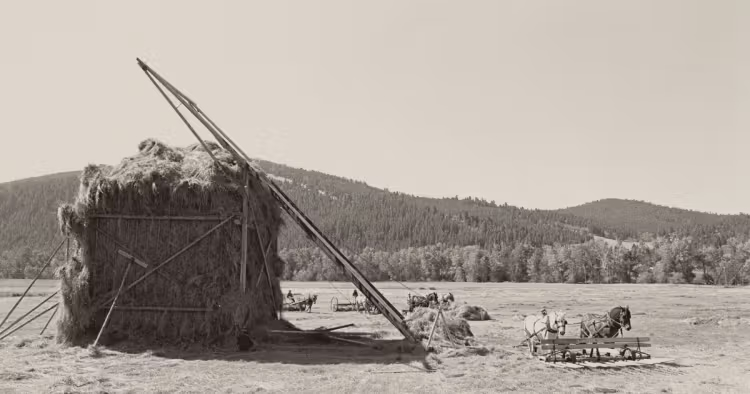
Then, every five miles or so, an old, spindly implement punctuates the scenery. It’s tall, maybe 30 feet, resembling a giant see-saw permanently out of balance. It’s not so much a stairway to heaven as it is a halted conveyor belt to nowhere; there’s no grain silo or corn crib nearby for a machine like this to fill up from above. Regardless, its efficacy in stacking giant piles of hay is clear from its construction. Grass grows tall around its base of rough-hewn lodgepoles, as if the earth might swallow it whole if it stayed put for another century.
This contraption [pictured at the top] is known as the beaverslide, patented in 1910 by Big Hole ranchers Herb Armitage and D.J. Stephens. The haystacking device consists of a wide, sliding fork at the base of a ramp and a cable pulley system rigged to the ramp’s underside. In practice, ranchers use a team of horses or a motorized vehicle with a winch to pull one of the cables perpendicular to the beaverslide, which in turn hoists the fork up the ramp, bringing a giant pile of hay up with it. (Ranchers rake cut hay onto the beaverslides with old buck rakes.) At the top of the ramp, the hay falls to the other side, forming three-story piles that can reach 25 tons in weight, depending on who you ask.
Details on the manufacturing and distribution of the beaverslide — named for its origins in Beaverhead County — are slim. The prevailing story is that ranchers often made their own, then made duplicates for neighboring ranches upon request, according to Big Hole rancher lore. Over the last few decades, the contraption has largely become a relic of a bygone era. But it’s not entirely obsolete, as some ranchers still use their old beaverslides today. With modern challenges like ballooning upgrade costs and the ever-present battle over a rancher’s right to repair their own equipment, the analog beaverslide makes more and more sense for those still using one with every passing hay season…
… he Kirkpatricks recall memories of neighbors being stuck in the middle of winter with broken-down bale processors and hungry cows. The closest repair shop in Jackson, an unincorporated community of roughly 20 people, is 42 miles south. The next closest shops or available technicians might be 53 miles away in Butte or 73 miles away in Dillon.
Many big-name mechanized implements run on trademarked chip technology that requires a trip to an authorized dealership for servicing. Even ranchers like Humbert who otherwise possess ample repair knowledge don’t have access to the diagnostic equipment necessary to solve problems on the fly. This might sound like sacrilege for an industry that lives and dies with rural, self-sufficient communities, but a bill calling for a rancher’s right to repair their own equipment died in the 2025 Montana legislature.
Score another point for the beaverslide…
Read on for more fascinating background: “Why Don’t You Beaverslide?” from @katiehillwriter.bsky.social
Watch the “technology” do it’s work here:
* A Tudor expression dating back to the mid-16th century, and used figuratively since 1673
###
As we honor old ways, we might recall that it was on this date in 1974 that Island Records released Country Life, the fourth studio album by Roxy Music.

“The most perfect political community is one in which the middle class is in control, and outnumbers both of the other classes”*…
For some, the prospect of further advances in AI and related tech (robotics, connectivity, et al.) conjures a future of existential risk, a Terminator-like dystopian future in which humans fight with “machines” for primacy. For others (among whom your correspondent numbers himself), AI (better understood as “augmented” than “artificial” intelligence) has real promise– but also dangers of a different (and very human) sort. Those technologies, dependent as they are on capital and specific/rare expertise, could fuel further concentration of wealth and power, could usher in an era of even greater inequality. Noah Smith is here to argue that my fears may be misplaced, that augmentation may narrow the skills gap and help reduce economic polarization…
On the app formerly known as Twitter, I’m known for occasionally going on rants about how it’s good to be normal and average and middle-class. To some degree this is because I believe that the only successful society is an egalitarian one where people don’t have to be exceptional in order to live good and comfortable and fulfilling lives. But some of it is also a reaction against the messages I was inundated with growing up. It seemed like every movie and book and TV show was telling me that nerds like me were special — that because we could do physics or program computers or even just play video games, we were destined to be exceptional. In the late 80s and 90s, it felt like we were on the cusp of a great shift, where the back-slapping jocks who had dominated American society in earlier times were on the verge of losing power and status to the bespectacled freaks and geeks. The Revenge of the Nerds was coming.
It wasn’t just fantasy, either. Over the next thirty years, the nerds really did win the economic competition. The U.S. shifted from manufacturing to knowledge industries like IT, finance, bio, and so on, effectively going from the world’s workshop to the world’s research park. This meant that simply being able to cut deals and manage large workforces were no longer the only important skills you needed to succeed at the highest levels of business. Bespectacled programmers and math nerds became our richest men. From the early 80s to the 2000s, the college earnings premium rose relentlessly, and a degree went from optional to almost mandatory for financial success.
The age of human capital was in full swing, and the general consensus was that “Average Is Over”. And with increased earnings came increased social status and personal confidence; by the time I moved out to San Francisco in 2016, tech people were clearly the masters of the Universe.
The widening gap in the performance of the nerds versus everyone else wasn’t the only cause of the rise in inequality in the U.S. — financialization, globalization, tax changes, the decline of unions, and other factors all probably played a role. But the increasing premium on human capital was impossible to ignore.
That trend lasted so long that most Americans can no longer remember anything else. We’ve become used to the idea that technology brings inequality, by delivering outsized benefits to the 20% of society who are smart and educated enough to take full advantage of it. It’s gotten to the point where we tacitly assume that this is just what technology does, period, so that when a new technology like generative AI comes along, people leap to predict that economic inequality will widen as a result of a new digital divide.
And it’s possible that will happen. I can’t rule it out. But I also have a more optimistic take here — I think it’s possible that the wave of new technologies now arriving in our economy will decrease much of the skills gap that opened up in the decades since 1980…
An optimistic take on technology and inequality: “Is it time for the Revenge of the Normies?” from @Noahpinion. Eminently worth reading in full.
* Aristotle
###
As we contemplate consequences, we might spare a thought for Joseph Glidden; he died on this date in 1906. An Illinois farmer, he developed and patented the design of the first commercially-feasible barbed wire in 1874 (an earlier, less successful patent preceded his)– a product that would transform the West. Before his innovation, settlers on the treeless plains had no easy way to fence livestock away from cropland, and ranchers had no way to prevent their herds from roaming far and wide. Glidden’s barbed wire opened the plains to large-scale farming, and closed the open range, bringing the era of the cowboy and the round-up to an end. With his partner, Isaac L. Ellwood, Glidden formed the Barb Fence Company of De Kalb, Illinois, and quickly became one of the wealthiest men in the nation.

You must be logged in to post a comment.