Posts Tagged ‘metaphor’
“I have said before that metaphors are dangerous”*…

… still, metaphor animates much of our thought and of the received wisdom that it can become. Quinn Slobodian unpacks the ways in which metaphors of the natural sciences loom large in the neoliberalism conception, then walks us through its myriad permutations, concluding with metaphor’s corrosion at the hands of Silicon Valley’s reactionary accumulation regime…
Polyps confounded political theorists in the 18th century. The creatures that collectively make up coral reefs acted in ways that defied both expectations of divine design and the established hierarchy of the animal kingdom. How could these lowest of organisms create such enormous structures—especially ones that appeared to be the product of one mind? How could microscopic creatures obstruct the ships of the most powerful forces on Earth, rupturing their hulls and forcing them to chart their way around polyp metropoli risen into islands? It’s no wonder that the anarchist anthropologist James C. Scott later drew an analogy between polyps and peasants. “Just as millions of anthozoan polyps create, willy-nilly, a coral reef,” he wrote, “so do thousands upon thousands of individual acts of subordination and evasion create a political or economic barrier reef of their own.”
The historian of science Whitney Barlow Robles quotes Scott in her wonderful book, Curious Species, where she explains how coral unsettled certainties. Fed by sunlight like grass, plants with their tentacles laid down layers of limestone. The power of polyps turned ideas of agency on their head, a molecular sightless mass acting as architect. Robles imagines it would be like “suddenly learning that butterflies, not people, planted all the trees in Central Park.”
It was a similar wonder at the endless events of the natural world that led classical liberals to draw connections between the order of nature and the order created by human exchange in the profane world of political economy. Philip Mirowski reminds us that natural metaphors serve double duty: they are “reassuring and graphically concrete images of order, situating humanity squarely at home in ‘its’ universe” while they also tame the disorder of nature, making “an unintelligible alien world comprehensible.”
Nature offered what Deirdre McCloskey calls the ”metaphors economists live by.” Because so much of our politics relies on an explicit and implicit understanding of economics, this means we live by those metaphors too. The intellectual movement of neoliberalism arrived at its ideas of the good society by thinking with and through nature. As the post-Cold War consensus around neoliberal globalization crumbles and the boundaries of individual freedom narrow, new metaphors might help us understand the successor ideology…
[Slobodian outlines the intellectual history of neoliberalism, from Friedrich Hayek, its intwined connection with he sciences, and the centrality of the “garden” metaphor in economics. He describes the displacement of the graden with the “swarm” and argues that it is now being wrestled into a mechanistic, surveillance-centric vision of control– a factory…]
… In Curious Species, Whitney Robles reminds us that the polyp agglomerations—those coral structures built by tiny, collective labor—were dubbed “colonies” in the language of the European merchant empires and the Romans before them. The metaphor was no accident. Colonial science mapped political fantasies onto biological forms.
Robles insists that the polyps were never docile subjects. Yet, however resilient, the polyps are not immortal. When the waters around them acidify and warm, these vast reef-structures bleach and break apart. The microorganisms that once formed a community detach from the whole and float away—winking, fluttering, nearly invisible. A nothing. A dispersal. Polyp politics does not just teach us about creation. It teaches us about endings, too.
The neoliberal imagination, when it looked to nature, saw spontaneous order, unplanned complexity, and the beautiful unpredictability of emergent systems. But it often underestimated the possibility of collapse—not as failure of planning, but as a systemic consequence of the very freedom it prized.
What happens when the waters change? When the reef dissolves?
In our current moment, we are no longer just asking how order emerges, but how it vanishes. We are watching the garden trodden underfoot, the swarm militarized, the factory reinstalled as a total system of command. And in this long shift—from polyps to protocols, from butterflies to drones—there is a profound political lesson.
Freedom, when real, is fragile. So is spontaneity. So is improvisation. The forces of order may begin in a coral reef or a Central Park meadow, but they can end in a codebase, a drone cloud, or a boardroom with no windows.
The question is no longer whether we can find metaphors from the natural world to describe human society. It is whether we can preserve the kinds of life that those metaphors once made thinkable…
As Robert Frost once said, “unless you are educated in metaphor, you are not safe to be let loose in the world”: “Garden, Swarm, Factory,” from The Ideas Letter and @open-society.bsky.social.
Apposite: “Artificial intelligence” as we’re being encouraged to understand and accept it is a lie that depends on a worldview the richest people on the planet need you to believe in, namely that intelligence is “measurable and hierarchical” “Toolmen.”
And further: “A Reality Check for Tech Oligarchs.”
* Milan Kundera
###
As we analyze our analogies, we might send lyrical birthday greetings to a master of metaphor, Walt Whitman; he was born on this date in 1819. A poet, essayist, and journalist; he also wrote two novels. Whitman is considered one of the most influential poets in American and world literature. He incorporated both transcendentalism and realism in his writings and is often called the father of free verse. His work was controversial in his time, particularly his 1855 poetry collection Leaves of Grass, which was described by some at the time (and again, more recently) as obscene for its overt sensuality.
Whitman grew up in Brooklyn, where over time he moved from printing to teaching to journalism, becoming the editor of the Brooklyn Daily Eagle in 1846. He began experimenting with a new form of poetry, revolutionary at the time, free of a regular rhythm or rhyme scheme, that has come to be known as “free verse.” In 1855, Whitman published, anonymously and at his own expense, the first edition of Leaves of Grass— which was revolutionary too in its content, celebrating the human body and the common man. Whitman spent the rest of his life revising and enlarging Leaves of Grass; the ninth edition appeared in 1892, the year of his death.

Whitman and the Butterfly, from the 1889 edition of Leaves of Grass (source: Library of Congress)
“Every living thing is made of cells, and everything a living thing does is done by the cells that make it up”*…
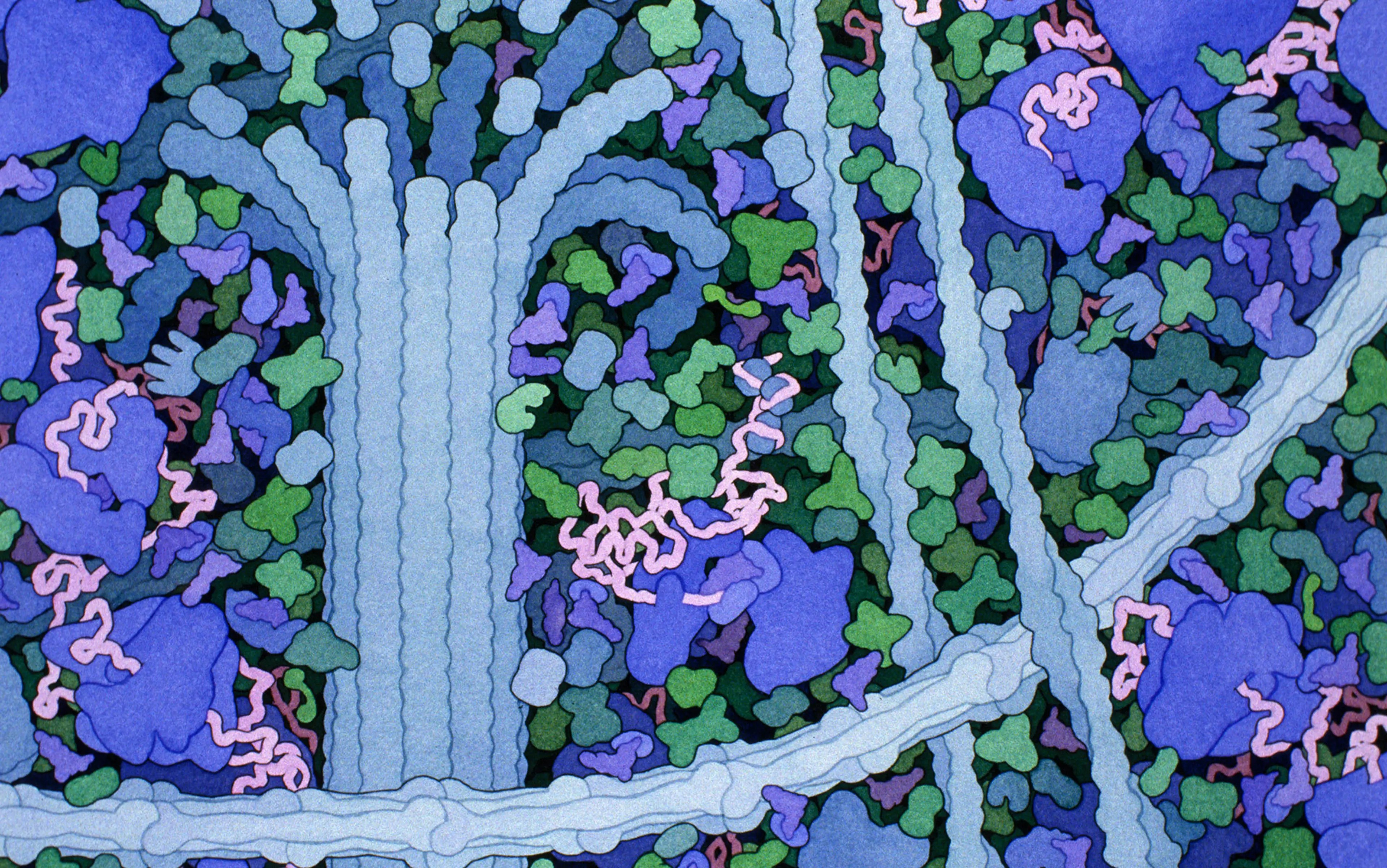
And so, as Charudatta Navare explains, we need to be thoughtful about how we talk about them, as prevailing scientific narratives project human social hierarchies onto nature in misleading ways…
When you think about it, it is amazing that something as tiny as a living cell is capable of behaviour so complex. Consider the single-cell creature, the amoeba. It can sense its environment, move around, obtain its food, maintain its structure, and multiply. How does a cell know how to do all of this? Biology textbooks will tell you that each eukaryotic cell, which constitutes a range of organisms from humans to amoeba, contains a control centre within a structure called the nucleus. Genes present in the nucleus hold the ‘information’ necessary for the cell to function. And the nucleus, in turn, resides in a jelly-like fluid called the cytoplasm. Cytoplasm contains the cellular organelles, the ‘little organs’ in the cell; and these organelles, the narrative goes, carry out specific tasks based on instructions provided by the genes.
In short, the textbooks paint a picture of a cellular ‘assembly line’ where genes issue instructions for the manufacture of proteins that do the work of the body from day to day. This textbook description of the cell matches, almost word for word, a social institution. The picture of the cytoplasm and its organelles performing the work of ‘manufacturing’, ‘packaging’ and ‘shipping’ molecules according to ‘instructions’ from the genes eerily evokes the social hierarchy of executives ordering the manual labour of toiling masses. The only problem is that the cell is not a ‘factory’. It does not have a ‘control centre’. As the feminist scholar Emily Martin observes, the assumption of centralised control distorts our understanding of the cell.
A wealth of research in biology suggests that ‘control’ and ‘information’ are not restricted at the ‘top’ but present throughout the cell. The cellular organelles do not just form a linear ‘assembly line’ but interact with each other in complex ways. Nor is the cell obsessed with the economically significant work of ‘manufacturing’ that the metaphor of ‘factory’ would have us believe. Instead, much of the work that the cell does can be thought of as maintaining itself and taking ‘care’ of other cells.
Why, then, do the standard textbooks continue to portray the cell as a hierarchy? Why do they invoke a centralised authority to explain how each cell functions? And why is the imagery so industrially loaded?…
We need better metaphors to describe cellular life: “The cell is not a factory,” from @charudatta_n in @aeonmag.
* cytologist and author L.L. Larison Cudmore
###
As we avoid anthropomorphism, we might recall that it was on this date in 1981 that the first patent for a life form (U.S. No. 4,259,444) was issued to Ananda Chakrabarty (who had done his research at GE). Chakrabarty had developed Pseudomonas bacterium (now called Burkholderia cepacia) which can be used to clean up toxic spills (as it can break down crude oil into simpler substances that can even become food for aquatic life)– an ability possessed by no naturally occurring bacteria.
The application had been originally denied by the patent office, on the grounds that under patent law at that time, living things were generally understood to not be patentable subject matter under 35 U.S.C. § 101.
Chakrabarty (and GE) appealed (to the Board of Patent Appeals and Interferences), lost, and appealed again ( the United States Court of Customs and Patent Appeals) and prevailed…. At which point, the Patent Office (led by director Sydney Diamond) appealed in civil court.
Ultimately, the Supreme Court ruled (5-4, Diamond v. Chakrabarty) in Chakrabarty’s favor. As Chief Justice Warren Burger wrote for the majority, life can be patented if they are the outcome of “human ingenuity and research” and not “nature’s handiwork”– a ruling that cleared the way for patents to be issued on genetically-engineered mice and other animals, seeds, and more.

“No one ever explained the octopuses”*…

We humans are forward-facing, gravity-bound plodders. David Borkenhagen wonders if the liquid motion of the octopus can radicalize our ideas about time…
… The octopus may navigate its ocean home with ease, but it can seem like a creature from another planet. It populates our popular visions of cosmic beings and extraterrestrial life, with its eight arms, three hearts, and a malleable body without bones. What’s more, its ability to camouflage itself, coupled with a propensity to hide in tight holes, make it a master of disguise. If seen, a water siphon that expels inhaled water can instantly propel the creature away from danger in any direction in three-dimensional aquatic space. Its web of radially symmetrical arms allow it to crawl in any direction with equal competence, regardless of how its head is oriented. Its soft and malleable body can move through any crevasse larger than its beak. And with its two eyes positioned on opposite sides of its head, it has a near-total field of vision with almost nothing hidden ‘behind’. These abilities give the octopus a radically different relationship to its surroundings compared with other species, human or otherwise. It is a relationship free of constraints.
And what about our bodies? Compared with the octopus, human beings appear corporeally constrained. We lack the fluid mobility and wide field of vision of our (very, very) distant cephalopod cousins. Instead, we have two eyes stuck in the front of our heads. We have a paltry two legs, hardwired for forward movement. And we are bound to our terrestrial ecological niche, where our bodies must continually counteract the downward pull of gravity.
It’s not only that our experiences of space are different. Our experiences of time are likely different, too. We think about the passage of time through our terrestrial experience of unidirectional motion through space – our metaphors of time are almost all grounded in the way our bodies move forward through the environment. Given this fact, how would an octopus, who can easily see and move in all directions, conceptualise time? Current research methods may be able to take us only part of the way toward an answer, but it’s far enough to consider a radical possibility: if we became more like an octopus, could we free time, metaphorically speaking, from its constraints? Could we experience it as multidimensional, fluid and free?…
[Borkenhagen reviews the research on octopuses and what it tells us about how their relationships with time and death]
… In many ways, the octopus represents a challenge, or a profound limit, to our conventional ways of thinking about time and death. But it’s more than a challenge. It’s also an invitation. With its unconstrained movements and semelparous lifecycle, the octopus offers a radically different perspective on the fluidity and flexibility of existence. Could we learn to move through time as an octopus moves through space? With equal access to the past, present and future – viewed wide or with sharp focus – we might better navigate the challenges of living and dying on Earth. The octopus invites us to think in a way that dissolves the boundaries between the present and the future, understanding our ‘ending’ less as a fixed point and more as a fluid process stretching across generations. As the boundary between life and death dissolves and becomes more porous, so do the boundaries between ourselves and others. The metaphors we used to inhabit our time here may seem impoverished, but there’s another way. It’s in the unconstrained movements of an octopus traveling through space – fluid, flexible and free…
“Octopus Time,” from @posts_modern in @aeonmag. Eminently worth reading in full.
Pair with The Mountain in the Sea by Ray Nayler and/or “Stories of Your Life” in the short story collection of the same title, by Ted Chiang
* Gail Garriger (@gailcarriger)
###
As we re-understand unfolding, we might recall that it was on this date in 1871 that the American Museum of Natural History opened to the public in New York City. Organized into a series of exhibits, the Museum’s collection–which had been gathered from the time of the Museum’s founding in 1869– went on view for the first time in the Central Park Arsenal, the Museum’s original home, on the eastern side of Central Park. The cornerstone of the Museum’s first building was laid in Manhattan Square (79th Street and Central Park West), the Museum’s current location, in 1874; but it is obscured from view by the many Museum buildings in the complex that today occupy most of the Square.

“The brain is a wonderful organ; it starts working the moment you get up in the morning and does not stop until you get into the office”*…

For as long as humans have thought, humans have thought about thinking. George Cave on the power and the limits of the metaphors we’ve used to do that…
For thousands of years, humans have described their understanding of intelligence with engineering metaphors. In the 3rd century BCE, the invention of hydraulics popularized the model of fluid flow (“humours”) in the body. This lasted until the 1500s, supplanted by the invention of automata and the idea of humans as complex machines. From electrical and chemical metaphors in the 1700s to advances in communications a century later, each metaphor reflected the most advanced thinking of that era. Today is no different: we talk of brains that store, process and retrieve memories, mirroring the language of computers.
I’ve always believed metaphors to be helpful and productive in communicating unfamiliar concepts. But this fascinating history of cognitive science metaphors shows that flawed metaphors can take hold and limit the scope for alternative ideas. In the worst case, the EU spent 10 years and $1.3 billion building a model of the brain based on the incorrect belief that the brain functions like a computer…
Thinking about thinking, from @George_Cave in @the_prepared.
Apposite: “Finding Language in the Brain.”
* Robert Frost
###
As we cogitate on cognition, we might send carefully-computed birthday greetings to Grace Brewster Murray Hopper. A seminal computer scientist and Rear Admiral in the U.S. Navy, “Amazing Grace” (as she was known to many in her field) was one of the first programmers of the Harvard Mark I computer (in 1944), invented the first compiler for a computer programming language, and was one of the leaders in popularizing the concept of machine-independent programming languages– which led to the development of COBOL, one of the first high-level programming languages.
Hopper also (inadvertently) contributed one of the most ubiquitous metaphors in computer science: she found and documented the first computer “bug” (in 1947).
She has both a ship (the guided-missile destroyer USS Hopper) and a super-computer (the Cray XE6 “Hopper” at NERSC) named in her honor.

.jpg)
“In every grain of sand there is the story of the earth”*…
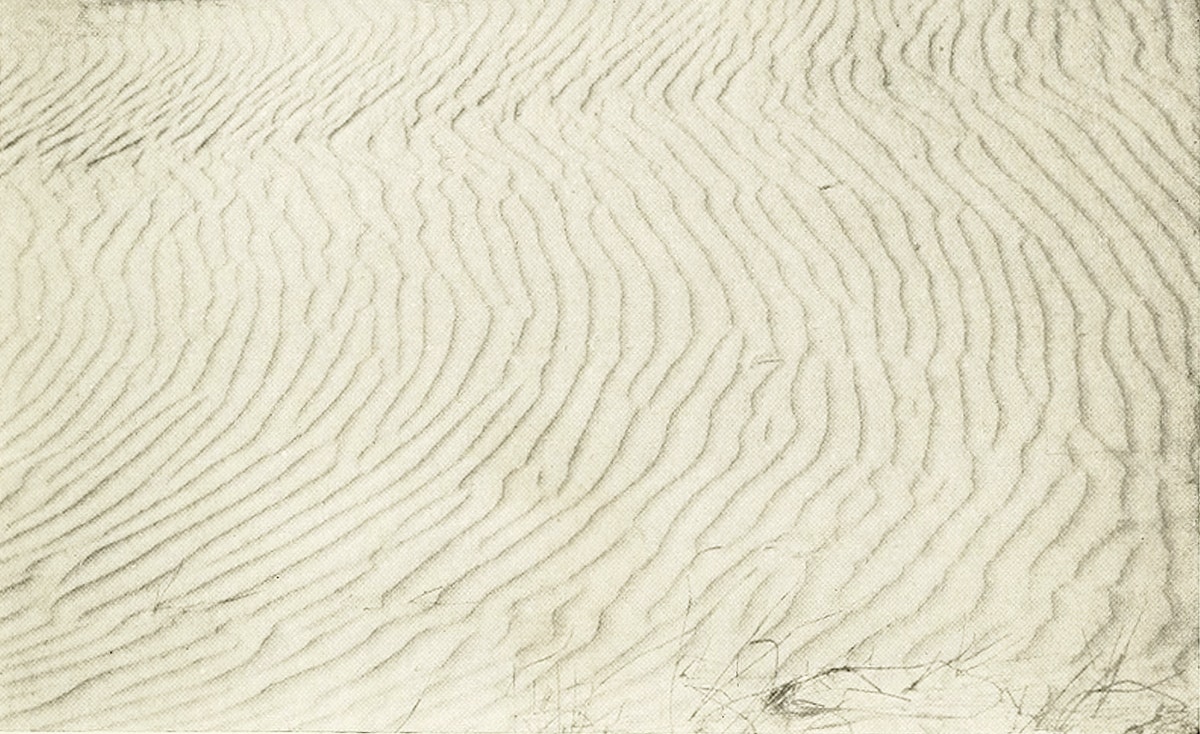
(Roughly) Daily has looked before (see here and here) at sand as a critical ingredient in the stuff of modern life. Today’s post features Steven Connor on the metaphorical power of sand…
Sand belongs to the great, diffuse class, undeclared, rarely described, but insistent and insinuating, of what may be called quasi-choate matters — among them mist, smoke, dust, snow, sugar, cinders, sleet, soap, syrup, mud, toffee, grit. Such pseudo-substances hover, drift, and ooze between consistency and dissolution, holding together even as they come apart from themselves. And, of all of these dishesive matters, sand is surely the most untrustworthy, the most shifting and shifty.
Nobody would seriously consider taking a stand on a cloud, but sand has betrayed many an architect and edifice. Sand is at once architectural and archiclastic. An eighteenth-century continuation of Baron Munchausen’s adventures describes how the Baron and his party survive a whirlwind of sand by scooping an igloo-style sand-chamber in which to shelter from the storm, and then digging a tunnel from their bunker back out into the light. Sand has the capacity to engulf and inundate, blearing contours, eroding and erasing every edge and eminence. As such it is the ultimate mockery of the permanence of stone, for it is no more than one of stone’s own moods, the manner in which stone, atomised, consumes itself. Shelley’s “Ozymandias” imagines the monumental statue of Rameses the Great dismembered on the Egyptian sands. The shattered chunks of head, legs, and pedestal portend a further, finer comminution, after the membra disjecta themselves will have been milled away into flatness: “Round the decay/Of that colossal wreck, boundless and bare,/The lone and level sands stretch far away.”
…
Sand is reversible. Only utter desiccation can attain to this pouring, milk-smooth liquefaction. Sand-baths were used in the ancient world both to draw out the damp ague of rheumatism and as a kind of sauna, to promote perspiration. Sand is the product of abrasion, but is also itself abrasive, used in sand-blasting to etch and burnish. Pliny tells us of the use of sand under a saw edge to make a clean cut in marble, and to polish it after it has been carved.
Sand signifies neutrality, indifference, and uniformity; yet it also has hairtrigger sensitivity and responsiveness. A grain of sand (in actual fact often a tiny parasite) is the irritant that provokes in the oyster the nacreous secretions that build into a pearl. Sand has a favoured relation to sound, putting a hoarse rattle in the throat of the wind, and is itself all ears. In 1787, the German physicist Ernst Chladni showed how drawing a violin bow over a metal plate could induce in the fine sand sprinkled on it hierophantic figurings of the sound, in quivering mandalas and ripple-fingered arpeggios. Though sand can disfigure and obliterate, it can also disclose the ghost wrist of wind and the perturbations of the earth. It is a detection and reception mechanism, forming ridged isobars, shivering musculature, oscilloscape of the air’s sculpting shoves and gusts.
Sand participates in dream and vision. The Sandman brings sleep by throwing or blowing sand into the eyes of children. But the sand does more than merely seal the eyes, for in many versions of this nursery tale, it is the very stuff that dreams are made on, the numb matter of sleep, swirling, particulate, that the sandman carries in his sack. The somnolence of sand is redoubled when in Top Hat (1935) Fred Astaire soothes Ginger Rogers to sleep in the hotel room below him by spreading sand on the floor and hush-dancing a susurrous soft-shoe shuffle. The origins of moon-walking are to be found in the novelty slides and scrapes across a sanded stage by music-hall acts like Wilson, Keppel and Betty. Specious it may be, but sand is also the secret stuff of omen and auspice, in the practice of divination through tossing and scrying handfuls of sand, known in Arabic as ilm al-raml, the science of the sand, or what might have been its Greek equivalent, psammomancy.
Sand is not only temporary, it is also the most temporised form of matter. It is the image or allegory of time, shifting, yet unshiftable. It seems a compiling of the minced, mounded years that go into its making, and grains of sand imitate the elementary atoms of time, moment upon pattering moment. Sand is featureless, without joints or divisions, even though it is nothing but division all the way down. Yet it is this very feature that makes it useful in the measurement of time, for, unlike other materials, sand will flow easily and regularly, even as its volume diminishes. Sand-glasses came into use in part because of the need to measure time at sea, far from any landmark; speed would be measured by counting the number of knots in a rope paid out from the back of the ship in the time it took for the sand to run through a half-minute glass. A half-hour period of watch, known as a “glass”, was also measured in this way. Grains of sand, in the form of quartz crystals, with their precise oscillations, still micro-regulate our time. In fact, the sand of hourglasses was often not quartz sand at all, but powdered marble, or eggshell. But we find it hard to give up the idea of the affinity of sand and the glass through which it runs, since silicates of sand are still the most important source of glass. George Herbert imagines this interfusion when he writes that “flesh is but the glasse, which holds the dust/That measures all our time; which also shall/Be crumbled into dust”, while for Gerard Manley Hopkins the soul itself is “soft sift/In an hourglass – at the wall/Fast, but mined with a motion, a drift,/And it crowds and it combs to the fall”…
From the mythical Sandman, through the grains in an hourglass, to an irritating mote lodged in the beachgoer’s eye, sand harbors unappreciated power: “The Dust That Measures All Our Time.”
###
As we muse on metaphor, we might send ideal birthday greetings to Marsilio Ficino; he was born on this date in 1433. An Italian scholar and Catholic priest, he was one of the most influential humanist philosophers of the early Italian Renaissance. The first translator of Plato’s complete extant works into Latin, he was important in the revival of Neoplatonism, and was in touch with every major academic thinker and writer of his day. His Florentine Academy was an attempt to revive Plato’s Academy, and influenced both the direction and the tenor of the Italian Renaissance and thus the development of European philosophy.
Ficino was also an astrologer, and is credited with having inspired the Tarot card deck– the Tarot of Marseilles– that was the pattern from which many subsequent tarot decks derive.

You must be logged in to post a comment.