Posts Tagged ‘genetics’
“Research is formalized curiosity. It is poking and prying with a purpose.”*…

First, internet search, then AI– we live in an age of ever-easier answers. But, of course, that bounty comes with two issues; most obviously, can we trust the answers we get? But as important as that is, it’s secondary to the other issue: what do we lose when we “outsource” the research? As Ben Franklin is reputed to have said (though it seems likelier to be a quote from he Xunzi, the works of Xun Kuang, a Chinese Confucian philosopher who lived the 4th century BC), “Tell me and I forget. Teach me and I remember. Involve me and I learn.”
Librarian Hana Lee Goldin is here to help, with an approach to building a map of where knowledge lives, and advice on how to find our way through it…
Suppose we want to understand why a freeway was built through a particular neighborhood and what happened to the people who lived there afterward. A search engine can surface articles about the project, while a chatbot can summarize those articles into one response. Neither interface necessarily reveals the full range of places where information about that history may exist. City planning records may explain how officials chose the route, while census tables can show how the neighborhood changed. A local archive may preserve residents’ letters or photographs from before construction, while later scholarship can connect that history to broader patterns of transportation policy and displacement.
Finding those materials involves more than searching for the right words because different kinds of information are organized and made discoverable in different ways. A library catalog contains structured records for books, journals, media, digital resources, and other materials, and it may also link to or include records for archival collections. An archive may organize thousands of records according to the person or institution that created or accumulated them, then describe groups of records rather than every individual document. A government data portal organizes measurements according to categories such as geography or reporting period, while a scholarly database helps us find research distributed across many publications. Each system is designed around different kinds of information and discovery, which means we may need to search each one differently.
That difference becomes easy to miss when many of these systems can be reached through the same general interfaces. A search engine can return a library record next to a government report, while an AI tool can synthesize information drawn from several kinds of sources into a single response. The access feels flattened even though the underlying information is still organized according to very different rules. When a search produces weak results, we may keep changing the keywords even though the larger problem is that we’re looking in the wrong place.
Before deciding what to search, then, we need to know what we’re trying to find. If we want to understand how the freeway route was approved, we need records of the decision-making process. If we want to know how the neighborhood’s population changed, we need measurements that allow us to compare the neighborhood before and after construction. Once we know what kind of information could answer each part of the question, we can ask who would have created or preserved that information and which research system is designed to help us find it.
What we need, then, is a way to see that larger research environment as a whole: the different kinds of places it contains, the roles those places play, and the paths that can carry a question from one to another. An atlas offers a model for doing that. An atlas can bring together different maps of the same territory, allowing us to see features and relationships that no single map can represent on its own.
From that model comes the Atlas of Learning, a framework for mapping the research environment itself. Instead of geographic territory, it maps where different kinds of information can be found, how those places and systems organize what they contain, and how we can move among them as a question develops. One part of the Atlas might show where original records are preserved, while another shows the systems through which published research can be discovered. Other parts can include places for structured learning or people whose expertise helps us find our way through systems we don’t yet know.
The routes among those parts are part of the Atlas too. A planning document may give us the formal name of an agency, while a scholarly article may give us a citation to an earlier source. An archival record may introduce the name of an organization whose records are preserved somewhere else. Those names, citations, institutions, and other clues allow one source to generate the next search.
The framework isn’t meant to contain every research resource that exists. It gives us a way to recognize different kinds of resources, understand what each can help us find, and see how one can lead toward another. As we discover new places and learn how to navigate them, we can add those destinations and routes to the Atlas ourselves.
Before so much of research converged onto a common screen, the form and setting of a resource often revealed what kind of knowledge we were entering: a card catalog described and located materials, a statistical yearbook gathered institutional measurements, and an archival collection placed us among the records of a person or organization. Those distinctions can become harder to see when a government report, library record, and generated response arrive through the same interface. Many parts of the research world can now be reached from the same screen, but that ease of access can make those parts look more interchangeable than they are.
The Atlas restores that larger view. Instead of presenting every resource as another result arriving through the same interface, it makes the different parts of the research environment visible in relation to one another. We can see which places are built for which kinds of questions and how a discovery in one part of the Atlas can open a route into another. As more of our information environment is encountered through common interfaces or generated responses, that layered view gives us back a sense of the terrain we’re moving through…
[Goldin unpacks the Atlas; explains how to find “routes” within it (and what to “pack” for the different “terrains” we will traverse); and offers a strategy for those occasions on which one finds oneself “stuck.” She concludes by explaining that, in fact, there is no one “master,” but rather a multiplicity of use-specific atlases…]
… An Atlas of Learning can begin whenever there is something we want to understand beyond a quick factual lookup. Each inquiry creates its own terrain because the places we need to visit depend on the question. A health question may take us through medical literature and public health agencies, while a historical question may lead toward archives, newspapers, or census records. The Atlas gives that particular inquiry a visible research environment of its own.
Because the Atlas is organized around a question, that question becomes the compass. It gives the research direction as new possibilities appear, helping us decide whether a newly discovered resource is relevant to what we’re trying to understand and what it might contribute to an answer. And it becomes the point we return to whenever the terrain grows more complicated, helping us recover our bearing and decide what to pursue next.
The working Atlas can be extremely lightweight. A spreadsheet, Notion page, mind map, document, or another information-management tool can all serve the same purpose. At minimum, we need the question, the research destinations that become relevant to answering it, and a brief note about what each can contribute. The form matters less than being able to look at the Atlas and see, at a glance, where this particular inquiry can go.
The Atlas represents the research terrain for a single question. It keeps the destinations connected to that question visible together, giving us a way to see the terrain as it develops and maintain our orientation within it. Something becomes part of the Atlas when it materially advances the inquiry, either by helping us answer the question or by opening a direction we may need to follow next. The result is a record of the sources and destinations that have become consequential to the research, rather than everything we happened to encounter along the way.
Building an Atlas gives us practice locating a question within a larger information environment and recognizing how different parts of that environment can help answer it. We also learn to follow connections as new territory appears and to find our bearings when the direction becomes uncertain. Taken together, those abilities form a kind of information literacy we can apply when we enter subjects we have never explored before.
With that practice, entering an unfamiliar subject becomes an act of orientation as much as discovery. We may begin with little sense of how knowledge about that subject is organized or where its records, research, and expertise reside, but we know that those structures are there to be found. As they come into view, the subject begins to acquire a geography of its own, one that we can learn to read even though we have never traveled through it before.
The Atlas of Learning is something we draw as each question opens a new research terrain around us. The destinations will change from one subject to the next, and the route will develop differently each time. What remains is the ability to look beyond the interface in front of us and see a larger world of places we can learn to navigate…
Mapping where knowledge lives: “The Atlas of Learning.”
And because we will continue to use online search in our research, this earlier piece from Goldin: “Google Has a Secret Reference Desk. Here’s How to Use It.“
* Zora Neale Hurston
###
As we do the work, we might take caution from the story of Paul Kammerer; he was born on this date in 1880. A biologist, he claimed to have produced experimental evidence that acquired traits could be inherited. Almost all of Kammerer’s experiments involved forcing various amphibians to breed in environments that were radically different from their native habitat to demonstrate Lamarkian inheritance. (This is the idea that learning one acquires during one’s lifetime is passed on to that person’s offspring: e,g, if you play guitar, your children will have nimble fingers; each generation builds upon the past and continues to improve.)
Several scientists tried– and failed– to replicate the results of his most famous (and striking) findings, from his experiments with the mid-wife toad; and Kammerer was accused of fraud. Suffering depression at the time, he shot himself. Arthur Koestler’s 1971 book The Case of the Midwife Toad, argued that while Kammerer’s results were incorrect, he had been the victim of Nazi sympathizers at the University of Vienna, who’d tampered with his results. But most biologists believe that Kammerer was a fraud and even the others, that he misinterpreted the results of his experiments.
(That said, it is worth noting that, while Kammerer’s results remain tainted, the notion of heritable learning has (re-)gained some steam, through the work of geneticists like Barbara McClintock and epigeneticists.)

“When you mix science and politics, you get politics:*…
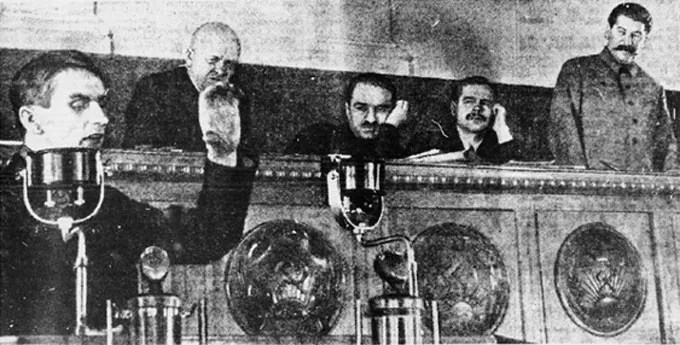
Tina Hesman Saey on a looming threat to the U.S…
Soviet scientists in the 1930s knew what could happen if they bucked the party line: denunciation, firing and banishment from the scientific establishment, even imprisonment and death. Political reprisals against those who opposed the views of dictator Joseph Stalin and his followers — and the dubious science they endorsed — led to the starvation of millions, as well as to decades of lost progress in fields from agriculture to molecular biology.
Now, scientists are warning that history could repeat itself — but in the United States.
A new proposal from the U.S. Office of Management and Budget would put political appointees in charge of funding decisions traditionally overseen by scientists. In recent years, the federal government has funded about 40 percent of basic science research in the United States.
The OMB’s more than 400-page proposed rule change would let political appointees decide how to hand out federal research funds and who can get them. It would cut funding for collaboration with scientists in other countries and restrict scientists’ ability to communicate their findings. What’s more, it could prevent research on matters that President Donald Trump’s administration has deemed “not in the national interest” — such as studies on health disparities, mRNA-based vaccines and research that doesn’t recognize biological sex as a strict binary.
The new rules would also give OMB the power to rescind previously approved research funds. The proposal “poses a sweeping threat to federal grantmaking and the responsible stewardship of American taxpayer dollars,” the science advocacy group Stand Up for Science Foundation said in a report. In addition, it would impact nonscientific grants supporting services for mental health, housing, education, veterans and Tribal nations, affecting the health and well-being of millions.
So far, OMB has received more than 98,000 comments on the proposal. The public comment period closes July 13. It then will be up to OMB to decide whether to keep the rule as is, revise it or scrap it.
These far-reaching measures are already drawing parallels to dark moments in scientific history. Some researchers say the recent mass firings, policy changes and grant cancellations at federal research institutions, including the U.S. National Institutes of Health and Centers for Disease Control and Prevention, closely mirror what happened in the U.S.S.R. under Stalin. “A similar threat now hangs over U.S. science,” the editorial board of The New England Journal of Medicine wrote in June.
Its editorial invoked the example of Trofim Lysenko [see here], an agronomist and astute political operator who rose to power in the 1930s Soviet Union under Stalin.
Until the 1930s, “the Soviet Union was a real powerhouse in the field of genetics,” says Lee Dugatkin, an evolutionary biologist and historian of science at the University of Louisville in Kentucky.
Then, Lysenko came along. “This guy was your sort of classic charlatan,” Dugatkin says. “He had the equivalent of a mail order degree in agriculture, but he was quite good with the press, and he started to basically spread this idea out there that he was capable of dramatically increasing crop yield, particularly wheat.”
Lysenko’s supposed innovation was a process called vernalization and amounted to soaking seeds in freezing water. The resulting plants — and all their offspring — should be resistant to the U.S.S.R.’s famously cold winters, Lysenko reasoned.
His reasoning was based on a disproven idea in evolutionary biology called Lamarckian inheritance. French biologist Jean-Baptiste Lamarck and his followers thought that things an organism experiences in its lifetime can be handed down to the next generation. The classic example is a giraffe that has to stretch to reach leaves producing offspring with long necks.
This idea ran counter to Mendelian genetics, which holds that genes — not environmental influences — control traits and are passed to offspring. Mendelian geneticists thought it would take five years to breed more cold-tolerant crops. Lysenko said he could do it in two to three years.
Stalin didn’t have time to wait. He was trying to get collective farms going and needed to increase crop yields to feed more than 150 million people. Large parts of the country had already suffered from famine in 1932 and 1933 and about 6 million people died. Some resorted to cannibalism.
Stalin embraced Lysenko’s quick-fix approach. That decision, says Michael Gordin, a historian of science at Princeton University, was “something that the majority of people at the time, and everyone since, considers the wrong side of the dispute.”
Lysenko was put in charge of a prestigious genetics institute and forced his scientifically unsound farming practices on the collective farms. His methods were disastrous.
Soaking seeds in freezing water hampered germination, leading to crop losses. Millions starved. Meanwhile, Mendelian genetics was branded a “whore of capitalism,” and geneticists were forced to renounce their views or lose their jobs. Many were jailed, and almost a dozen were executed or died in prison.
The Soviet Union lost its scientific leadership role and sat on the sidelines for important scientific discoveries of the 1950s and beyond. One, Gordin says, was the development of “massively” productive hybrid corn. The country also missed out on the discovery of DNA and the advent of molecular biology, putting Soviet genetics decades behind the rest of the world.
Soviet genetics did not recover from Lysenko’s influence until after the break-up of the Soviet Union in the late 1980s and early 1990s, Gordin says. “I think you’d be hard pressed to find anybody who thinks that … Russia is today, or Ukraine, or any post-Soviet successor state, is a leading molecular biology country.”…
The Soviets did it, and it didn’t end well: “Here’s what happens when you put politicians in charge of science,” from @thsaey.bsky.social in @sciencenews.bsky.social.
See also: Idiocracy
###
As we remember the past so as not to repeat it, we might recall that it was on this date in 1834 that the Spanish Inquisition (finally) ended. Authorized by Pope Sixtus IV in 1478, the Inqusition was initially led by inquisitors (Miguel de Morillo and Juan de San Martín) who were appointed by the future Catholic monarchs, King Ferdinand II of Aragon and Queen Isabella I of Castile. It was originally (ostensibly) intended primarily to identify heretics; its aim, to maintain Christian orthodoxy. But it became an effective instrument of state power by replacing the Medieval Inquisition, which was under Papal control.
Over its course, the Inquisition prosecuted an estimated 150,000 people for various offences. An estimated 3,000–5,000 were turned over to the state for execution, particularly in the initial 50 years, mostly by burning at the stake. Other punishments included penance and public flogging, exile, enslavement on galleys, and prison terms ranging from several years to life. In many of these punishments an important motive was the confiscation of all the victims’ property.
As Monty Python observed, “nobody expects the Spanish Inquisition.” And nobody expected it to last 356 years.

“Juggling is sometimes called the art of controlling patterns, controlling patterns in time and space”*…

A skill for our times…
The Library of Juggling is an attempt to list all of the popular (and perhaps not so popular) juggling tricks in one organized place. Despite the growing popularity of juggling, few websites are dedicated to collecting and archiving the various patterns that are being performed. Most jugglers are familiar with iconic tricks such as the Cascade and Shower, but what about Romeo’s Revenge or the 531 Mills Mess? The goal of this website is to guarantee that the tricks currently circulating around the internet and at juggling conventions are found, animated, and catalogued for the world to see. It is a daunting task, but for the sake of jugglers everywhere it must be done.
For every trick found in the Library, there will be an animated representation of the pattern created via JugglingLab, in addition to general information about the trick (siteswap, difficulty level, prerequisite tricks, etc.). If I am able to run the pattern, then I will provide a text-based tutorial for the trick with the help of animations. I will also include links to other tutorials for the trick that can be found online, ranging from YouTube videos to private sites like this one. If I am unable to provide my own tutorial, there will still be a short description of the trick in addition to outside tutorials and demonstrations…
… if you have come to the Library looking to find out how to start juggling, than it would be best to begin with the Three Ball Cascade pattern. If you are a juggler who is already familiar with the basics, then the various tricks included in the Library can be accessed via the navigation tree on the left, or you can click here to view all of the tricks by difficulty…
Enjoy “The Library of Juggling.”
And see also: “The Museum of Juggling History,” the resources at the International Jugglers’ Association, and “The world cannot be governed without juggling.”
* mathematician (and juggler) Ronald Graham
###
As we toss ’em up, we might send carefully-calculated birthday greetings to G. H. Hardy; he was born on this date in 1877. A mathematician who made fundamental contributions to number theory and mathematical analysis, Hardy juggled other interests as well– for example his Hardy–Weinberg principle (“allele and genotype frequencies in a population will remain constant from generation to generation in the absence of other evolutionary influences”) is now a basic principle of population genetics.
In Hardy’s own estimation, his greatest contribution was something else altogether: from 1917, Hardy was the mentor of the Indian mathematician Srinivasa Ramanujan, a relationship that has become celebrated. Hardy almost immediately recognised Ramanujan’s extraordinary (albeit untutored brilliance), and the two became close collaborators. When asked by a young Paul Erdős what his greatest contribution to mathematics was, Hardy unhesitatingly replied that it was the discovery of Ramanujan, remarking that on a scale of mathematical ability, his own ability would be 25, Littlewood would be 30, Hilbert would be 80, and Ramanujan would be 100.

“There is no such thing as a dysfunctional organization, because every organization is perfectly aligned to achieve the results it currently gets”*…

… and if we’re not careful, we might not be too pleased with what we get. Sam Altman says the one-person billion-dollar company is coming. Evan Ratliff tells the tale of his attempt to build a completely AI-automated venture…
… If you’ve spent any time consuming any AI news this year—and even if you’ve tried desperately not to—you may have heard that in the industry, 2025 is the “year of the agent.” This year, in other words, is the year when AI systems are evolving from passive chatbots, waiting to field our questions, to active players, out there working on our behalf.
There’s not a well agreed upon definition of AI agents, but generally you can think of them as versions of large language model chatbots that are given autonomy in the world. They are able to take in information, navigate digital space, and take action. There are elementary agents, like customer service assistants that can independently field, triage, and handle inbound calls, or sales bots that can cycle through email lists and spam the good leads. There are programming agents, the foot soldiers of vibe coding. OpenAI and other companies have launched “agentic browsers” that can buy plane tickets and proactively order groceries for you.
In the year of our agent, 2025, the AI hype flywheel has been spinning up ever more grandiose notions of what agents can be and will do. Not just as AI assistants, but as full-fledged AI employees that will work alongside us, or instead of us. “What jobs are going to be made redundant in a world where I am sat here as a CEO with a thousand AI agents?” asked host Steven Bartlett on a recent episode of The Diary of a CEO podcast. (The answer, according to his esteemed panel: nearly all of them). Dario Amodei of Anthropic famously warned in May that AI (and implicitly, AI agents) could wipe out half of all entry-level white-collar jobs in the next one to five years. Heeding that siren call, corporate giants are embracing the AI agent future right now—like Ford’s partnership with an AI sales and service agent named “Jerry,” or Goldman Sachs “hiring” its AI software engineer, “Devin.” OpenAI’s Sam Altman, meanwhile, talks regularly about a possible billion-dollar company with just one human being involved. San Francisco is awash in startup founders with virtual employees, as nearly half of the companies in the spring class of Y Combinator are building their product around AI agents.
Hearing all this, I started to wonder: Was the AI employee age upon us already? And even, could I be the proprietor of Altman’s one-man unicorn? As it happens, I had some experience with agents, having created a bunch of AI agent voice clones of myself for the first season of my podcast, Shell Game.
I also have an entrepreneurial history, having once been the cofounder and CEO of the media and tech startup Atavist, backed by the likes of Andreessen Horowitz, Peter Thiel’s Founders Fund, and Eric Schmidt’s Innovation Endeavors. The eponymous magazine we created is still thriving today. I wasn’t born to be a startup manager, however, and the tech side kind of fizzled out. But I’m told failure is the greatest teacher. So I figured, why not try again? Except this time, I’d take the AI boosters at their word, forgo pesky human hires, and embrace the all-AI employee future…
Eminently worth reading in full: “All of My Employees Are AI Agents, and So Are My Executives,” from @evrat.bsky.social in @wired.com.
Via Caitlin Dewey (@caitlindewey.bsky.social), whose tease/summary puts it plainly:
Ratliff, the undefeated king of tech journalism stunts, is back with another banger: For this piece and the accompanying podcast series, he created a start-up staffed entirely by so-called AI agents. The agents can communicate by email, Slack, text and phone, both with Ratliff and among themselves, and they have free range to complete tasks like writing code and searching the open internet. Despite their capabilities, however, the whole project’s a constant farce. A funny, stupid, telling farce that says quite a lot about the future of work that many technologists envision now…
###
As we analyze autonomy, we might we might spare a jaundiced thought for Trofim Denisovich Lysenko; he died on this date in 1976. A Soviet biologist and agronomist, he believed the Mendelian theory of heredity to be wrong, and developed his own, allowing for “soft inheritance”– the heretability of learned behavior. (He believed that in one generation of a hybridized crop, the desired individual could be selected and mated again and continue to produce the same desired product, without worrying about separation/segregation in future breeds–he assumed that after a lifetime of developing (acquiring) the best set of traits to survive, those must be passed down to the next generation.)
In many way Lysenko’s theories recall Lamarck’s “organic evolution” and its concept of “soft evolution” (the passage of learned traits), though Lysenko denied any connection. He followed I. V. Michurin’s fanciful idea that plants could be forced to adapt to any environmental conditions, for example converting summer wheat to winter wheat by storing the seeds in ice. With Stalin’s support for two decades, he actively obstructed the course of Soviet biology, caused the imprisonment and death of many of the country’s eminent biologists who disagreed with him, and imposed conditions that contributed to the disastrous decline of Soviet agriculture and the famines that resulted.
Interestingly, some current research suggests that heritable learning– or a semblance of it– may in fact be happening by virtue of epigenetics… though nothing vaguely resembling Lysenko’s theory.

“The most important factor in survival is neither intelligence nor strength but adaptability”*…

Indeed. Scientists have accepted this precept since Charles Darwin‘s publication of Origin of the Species. But how– and at what pace– does that adaptation happen? From those earliest days, the assumption was that change/adaptation happened slowly, roughly evenly– gradually– over time.
But in 1972, paleontologists Niles Eldredge and Stephen Jay Gould published a landmark paper developing their theory and called it punctuated equilibria. Their paper built upon Ernst Mayr‘s model of geographic speciation, I. M. Lerner‘s theories of developmental and genetic homeostasis, and their own empirical research. Eldredge and Gould proposed that the degree of gradualism commonly attributed to Darwin is virtually nonexistent in the fossil record, and that stasis dominates the history of most fossil species. Rather, they argued, when significant evolutionary change occurs, it is generally restricted to rare and geologically rapid events of branching speciation called cladogenesis (the process by which a species splits into two distinct species, rather than one species gradually transforming into another).
Jake Buhler reports on recent work that confirms the punctuated equilibrium theory and adds more detail…
Over the last half-billion years, squid, octopuses and their kin have evolved much like a fireworks display, with long, anticipatory pauses interspersed with intense, explosive changes. The many-armed diversity of cephalopods is the result of the evolutionary rubber hitting the road right after lineages split into new species, and precious little of their evolution has been the slow accumulation of gradual change.
They aren’t alone. Sudden accelerations spring from the crooks of branches in evolutionary trees, across many scales of life — seemingly wherever there’s a branching system of inherited modifications — in a dynamic not examined in traditional evolutionary models.
That’s the perspective emerging from a new mathematical framework (opens a new tab) published in Proceedings of the Royal Society B that describes the pace of evolutionary change. The new model, part of a roughly 50-year-long reimagining of evolution’s tempo, is rooted in the concept of punctuated equilibrium, which was introduced by the paleontologists Niles Eldredge and Stephen Jay Gould in 1972.
“Species would just sit still in the fossil record for millions of years, and then all of a sudden — bang! — they would turn into something else,” explained Mark Pagel, an evolutionary biologist at the University of Reading in the United Kingdom.
Punctuated equilibrium was initially a controversial proposal. The theory diverged from the dominant, century-long view that evolution adhered to a slow, steady pace of Darwinian gradualism, in which species incrementally and almost imperceptibly developed into new ones. It opened the confounding possibility that there was a discontinuity between the selection processes behind the microevolutionary changes that occur within a population and those driving the long-term, broad-scale changes that take place higher than the species level, known as macroevolution.
In the decades since, researchers have continued to debate these views as they’ve gathered more data: Paleontologists have accumulated fossil datasets tracing macroevolutionary changes in ancient lineages, while molecular biologists have reconstructed microevolution on a more compressed timescale — in DNA and the proteins they encode.
Now there are enough datasets to more fully test the theories of evolutionary change. Recently, a team of scientists blended insights from several evolutionary models with new methods to build a mathematical framework that better captures real evolutionary processes. When the team applied their tools to a selection of evolutionary datasets (including their own data from research into an ancient protein family), they found that evolutionary spikes weren’t just common, but somewhat predictably clustered at the forks in the evolutionary tree.
Their model showed that proteins contort themselves into new iterations more rapidly around the time they diverge from each other. Human languages twist and recast themselves at the bifurcations in their own family tree. Cephalopods’ soft bodies sprout arms and bloom with suckers at these same splits.
The new study adds to previous support for the punctuated equilibrium phenomenon, said Pagel, who wasn’t involved in the project. However, the rapid evolutionary behavior isn’t a unique process separate from natural selection, as Eldredge and Gould suggested, but rather the result of periods of extremely rapid adaptation propelling evolutionary change.
“This is really a rather beautiful story in the philosophy of science,” Pagel said…
Read on for the fascinating story of the updated evolutionary model shows that living systems evolve in a split-and-hit-the-gas dynamic, where new lineages appear in sudden bursts rather than during a long marathon of gradual changes: “The Sudden Surges That Forge Evolutionary Trees,” from @jakebuehler.bsky.social in @quantamagazine.bsky.social.
Given the strains that the Antropocene is putting on our environment, this could be timely…
* Charles Darwin
###
As we dissect development, we might spare a thought for Barabara McClintock; she died on this date in 1992. A cytogeneticist, she is regarded as one of the most important figures in the history of genetics. In the 1940s and 50s McClintock’s work on the cytogenetics of maize led her to theorize that genes are transposable – they can move around – on and between chromosomes. McClintock drew this inference by observing changing patterns of coloration in maize kernels over generations of controlled crosses. The idea that genes could move did not seem to fit with what was then known about genes, but improved molecular techniques of the late 1970s and early 1980s allowed other scientists to confirm her discovery. She was awarded the 1983 Nobel Prize in Physiology or Medicine, the first American woman to win an unshared Nobel Prize.
For more on McClintock’s work and its legacy, see here and here.

You must be logged in to post a comment.