Posts Tagged ‘genetics’
“An understanding of the natural world, and what’s in it is a source of not only great curiosity but great fulfillment”*…
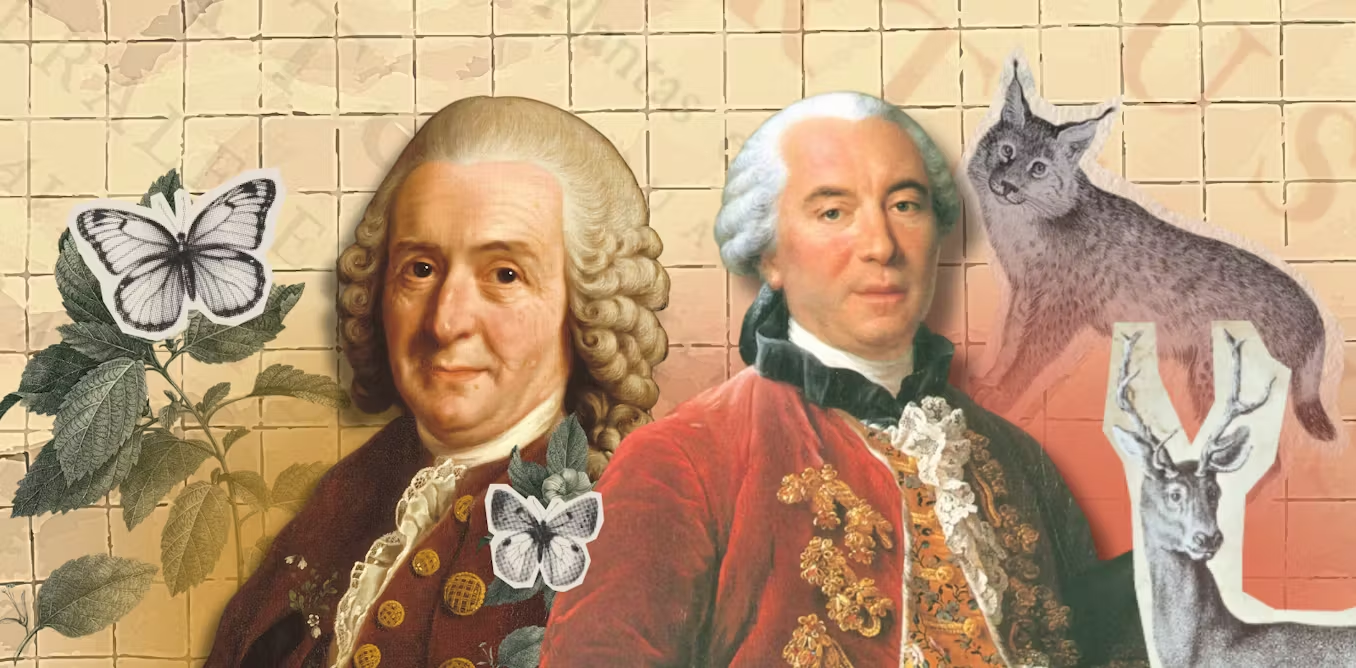
Ah yes, but in what does that understanding consist? John Long considers the competing frameworks of Linnaeus and Buffon…
The modern science biography must hold back no punches in its mission to represent the subject’s life, equally celebrating their great works while including their personal shortcomings.
Jürgen Neffe’s Einstein: A Biography (2005) and Dava Sobel’s The Elements of Marie Curie (2024) are wonderful examples of this style. Such books succeed in clearly explaining the complex science of their subject’s work for non-scientific readers, enabling a deep appreciation of their achievements and bringing them to life as rounded, flawed humans.
The modern science biography must hold back no punches in its mission to represent the subject’s life, equally celebrating their great works while including their personal shortcomings.
Jürgen Neffe’s Einstein: A Biography (2005) and Dava Sobel’s The Elements of Marie Curie (2024) are wonderful examples of this style. Such books succeed in clearly explaining the complex science of their subject’s work for non-scientific readers, enabling a deep appreciation of their achievements and bringing them to life as rounded, flawed humans.
Jason Roberts’ Every Living Thing – The Great and Deadly Race to Know all Life is another of these rare works. This engrossing, precisely researched book focuses on two central characters born in the same year: Carl Linnaeus (1707-1778), a Swede, and Frenchman Georges-Louis LeClerc, the Compte de Buffon (1707-1788), better known as just Buffon.
Roberts’ book won the 2025 Pulitzer Prize for biography. His writing pulls the reader effortlessly through the story, revealing delightful, unexpected twists and turns in the two men’s complex and disparate lives. Each worked diligently to reach a level of global notoriety for their many published books. Both are revered in the natural history world today.
Linnaeus, a biologist and physician, is known for his system of hierarchical classification: how all living things comprise a genus and species, (we humans are Homo sapiens), which fit into families, orders, classes and so on. (A good many intermediate ranks were added later). While his work has been hugely influential, Linnaeus is portrayed by Roberts at times as being lazy, vain and unethical.
Linnaeus was primarily driven to be the first to name new species. Buffon was working on a grand thesis of how all life’s organisms function and are related to one another. A wealthy count who inherited a vast fortune at the age of ten, Buffon trained as a lawyer but became fascinated by the trees that grew in his large garden.
Buffon is best known today for his extensive books on natural history and works on mathematics and cosmology. He calculated the Earth was much older than the Bible predicted and that life sprung from unorganised matter. He explored the relationships between organisms rather than how they were classified. His core work formed the basis for modern evolutionary theory.
Why was all this important? At the time, the task of classifying plants was vital to the growing economies of nations. Travellers to the far reaches of the globe brought back examples of economically valuable new species, like plant foods, medicinal plants or beautiful ornamental specimens.
The author’s central thesis is Linnaeus was not as brilliant as history paints him and Buffon was a far greater genius for his day.
Where does genius come from, Roberts asks? Is it inherent by birth, grown from an inspiring education, or is it something within that is nurtured by passion?
Both these brilliant men who made a lasting mark on science came from not very inspiring families. Nor did they excel at school or university. This story shows success in academic work is not just about intellect, but intimately tied to the ethics and morality of doing research…
Eminently worth reading in full: “How do we understand life on Earth? A prize-winning biography charts the tension between two types of science ‘genius’” from @theconversation.com.
* David Attenborough, who also observed, “We moved from being a part of nature to being apart from nature.”
###
As we noodle on knowing, we might send birthday greetings to Gregor Mendel; he was born on this date in 1822 (though some sources give the date as July 20). A botanist, geneticist, and monk, he pioneered in the study of heredity.
Mendel spent his adult life with the Augustinian monastery in Brunn, where as a plant experimenter, he was the first to lay the mathematical foundation of the science of genetics, in what came to be called Mendelism. Over the period 1856-63, Mendel grew and analyzed over 28,000 pea plants. He carefully studied for each their plant height, pod shape, pod color, flower position, seed color, seed shape and flower color. He made two very important generalizations from his pea experiments, known today as the Laws of Heredity, and coined the genetic terms recessiveness and dominance. He read a paper on his studies in 1865 to the Brünn Society for Natural Sciences in Moravia– but it lay unappreciated until 1900.

“A world that is safe for mothers is safe for all”*…

There’s much discussion today of falling fertility rates and the prospect of a shrinking population. In her terrific newsletter, Your Local Epidemiologist, Katelyn Jetelina explores the (real) reasons why, and what can be done…
In the U.S.—and across much of the world—fertility rates are falling, and populations are projected to shrink.

The reasons people are worried vary. Some fear a loss of global influence or long-term human survival. Others approach the issue through religious, political, or ideological lenses—or just out of curiosity. Whatever the motivation, the question keeps coming up: What can we do?
In response, the new administration—guided in part by Project 2025—is considering financial incentives to encourage people to have more children. Ideas include education, like on menstrual cycles, or a “National Medal of Motherhood” to mothers with six or more children, as well as financial incentives like a $5,000 cash baby bonus or Fulbright scholarships reserved for mothers.
Globally, paying families to have children has yielded mixed results. In Russia, for example, payments ($10,000) have increased fertility rates by about 20%. However, in Canada during the 1970s, similar efforts yielded only a short-term increase.
So no—we don’t need to blindly throw spaghetti at the wall. We have the evidence: if we want people to have more children, we need to create a society that actually supports parents…
[Jetelina unpacks the dynamics at play: access to affordable health care, the lack of support for new parents, the cost of raising a child, the climate of fear of maternal mortality, and the dismantling of programs that support women…]
… People aren’t having fewer children because they don’t care about family, faith, or their future, or the future of this country. They’re having fewer because the system makes it too hard, too risky, and too expensive. A $5,000 payment is a drop in the bucket compared to what is required of families in this day and age.
If the government wants to be part of the solution, it shouldn’t just throw out incentives. It should invest in the foundation: affordable care, parental leave, safe childbirth, and supportive systems.
Let’s focus on what matters: building a society where families can thrive. If we do that, everything else—including birth rates—may just follow…
It’s not rocket science: “Birth rates are falling. But solutions are focused on the wrong thing,” from @kkjetelina.bsky.social.
(Image at top: source)
* Abhijit Naskar (@naskarism.bsky.social)
###
As noodle on nativity, we might spare a thought for Edouard Van Beneden; he died on this date in 1910. An embryologist, cytologist and marine biologist, he made discoveries concerning fertilization in sex cells and chromosome numbers in body cells. His studies (of the roundworm Ascaris) showed that sexual fertilization results from the union of two different cell half-nuclei. Thus a new single cell is created with its number of chromosomes derived as one-half from the male sperm and the other half from the female egg. Van Beneden also determined that the chromosome number is constant for every body cell of a species. His theory of embryo formation in mammals became a standard scientific principle.

“The secret of longevity is to keep breathing”*…

Shelly Fan, with news of a new study that proports to gauge the limits of longevity…
In 1997, Jeanne Calment passed away at the age of 122 and a half. The longest living human documented to date, she pushed the boundary of what was previously considered the maximum human lifespan.
Meanwhile, in 2023, Guinness World Records recognized Pat the mouse as the oldest mouse alive at a little over nine and a half years old—just a sliver in years compared to humans.
When it comes to lifespan, we mammals have an astonishing range. The common shrew lives less than two years; bowhead whales thrive for at least 211 years. Why the discrepancy?
Part of it, according to Dr. Steve Horvath and colleagues at the University of California, Los Angeles, comes down to epigenetics: the chemical tags attached to DNA that flip genes on or off. The type and position of these tags shift through major life events—puberty, aging—and even with dietary changes.
Unlike genetics, the study of genes coded in DNA, epigenetics better captures the “here and now” of gene expression as we go through life. Previously, Horvath and others have tapped epigenetics to develop “aging clocks” that predict a person’s biological age—that is, how old your body is biologically, rather than the number of candles on your birthday cake.
In a new study in Science Advances, Horvath’s team expanded their epigenetic clocks to predict three life-changing traits: gestation time—how long the next generation fully grows in the womb—puberty, and maximal lifespan.
“Many have suggested that epigenetic mechanisms play a role in determining lifespan,” wrote the team in the paper.
Taking advantage of data from the Mammalian Methylation Consortium, they analyzed one type of epigenetic modification in over 15,000 tissue samples across 348 mammals and developed multiple epigenetic predictors for the three life-history traits across species.
The predictors were reliable. When challenged with lifestyle and demographic factors often associated with changing epigenetic markers—for example, weight, race, and biological sex—they retained their accuracy. Surprisingly, even notable methods for extending lifespan in the lab, for example, caloric restriction, had little effect on the clock’s measures.
“This [epigenetic] signature may be an intrinsic property of each species that is difficult to change,” the team wrote…
More at: “New ‘Aging Clock’ Predicts the Maximum Lifespan of 348 Mammals Including Humans,” from @ShellyFan in @singularityu.
The underlying paper, “Epigenetic predictors of species maximum life span and other life-history traits in mammals,” is here.
* Sophie Tucker
###
As we age, we might send quixotic birthday greetings to Roy Walford; he was born on this date in 1924. A professor of pathology (also at UCLA), he was a pioneer in arguing for calorie restriction as a way of extending life (and a crew member of Biosphere 2.)
Walford died in 2004 at the age of 79 (though in fairness, his demise was a result of Lou Gehrig’s disease, which a could have been the result of low oxygen, high nitrous oxide levels in the Biosphere, causing the loss of brain cells).

“A horse! a horse! my kingdom for a horse!”*…

The horse transformed human history—and now, as Christina Larson reports, scientists have a clearer idea of when humans began to transform the horse…
Around 4,200 years ago, one particular lineage of horse quickly became dominant across Eurasia, suggesting that’s when humans started to spread domesticated horses around the world, according to research published [recently] in the journal Nature.
There was something special about this horse: It had a genetic mutation that changed the shape of its back, likely making it easier to ride.
“In the past, you had many different lineages of horses,” said Pablo Librado, an evolutionary biologist at the Spanish National Research Council in Barcelona and co-author of the new study. That genetic diversity was evident in ancient DNA samples the researchers analyzed from archaeological sites across Eurasia dating back to 50,000 years ago.
But their analysis of 475 ancient horse genomes showed a notable change around 4,200 years ago.
That’s when a specific lineage that first arose in what’s known as the Pontic-Caspian Steppe, a plains region that stretches from what is now northeastern Bulgaria across Ukraine and through southern Russia, began to pop up all across Eurasia and quickly replaced other lineages. Within three hundred years, the horses in Spain were similar to those in Russia.
“We saw this genetic type spreading almost everywhere in Eurasia—clearly this horse type that was local became global very fast,” said co-author Ludovic Orlando, a molecular archaeologist at the Centre for Anthropobiology and Genomics of Toulouse in France.
The researchers believe that this change was because a Bronze Age people called the Sintashta had domesticated their local horse and begun to use these animals to help them dramatically expand their territory.
Domesticating wild horses on the plains of Eurasia was a process, not a single event, scientists say.
Archaeologists have previously found evidence of people consuming horse milk in dental remains dating to around 5,500 years ago, and the earliest evidence of horse ridership dates to around 5,000 years ago. But it was the Sintashta who spread the particular horses they had domesticated across Eurasia, the new study suggests…
People had domesticated other animals several thousand years before horses—including dogs, pigs, cattle, goats and sheep. But the new research shows that the shrinking genetic diversity associated with domestication happened much faster in horses.
“Humans changed the horse genome stunningly quickly, perhaps because we already had experience dealing with animals,” said Laurent Frantz, who studies the genetics of ancient creatures at the Ludwig Maximilian University of Munich and was not involved in the study.
“It shows the special place of horses in human societies.”…
“Scientists have traced the origin of the modern horse to a lineage that emerged 4,200 years ago,” from @larsonchristina in @physorg_com.
* Shakespeare, Richard III
###
As we mount up, we might recall that it was on this date in 1878 that Eadweard Muybridge took a series of photographs to prove that all four feet of a horse leave the ground when it runs. He had been retained by former California Governor (and university founder) Leland Stanford to help settle a bet. While Muybridge was best known in his own day for his large photographs of Yosemite Valley, he did seminal early work on motion picture projection, and the approaches he developed for the study of motion are at the heart of both animation and computer analysis today.

“Judge me by my size, do you?”*…

A tiny variety of the fork fern seems altogether unremarkable– but has a genome that dwarfs the human genome in size. Max Kozlov explains what that might teach us…
A small, unassuming fern-like plant has something massive lurking within: the largest genome ever discovered, outstripping the human genome by more than 50 times.
The plant (Tmesipteris oblanceolata) contains a whopping 160 billion base pairs, the units that make up a strand of DNA. That’s 11 billion more than the previous record holder, the flowering plant Paris japonica, and 30 billion more than the marbled lungfish (Protopterus aethiopicus), which has the largest animal genome. The findings were published [on May 31] in iScience…
The world’s genomic champion, which is native to New Caledonia and neighbouring archipelagos in the South Pacific, is a species of plant called a fork fern. Its colossal number of base pairs raises questions as to how the plant manages its genetic material. Only a small proportion of DNA is made of protein-coding genes, leading study co-author Ilia Leitch, an evolutionary biologist at London’s Royal Botanic Gardens, Kew, to wonder how the plant’s cellular machinery accesses those bits of the genome “amongst this huge morass of DNA. It’s like trying to find a few books with the instructions for how to survive in a library of millions of books — it’s just ridiculous.”
There’s also the question of how and why an organism evolved to have so many base pairs. Generally, having more base pairs leads to higher demand for the minerals that comprise DNA and for energy to duplicate the genome with every cell division, Leitch says. But if the organism lives in a relatively stable environment with little competition, a gargantuan genome might not come with a high cost, she adds.
That could help to provide an explanation — although a rather boring one — for the fork fern’s large genome: it might be neither detrimental nor particularly helpful for the plant’s ability to survive and reproduce, so the fork fern has gone on accumulating base pairs over time, says Julie Blommaert, a genomicist at the New Zealand Institute for Plant and Food Research in Nelson.
For now, researchers can only speculate on answers to these questions. The largest genome to be sequenced and assembled belongs to the European mistletoe (Viscum album), with about 90 billion base pairs. Modern techniques might not be sufficient to do the same for the fork fern’s genome: even if it’s sequenced, there’s still the computational challenge of taking the data and “sticking them together in a way that biologically reflects what’s going on”, Leitch says.
Finding ways to analyse enormous genomes could yield crucial insights into how genome size influences where organisms can grow, how they are able to flourish in their environments and their resilience to climate change, independent of their specific DNA sequence, she adds. Pellicer says it’s remarkable that a tiny, non-flowering plant that most people “wouldn’t bother to stop and look at” could offer such important lessons. “The beauty of the plant is inside.”
“Biggest genome ever found belongs to this odd little plant,” from @maxdkozlov in @Nature.
* Yoda, “The Empire Strikes Back”
###
As we rescope scale, we might send insightful birthday greetings to Phillip Allen Sharp; he was born on this date in 1944. A geneticist and molecular biologist, he co-discovered RNA splicing— for which he shared the 1993 Nobel Prize in Physiology or Medicine (with Richard J. Roberts). His work has spurred new research in evolutionary biology, and has contributed to the development of both treatments and vaccines for infectious diseases, cancer and other ailments.

You must be logged in to post a comment.