Posts Tagged ‘Phillip Allen Sharp’
“Judge me by my size, do you?”*…
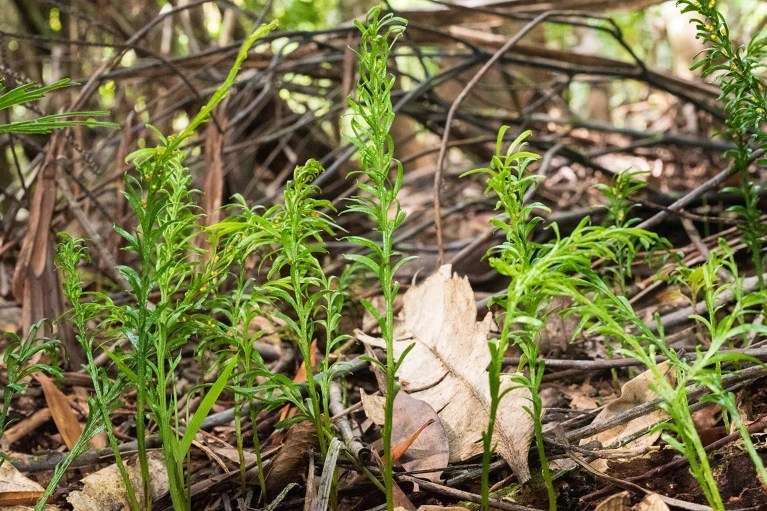
A tiny variety of the fork fern seems altogether unremarkable– but has a genome that dwarfs the human genome in size. Max Kozlov explains what that might teach us…
A small, unassuming fern-like plant has something massive lurking within: the largest genome ever discovered, outstripping the human genome by more than 50 times.
The plant (Tmesipteris oblanceolata) contains a whopping 160 billion base pairs, the units that make up a strand of DNA. That’s 11 billion more than the previous record holder, the flowering plant Paris japonica, and 30 billion more than the marbled lungfish (Protopterus aethiopicus), which has the largest animal genome. The findings were published [on May 31] in iScience…
The world’s genomic champion, which is native to New Caledonia and neighbouring archipelagos in the South Pacific, is a species of plant called a fork fern. Its colossal number of base pairs raises questions as to how the plant manages its genetic material. Only a small proportion of DNA is made of protein-coding genes, leading study co-author Ilia Leitch, an evolutionary biologist at London’s Royal Botanic Gardens, Kew, to wonder how the plant’s cellular machinery accesses those bits of the genome “amongst this huge morass of DNA. It’s like trying to find a few books with the instructions for how to survive in a library of millions of books — it’s just ridiculous.”
There’s also the question of how and why an organism evolved to have so many base pairs. Generally, having more base pairs leads to higher demand for the minerals that comprise DNA and for energy to duplicate the genome with every cell division, Leitch says. But if the organism lives in a relatively stable environment with little competition, a gargantuan genome might not come with a high cost, she adds.
That could help to provide an explanation — although a rather boring one — for the fork fern’s large genome: it might be neither detrimental nor particularly helpful for the plant’s ability to survive and reproduce, so the fork fern has gone on accumulating base pairs over time, says Julie Blommaert, a genomicist at the New Zealand Institute for Plant and Food Research in Nelson.
For now, researchers can only speculate on answers to these questions. The largest genome to be sequenced and assembled belongs to the European mistletoe (Viscum album), with about 90 billion base pairs. Modern techniques might not be sufficient to do the same for the fork fern’s genome: even if it’s sequenced, there’s still the computational challenge of taking the data and “sticking them together in a way that biologically reflects what’s going on”, Leitch says.
Finding ways to analyse enormous genomes could yield crucial insights into how genome size influences where organisms can grow, how they are able to flourish in their environments and their resilience to climate change, independent of their specific DNA sequence, she adds. Pellicer says it’s remarkable that a tiny, non-flowering plant that most people “wouldn’t bother to stop and look at” could offer such important lessons. “The beauty of the plant is inside.”
“Biggest genome ever found belongs to this odd little plant,” from @maxdkozlov in @Nature.
* Yoda, “The Empire Strikes Back”
###
As we rescope scale, we might send insightful birthday greetings to Phillip Allen Sharp; he was born on this date in 1944. A geneticist and molecular biologist, he co-discovered RNA splicing— for which he shared the 1993 Nobel Prize in Physiology or Medicine (with Richard J. Roberts). His work has spurred new research in evolutionary biology, and has contributed to the development of both treatments and vaccines for infectious diseases, cancer and other ailments.

You must be logged in to post a comment.