Posts Tagged ‘Kevin Kelly’
“Men have become the tools of their tools”*…

Visionary philosopher Bernard Stiegler argued that it’s not our technology that makes humans special; rather, it’s our relationship with that technology. Bryan Norton explains…
It has become almost impossible to separate the effects of digital technologies from our everyday experiences. Reality is parsed through glowing screens, unending data feeds, biometric feedback loops, digital protheses and expanding networks that link our virtual selves to satellite arrays in geostationary orbit. Wristwatches interpret our physical condition by counting steps and heartbeats. Phones track how we spend our time online, map the geographic location of the places we visit and record our histories in digital archives. Social media platforms forge alliances and create new political possibilities. And vast wireless networks – connecting satellites, drones and ‘smart’ weapons – determine how the wars of our era are being waged. Our experiences of the world are soaked with digital technologies.
But for the French philosopher Bernard Stiegler, one of the earliest and foremost theorists of our digital age, understanding the world requires us to move beyond the standard view of technology. Stiegler believed that technology is not just about the effects of digital tools and the ways that they impact our lives. It is not just about how devices are created and wielded by powerful organisations, nation-states or individuals. Our relationship with technology is about something deeper and more fundamental. It is about technics.
According to Stiegler, technics – the making and use of technology, in the broadest sense – is what makes us human. Our unique way of existing in the world, as distinct from other species, is defined by the experiences and knowledge our tools make possible, whether that is a state-of-the-art brain-computer interface such as Neuralink, or a prehistoric flint axe used to clear a forest. But don’t be mistaken: ‘technics’ is not simply another word for ‘technology’. As Martin Heidegger wrote in his essay ‘The Question Concerning Technology’ (1954), which used the German term Technik instead of Technologie in the original title: the ‘essence of technology is by no means anything technological.’ This aligns with the history of the word: the etymology of ‘technics’ leads us back to something like the ancient Greek term for art – technē. The essence of technology, then, is not found in a device, such as the one you are using to read this essay. It is an open-ended creative process, a relationship with our tools and the world.
This is Stiegler’s legacy. Throughout his life, he took this idea of technics, first explored while he was imprisoned for armed robbery, further than anyone else. But his ideas have often been overlooked and misunderstood, even before he died in 2020. Today, they are more necessary than ever. How else can we learn to disentangle the effects of digital technologies from our everyday experiences? How else can we begin to grasp the history of our strange reality?…
[Norton unspools Stiegler’s remarkable life and the development of his thought…]
… Technology, for better or worse, affects every aspect of our lives. Our very sense of who we are is shaped and reshaped by the tools we have at our disposal. The problem, for Stiegler, is that when we pay too much attention to our tools, rather than how they are developed and deployed, we fail to understand our reality. We become trapped, merely describing the technological world on its own terms and making it even harder to untangle the effects of digital technologies and our everyday experiences. By encouraging us to pay closer attention to this world-making capacity, with its potential to harm and heal, Stiegler is showing us what else is possible. There are other ways of living, of being, of evolving. It is technics, not technology, that will give the future its new face…
Eminently worth reading in full: “Our tools shape our selves,” from @br_norton in @aeonmag.
Compare and contrast: Kevin Kelly‘s What Technology Wants
* Henry David Thoreau
###
As we own up, we might send phenomenological birthday greetings to Immanuel Kant; he was born on this date in 1724. One of the central figures of modern philosophy, Kant is remembered primarily for his efforts to unite reason with experience (e.g., Critique of Pure Reason [Kritik der reinen Vernunft], 1781), and for his work on ethics (e.g., Metaphysics of Morals [Die Metaphysik der Sitten], 1797) and aesthetics (e.g., Critique of Judgment [Kritik der Urteilskraft], 1790).
But Kant made important contributions to mathematics and astronomy. For example: his argument that mathematical truths are a form of synthetic a priori knowledge was cited by Einstein as an important early influence on his work. And his description of the Milky Way as a lens-shaped collection of stars that represented only one of many “island universes,” was later shown to be accurate by Herschel.
Act so as to treat humanity, whether in your own person or in that of another, at all times also as an end, and not only as a means.

“We are as gods and might as well get good at it”*…

In 1968, Stewart Brand and small group of colleagues published the first Whole Earth Catalog, then followed it over the years with a series of updates, spin-offs, and sequels. An at-the-time unprecedented marriage of counterculture magazine and product catalog, it (and its successors) have been enormously influential. Now, as Long Now‘s Jacob Kupperman reports, the entire run of Whole Earth publications is freely available online…
When the Whole Earth Catalog arrived in the Fall of 01968, it came bearing a simple, epochal label: “Access to Tools.” As its editor and Long Now Co-founder Stewart Brand wrote in the introduction to that first edition, the goal was for the Catalog to serve as an “evaluation and access device” for tools that empowered its readers “to conduct his own education, find his own inspiration, shape his own environment, and share his adventure with whoever is interested.”
The key word in all of that idealistic declaration of purpose was “access.” The Whole Earth Catalog did not intend to directly grant its readers this knowledge, wisdom, and mastery, but to provide a kaleidoscopic array of gateways from which they could attempt to find it themselves.
Yet for years, access to the Whole Earth Catalog itself has been difficult. 55 years on from the first publication of the Catalog, it mostly lives on in the interstices — as a symbol of a vibrant countercultural history and an inspiration for writers, designers, and technologists, but less so as an actual set of catalogs that you can read. The Catalog is not lost media per se — copies can be found in libraries, archives, and personal collections across the world — but accessing its trove of information is no longer as easy as it was in its heyday.
That is, until now.
on the 55th anniversary of the publication of the original Whole Earth Catalog, Gray Area and the Internet Archive have made the Catalog freely available online via the Whole Earth Index, a website bringing together more than 130 Whole Earth Catalog-related publications, ranging from some of the earliest Catalogs published in the late 01960s and early 01970s to 02002 issues of Whole Earth Magazine.
Within the site’s grid of publications rests a cornucopia of writing and curation, from in-depth looks at space colonies to ecological analyses of the insurance industry to reporting on the state of the global teenager at the turn of the 01990s. The Whole Earth Index is a work of love, a noncommercial enterprise designed, as project lead and Gray Area Executive Director Barry Threw told Long Now Ideas, to “allow us to reflect on how we got to where we are and regain some of that connection to the countercultural world” of the Bay Area of the 01960s and 01970s.
…
For the people who helped make the Whole Earth Catalog and its descendants, the Whole Earth Index is in many ways a dream come true. Long Now Board Member Kevin Kelly, who wrote for, edited, and led the CoEvolution Quarterly, the Whole Earth Review, and later editions of the Whole Earth Catalog, told us that he found “the interface to this historic collection to be as good, maybe even better, as reading the original paper artifacts,” adding that he’d “been giddy with delight in how satisfying this archive is.” The project’s model of “instant access from your home, for free!”, Kelly noted, was something that the team behind the Whole Earth Catalog could only dream of when they began their work.
The open-ended design of the Whole Earth Index is intended as a sort of provocation towards future works — a message and invitation in the spirit of the original catalog’s epochal claim that “we are as gods and might as well get good at it.” The tens of thousands of scanned pages will live on the servers of the Internet Archive — as good a place as any to try and stave off a Digital Dark Age — but the ideas of the Whole Earth Catalog and its heirs will always live among those of us who read it and access its tools. What will you do with them?
The Whole Earth Catalog and its descendants are newly available online through the Whole Earth Index: “The Lasting Whole Earth Catalog,” from @Jacobkupp and @longnow.
* Stewart Brand, in the “Statement of Purpose” in the first Whole Earth Catalog
###
As we treasure tools, we might spare a thought for a man whose work kicked in about the same time as the Whole Earth Catalog– and intersected with it in myriad ways (e.g., The WELL), Jon Postel; he died on this date in 1998. A computer scientist, he played a pivotal role in creating and administering the Internet. As a graduate student in the late 1960s, he was instrumental in developing ARPANET, the forerunner of the internet. He is known principally for being the Editor of the Request for Comment (RFC) document series from which internet standards emerged, for Simple Mail Transfer Protocol (SMTP), and for founding and administering the Internet Assigned Numbers Authority (IANA) until his death.
During his lifetime he was referred to as the “god of the Internet” for his comprehensive influence; Postel himself noted that this “compliment” came with a barb, the suggestion that he should be replaced by a “professional,” and responded with typical self-effacing matter-of-factness: “Of course, there isn’t any ‘God of the Internet.’ The Internet works because a lot of people cooperate to do things together.”

“We shape our tools and thereafter our tools shape us”*…

Theodore “Ted” Kaczynski— the Unabomber– died yesterday in a federal prison. It’s an occasion to revisit Kevin Kelly‘s thoughts on Kaczynski and his manifesto…
Ted Kaczynski, the convicted bomber who blew up dozens of technophilic professionals, was right about one thing: technology has its own agenda. The technium is not, as most people think, a series of individual artifacts and gadgets for sale. Rather, Kaczynski, speaking as the Unabomber, argued that technology is a dynamic holistic system. It is not mere hardware; rather it is more akin to an organism. It is not inert, nor passive; rather the technium seeks and grabs resources for its own expansion. It is not merely the sum of human action, but in fact it transcends human actions and desires. I think Kaczynski was right about these claims. In his own words the Unabomber says: “The system does not and cannot exist to satisfy human needs. Instead, it is human behavior that has to be modified to fit the needs of the system. This has nothing to do with the political or social ideology that may pretend to guide the technological system. It is the fault of technology, because the system is guided not by ideology but by technical necessity.”
I too argue that the technium is guided by “technical necessity.” [See Kevin’s What Technology Wants.] That is, baked into the nature of this vast complex of technological systems are self-serving aspects – technologies that enable more technology, and systems that preserve themselves — and also inherent biases that lead the technium in certain directions, outside of human desire. Kaczynski writes “modern technology is a unified system in which all parts are dependent on one another. You can’t get rid of the ‘bad’ parts of technology and retain only the ‘good’ parts.”
The truth of Kaczynski’s observations does not absolve him of his murders, or justify his insane hatred. Kaczynski saw something in technology that caused him to lash out with violence, but despite his mental imbalance, he was able to articulate that view with surprising clarity his sprawling, infamous 35,000-word manifesto. Kaczynski murdered three people (and injured 23 more) in order to get this manifesto published. His despicable desperation and crimes hide a critique that has gained a minority following by other luddites. The center section of his argument is clear, remarkably so, given his cranky personal grievances against leftists that bookend his rant. Here, in meticulous, scholarly precision, Kaczynski makes his primary claim that “freedom and technological progress are incompatible,” and that therefore technological progress must be undone.
As best I understand, the Unabomber’s argument goes like this:
- Personal freedoms are constrained by society, as they must be.
- The stronger that technology makes society, the less freedoms.
- Technology destroys nature, which strengthens technology further.
- This ratchet of technological self-amplification is stronger than politics.
- Any attempt to use technology or politics to tame the system only strengthens it.
- Therefore technological civilization must be destroyed, rather than reformed.
- Since it cannot be destroyed by tech or politics, humans must push industrial society towards its inevitable end of self-collapse.
- Then pounce on it when it is down and kill it before it rises again.
In short, Kaczynski claims that civilization is the disease and not the cure. He wasn’t the first to make this claim. Rants against the machine of civilization go back as far as Freud and beyond. But the assaults against industrial society speed up as industry sped up. Edward Abbey, the legendary wilderness activist, considered industrial civilization to be a “destroying juggernaut” wrecking both the planet and humans. Abbey did all he could personally to stop the juggernaut with monkey wrenching maneuvers – sabotaging logging equipment and so forth. Abbey was the iconic Earth Firster who inspired many fire throwing followers. The luddite theorist, Kirkpatrick Sale, who unlike Abbey, railed against the machine while living in a brownstone in Manhattan, refined the idea of “civilization as disease.”…
[Kevin unpacks Kaczynski’s argument…]
The problem is that Kaczynski’s most basic premise, the first axiom in his argument, is not true. The Unabomber claims that technology robs people of freedom. But most people of the world find the opposite. They gravitate towards venues of increasing technology because they recognize they have more freedoms when they are empowered with it. They (that is we) realistically weigh the fact that yes, indeed, some options are closed off when adopting new technology, but many others are opened, so that the net gain is a plus of freedom, choices, and possibilities.
Consider Kaczynski himself. For 25 years he lived in a type of self-enforced solitary confinement in a dirty (see the photos and video) smoky shack without electricity, running water, or a toilet – he cut a hole in the floor for late night pissing. In terms of material standards the cell he now occupies in the Colorado Admax prison is a four-star upgrade: larger, cleaner, warmer, with the running water, electricity and the toilet he did not have, plus free food, and a much better library. In his Montana hermitage he was free to move about as much as the snow and weather permitted him. He could freely choose among a limited set of choices of what to do in the evenings. He may have personally been content with his limited world, but overall his choices were very constrained, although he had unshackled freedom within those limited choices. Sort of like, “you are free to hoe the potatoes any hour of the day you want.” Kaczynski confused great latitude within limited choices as superior over modest latitude in an expanding number of choices…
This is the chief reason billions of people migrate from mountain shacks – very much like Kaczynski’s – all around the world. A smart kid living in a smoky one-room shack in the hills of Laos, or Cameroon, or Bolivia will do all he/she can to make their way against all odds to the city where there are – so obvious to them – vastly more freedom and choices. They would find Kaczynski’s argument that there is more freedom back in the stifling hut they just escaped from plain crazy.
The young are not under some kind of technological spell that warps their mind into believing civilization is better. Sitting in the mountains they are under no spell but poverty’s. They clearly know what they give up when they leave. They understand the comfort and support of family, the priceless value of community acquired in a small village, the blessings of clean air and the soothing wholeness of the natural world. They feel the loss of immediate access to these, but they come to the city anyway because in the end, the tally favors the freedoms created by civilization. They can (and will) return to the hills to be rejuvenated…
[Kevin considers the “green anarchist” and anti-civilizationists…]
The ultimate problem is that the paradise the Kaczynski is offering, the solution to civilization so to speak, is the tiny, smoky, dingy, smelly wooden prison cell that absolutely nobody else wants to dwell in. It is a paradise billions are fleeing from. Civilization has its problems but in almost every way it is better than the Unabomber’s shack.
The Unabomber is right that technology is a holistic, self-perpetuating machine. He is wrong to bomb it for many reasons, not the least is that the machine of civilization offers us more actual freedoms than the alternative. There is a cost to run this machine, a cost we are only beginning to reckon with, but so far the gains from this ever enlarging technium outweigh the alternative of no machine at all…
For all of the ways in which Ted Kaczynski was misguided, @kevin2kelly argues, “The Unabomber Was Right” about one big thing. Eminently worth reading in full.
* Frequently attributed to Marshall McLuhan, but actually written by Father John Culkin, SJ, a Professor of Communication at Fordham University in New York and friend of McLuhan.
###
As we ponder the prices we pay, we might recall that it was on this date in 1976 that Texas Instruments Inc. introduced Speak & Spell, a talking learning aid for ages 7 and up. Its debut marked the first electronic duplication of the human vocal tract on a single chip of silicon. Earlier “speaking toys” (like Mattel’s See ‘n Say line or the even earlier Chatty Cathy dolls) had relied on tape or phonograph recordings.

“The test of a first-rate intelligence is the ability to hold two opposed ideas in the mind at the same time, and still retain the ability to function”*…
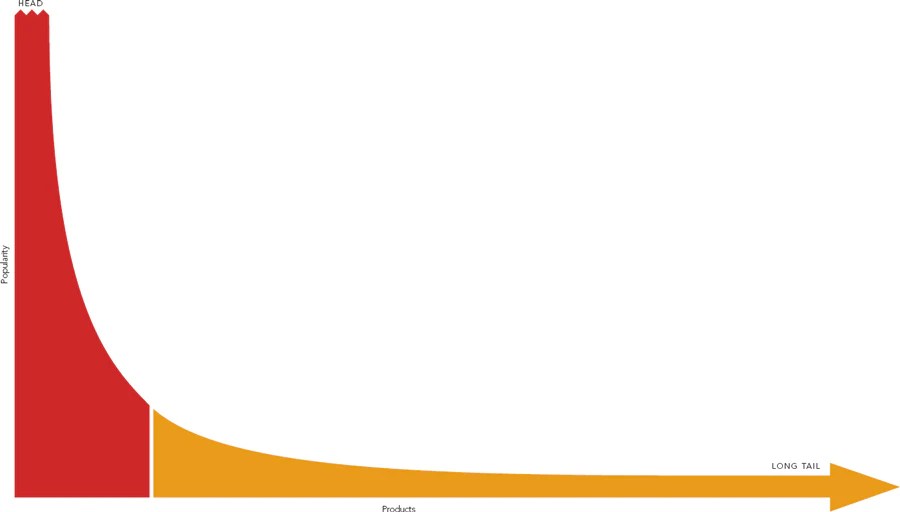
One the one hand: Ted Gioia suggests that, while ‘The Long Tail’ was supposed to boost alternative voices in music, movies, and books, the exact opposite has happened…
When I first heard people predict the rise of the Long Tail, I was amused. Not only did it seem wrong-headed, but it ran counter to everything I saw happening around me.
It pains me to say this—because the Long Tail was sold to us as an economic law that not only predicted a more inclusive era of prosperity, but would especially help creative people. According to its proponents, the Long Tail would revitalize our culture by expanding the scope of the arts and giving a boost to visionaries on the fringes of society.
Alternative voices would be nurtured and flourish. Music would get cooler and more surprising. Books would become more diverse and interesting. Indie films would reach larger audiences. Etc. etc. etc.
Hey, what’s not to like?
But it never happened. More to the point, it was never going to happen because the story was a fairy tale. I knew it back then because I had been hired on a number of occasions to analyze the Long Tail myself. But the flaws in the reasoning are far more obvious today, even to me.
Nonetheless many believed it—and many still do. So it’s worth digging into the story of the Long Tail, and examining exactly why it never delivered its promise.
And maybe we can find some alternative pathway to that lost cultural renaissance by seeing how this one went off the rails.
…
On the other hand: Cal Newport suggest that Kevin Kelly‘s fourteen-year-old prediction that an artist could make a living online with a thousand true fans is (finally) coming true…
In his “1,000 True Fans” essay, Kelly explains that he wasn’t as excited about this new economic model as others seemed to be. “The long tail is famously good news for two classes of people: a few lucky aggregators, such as Amazon and Netflix, and 6 billion consumers,” he writes. “But the long tail is a decidedly mixed blessing for creators.” If your work lives in the long tail, the introduction of Internet-based markets might mean that you go from selling zero units of your creations to selling a handful of units a month, but this makes little difference to your livelihood. “The long tail offers no path out of the quiet doldrums of minuscule sales,” Kelly writes. “Other than aim for a blockbuster hit, what can an artists do to escape the long tail?”
This question might seem fatalistic, but Kelly had a solution. If your creative work exists in the long tail, generating a small but consistent number of sales, then it’s probably sufficiently good to support a small but serious fan base, assuming you’re willing to put in the work required to cultivate this community. In an earlier age, a creative professional might be limited to fans who lived nearby. But by using the tools of the Internet, Kelly argued, it was now possible for creative types to both find and interact with supporters all around the world…
A shining example of the 1,000 True Fans model is the podcasting boom. There are more than eight hundred and fifty thousand active podcasts available right now. Although most of these shows are small and don’t generate much money, the number of people making a full-time living off original audio content is substantial. The key to a financially viable podcast is to cultivate a group of True Fans eager to listen to every episode. The value of each such fan, willing to stream hours and hours of a creator’s content, is surprisingly large; if sufficiently committed, even a modest-sized audience can generate significant income for a creator. According to an advertising agency I consulted, for example, a weekly podcast that generates thirty thousand downloads per episode should be able to reach Kelly’s target of generating a hundred thousand dollars a year in income. Earning a middle-class salary by talking through a digital microphone to a fiercely loyal band of supporters around the world, who are connected by the magic of the Internet, is about as pure a distillation of Kelly’s vision as you’re likely to find…
The real breakthroughs that enabled the revival of the 1,000 True Fans model are better understood as cultural. The rise in both online news paywalls and subscription video-streaming services trained users to be more comfortable paying à la carte for content. When you already shell out regular subscription fees for newyorker.com, Netflix, Peacock, and Disney+, why not also pay for “Breaking Points,” or throw a monthly donation toward Maria Popova? In 2008, when Kelly published the original “1,000 True Fans” essay, it was widely assumed that it would be hard to ever persuade people to pay money for most digital content. (This likely explains why so many of Kelly’s examples focus on selling tangible goods, such as DVDs or custom prints.) This is no longer true. Opening up these marketplaces to purely digital artifacts—text, audio, video, online classes—significantly lowered the barriers to entry for creative professionals looking to make a living online…
But can this last? Is it destined to fall prey to the forces that Gioia catalogues?
The recent history of the Internet, however, warns that we shouldn’t necessarily expect the endearingly homegrown nature of these 1,000 True Fans communities to persist. When viable new economic niches emerge online, venture-backed businesses, looking to extract their cut, are typically not far behind. Services such as Patreon and Kickstarter are jostling for a dominant position in this direct-to-consumer creative marketplace. A prominent recent example of such attempts to centralize the True Fan economy is Substack, which eliminates friction for writers who want to launch paid e-mail newsletters. Substack now has more than a million subscribers who pay for access to newsletters, and is currently valued at around six hundred and fifty million dollars. With this type of money at stake, it’s easy to imagine a future in which a small number of similarly optimized platforms dominate most of the mechanisms by which creative professionals interact with their 1,000 True Fans. In the optimistic scenario, this competition will lead to continued streamlining of the process of serving supporters, increasing the number of people who are able to make a good living off of their creative work: an apotheosis of sorts of Kelly’s original vision. A more pessimistic prediction is that the current True Fan revolution will eventually go the way of the original Web 2.0 revolution, with creators increasingly ground in the gears of monetization. The Substack of today makes it easy for a writer to charge fans for a newsletter. The Substack of tomorrow might move toward a flat-fee subscription model, driving users toward an algorithmically optimized collection of newsletter content, concentrating rewards within a small number of hyper-popular producers, and in turn eliminating the ability for any number of niche writers to make a living…
The future of the creative economy: “Where Did the Long Tail Go?,” from @tedgioia and “The Rise of the Internet’s Creative Middle Class,” from Cal Newport on @kevin2kelly in @NewYorker.
* F. Scott Fitzgerald (“The Crack-Up,” Esquire, February, 1936)
###
As we contemplate culture and commerce, we might recall that it was on this date in 1894 (after 30 states had already enshrined the occasion) that Labor Day became a federal holiday in the United States.

I for one welcome our new computer overlords…

In the aftermath of Watson’s triumph over humanity’s best, your correspondent thought it wise to remind readers (and himself) that this is not the first time that we mortals have faced the onslaught of astounding new technology.
The good folks at Dark Roasted Blend have compiled a nifty through-the-ages recap of attempts to create “life” in new-fangled ways; from Leonardo’s “robot” and John Dee’s “flying beetle” to an “steam-powered hiker” and an “electric milk man” from Victorian England, there’s quite a selection in “Amazing Automatons: Ancient Robots & Victorian Androids.”
It’s all fascinating; but the sweet spot is surely the selection of creations from the 18th (and early 19th) centuries, when the then-highly-developed crafts of metal working and watchmaking were turned to automata. Consider, for example…

Jacques Vaucason created numerous working figures, including a flute player, which actually played the instrument, in 1738, plus this duck from 1739. The gilded copper bird could sit, stand, splash around in water, quack and even give the impression of eating food and digesting it.


Pierre Jaquet-Doz created three automata, The Writer, The Draughtsman and The Musician, which are still considered scientific marvels today. The Draughtsman is capable of producing four distinct pictures, while the Writer dips his pen in the ink and can write as many as forty letters. The Musician’s fingers actually play the organ and the figure ends her performance with a bow.
More, at Dark Roasted Blend.
As we remind ourselves to re-read Kevin Kelly’s excellent What Technology Wants and then to retake the Turing Test, we might stage a dramatic memorial dramatist and scenic innovator James Morrison Steele (“Steele”) MacKaye; he died on this date in 1894. He opened the Madison Square Theatre in 1879, where he created a huge elevator with two stages stacked one on top of the other so that elaborate furnishings could be changed quickly between scenes. MacKaye was the first to light a New York theatre– the Lyceum, which he founded in 1884– entirely by electricity. And he invented and installed overhead and indirect stage lighting, movable stage wagons, artificial ventilation, the disappearing orchestra pit, and folding seats. In all, MacKaye patented over a hundred inventions, mostly for the improvement of theatrical production and its experience.

You must be logged in to post a comment.