Archive for February 2025
“It is what you read when you don’t have to that determines who you will be when you can’t help it”*…

Indeed. And not just what one reads, but how one reads it. The estimable Henry Farrell reviews the “tech canon” that seems to underlie so much of what Silicon Valley and the tech world at large is advocating. That canon’s celebration of great men and the acomplishments of small teams helps explain everything from Mark Andreessen’s accelerationist manifesto through the machinations of DOGE to Jeff Bezos’ resteering of The Washington Post…
… Tech luminaries seem to opine endlessly about books and ideas, debating the merits and defects of different flavors of rationalism, of basic economic principles and of the strengths and weaknesses of democracy and corporate rule.
This fervor has yielded a recognizable “Silicon Valley canon.” And as Elon Musk and his shock troops descend on Washington with intentions of reengineering the government, it’s worth paying attention to the books the tech world reads — as well as the ones they don’t. Viewed through the canon, DOGE’s grand effort to cut government down to size is the latest manifestation of a longstanding Silicon Valley dream: to remake politics in its image.
Last August, Tanner Greer, a conservative writer with a large Silicon Valley readership, asked on X what the contents of the “vague tech canon” might be. He’d been provoked when the writer and technologist Jasmine Sun asked why James Scott’s Seeing Like a State, an anarchist denunciation of grand structures of government, had become a “Silicon Valley bookshelf fixture.” The promptled Patrick Collison, co-founder of Stripe and a leading thinker within Silicon Valley, to suggest a list of 43 sources, which he stressed were not those he thought “one ought to read” but those that “roughly cover[ed] the major ideas that are influential here.”
In a later response, Greer argued that the canon tied together a cohesive community, providing Silicon Valley leaders with a shared understanding of power and a definition of greatness. Greer, like Graham, spoke of the differences between cities. He described Washington, DC as an intellectually stultified warren of specialists without soul, arid technocrats who knew their own narrow area of policy but did not read outside of it. In contrast, Silicon Valley was a place of doers, who looked to books not for technical information, but for inspiration and advice. The Silicon Valley canon provided guideposts for how to change the world.
Said canon is not directly political. It includes websites, like LessWrong, the home of the rationalist movement, and Slate Star Codex/Astral Codex Ten, for members of the “grey tribe” who see themselves as neither conservative nor properly liberal. [Paul] Graham’s many essays are included, as are science fiction novels like Neal Stephenson’s The Diamond Age. Much of the canon is business advice on topics such as how to build a startup.
But such advice can have a political edge. Peter Thiel’s Zero to One, co-authored with his former student and failed Republican Senate candidate Blake Masters, not only tells startups that they need to aspire to monopoly power or be crushed, but describes Thiel’s early ambitions (along with other members of the so-called PayPal mafia) to create a global private currency that would crush the US dollar.
Then there are the Carlylian histories of “great men” (most of the subjects and authors were male) who sought to change the world. Older biographies described men like Robert Moses and Theodore Roosevelt, with grand flaws and grander ambitions, who broke with convention and overcame opposition to remake society.
Such stories, in Greer’s description, provided Silicon Valley’s leaders and aspiring leaders with “models of honor,” and examples of “the sort of deeds that brought glory or shame to the doer simply by being done.” The newer histories both explained Silicon Valley to itself, and tacitly wove its founders and small teams into this epic history of great deeds, suggesting that modern entrepreneurs like Elon Musk — whose biography was on the list — were the latest in a grand lineage that had remade America’s role in the world.
Putting Musk alongside Teddy Roosevelt didn’t simply reinforce Silicon Valley’s own mythologized self-image as the modern center of creative destruction. It implicitly welded it to politics, contrasting the politically creative energies of the technology industry, set on remaking the world for the better, to the Washington regulators who frustrated and thwarted entrepreneurial change. Mightn’t everything be better if visionary engineers had their way, replacing all the messy, squalid compromises of politics with radical innovation and purpose-engineered efficient systems?…
[Farrel discusses James Davidson and William Rees-Mogg’s The Sovereign Individual and the enhusiastic reactions of SV avatars Balaji Srinivasan and Curtis Yarvin…]
… We don’t know which parts of the canon Musk has read, or which ones influenced the young techies he’s hired into DOGE. But it’s not hard to imagine how his current gambit looks filtered through these ideas. From this vantage, DOGE’s grand effort to cut government down to size is the newest iteration of an epic narrative of change.
Musk, a heroic entrepreneur, will surely make history as his tiny team of engineers cuts the government Leviathan down to size. One DOGE recruiter framed the challenge as “a historic opportunity to build an efficient government, and to cut the federal budget by 1/3.” When a small team remakes government wholesale, the outcome will surely be simpler, cheaper and more effective. That, after all, fits with the story that Silicon Valley disruptors tell themselves.
From another perspective, hubris is about to get clobbered by nemesis. Jasmine Sun’s question about why so many people in tech read Seeing Like a State hints at the misunderstandings that trouble the Silicon Valley canon. Many tech elites read the book as a denunciation of government overreach. But Scott was an excoriating critic of the drive to efficiency that they themselves embody…
… Seeing Like a State, properly understood, is a warning not just to bureaucrats but to social engineers writ large. From Scott’s broader perspective, AI is not a solution, but a swift way to make the problem worse. It will replace the gross simplifications of bureaucracy with incomprehensible abstractions that have been filtered through the “hidden layers” of artificial neurons that allow it to work. DOGE’s artificial-intelligence-fueled vision of government is a vision from Franz Kafka, not Friedrich Hayek…
… Some of this revised canon might draw on Patrick Collison’s own bookshelves, which contain a far wider range of ideas than the canon itself. Collison’s reading interests tend toward classical liberalism, but writers who rub shoulders on his shelves, like Karl Popper and Elinor Ostrom, could be brought into debate with less well-known liberals like Ernest Gellner and contemporary left-liberals like Danielle Allen. All of these thinkers are deeply concerned with building and maintaining a genuinely plural society in which groups can get along despite their differences…
We are what we read: “Silicon Valley’s Reading List Reveals Its Political Ambitions” (gift article) from @himself.bsky.social in @bloomberglp.bsky.social. Eminently worth reading in full…
… as is Farrell’s addendum (in his wonderful newsletter): “Silicon Valley’s thing about Great Men“– “There is an alternative.”
And listen to Farrell discuss these issues (with Max Read and John Ganz) in the podcast episode “The Silicon Valley canon and malformed publics“
And for a reminder that this phenomenon has long, deep roots, see “Geeks for Monarchy: The Rise of the Neoreactionaries,” from TechCrunch in 2013.
* Oscar Wilde
###
As we anguish over antecedents, we might recall that it was on this date in 1854 that the Republican Party was “organized” (In Ripon, Wisconsin). It held its first public meeting on March 20th and its first convention on July 6 of that same year.
The party grew out of opposition to the Kansas–Nebraska Act, which repealed the Missouri Compromise and opened the Kansas and Nebraska Territories to slavery and future admission as slave states, and was largely animated by anti-slavery advocates (including some ex-Whigs, and ex-Free Soilers).
The Kansas–Nebraska Act was authored by Democratic Senator Stephen A. Douglas and passed in 1854… the same Stephen Douglas that debated Abraham Lincoln in the 1858 Illinois Senate race. Douglas was re-elected by the Illinois General Assembly, 54–46. (Until 1913, when the 17th Amendment to the United States Constitution— which provides that senators shall be elected by the people of their states– was ratified, senators were elected by their respective state legislatures.) But the publicity made Lincoln a national figure and laid the groundwork for his 1860 presidential campaign.
How times change…

“Tell it like it is”*…
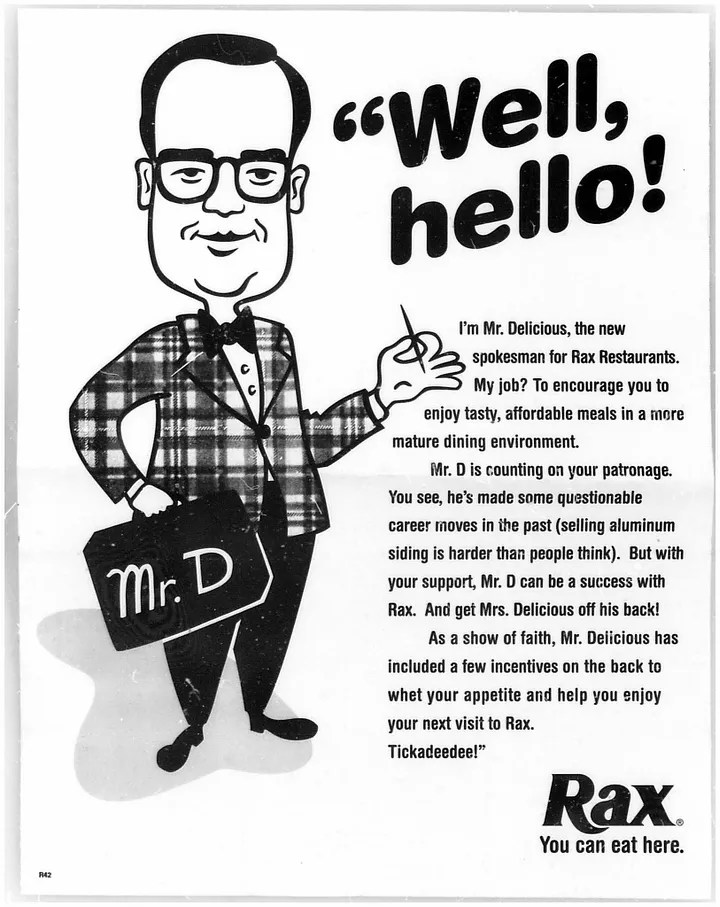
Most fast food chains court children. Mr. Delicious targeted depressed adults. Jake Rossen reports…
It’s not often that a mascot for a fast-food franchise will detail the discomfort prompted by hemorrhoid surgery in a national television advertisement. But Mr. Delicious rarely played by the rules.
Mr. Delicious was the cartoon spokesman for Rax, a chain of roast beef eateries that grew popular in the 1980s. But by 1992, sales were dwindling—so the company recruited “Mr. D” to liven up their brand identity. Middle-aged and burdened by a difficult marriage, the character was an anti-Ronald McDonald.
“Mr. Delicious just had some rather delicate surgery,” he announced in one spot for value meals priced in round numbers. “If there’s no change, he doesn’t have to squirm so much to put it back in his pocket, does he? He just grabs his combo and drives ever so slowly over the speed bump.”
In other spots, Mr. Delicious would refer to his aversion to children, a midlife crisis involving inappropriately aged women, and heading to Rax to nurse a hangover.
Rax thought the irreverent Mr. Delicious was a solution to their ailing sales numbers. They were greatly mistaken…
Read on for the instructive– and very amusing– tale, along with more arresting examples of the spots (including an account of his trip to Bora Bora with two female “friends”): “The Tortured Soul of Mr. Delicious, Fast Food’s Most Bizarre Mascot,” from @mental_floss.
And watch the promotional video that introduced Mr. Delicious:
More on Mr. D at “Mr. Delicious: The Fast Food Mascot Who Had A Mid-Life Crisis” (source of the image at the top).
* R&B singer Roy Milton in 1954 (canonizing a phrase in use since the 1940s in Black speech)
###
As we brood over branding, we might that it was on this date in 1879 that saccharin (AKA saccharine, benzosulfimide, or E954), an nutrition-free artificial sweetener, was discovered by Constantine Fahlberg and Ira Remsen at Johns Hopkins University. 500 times sweeter than sucrose, it can have a bitter or metallic aftertaste, especially at high concentrations.
Commercialized from soon after its discovery, saccharin took off during the sugar shortages of World War I. It was (and to some extent still is) used as a stand-alone sugar substitute (e.g., “Sweet’n Low), to sweeten products like drinks, candies, baked goods, tobacco products, excipients, and for masking the bitter taste of some medicines.
The FDA required warning labels from 1977 to 2000 on products using saccharin because it was a suspected carcinogen. After additional research, the FDA repealed the warning labels and declared saccharin safe for consumption.

“We have lived in this world where little things are done for love and big things for money. Now we have Wikipedia. Suddenly big things can be done for love.”*…
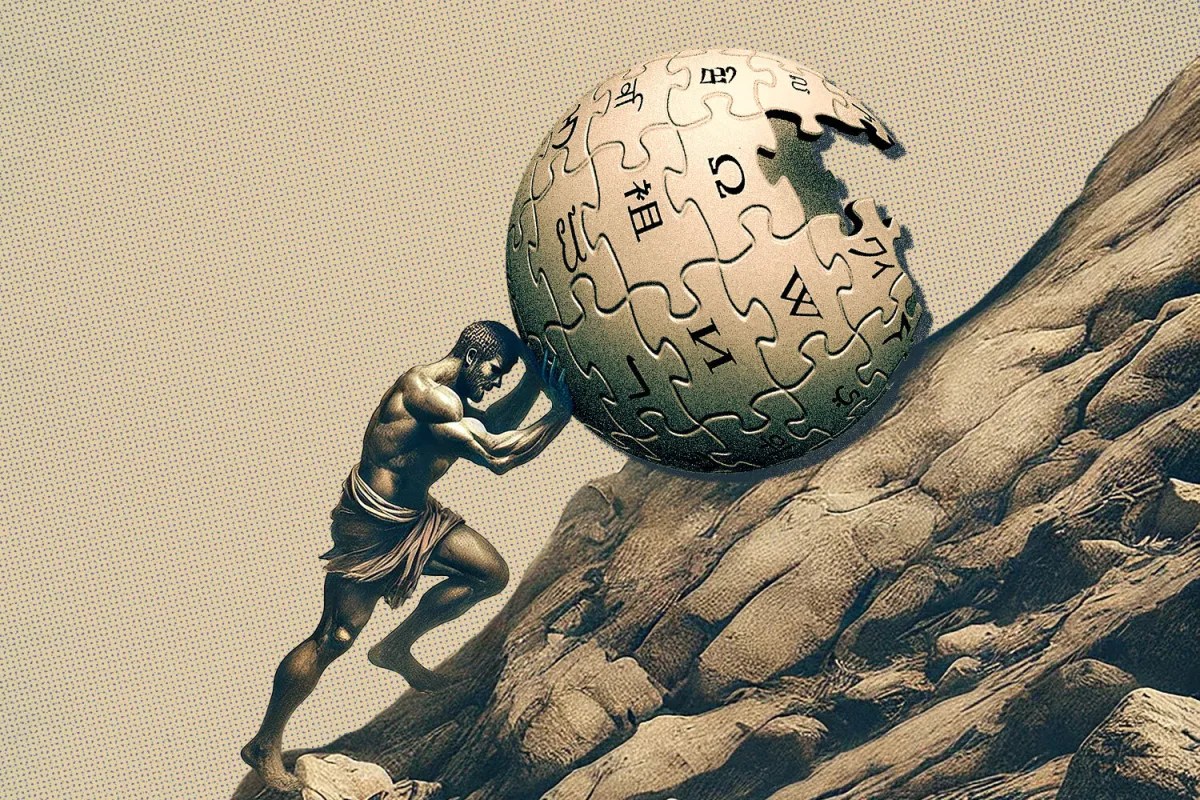
Since it was launched in 2001, Wikipedia has gone from curiosity to “bane of teachers” to cherished resource– the largest and most-read reference work in history, consistently among the top ten websites visited globally. Free and run by a network of volunteers (it’s hosted by the Wikimedia Foundation, an American nonprofit funded mainly by donations from readers), it has always been an anomaly– and has always been under some kind of threat.
Tobias Carroll of Inside Hook interviewed author, tech lawyer, and long-time student of Wikipedia Stephen Harrison on what the future might hold– is a tipping point coming?…
Has there ever been a time when Wikipedia wasn’t controversial? The long-running online encyclopedia has sparked plenty of debates since its founding in 2001, and has at various points been the subject of critiques from all across the political spectrum. It’s also an invaluable resource to millions around the world, host to a wealth of knowledge about everything from military battles to defunct sports teams.
Over the years, Stephen Harrison has written extensively about Wikipedia, including in a series of articles at Slate and his newsletter Source Notes. He’s also the author of a recent thriller, The Editors, about the international intrigue surrounding a Wikipedia-like website in the months leading up to the 2020 pandemic.
Harrison spoke with InsideHook about Wikipedia’s shifting place in internet culture, the many threats to it (including those from Elon Musk) and where he sees the encyclopedia going in the years to come…
… [Carroll] We’re now seeing people like Elon Musk targeting Wikipedia with existential criticism. What do you see as the biggest threats to Wikipedia — do you think it’s AI? Is it powerful people looking to make radical changes to how it works?
[Harrison] To some extent, it’s all of the above. I think it’s always under threat; even at the beginning they wondered if it would last and if people would keep contributing to it. There have been alternatives to it, like Conservapedia and RationalWiki and things like that, but they haven’t gotten the same traction. It’s a question of Joan Didion’s point about whether the center will hold. Hopefully Wikipedia will.
Now we have Elon Musk, who’s taken a pretty negative stance against Wikipedia. Of course, that’s very self-serving on his end because he wants people to go to his platform X, right? And he doesn’t like some of the content on his Wikipedia page, even the content that’s true about him being primarily an investor in a lot of these companies. He just doesn’t want to be couched or described as an investor because he has a certain narrative that he’s trying to put out there.
I think that there was always tension in the site. I think that to some extent people wanted to attack Wikipedia for something else, but it was very convenient to say, “Oh no, it’s all about women and minorities and underrepresented groups.” On the other hand, I want to say it does challenge some notions of what is encyclopedic. Wikipedia has kind of a small-c conservative view on topics that are notable.
The definition of notability has been repeat coverage and mainstream reliable sources, which a lot of people in underrepresented groups didn’t have for a long time. There’ll be people on Wikipedia, old-school editors, who’ll take issue with that. Editors aren’t just young guys in Silicon Valley. There are a lot of people — like the character Ed in The Editors — that have just been with the project for a long time, and they have their own views, too. They’ll say, “We’re an encyclopedia. We’re not here to try to right history’s wrongs.”I’m not saying that it needs to get to 50-50 in terms of male and female articles. But for a long time, it was less than 10% [biographical articles about] women. Now it’s like climbing up to 20%, so it’s getting a little bit closer…
… I think the issue is that I’m increasingly finding myself asking AI applications questions that I might have initially gone to Wikipedia for. That pushes Wikipedia further into the background. Are humans going to keep contributing to Wikipedia if it’s perceived that all the information is going to ChatGPT or Perplexity or Grok?
I’ll be interested to see how Wikipedia editors overcome that. Maybe if there’s a silver lining it’s that Wikipedia editors have never been that egotistical. They’re always a little bit behind the scenes. So maybe they won’t mind their information going out to other sources as it does with Google knowledge panels or Alexa or Siri or something like that.
On the other hand, I don’t think they like the idea of it just doing free labor for tech companies. It gets to be a really tough problem: should Google or OpenAI donate more money to the Wikimedia Foundation? But you don’t want there to be any editorial control or any undue influence by Big Tech. So It’s a little bit of a mess. I think that part of it will involve requiring that these LLMs start citing or stating that this information comes from Wikipedia to give some sort of provenance to Wikipedia….
… I’ve been concerned that Wikipedia isn’t recruiting the younger generation. But then every time I’ve expressed worry about that, I find new contributors joining. I think that there’s a certain personality dimension that’s attracted to editing Wikipedia. And those people, hopefully, always find the site.
I think that there’s this political-industrial complex right now where everything is being politicized, right? And the right wing has an interest in portraying Wikipedia as left-wing and a kind of liberal media. What I would hope is that Wikipedia can withstand some of those criticisms. I don’t want only half of the readership to think about Wikipedia as a resource that can be used. But if I had to guess, I think it’s going to get worse before it gets better in terms of partisan rhetoric about Wikipedia…
“How Long Can Wikipedia Hold On?” @tobiascarroll.bsky.social and @stephenharrison.com.
* Clay Shirky
###
As we look it up, we might recall that it was on this date in 1991 that Tim Berners-Lee showed the world the first web browser (and first WYSIWYG HTML editor), “WorldWideWeb” (the name of which was changed to “Nexus” after the debut of the World Wide Web later that year to avoid confusion between the brower and the network it was browsing).

“Wild above rule or art, enormous bliss”*…

What greater joy than that of creation? John Crace on the all-time champion coiner of English words…
To many scholars he is still the sublime English poet. To the rest of us, he’s the blind bloke who wrote the scarily long and difficult epic about heaven, hell and the failure of the English revolution we were made to read at school. But John Milton… deserves to be remembered for rather more than Paradise Lost. Step aside Martin Amis, Will Self et al; Milton is in a league of his own for neologisms.
According to Gavin Alexander, lecturer in English at Cambridge university and fellow of Milton’s alma mater, Christ’s College, who has trawled the Oxford English Dictionary (OED) for evidence, Milton is responsible for introducing some 630 words to the English language, making him the country’s greatest neologist, ahead of Ben Jonson with 558, John Donne with 342 and Shakespeare with 229. Without the great poet there would be no liturgical, debauchery, besottedly, unhealthily, padlock, dismissive, terrific, embellishing, fragrance, didactic or love-lorn. And certainly no complacency.
The OED does tend to privilege famous writers with first usage,” Alexander admits, “and early-modern English – a composite of Germanic and Romance languages – was ripe for innovation. If you couldn’t think of a word, you could just make one up, ideally based on a term from French or Latin that others educated in those languages would understand. Yet, by any standards, Milton was an extraordinary linguist and his freedom with language can be related to his advocacy of personal, political and religious freedoms.”
Milton’s coinages can be loosely divided into five categories. A new meaning for an existing word – he was the first to use space to mean “outer space”; a new form of an existing word, by making a noun from a verb or a verb from an adjective, such as stunning and literalism; negative forms, such as unprincipled, unaccountable and irresponsible – he was especially fond of these, with 135 entries beginning with un-; new compounds, such as arch-fiend and self-delusion; and completely new words, such as pandemonium and sensuous.
Not that Milton got things all his own way. Some of his words, such as intervolve (to wind within each other) and opiniastrous (opinionated), never quite made it into regular usage – which feels like our loss rather than his…
“John Milton – our greatest word-maker,” from @mrjohncrace.bsky.social in @theguardian.com.
For an appreciation of the revolutionary afterlife of Milton’s masterwork, Paradise Lost, see Orlando Reade‘s What In Me Is Dark. (TotH to PN)
* John Milton, Paradise Lost
###
As we reach for the right word, we might send articulate birthday greetings to Anthony Burgess; he was born on this date in 1917. An author primarily of comic fiction (e.g., the Enderby quartet), he strayed to other turf (like Earthly Powers, one of your correspondent’s faves). He is, of course, best known for his dystopian satire A Clockwork Orange— for which he invented a slang argot (“Nadsat“) that, while it added little to the vernacular, certainly had an impact on those of us who read the book or saw Stanley Kubrick’s film adaptation.

“Even though our lives wander, our memories remain in one place”*…

Your correspondent’s fascination with the “memory palace,” the age-old technique of memorization, has shown up in (R)D many times before (e.g., here, here, here, here, here, and here :) That it works has been long understood– but how it works, not so much. Ingrid Wickelgren reports on research that may offer a clue…
After shuffling the cards in a standard 52-card deck, Alex Mullen, a three-time world memory champion, can memorize their order in under 20 seconds. As he flips though the cards, he takes a mental walk through a house. At each point in his journey — the mailbox, front door, staircase and so on — he attaches a card. To recall the cards, he relives the trip.
This technique, called “method of loci” or “memory palace,” is effective because it mirrors the way the brain naturally constructs narrative memories: Mullen’s memory for the card order is built on the scaffold of a familiar journey. We all do something similar every day, as we use familiar sequences of events, such as the repeated steps that unfold during a meal at a restaurant or a trip through the airport, as a home for specific details — an exceptional appetizer or an object flagged at security. The general narrative makes the noteworthy features easier to recall later.
“You are taking these details and connecting them to this prior knowledge,” said Christopher Baldassano, a cognitive neuroscientist at Columbia University. “We think this is how you create your autobiographical memories.”
Psychologists empirically introduced this theory some 50 years ago, but proof of such scaffolds in the brain was missing. Then, in 2018, Baldassano found it: neural fingerprints of narrative experience, derived from brain scans, that replay sequentially during standard life events. He believes that the brain builds a rich library of scripts for expected scenarios — restaurant or airport, business deal or marriage proposal — over a person’s lifetime.
These standardized scripts, and departures from them, influence how and how well we remember specific instances of these event types, his lab has found. And recently, in a paper published in Current Biology in fall 2024, they showed that individuals can select a dominant script for a complex, real-world event — for example, while watching a marriage proposal in a restaurant, we might opt, subconsciously, for either a proposal or a restaurant script — which determines what details we remember…
The fascinating details of how, by screening films in a brain scanner, neuroscientists discovered a rich library of neural scripts — from a trip through an airport to a marriage proposal — that form scaffolds for memories of our experiences: “How ‘Event Scripts’ Structure Our Personal Memories,” from @iwickelgren in @quantamagazine.bsky.social.
* Marcel Proust
###
As we remember (and lest we forget), we might recall that it was on this date in 1920 that Adolf Hitler, the propaganda head of the German Worker’s Party (DAP) gave a speech (now known as “Hitler’s Hofbräuhaus speech”) to 2,000 followers at a Munich beer hall announcing the change in the party’s name to the Nationalsozialistische Deutsche Arbeiterpartei (“National Socialist German Workers’ Party”, or Nazi Party). It was then that the party officially announced that only persons of “pure Aryan descent” could become members and that their spouses had to be “racially pure” as well.

Oh, and on this date in 1868, an American President (Andrew Johnson) was impeached for the first time.
You must be logged in to post a comment.