Posts Tagged ‘saccharin’
“Tell it like it is”*…
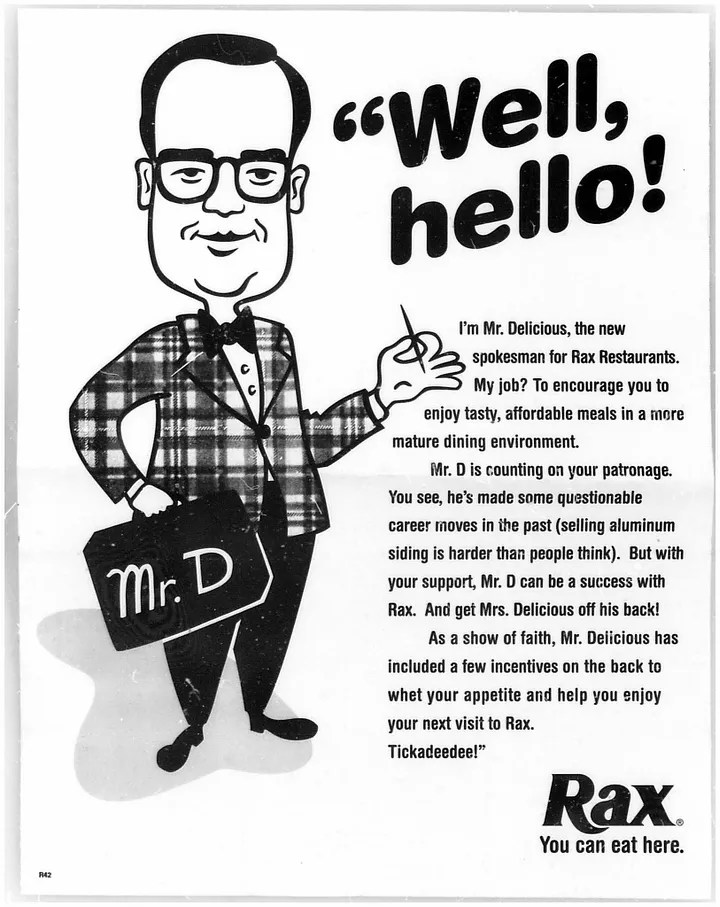
Most fast food chains court children. Mr. Delicious targeted depressed adults. Jake Rossen reports…
It’s not often that a mascot for a fast-food franchise will detail the discomfort prompted by hemorrhoid surgery in a national television advertisement. But Mr. Delicious rarely played by the rules.
Mr. Delicious was the cartoon spokesman for Rax, a chain of roast beef eateries that grew popular in the 1980s. But by 1992, sales were dwindling—so the company recruited “Mr. D” to liven up their brand identity. Middle-aged and burdened by a difficult marriage, the character was an anti-Ronald McDonald.
“Mr. Delicious just had some rather delicate surgery,” he announced in one spot for value meals priced in round numbers. “If there’s no change, he doesn’t have to squirm so much to put it back in his pocket, does he? He just grabs his combo and drives ever so slowly over the speed bump.”
In other spots, Mr. Delicious would refer to his aversion to children, a midlife crisis involving inappropriately aged women, and heading to Rax to nurse a hangover.
Rax thought the irreverent Mr. Delicious was a solution to their ailing sales numbers. They were greatly mistaken…
Read on for the instructive– and very amusing– tale, along with more arresting examples of the spots (including an account of his trip to Bora Bora with two female “friends”): “The Tortured Soul of Mr. Delicious, Fast Food’s Most Bizarre Mascot,” from @mental_floss.
And watch the promotional video that introduced Mr. Delicious:
More on Mr. D at “Mr. Delicious: The Fast Food Mascot Who Had A Mid-Life Crisis” (source of the image at the top).
* R&B singer Roy Milton in 1954 (canonizing a phrase in use since the 1940s in Black speech)
###
As we brood over branding, we might that it was on this date in 1879 that saccharin (AKA saccharine, benzosulfimide, or E954), an nutrition-free artificial sweetener, was discovered by Constantine Fahlberg and Ira Remsen at Johns Hopkins University. 500 times sweeter than sucrose, it can have a bitter or metallic aftertaste, especially at high concentrations.
Commercialized from soon after its discovery, saccharin took off during the sugar shortages of World War I. It was (and to some extent still is) used as a stand-alone sugar substitute (e.g., “Sweet’n Low), to sweeten products like drinks, candies, baked goods, tobacco products, excipients, and for masking the bitter taste of some medicines.
The FDA required warning labels from 1977 to 2000 on products using saccharin because it was a suspected carcinogen. After additional research, the FDA repealed the warning labels and declared saccharin safe for consumption.

“The house smelled musty and damp, and a little sweet, as if it were haunted by the ghosts of long-dead cookies”*…

Girl Scout Cookies come in a dizzying variety. Between cool Thin Mints and decadent Peanut Butter Patties, there’s a flavor that appeals to everyone. Which is helpful to the girls in the American youth organization, who sell the cookies to learn business skills and raise funds.
It’s a big operation, so much so that seemingly similar cookies differ across the United States. Since two commercial bakers provide the cookies to different parts of the country, one scout’s Peanut Butter Patty is another’s Tagalong. Even the recipes are slightly different. But all Girl Scout cookies have a common ancestor. Surprisingly, it was kind of boring.
It was an innocuous beginning for a glorious, cookie-filled century. The recipe for the original cookie was provided by local Scouting director Florence E. Neil and printed in the July 1922 issue of The American Girl Magazine (now defunct and unrelated to the current, doll-related American Girl magazine). It was very simple: a cup of butter (or “substitute”) mixed with sugar, eggs, vanilla, milk, and flour. Baking the mix in a “quick” oven produced super simple sugar cookies.
But simplicity was likely necessary, as the scouts baked the cookies themselves. According to the Girl Scouts, this recipe was distributed to 2,000 scouts in the Chicago area who likely needed something quick, simple, and inexpensive to sell. The ingredients for a batch of six to seven dozen cookies clocked in at 26 to 36 cents, which in today’s money is less than six dollars. The scouts could sell a dozen cookies for about the same amount, making a tidy profit…
The tasty tale in its entirety at “The First Girl Scout Cookie Was Surprisingly Boring.”
* Neil Gaiman, American Gods
###
As we take just one more, we might send almost, but not quite cloying birthday greeting to Ira Remsen; he was born on this date in 1846. A physician and chemist who became the second President of Johns Hopkins University, he is perhaps best remembered as the discoverer (with Constantin Fahlberg) of the artificial sweetener saccharin.

The tastiest of the tasty…

Inspired by The Morning News’ Tournament of Books, the folks at Food52.com launched The Tournament of Cookbooks!— in which “the 16 most notable cookbooks of the year vied for the coveted Piglet trophy,” with leading food writers and chefs servings as judges.
And a winner has emerged: April Bloomfield’s A Girl and Her Pig, Recipes and Stories. Follow her progress– and the fates of the vanquished– in this summary bracket.
###
As we reach for our forks, we might spare a sweet thought for Ira Remsen; he died on this date in 1927. An accomplished doctor, medical researcher, and the second President of Johns Hopkins University, Remsen is perhaps best remembered for his discovery (in 1879), with research assistant Constantin Fahlberg, of the artificial sweetener orthobenzoyl sulfimide. (Munching on a roll in the lab, Remsen noticed that it was unnaturally sweet; as there was nothing unusual about the bread, he licked his fingers, onto which a few grains of the chemical had stuck. Eureka!) Remsen and his assistant published the finding the following year, and Remsen put it out of his mind… until Fahlberg patented the sweetener and began to market it as “saccharin.”

Ira Remsen
You must be logged in to post a comment.