Posts Tagged ‘wealth’
“A man must always live by his work, and his wages must at least be sufficient to maintain him”*…

Nathan Yau is back with a(nother) arresting graphic analysis– this time, of the median salaries of different occupations in the U.S. (based on 2024– so, pre-purge— data from the Bureau of Labor Statistics). The median salary for full-time workers in the United States was $49,500; but salaries vary by occupation. The interactive infographic featured in the screengrab above shows– and allows you to explore– the spread…
Healthcare practitioners, such as surgeons and emergency medicine physicians, sit at the top. Airline pilot is the only occupation with a median salary above $220,000 that is not in the healthcare category. Then there are the CEOs and managers, followed by computer and math jobs. After that, most jobs sit below the $100,000-mark by median…
… The internet tends to skew our perception of how much people make. We see the things that people buy, but that is not always a good indicator for the wages people earn. These distributions are more bottom heavy than you might expect if you based your estimates on social media.
That said, all these jobs have a range of salaries, too. It’s not just variation within job categories, but variation for each job. The above charts, along with median salary, show 25th and 75th percentiles.
For example, construction supervisors make a median salary of $78,690, but 25% made $62,400 or less (25th percentile) and 75% made $100,200 or less (75th percentile).
There are also geographic differences, made more interesting by cost of living, but we’ll save that for another time…
Explore the comparative data: “Salary and Occupation” from @flowingdata.com.
It is, of course, important to remember (in a time like this, when so much attention is paid to the very rich) that this data excludes “unearned income,” the revenue that accrues to wealth (stocks, bonds, real estate, et al.) and the benefits of “contingent” stock/option bonuses. Along with inherited wealth, they explain most of the wealth gap (and economic angst) that plagues the U.S. today.
* Adam Smith, An Inquiry into the Nature and Causes of the Wealth of Nations
###
As we investigate inequity, we might recall that on this date in 1859, Norton I distributed letters to the newspapers of San Francisco proclaiming himself Emperor of North America…
At the peremptory request and desire of a large majority of the citizens of these United States, I, Joshua Norton, formerly of Algoa Bay, Cape of Good Hope, and now for the last 9 years and 10 months past of S. F., Cal., declare and proclaim myself Emperor of these U. S.; and in virtue of the authority thereby in me vested, do hereby order and direct the representatives of the different States of the Union to assemble in Musical Hall, of this city, on the 1st day of Feb. next, then and there to make such alterations in the existing laws of the Union as may ameliorate the evils under which the country is laboring, and thereby cause confidence to exist, both at home and abroad, in our stability and integrity.
– NORTON I, Emperor of the United States.

“Wheat feeds the West, rice sustains the East”

Tomas Pueyo on why this is so… and what that has meant for culture and history…
What’s your staple, bread or rice?
This is a momentous fact, for it might have determined politics, culture, and wealth.
How? Well, bread comes from wheat, and rice from… rice…
… Wheat and rice are not harvested in the same places. Rice and bread are the predominant food where rice and wheat are respectively the predominant crops. Here’s another way to look at the same data:

This, in turn, is determined mainly by this:

… But this doesn’t fully explain it since it also rains a lot in Ireland, for example, but nobody grows rice there. You need the heat found closer to the equator: Rice grows in hot, wet, flat, floodable areas, whereas wheat prefers cooler, drier, better drained areas.
Flooding rots wheat but can 3x the yields of rice. That makes wheat well adapted to hills, whereas rice can only survive on hills when they are terraced.
This sounds like just a fun fact, but it ain’t. Because rice generates twice as many calories per unit of area.
This means that rice nourishes families on half the land that wheat requires. Which means population density in rice areas can be twice as high as in wheat areas, or four times with double cropping. A hectare of land can feed 1.5 families with wheat and 6 with rice.
Yet rice paddies also require a lot of work—twice as much as wheat. And that work is almost year-round: preparing paddies, raising seedlings in nurseries, transplanting every single seedling by hand into flooded fields, managing water, pumping it, weeding, harvesting, and threshing—often followed by a second rice crop or a winter crop. These tasks peak during transplanting and harvest, creating critical seasons where a huge amount of work must be done in a short window of time.
Crucially, this labor cannot be delayed—if you miss the planting window or harvest late, the crop is ruined. As a result, rice farmers developed reciprocal labor exchange: neighbors help each other transplant and harvest in time. The timeliness pressure meant rice villages became tightly cooperative communities to ensure everyone’s fields were tended before it was too late.
Wheat farming historically had a more seasonal rhythm with periods of relative quiet. Wheat is typically sown in the fall or spring and then mainly just left to grow with the rain. Aside from episodic weeding or guarding the fields, there was less continuous labor until harvest time. Harvest itself was a crunch period requiring many hands with sickles—European villages would collaborate during harvest, and farmers might hire extra reapers.
These differences made these regions diverge across politics, culture, and economy…
Read on: “How Bread vs Rice Molded History,” from Pueyo’s Uncharted Territories.
* adage
###
As we deliberate on our diets and their destinies, we might recall that it was on this date in 1887 that Chester A. Hodge of Beloit, Wisconsin received patent No. 367,398 for ‘spur rowel’ barbed wire (consisting of spur shaped wheels with 8 or 10 points mounted between 2 wires). It was one of many patents for barbed wire (e.g., here), which spread across the American West rapidly (thanks, in no small measure to the guy featured in the almanac entry here)– and (by protecting farmers from foraging open-range cattle) paved the way for the expansion of wheat (and other kinds of) farming.

“I seen my opportunities and I took em”*…

Since he kicked off his campaign, Trump’s business empire has landed billions of dollars of deals at home and abroad. Max Abelson and Annie Massa bring the receipts…
The way Donald Trump sees it, he’s the greatest businessman to campaign for the White House.
“I’m the most successful person ever to run,” he told an Iowa reporter in 2015. “I have a Gucci store that’s worth more than Romney.”
That might have been an exaggeration, but this isn’t: A decade later, no modern American president has positioned his family to make so much money while in the White House. Already, since the early days of his reelection campaign, he’s more than doubled his net worth to about $5.4 billion.
In that time, the Trump name has powered more than $10 billion of real estate projects, a multibillion-dollar valuation for his money-losing social-media company, more than $500 million in sales from just one of his crypto ventures and millions of dollars more from stakes in companies that offer financial services, guns and drone parts. Family members have also scored an array of corporate positions — at least seven new roles as an adviser or executive for his oldest son, Donald Trump Jr., alone.
Compared with the tumult of the presidency, the empire’s approach is consistent and clear: Sell the family name. In any other era, this scale of presidential moneymaking would threaten to be the story of the year, but political uproar has hogged most of the attention.
In his first months in power, Trump put tariffs on and took some off, blamed Ukraine for Russia’s attacks, sent immigrants to a foreign prison and teased a third term that the Constitution doesn’t allow. And as he’s hacked away at the government’s workforce and budget, he’s shrunk the agencies and offices that oversee his public company, crypto projects and even conflicts of interest.
Trump has loosened constraints on overseas dealmaking that were put in place in his last administration. (He also let Elon Musk, the billionaire leading an effort to slash government spending, police his own conflicts). This week, he’s scheduled to dine with his new memecoin’s top holders.
What makes this era even more remarkable is how close Trump came to ruin. His first term ended with a riot at the Capitol, later followed by a $454 million civil fraud judgment and his conviction for falsifying business records. Trump has appealed both.
Now, his assets are in a trust overseen by his oldest son. And despite talk of a recession, the clan stands to get richer than ever.
“President Trump has been the most transparent president in history in all respects, including when it comes to his finances,” said a White House spokesperson. “President Trump handed over his multibillion-dollar empire in order to serve our country, and he has sacrificed greatly. President Trump has disclosed his financial holdings through his annual financial disclosure report and he will continue to do so.”
Trump Jr. said he shouldn’t be expected to change his career on account of his dad’s power.
“I’m a private citizen who has been a businessman and serial investor my entire adult life,” he said in a statement. “It’s ridiculous to expect me to stop doing what I’ve always done to provide for my five children just because my dad was elected president.”
These are the corporate connections, crypto projects and licensing deals — all of them since the 2024 campaign began — that the Trumps are using to climb higher than ever…
The gory (and mind-boggling) details: “The Trump Family’s Money-Making Machine” (gift link) from @bloomberg.com.
Apposite: “A World of MAGA Liquor Is Exploding Online. But What If It’s Not Real?“
* “Everybody is talkin’ these days about Tammany men growin’ rich on graft, but nobody thinks of drawin’ the distinction between honest graft and dishonest graft. There’s an honest graft, and I’m an example of how it works. I might sum up the whole thing by sayin’: “I seen my opportunities and I took ’em.” — George Washington Plunkitt, New York State Senator and “Sage of Tammany Hall” (See also)
###
As we ponder probity (and its absence), we might spare a thought for Jonathan Wild; he died on this date in 1725. An English thief-taker and a major figure in the organization and growth of London’s criminal underworld, he was notable for operating on both sides of the law: posing as a public-spirited vigilante known as the “Thief-Taker General,” he simultaneously ran a significant criminal empire, and used his crimefighting role to remove rivals and launder the proceeds of his own crimes (fencing, but also selling goods he’d stolen back to their owners).

“Never call an accountant a credit to his profession; a good accountant is a debit to his profession.”*…

The estimable Henry Farrell on accountancy as a lens on the hidden systems of the world…
When reading Cory Doctorow’s latest novel, The Bezzle [which your correspondent highly recommends], I kept on thinking about another recent book, Bruce Schneier’s A Hacker’s Mind: How the Powerful Bend Society’s Rules and How to Bend Them Back [ditto]. Cory’s book is fiction, and Bruce’s non-fiction, but they are clearly examples of the same broad genre (the ‘pre-apocalyptic systems thriller’?). Both are about hackers, but tell us to pay attention to other things than computers and traditional information systems. We need to go beneath the glossy surfaces of cyberpunk and look closely at the messy, complex systems of power beneath them. And these systems – like those described in the very early cyberpunk of William Gibson and others – are all about money and power.
What Bruce says:
In my story, hacking isn’t just something bored teenagers or rival governments do to computer systems … It isn’t countercultural misbehavior by the less powerful. A hacker is more likely to be working for a hedge fund, finding a loophole in financial regulations that lets her siphon extra profits out of the system. He’s more likely in a corporate office. Or an elected official. Hacking is integral to the job of every government lobbyist. It’s how social media systems keep us on our platform.
Bruce’s prime example of hacking is Peter Thiel using a Roth IRA to stash his Paypal shares and turn them into $5 billion, tax free.
This underscores his four key points. First, hacking isn’t just about computers. It’s about finding the loopholes; figuring out how to make complex system of rules do things that they aren’t supposed to. Second, it isn’t countercultural. Most of the hacking you might care about is done by boring seeming people in boring seeming clothes (I’m reminded of Sam Anthony’s anecdote about how the costume designer of the film Hackers visited with people at a 2600 conference for background research, but decided that they “were a bunch of boring nerds and went and took pictures of club kids on St. Marks instead”). Third, hacking tends to reinforce power symmetries rather than undermine them. The rich have far more resources to figure out how to gimmick the rules. Fourth, we should mostly identify ourselves not with the hackers but the hacked. Because that is who, in fact, we mostly are….
…
… Still, there are things you can do to fight back. One of the major themes of The Bezzle is that prison is now a profit model. Tyler Cowen, the economist, used to talk a lot about “markets in everything.” I occasionally responded by pointing to “captive markets in everything.” And there isn’t any market that is more literally captive than prisoners. As for-profit corporations (and venal authorities) came to realize this, they started to systematically remake the rules and hack the gaps in the regulatory system to squeeze prisoners and their relatives for as much money as possible, charging extortionate amounts for mail, for phone calls, for books that could only be accessed through proprietary electronic tablets.
That’s changing, in part thanks to ingenious counter hacking. The Appeal published a piece last week on how Securus, “the nation’s largest prison and jail telecom corporation,” had to effectively default on nearly a billion dollars of debt. Part of the reason for the company’s travails is that activists have figured out how to use the system against it…
…
… In other sectors, where companies doing sketchy things have publicly traded shares, activists have started getting motions passed at shareholder meetings, to challenge their policies. However, the companies have begun in turn to sue, using the legal system in unconventional ways to try to prevent these unconventional tactics. Again, as both Bruce and Cory suggest, the preponderance of hacking muscle is owned by the powerful, not those challenging them.
Even so, the more that ordinary people understand the complexities of the system, the more that they will be able to push back. Perhaps the most magnificent example of this is Max Schrems, an Austrian law student who successfully bollocksed-up the entire system of EU-US data transfers by spotting loopholes and incoherencies and weaponizing them in EU courts. Cory’s Martin Hench books seem to me to purpose-designed to inspire a thousand Max Schrems – people who are probably past their teenage years, have some grounding in the relevant professions, and really want to see things change.
And in this, the books return to some of the original ambitions of ‘cyberpunk,’ a somewhat ungainly and contested term that has come to emphasize the literary movement’s countercultural cool over its actual intentions…
One word that never appears in Neuromancer, and for good reason: “Internet.” When it was written, the Internet was just one among many information networks, and there was no reason to suspect that it would defeat and devour its rivals, subordinating them to its own logic. Before cyberspace and the Internet became entangled, Gibson’s term was a synecdoche for a much broader set of phenomena. What cyberspace actually referred to back then was more ‘capitalism’ than ‘computerized information.’
So, in a very important sense, The Bezzle returns to the original mission statement – understanding how the hacker mythos is entwined with capitalism. To actually understand hacking, we need to understand the complex systems of finance and how they work. If you really want to penetrate the system, you need to really grasp what money is and what it does. That, I think, is what Cory is trying to tell us. And so too Bruce. The nexus between accountancy and hacking is not a literary trick or artifice. It is an important fact about the world, which both fiction and non-fiction writers need to pay attention to…
Eminently worth reading in full: “Today’s hackers wear green eyeshades, not mirrorshades,” from @henryfarrell in his invaluable newsletter Programmable Mutter.
###
As we ponder power, we might recall that on this date in 1927, a “counter-hacker” in a different domain, Mae West, was sentenced to jail for obscenity.
Her first starring role on Broadway was in a 1926 play entitled Sex, which she wrote, produced, and directed. Although conservative critics panned the show, ticket sales were strong. The production did not go over well with city officials, who had received complaints from some religious groups, and the theater was raided and West arrested along with the cast. She was taken to the Jefferson Market Court House (now Jefferson Market Library), where she was prosecuted on morals charges, and on April 19, 1927, was sentenced to 10 days for “corrupting the morals of youth.” Though West could have paid a fine and been let off, she chose the jail sentence for the publicity it would garner. While incarcerated on Welfare Island (now known as Roosevelt Island), she dined with the warden and his wife; she told reporters that she had worn her silk panties while serving time, in lieu of the “burlap” the other girls had to wear. West got great mileage from this jail stint. She served eight days with two days off for “good behavior”.
Wikipedia

“It is not great wealth in a few individuals that proves a country is prosperous, but great general wealth evenly distributed among the people”*…
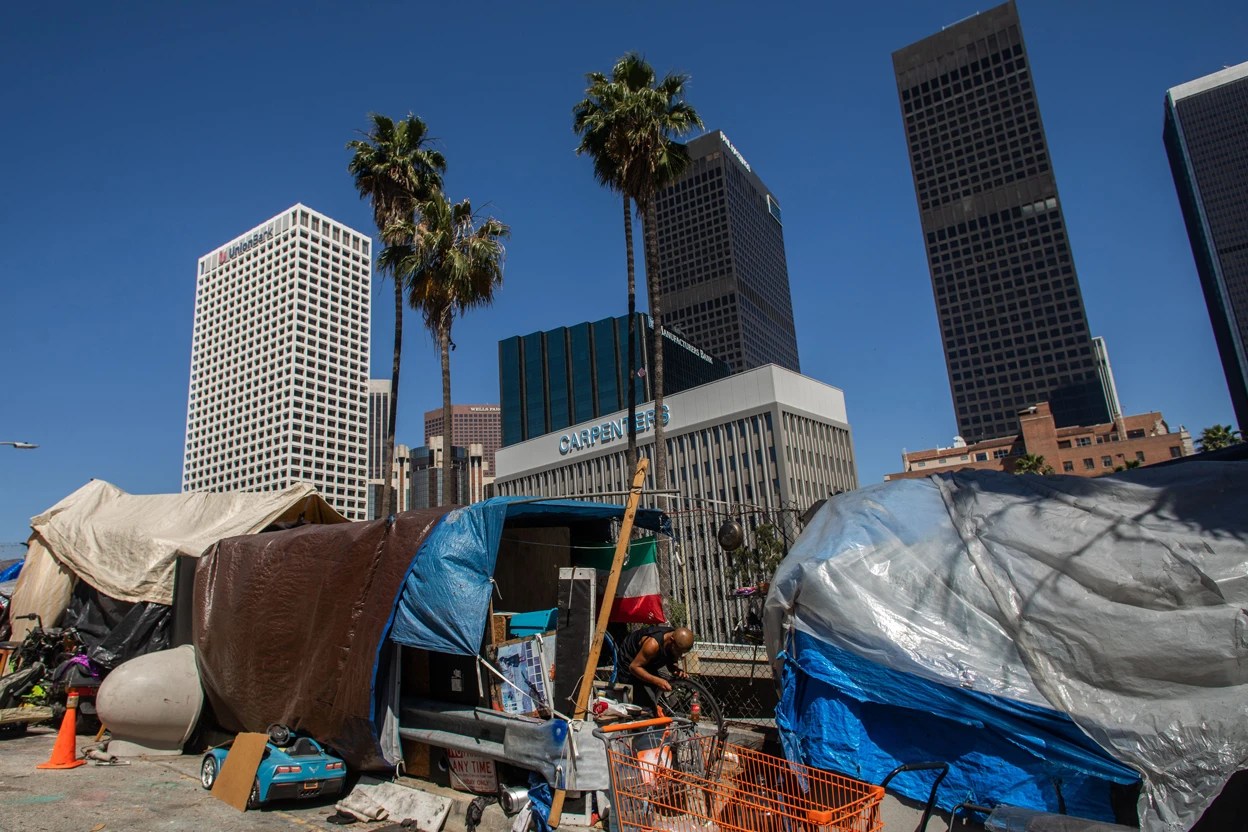
Richard Wilkinson and Kate Pickett on the research that suggest that greater equality is essential for sustainability, both natural and social. The science, they argue, is clear: people in more-equal societies are more trusting, cooperative, and more likely to protect the environment than are those in unequal, consumer-driven ones…
As environmental, social and humanitarian crises escalate, the world can no longer afford two things: first, the costs of economic inequality; and second, the rich. Between 2020 and 2022, the world’s most affluent 1% of people captured nearly twice as much of the new global wealth created as did the other 99% of individuals put together, and in 2019 they emitted as much carbon dioxide as the poorest two-thirds of humanity. In the decade to 2022, the world’s billionaires more than doubled their wealth, to almost US$12 trillion.
The evidence gathered by social epidemiologists, including us, shows that large differences in income are a powerful social stressor that is increasingly rendering societies dysfunctional. For example, bigger gaps between rich and poor are accompanied by higher rates of homicide and imprisonment. They also correspond to more infant mortality, obesity, drug abuse and COVID-19 deaths, as well as higher rates of teenage pregnancy and lower levels of child well-being, social mobility and public trust. The homicide rate in the United States — the most unequal Western democracy — is more than 11 times that in Norway (see go.nature.com/49fuujr). Imprisonment rates are ten times as high, and infant mortality and obesity rates twice as high.
These problems don’t just hit the poorest individuals, although the poorest are most badly affected. Even affluent people would enjoy a better quality of life if they lived in a country with a more equal distribution of wealth, similar to a Scandinavian nation. They might see improvements in their mental health and have a reduced chance of becoming victims of violence; their children might do better at school and be less likely to take dangerous drugs.
The costs of inequality are also excruciatingly high for governments. For example, the Equality Trust, a charity based in London (of which we are patrons and co-founders), estimated that the United Kingdom alone could save more than £100 billion ($126 billion) per year if it reduced its inequalities to the average of those in the five countries in the Organisation for Economic Co-operation and Development (OECD) that have the smallest income differentials — Denmark, Finland, Belgium, Norway and the Netherlands. And that is considering just four areas: greater number of years lived in full health, better mental health, reduced homicide rates and lower imprisonment rates.
Many commentators have drawn attention to the environmental need to limit economic growth and instead prioritize sustainability and well-being. Here we argue that tackling inequality is the foremost task of that transformation. Greater equality will reduce unhealthy and excess consumption, and will increase the solidarity and cohesion that are needed to make societies more adaptable in the face of climate and other emergencies…
Eminently worth reading in full: “Why the world cannot afford the rich,” from @ProfRGWilkinson and @ProfKEPickett in @Nature.
* Victoria Woodhull, the first woman to run for President of the United States, 1872
###
As we find balance, we might recall that it was on this date in 1914 that Charlie Chaplin first appeared as (what became is signature character) “The Tramp” in Mack Sennet’s Mabel’s Strange Predicament.

You must be logged in to post a comment.