Posts Tagged ‘Cory Doctorow’
“Everything is destroyed by its own particular vice: the destructive power resides within”*…
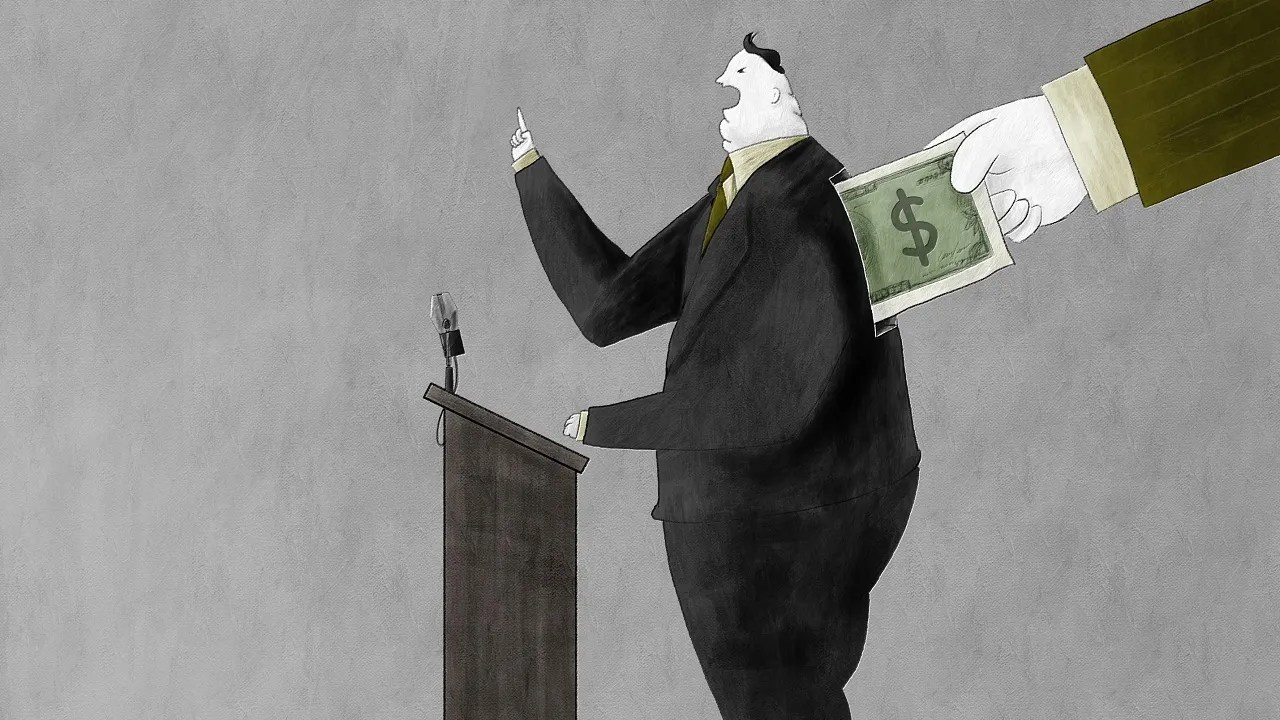
Government graft in the U. S. has a long (and unbroken) history; but there have been especially corrupt periods, for instance in the Jacksonian era and the Gilded Age… and again today.
Profiteering and insider trading, “pay-to-play”/influence peddling, foreign emoluments, conflicts of interest, regulatory and policy favors, purchased pardons (and commutations)– we’ve got it all, and at epic levels.
The estimable Cory Doctorow uses a telling comparison to drill down on one of the dominant strands: Trump’s (ironic) campaign to fight (what he identifies as) corruption…
… It’s a story about boss-politics anti-corruption, in which anti-corruption is pursued to corrupt ends.
From 2012-2015, Xi Jinping celebrated his second term as the leader of China with a mass purge undertaken in the name of anti-corruption. Officials from every level of Chinese politics were fired, and many were imprisoned. This allowed Xi to consolidate his control over the CCP, which culminated in a rule-change that eliminated term-limits, paving the way for Xi to continue to rule China for so long as he breathes and wills to power.
Xi’s purge exclusively targeted officials in his rivals’ power-base, kneecapping anyone who might have blocked his power-grab. But just because Xi targeted his rivals’ princelings and foot-soldiers, it doesn’t mean that Xi was targeting the innocent. A 2018 paper by an economist (Peter Lorentzen, USF) and a political scientist (Xi Lu, NUS) concluded that Xi’s purge really did target corrupt officials.
The authors reached this conclusion by referencing the data published in the resulting corruption trials, which showed that these officials accepted and offered bribes and feathered their allies’ nests at public expense.
In other words, Xi didn’t cheat by framing innocent officials for crimes they didn’t commit. The way Xi cheated was by exclusively targeting his rivals’ allies. Lorentzen and Lu’s paper make it clear that Xi could easily have prosecuted many corrupt officials in his own power base, but he left them unmolested.
This is corrupt anti-corruption. In an environment in which everyone in power is crooked, you can exclusively bring legitimate prosecutions, and still be doing corruption. You just need to confine your prosecutions to your political enemies, whether or not they are more guilty than your allies (think here of the GOP dragging the Clintons into Epstein depositions).
14 years later, Xi’s anti-corruption purges continue apace, with 100 empty seats at this year’s National People’s Congress, whose former occupants are freshly imprisoned or awaiting trial.
I don’t know the details of all 100 prosecutions, but China absolutely has a corruption problem that goes all the way to the upper echelon of the state. I find it easy to believe that the officials Xi has targeted are guilty – and I also wouldn’t be surprised to hear that they are all supporters of Xi’s internal rivals for control of the CCP.
As the Epstein files demonstrate, anyone hoping to conduct a purge of America’s elites could easily do so without having to frame anyone for crimes they didn’t commit (remember, Epstein didn’t just commit sex crimes – he was also a flagrant financial criminal and he implicated his network in those crimes).
It’s not just Epstein. As America’s capital classes indulge their incestuous longings with an endless orgy of mergers, it’s corporate Habsburg jaws as far as the eye can see. These mergers are all as illegal as hell, but if you fire a mouthy comedian, you can make serious bank.
And if you pay the right MAGA chud podcaster a million bucks, he’ll grease your $14b merger through the DoJ.
And once these crooks merge to monopoly, they embark on programs of lawlessness that would shame Al Capone, but again, with the right podcaster on your side, you can keep on “robbing them blind, baby!”
The fact that these companies are all guilty is a foundational aspect of Trumpism. Boss-politics antitrust – and anti-corruption – doesn’t need to manufacture evidence or pretexts to attack Trump’s political rivals. When everyone is guilty, you have a target-rich environment for extorting bribes.
Just because the anti-corruption has legit targets, it doesn’t follow that the whole thing isn’t corrupt…
On the practice of selective enforcement and prosecution: “Corrupt anticorruption,” from @pluralistic.net.web.brid.gy.
For thoughts on what we can do about all of this, see “Building political integrity to stamp out corruption: three steps to cleaner politics” (source of the image above)
* Menander
###
As we decide on disinfectants, we might recall that it was on this date in 37 CE, following the death of Tiberius, that the Roman Senate annulled Tiberius’ will and confirmed Caligula, his grandnephew, as the third Roman emperor. (Tiberius had willed that the reign should be shared by his nephew [and adopted son] Germanicus and Germanicus’ son, Caligula.)
While he has been remembered as the poster boy for profligacy and corruption, Caligula (“Little Boots”) is generally agreed to have been a temperate ruler through the first six months of his reign. His excesses after that– cruelty, self-dealing, extravagance, sexual perversity– are “known” to us via sources increasingly called into question.
Still, historians agree that Caligula did work hard to increase the unconstrained personal power of the emperor at the expense of the countervailing Principate; and he oversaw the construction of notoriously luxurious dwellings for himself. In 41 CE, members of the Roman Senate and of Caligula’s household attempted a coup to restore the Republic. They enlisted the Praetorian Guard, who killed Caligula– the first Roman Emperor to be assassinated (Julius Caesar was assassinated, but was Dictator, not Emperor). In the event, the Praetorians thwarted the Republican dream by appointing (and supporting) Caligula’s uncle Claudius as the next Emperor.

“Unless we change direction, we are likely to end up where we are headed”*…

… And so, the estimable Cory Doctorow argues in his wonderful blog/newsletter Pluralistic, we’d better make ourselves ready.
Further, in a fashion to last week’s (R)D post on the arrival of authoritarianism in the U.S. (to which your correspondent would have added Garret Graff‘s powerful essay had it landed in time)…
As Trump rails against free trade, demands public ownership stakes in corporations that receive government funds, and (selectively) enforces antitrust law, some (stupid) people are wondering, “Is Trump a communist?”
In The American Prospect, David Dayen writes about the strange case of Trump’s policies, which fly in the face of right wing economic orthodoxy and have the superficial trappings of a leftist economic program.
The problem isn’t that tariffs are always bad, nor is it that demanding state ownership stakes in structurally important companies that depend on public funds is bad policy. The problem is that Trump’s version of these policies sucks, because everything Trump touches dies, and because he governs solely on vibes, half-remembered wisdom imparted by the last person who spoke to him, and the dying phantoms of old memories as they vanish beneath a thick bark of amyloid plaque.
Take Trump’s demand for a 10% stake in Intel (a course of action endorsed by no less than Bernie Sanders). Intel is a company in trouble, whose financialization has left it dependent on other companies (notably TMSC) to make its most advanced chips. The company has hollowed itself out, jettisoning both manufacturing capacity and cash reserves, pissing away the funds thus freed up on stock buybacks and dividends.
Handing Trump a 10% “golden share” does nothing to improve Intel’s serious structural problems. And if you take Trump at his word and accept that securing US access to advanced chips is a national security priority, Trump’s Intel plan does nothing to advance that access. But it gets worse: Trump also says denying China access to these chips is a national security priority, but he greenlit Nvidia’s plan to sell its top-of-the-range silicon to China in exchange for a gaudy statuette and a 15% export tax.
It’s possible to pursue chip manufacturing as a matter of national industrial policy, and it’s even possible to achieve this goal by taking ownership stakes in key firms – because it’s often easier to demand corporate change via a board seat than it is to win the court battles needed to successfully invoke the Defense Production Act. The problem is that Trumpland is uninterested in making any of that happen. They just want a smash and grab and some red meat for the base: “Look, we made Intel squeal!”
Then there’s the Trump tariffs. Writing in Vox EU, Lausanne prof of international business Richard Baldwin writes about the long and checkered history of using tariffs to incubate and nurture domestic production.
The theory of tariffs goes like this: if we make imports more expensive by imposing a tax on them (tariffs are taxes that are paid by consumers, after all), then domestic manufacturers will build factories and start manufacturing the foreign goods we’ve just raised prices on. This is called “import substitution,” and it really has worked, but only in a few cases.
What do those cases have in common? They were part of a comprehensive program of “export discipline, state-directed credit, and careful government–business coordination.”
In other words, tariffs only work to reshore production where there is a lot of careful planning, diligent data-collection, and review. Governments have to provide credit to key firms to get them capitalized, provide incentives, and smack nonperformers around. Basically, this is the stuff that Biden did for renewables with the energy sector, and – to a lesser extent – for silicon with the CHIPS Act.
Trump’s not doing any of that. He’s just winging it. There’s zero follow-through. It’s all about appearances, soundbites, and the libidinal satisfaction of watching corporate titans bend the knee to your cult leader.
This is also how Trump approaches antitrust. When it comes to corporate power, both Trump and Biden’s antitrust enforcers are able to strike terror into the hearts of corporate behemoths. The difference is that the Biden administration prioritized monopolists based on how harmful they were to the American people and the American economy, whereas Trump’s trustbusters target companies based on whether Trump is mad at them.
What’s more, any company willing to hand a million or two to a top Trump enforcer can just walk away from the charges.
In her 2023 book Doppelganger, Naomi Klein introduces the idea of a right-wing “mirror world” that offers a conspiratorial, unhinged version of actual problems that leftists wrestle with.
For example, the antivax movement claims that pharma companies operate on the basis of unchecked greed, without regard to the harm their defective products cause to everyday people. When they talk about this, they sound an awful like leftists who are angry that the Sacklers killed a million Americans with their opiods and then walked away with billions of dollars.
Then there are the conspiracy theories about voting machines. Progressives have been sounding the alarm about the security defects in voting machine since the Bush v Gore years, but that doesn’t mean that Venezuelan hackers stole the 2020 election for Biden.
When anti-15-minute-city weirdos warn that automated license-plate cameras are a gift to tyrants both petty and gross, they are repeating a warning that leftists have sounded since the Patriot Act.
The mirror-world is a world where real problems (the rampant sexual abuse of children by powerful people and authortiy figures) are met with fake solutions (shooting up pizza parlors and transferring Ghislaine Maxwell to a country-club prison).
Most of the people stuck in the mirror world are poor and powerless, because desperation makes you an easy mark for grifters peddling conspiracy theories. But Trump’s policies on corporate power are what happens in the mirror world inhabited by the rich and powerful.
Trump is risking the economic future of every person in America (except a few cronies), but that’s not the only risk here. There’s also the risk that reasonable people will come to view industrial policy, government stakes in publicly supported companies, and antitrust as reckless showboating, a tactic exclusively belonging to right wing nutjobs and would-be dictators.
Sociologists have a name for this: they call it “schismogenesis,” when a group defines itself in opposition to its rivals. Schismogenesis is progressives insisting that voting machines and pharma companies are trustworthy and that James Comey is a resistance hero.
After we get rid of Trump, America will be in tatters. We’re going to need big, muscular state action to revive the nation and rebuild its economy. We can’t afford to let Trump poison the well for the very idea of state intervention in corporate activity…
Trump’s mirror-world New Deal: “The capitalism of fools,” from @pluralistic.net.web.brid.gy.
And for a (think tank’s) take on the state of socio-political play: “U.S. Democratic Backsliding in Comparative Perspective.”
* Chinese proverb
###
As we ready ourselves, we might note (per the Garret Graff piece linked above) that…
Just months short of the nation’s 250th birthday, Donald Trump is close to batting a thousand at speed-running the very abuses of power that led the Founders to write the Declaration of Independence in the first place. Does any of this sound familiar:
- He has refused his Assent to Laws, the most wholesome and necessary for the public good.
- For taking away our Charters, abolishing our most valuable Laws, and altering fundamentally the Forms of our Governments
- He has kept among us, in times of peace, Standing Armies without the Consent of our legislatures.
- He has erected a multitude of New Offices, and sent hither swarms of Officers to harrass our people, and eat out their substance.
- He has obstructed the Administration of Justice, by refusing his Assent to Laws for establishing Judiciary powers.
- He has abdicated Government here, by declaring us out of his Protection and waging War against us.
- For cutting off our Trade with all parts of the world
- For imposing Taxes on us without our Consent
- For depriving us in many cases, of the benefits of Trial by Jury
- For transporting us beyond Seas to be tried for pretended offences
And so on…
And we might recall that it was on this date in 1752 that the Liberty Bell was officially placed in the Pennsylvania State House (now Independence Hall) in Philadelphia. In its early years, the bell was used to summon lawmakers to legislative sessions and to alert citizens to public meetings and proclamations. It is likely that the Liberty Bell was among the bells in Philadelphia to ring on July 8, 1776, when the Declaration of Independence was first read to the public, although no contemporary account of the ringing exists.


“Never call an accountant a credit to his profession; a good accountant is a debit to his profession.”*…

The estimable Henry Farrell on accountancy as a lens on the hidden systems of the world…
When reading Cory Doctorow’s latest novel, The Bezzle [which your correspondent highly recommends], I kept on thinking about another recent book, Bruce Schneier’s A Hacker’s Mind: How the Powerful Bend Society’s Rules and How to Bend Them Back [ditto]. Cory’s book is fiction, and Bruce’s non-fiction, but they are clearly examples of the same broad genre (the ‘pre-apocalyptic systems thriller’?). Both are about hackers, but tell us to pay attention to other things than computers and traditional information systems. We need to go beneath the glossy surfaces of cyberpunk and look closely at the messy, complex systems of power beneath them. And these systems – like those described in the very early cyberpunk of William Gibson and others – are all about money and power.
What Bruce says:
In my story, hacking isn’t just something bored teenagers or rival governments do to computer systems … It isn’t countercultural misbehavior by the less powerful. A hacker is more likely to be working for a hedge fund, finding a loophole in financial regulations that lets her siphon extra profits out of the system. He’s more likely in a corporate office. Or an elected official. Hacking is integral to the job of every government lobbyist. It’s how social media systems keep us on our platform.
Bruce’s prime example of hacking is Peter Thiel using a Roth IRA to stash his Paypal shares and turn them into $5 billion, tax free.
This underscores his four key points. First, hacking isn’t just about computers. It’s about finding the loopholes; figuring out how to make complex system of rules do things that they aren’t supposed to. Second, it isn’t countercultural. Most of the hacking you might care about is done by boring seeming people in boring seeming clothes (I’m reminded of Sam Anthony’s anecdote about how the costume designer of the film Hackers visited with people at a 2600 conference for background research, but decided that they “were a bunch of boring nerds and went and took pictures of club kids on St. Marks instead”). Third, hacking tends to reinforce power symmetries rather than undermine them. The rich have far more resources to figure out how to gimmick the rules. Fourth, we should mostly identify ourselves not with the hackers but the hacked. Because that is who, in fact, we mostly are….
…
… Still, there are things you can do to fight back. One of the major themes of The Bezzle is that prison is now a profit model. Tyler Cowen, the economist, used to talk a lot about “markets in everything.” I occasionally responded by pointing to “captive markets in everything.” And there isn’t any market that is more literally captive than prisoners. As for-profit corporations (and venal authorities) came to realize this, they started to systematically remake the rules and hack the gaps in the regulatory system to squeeze prisoners and their relatives for as much money as possible, charging extortionate amounts for mail, for phone calls, for books that could only be accessed through proprietary electronic tablets.
That’s changing, in part thanks to ingenious counter hacking. The Appeal published a piece last week on how Securus, “the nation’s largest prison and jail telecom corporation,” had to effectively default on nearly a billion dollars of debt. Part of the reason for the company’s travails is that activists have figured out how to use the system against it…
…
… In other sectors, where companies doing sketchy things have publicly traded shares, activists have started getting motions passed at shareholder meetings, to challenge their policies. However, the companies have begun in turn to sue, using the legal system in unconventional ways to try to prevent these unconventional tactics. Again, as both Bruce and Cory suggest, the preponderance of hacking muscle is owned by the powerful, not those challenging them.
Even so, the more that ordinary people understand the complexities of the system, the more that they will be able to push back. Perhaps the most magnificent example of this is Max Schrems, an Austrian law student who successfully bollocksed-up the entire system of EU-US data transfers by spotting loopholes and incoherencies and weaponizing them in EU courts. Cory’s Martin Hench books seem to me to purpose-designed to inspire a thousand Max Schrems – people who are probably past their teenage years, have some grounding in the relevant professions, and really want to see things change.
And in this, the books return to some of the original ambitions of ‘cyberpunk,’ a somewhat ungainly and contested term that has come to emphasize the literary movement’s countercultural cool over its actual intentions…
One word that never appears in Neuromancer, and for good reason: “Internet.” When it was written, the Internet was just one among many information networks, and there was no reason to suspect that it would defeat and devour its rivals, subordinating them to its own logic. Before cyberspace and the Internet became entangled, Gibson’s term was a synecdoche for a much broader set of phenomena. What cyberspace actually referred to back then was more ‘capitalism’ than ‘computerized information.’
So, in a very important sense, The Bezzle returns to the original mission statement – understanding how the hacker mythos is entwined with capitalism. To actually understand hacking, we need to understand the complex systems of finance and how they work. If you really want to penetrate the system, you need to really grasp what money is and what it does. That, I think, is what Cory is trying to tell us. And so too Bruce. The nexus between accountancy and hacking is not a literary trick or artifice. It is an important fact about the world, which both fiction and non-fiction writers need to pay attention to…
Eminently worth reading in full: “Today’s hackers wear green eyeshades, not mirrorshades,” from @henryfarrell in his invaluable newsletter Programmable Mutter.
###
As we ponder power, we might recall that on this date in 1927, a “counter-hacker” in a different domain, Mae West, was sentenced to jail for obscenity.
Her first starring role on Broadway was in a 1926 play entitled Sex, which she wrote, produced, and directed. Although conservative critics panned the show, ticket sales were strong. The production did not go over well with city officials, who had received complaints from some religious groups, and the theater was raided and West arrested along with the cast. She was taken to the Jefferson Market Court House (now Jefferson Market Library), where she was prosecuted on morals charges, and on April 19, 1927, was sentenced to 10 days for “corrupting the morals of youth.” Though West could have paid a fine and been let off, she chose the jail sentence for the publicity it would garner. While incarcerated on Welfare Island (now known as Roosevelt Island), she dined with the warden and his wife; she told reporters that she had worn her silk panties while serving time, in lieu of the “burlap” the other girls had to wear. West got great mileage from this jail stint. She served eight days with two days off for “good behavior”.
Wikipedia

“When the past is always with you, it may as well be present; and if it is present, it will be future as well.”*…
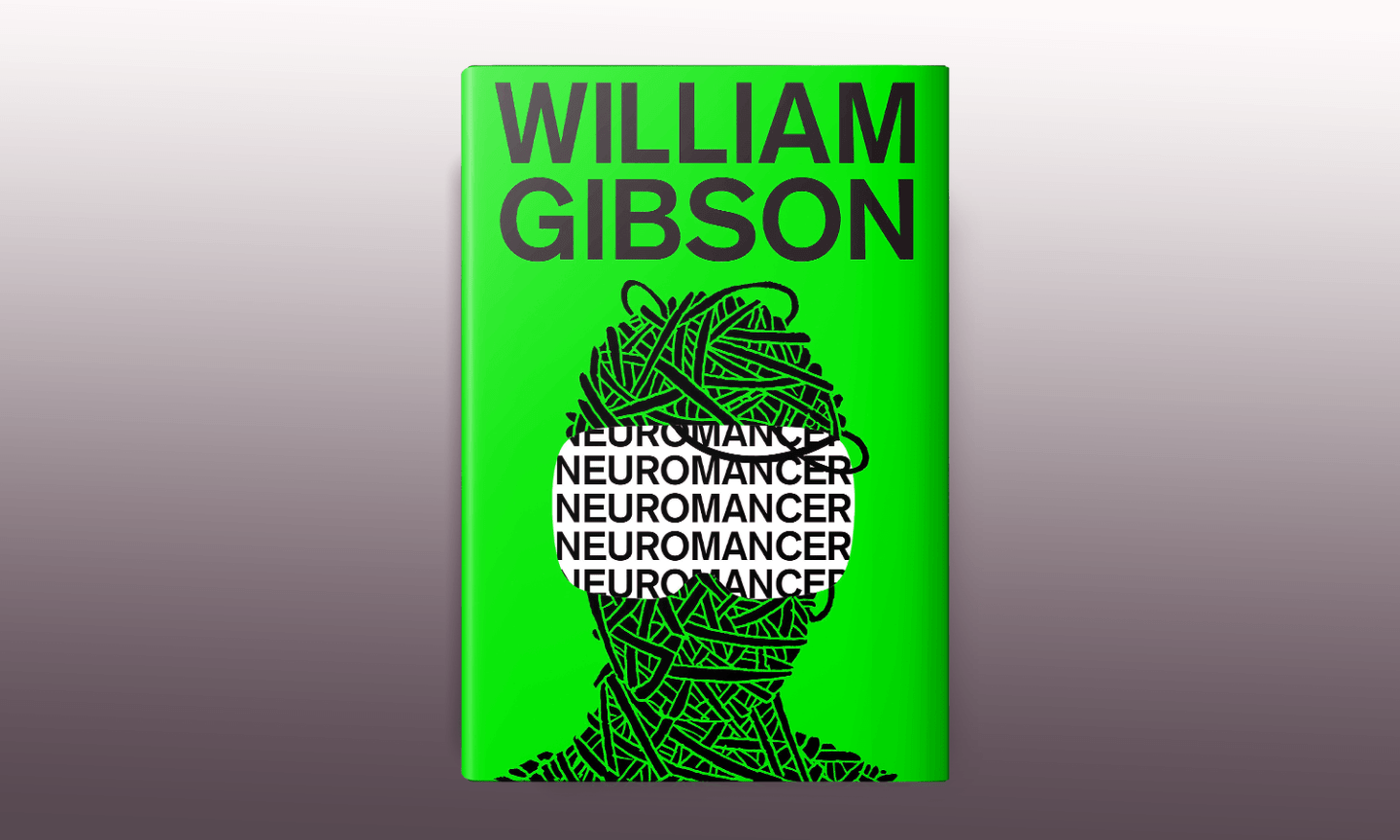
It’s been nearly 40 years since Gibson’s seminal Neuromancer was published. As Cory Doctorow notes, Eileen Gunn was a friend of Gibson’s from the earliest days, who while an exec at Microsoft, hosted him – then a penniless aspiring writer – in Seattle and took him to the hacker bars where he eavesdropped on what he calls “the poetics of the technological subculture.” She reflects on Neuromancer‘s impact– its lessons and the questions it raises– then and now…
… William Gibson’s cool, collected language doesn’t make a big deal about this being the future. Your brain glides smoothly past quotidian details that might have been futuristic the first time you read them, but now are just the way the world rolls. The transition to global connectedness and a global economy has been accomplished; cyberspace is here and people all over the world have casual access to it; outer space is an international arena and not just a US/Soviet hegemony. There are Russians here, or, at least, the clunky remains of their materiel, but, presciently, there are no Soviets in Neuromancer...
What is most interesting about Neuromancer is not the caper––although that’s certainly intricate and interesting itself. It’s not simply the suggestion of a compelling future––some of which has vanished from the text merely by coming to pass, but much of which is intact and captivating. What is most interesting to me, after forty years and many re-readings, is its meditation on the relationship between personality and memory and humanity, on originality and creativity, on what makes people real…
Gibson himself has said that, in creating a future that didn’t end in a global nuclear disaster, he thought he was creating an optimistic future. In the 1980s, reading Neuromancer’s grim future somehow alleviated, for me at least, the fear that the unknown future would be unsurvivable. It made today a familiar place. Our fears are different now, but Gibson’s books continue to serve that purpose….
I urge you to read and re-read not only Neuromancer, but Count Zero and Mona Lisa Overdrive, the subsequent books in the Sprawl trilogy. As Gibson continued to explore this alternate future, he continued to extend his mastery of craft and content. In the two following books, his larger vision of what he was writing about becomes evident, as I think it did to him as he wrote them. The Gibsonian world and the Gibsonian universe are larger and more diverse than Neuromancer, larger even than this entire trilogy. They contain multitudes. If you don’t already know them, I hope you will check them all out. His peculiar dystopian optimism, that humans will somehow elude complete obliteration, has grown larger over the years, and we need it more than ever…
Amen. “William Gibson’s Neuromancer: Does the Edge Still Bleed?,” from @eileen_gunn via @doctorow.
* William Gibson, Neuromancer
###
As we find our ways forward, we might send ruminative birthday greetings to a master of a different genre, Georges Joseph Christian Simenon; he was born on this date in 1903. A prolific author (who published nearly 500 novels and numerous short works), he is best known as the creator of the fictional detective Jules Maigret. His work is featured in the collection La Pléiade (inspiration for the Library of America), and in 1966 he was awarded the Mystery Writers of America’s highest honor, the Grand Master Award.

“Everyone waits in line”*…

What we can learn from studying the crowd-management approaches at Disneyland…
Who gets to do what and when at a themepark may sound like a trivial question, but I think it’s a perfect little microcosm for the distributional problems that are at the heart of all political economy – questions that the pandemic’s shortages and shocks threw into stark relief…
Stay in your lane: “The definitive answers to Disney’s pernicious queueing debates,” from Cory Doctorow (@doctorow)
The video that Cory recommends:
(image at the top: source)
* Paul Theroux
###
As we bide our time, we might recall that it was on this date in 1971 that traffic-choking crowds jammed Walt Disney World to capacity (on the day after Thanksgiving). Shortly before noon the Florida park closed its gates to additional visitors.

You must be logged in to post a comment.