Posts Tagged ‘Caligula’
“Everything is destroyed by its own particular vice: the destructive power resides within”*…
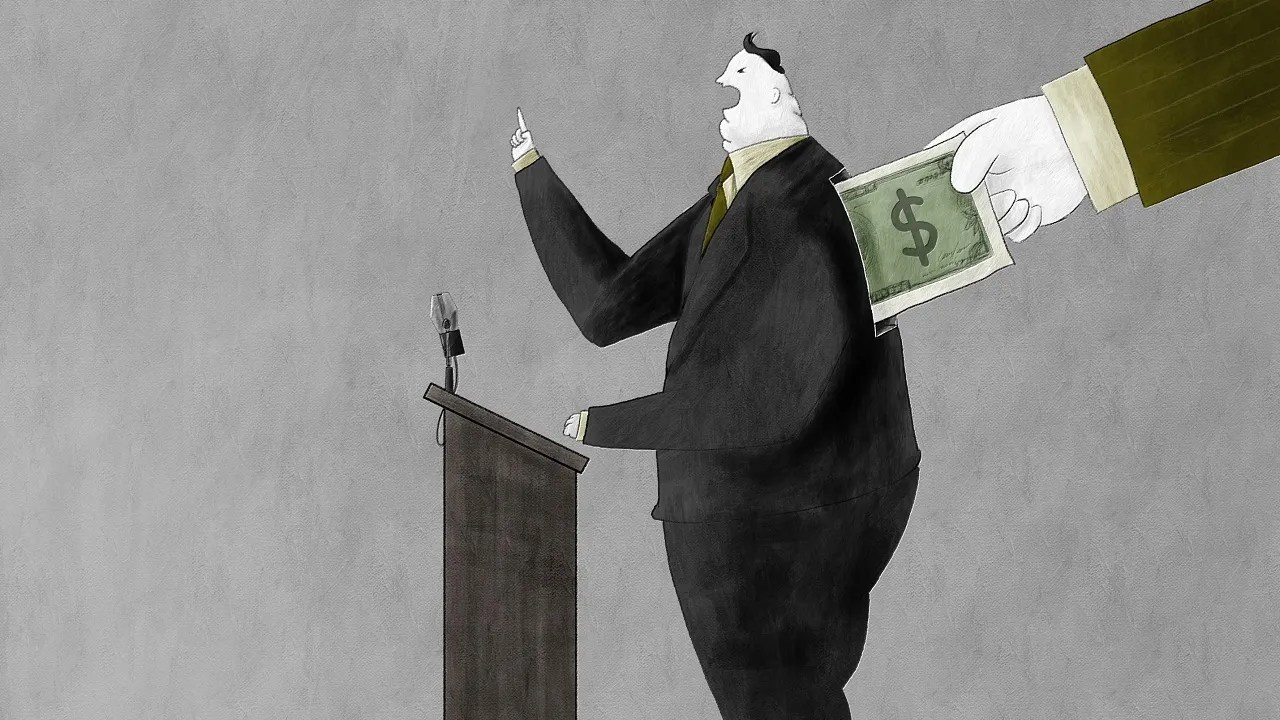
Government graft in the U. S. has a long (and unbroken) history; but there have been especially corrupt periods, for instance in the Jacksonian era and the Gilded Age… and again today.
Profiteering and insider trading, “pay-to-play”/influence peddling, foreign emoluments, conflicts of interest, regulatory and policy favors, purchased pardons (and commutations)– we’ve got it all, and at epic levels.
The estimable Cory Doctorow uses a telling comparison to drill down on one of the dominant strands: Trump’s (ironic) campaign to fight (what he identifies as) corruption…
… It’s a story about boss-politics anti-corruption, in which anti-corruption is pursued to corrupt ends.
From 2012-2015, Xi Jinping celebrated his second term as the leader of China with a mass purge undertaken in the name of anti-corruption. Officials from every level of Chinese politics were fired, and many were imprisoned. This allowed Xi to consolidate his control over the CCP, which culminated in a rule-change that eliminated term-limits, paving the way for Xi to continue to rule China for so long as he breathes and wills to power.
Xi’s purge exclusively targeted officials in his rivals’ power-base, kneecapping anyone who might have blocked his power-grab. But just because Xi targeted his rivals’ princelings and foot-soldiers, it doesn’t mean that Xi was targeting the innocent. A 2018 paper by an economist (Peter Lorentzen, USF) and a political scientist (Xi Lu, NUS) concluded that Xi’s purge really did target corrupt officials.
The authors reached this conclusion by referencing the data published in the resulting corruption trials, which showed that these officials accepted and offered bribes and feathered their allies’ nests at public expense.
In other words, Xi didn’t cheat by framing innocent officials for crimes they didn’t commit. The way Xi cheated was by exclusively targeting his rivals’ allies. Lorentzen and Lu’s paper make it clear that Xi could easily have prosecuted many corrupt officials in his own power base, but he left them unmolested.
This is corrupt anti-corruption. In an environment in which everyone in power is crooked, you can exclusively bring legitimate prosecutions, and still be doing corruption. You just need to confine your prosecutions to your political enemies, whether or not they are more guilty than your allies (think here of the GOP dragging the Clintons into Epstein depositions).
14 years later, Xi’s anti-corruption purges continue apace, with 100 empty seats at this year’s National People’s Congress, whose former occupants are freshly imprisoned or awaiting trial.
I don’t know the details of all 100 prosecutions, but China absolutely has a corruption problem that goes all the way to the upper echelon of the state. I find it easy to believe that the officials Xi has targeted are guilty – and I also wouldn’t be surprised to hear that they are all supporters of Xi’s internal rivals for control of the CCP.
As the Epstein files demonstrate, anyone hoping to conduct a purge of America’s elites could easily do so without having to frame anyone for crimes they didn’t commit (remember, Epstein didn’t just commit sex crimes – he was also a flagrant financial criminal and he implicated his network in those crimes).
It’s not just Epstein. As America’s capital classes indulge their incestuous longings with an endless orgy of mergers, it’s corporate Habsburg jaws as far as the eye can see. These mergers are all as illegal as hell, but if you fire a mouthy comedian, you can make serious bank.
And if you pay the right MAGA chud podcaster a million bucks, he’ll grease your $14b merger through the DoJ.
And once these crooks merge to monopoly, they embark on programs of lawlessness that would shame Al Capone, but again, with the right podcaster on your side, you can keep on “robbing them blind, baby!”
The fact that these companies are all guilty is a foundational aspect of Trumpism. Boss-politics antitrust – and anti-corruption – doesn’t need to manufacture evidence or pretexts to attack Trump’s political rivals. When everyone is guilty, you have a target-rich environment for extorting bribes.
Just because the anti-corruption has legit targets, it doesn’t follow that the whole thing isn’t corrupt…
On the practice of selective enforcement and prosecution: “Corrupt anticorruption,” from @pluralistic.net.web.brid.gy.
For thoughts on what we can do about all of this, see “Building political integrity to stamp out corruption: three steps to cleaner politics” (source of the image above)
* Menander
###
As we decide on disinfectants, we might recall that it was on this date in 37 CE, following the death of Tiberius, that the Roman Senate annulled Tiberius’ will and confirmed Caligula, his grandnephew, as the third Roman emperor. (Tiberius had willed that the reign should be shared by his nephew [and adopted son] Germanicus and Germanicus’ son, Caligula.)
While he has been remembered as the poster boy for profligacy and corruption, Caligula (“Little Boots”) is generally agreed to have been a temperate ruler through the first six months of his reign. His excesses after that– cruelty, self-dealing, extravagance, sexual perversity– are “known” to us via sources increasingly called into question.
Still, historians agree that Caligula did work hard to increase the unconstrained personal power of the emperor at the expense of the countervailing Principate; and he oversaw the construction of notoriously luxurious dwellings for himself. In 41 CE, members of the Roman Senate and of Caligula’s household attempted a coup to restore the Republic. They enlisted the Praetorian Guard, who killed Caligula– the first Roman Emperor to be assassinated (Julius Caesar was assassinated, but was Dictator, not Emperor). In the event, the Praetorians thwarted the Republican dream by appointing (and supporting) Caligula’s uncle Claudius as the next Emperor.

“Heavy Metal is the most conservative of all loud music. Let’s face it, not even a gym teacher could get as many people to dress alike.”*…

Jeremy Swist on heavy metal’s fascination with Roman emperors…
Roman emperors have enjoyed a prolific reception in metal music around the world—Caligula and Nero most of all, with not only hundreds of individual songs but also entire concept albums dedicated to them, such as the Belgian band Paragon Impure’s 2005 album To Gaius! (For the Delivery of Agrippina) and the Russian band Neron Kaisar’s 2013 album Madness of the Tyrant. The year 2021 saw the release of two separate records about Nero: the UK band Acid Age’s Semper Pessimus and the Canadian band Ex Deo’s The Thirteen Years of Nero. The extent of certain emperors’ popularity can even be quantified, thanks to the online database Encyclopaedia Metallum. Entering each emperor’s name into the advanced search for their appearance in lyrics and song titles, and after eliminating duplicates and false positives (e.g., nero being Italian for “black”), led me to create the following bar graph, which went semi-viral on Twitter in April 2021:

Nero with 139 songs, followed by Caligula with 110, tops a sizable catalogue of 444 songs. Yet this data set consists only of mentions by name in songs with available lyrics in the Encyclopaedia Metallum and excludes untold numbers of tracks about emperors that do not name them, such as “Incitatus,” an old-school death metal ode to Caligula’s horse and would-be consul from 2019 by the Brazilian band Orthostat, or the American band Graves of Valor’s 2009 song “Locusta,” named after the woman Nero praises as the poisoner of not only his predecessor Claudius but also his stepbrother Britannicus and his mother Agrippina.
The numbers speak for themselves: emperors are metal. But why?…
Find out: “Enjoy My Flames,” from @MetalClassicist in @laphamsquart— an illuminating (and entertaining) look at (what is, in the end) a fascinating sub-genre of historical fiction, and what it tells us about our times.
###
As we ponder head-banging, we might recall that on this date in 2003 Metallica’s St. Anger (the heavy metal band’s eighth studio album) was released– and went to #1 on the Billboard album chart (holding off a strong entry at #2 by Jewel, who’d moved on from her folkier roots to dance pop with 0304).

“The Roman era’s declension was a time in which bizarreness masqueraded as creativity”*…

The Roman Empire “shrank” from being ruled from several different cities in the fifth century, among them Alexandria, Antioch, Constantinople and Rome itself, to just Constantinople. Daisy Dunn reviews Paul Stephenson‘s new history of that period, The New Rome— a comprehensive explanation of the Eastern Empire’s transformation into Byzantium.
Drawing on scientific data, Stephenson demonstrates that the challenges faced by the last Roman emperors weren’t simply martial, economic, and theological; they also faced natural disasters, the degradation of the human environment, and pathogens previously unknown to the empire’s densely populated, unsanitary cities. In the end, despite the Plague of Justinian, regular “barbarian” invasions, a war with Persia, and the rise of Islam, the empire endured as a political entity (albeit “post-Roman”). But Greco-Roman civilization, a world of interconnected cities that had shared a common material culture for a millennium, did not…
Attempts to answer the time-old question of why Rome fell have been characterised in recent years by a new awareness of the role that factors including pollution and climate change played. Anyone who has shrugged at the suggestion that the weather had anything to do with the demise of such a mighty empire will, I think, come away from this book persuaded that climate change and natural disasters provide an important part of the answer. Far from being moralistic and attempting to apply the examples of the past as a warning, Stephenson lays down the evidence unemotionally, and lets it speak for itself.
The causes of change were not purely driven by human behaviour, though smelting and, even more so, heavy warfare in the era of invading Huns and Vandals, had a significant environmental impact. Pollen records reveal a dramatic decline in the growing of cereals in Greece by about 600AD and, from the seventh century, pollination was happening predominantly through nature rather than agriculture.
The root cause of this was the destruction of arable land following invasions and the decline in human settlements. Add to this diminishing sunlight — measurements of “deposited radionuclides” indicate a significant reduction of light between the midfourth and late seventh centuries — and we are looking at a radically different landscape in this period from that of the High Empire…
A new history of Byzantium reveals the inner workings of a late antique empire: “Wonders and warnings from the ancient world,” from @DaisyfDunn in @TheCriticMag.
* Edward Gibbon, The Decline and Fall of the Roman Empire
###
As we ponder precedent, we might recall that Rome’s prior history had not been without its perturbations. Indeed, it was on this date in 37 CE, following the death of Tiberius, that the Roman Senate annulled Tiberius’ will and confirmed Caligula, his grandnephew, the third Roman emperor. (Tiberius had willed that the reign should be shared by his nephew [and adopted son] Germanicus and Germanicus’ son, Caligula.)
While he has been remembered as the poster boy for profligacy, Caligula (“Little Boots”) is generally agreed to have been a temperate ruler through the first six months of his reign. His excesses after that– cruelty, extravagance, sexual perversity– are “known” to us via sources increasingly called into question.
Still, historians agree that Caligula did work hard to increase the unconstrained personal power of the emperor at the expense of the countervailing Principate; and he oversaw the construction of notoriously luxurious dwellings for himself. In 41 CE, members of the Roman Senate and of Caligula’s household attempted a coup to restore the Republic. They enlisted the Praetorian Guard, who killed Caligula– the first Roman Emperor to be assassinated (Julius Caesar was assassinated, but was Dictator, not Emperor). In the event, the Praetorians thwarted the Republican dream by appointing (and supporting) Caligula’s uncle Claudius the next Emperor.
“Before the monopoly should be permitted, there must be reason to believe it will do some good – for society, and not just for monopoly holders”*…

From the ever-illuminating Matt Stoller (@matthewstoller), eagle-eyed sentinel against exploitative monopolies…
I write a lot about big tech, but today’s issue is about something so basic and fundamental we literally don’t think about it. Salt. Salt mining is one of humanities’ oldest industries, with wars fought over this commodity. Cities like Venice monopolized the salt trade in the middle ages for geopolitical reasons, and the British tried to block colonists from access to salt during the American Revolution to prevent their ability to preserve food.
Today salt is still used in everything from chemicals to food preservation. Its main use is deicing our roads, because salt from mines across North America, and shipped in from overseas, makes it possible to drive in all sorts of weather. Salt saves lives, stops car accidents, and makes our economy run.
And in the U.S. and Canada, salt mining is being monopolized, as we speak…
In the winter, when it’s really cold and snowy, what Americans need is not a competitive semiconductor industry or better app stores. They need salt. And not the kind of salt that flavors our food, but the kind that melts snow and ice. If we don’t have salt, no one can drive, because salt is what keeps our roads manageable. Without salt, trucks can’t deliver supplies, people can’t get to stores or work, and the economy comes to a standstill.
And people die. A lot of them.
Every year, over 1300 people die in car accidents due to snowy, slushy, or icy pavement, with another 117,000 injured. Snowy weather is also a huge waste of time and money, costing roughly $500M a day, and 544 million vehicle-hours a year of delay. Road salt doesn’t eliminate this problem entirely, but it comes close, reducing collisions by up to 88% and injuries by 85%. Studies show that deicing salt pays for itself within the first 25 minutes after it is spread. Roughly 40% of domestic salt, produced largely from mining, is used not for food or chemicals, but for deicing. It’s a major expense for cities and states, and commercial customers like shopping malls. And because weather leads to demand spikes, and America tends to operate in just-in-time style inventory models instead of managing risk by storing surpluses of critical commodities, there are often shortages of road salt precisely when everyone needs it most.
And that’s why I paid attention when ex-convict and junk bond king Michael Milken’s alleged private equity firm, Stone Canyon, bought two major salt producers over the last year. Early in 2020, Stone Canyon acquired Kissner, a producer of deicing salt, private label consumer salt, and salt-related chemicals. Then, nine months later, Stone Canyon bought Morton’s Salt, the largest producer in the world, for $3.2 billion, and it is now awaiting antitrust approval. Kissner is itself a roll-up of the salt industry, having bought Central Salt and Lion Salt and turned itself from a small Ontario-based regional distributor of ice melt into one of the giants of the industry. So Stone Canyon is overseeing a roll-up of roll-ups.
This series of mergers should terrify cities across the upper Midwest, who have to buy salt in unpredictable spot markets and often deal with shortages when the weather gets bad. Minnesota, for instance, bought roughly 1.5 million tons of salt for the 2020 season. Salt is a regional business, it’s just not economical to move extremely bulky road salt over land more than 150 miles, so while port cities can get salt from abroad in ocean vessels, and salt can be barged up the Mississippi river, much of the upper Midwest and Canada has to buy local. (It doesn’t help that America’s rail system is monopolized.)…
The salt industry is an oligopoly, and the number of suppliers to Governments in regions of the Great Lakes markets will shrink from 4 to 3 and in some geographies from 3 suppliers to 2. There are two consequences of this consolidation of salt production. The first is that prices will go up, and municipal budgets will be stretched.
Salt is sold in blind bidding processes. Governments put out tender offers, and then suppliers bid. When bidding, suppliers will set prices by considering the supply levels among competitors. If there are only two competitors in a market and one of them has committed their salt production for the year, then the remaining one is a monopolist who can just set the price. This is particularly true for a bunch of Midwestern states, like Michigan, Ohio, Indiana, Illinois, Wisconsin, and Minnesota.
But the much more serious problem is that of shortages. The industry manages demand spikes from weather not by having spare production capacity or lots of storage, but by overpromising salt deliveries. The rule of thumb is that one out of every five years will see a mild winter with few sales, three out of five will be snowy but normal, and one out of five will involve extreme weather and much higher demand. Of course, rules of thumb have gone out of the window now that there’s more extreme weather, which means demand drops and spikes will be more common.
One of the best ways of winning market share is to bid low, and then if demand is high, to simply not deliver to Commercial customers (Landscapers that service residential and commercial customers are almost always shafted first, meaning driveways and sidewalks go unsalted.) There are penalties in contracts for doing this to government customers, but when the snow hits, it doesn’t matter and the producers often pay the penalties if they are even enforced by the government entities. All customers need the salt when it snows, and a contract dispute doesn’t get in the way.
It’s quite possible, and indeed likely, that shortages will worsen. Without competition, it will be much harder to go to a different supplier, because there won’t be any other suppliers. And private equity takeovers in general are operational nightmares, which means that it’s likely Kissner and Morton will have problems with production and distribution purely because mergers tend not to work out.
There’s one final piece of the problem. Because private equity firms have too much money and not enough acquisition targets, prices for mid-market industrial companies are really high. So Stone Canyon almost certainly overpaid for both Kissner and Morton’s. To justify its investment, Stone Canyon is going to have to cut costs and reduce capital spending, which will harm production, because salt mining needs a lot of investment. Then it will likely have to raise prices. In other words, if the merger goes through, the financial pressure of paying such rich prices for salt firms will force significant price hikes, and potentially shortages in the market…
A private-equity salt roll-up suggests that we’re in for shortages and price spikes: “How a Salt Monopoly Could Spike Car Accidents in the Midwest,” eminently worth reading in full.
For other reasons to be paying attention to salt: “How America got addicted to road salt — and why it’s become a problem.”
* Lawrence Lessig
###
As we study saline substitutions, we might recall that it was on this date in 37 CE, following the death of Tiberius, that the Roman Senate annulled Tiberius’ will and confirmed Caligula, his grandnephew, the third Roman emperor. (Tiberius had willed that the reign should be shared by his nephew [and adopted son] Germanicus and Germanicus’ son, Caligula.)
While he has been remembered as the poster boy for profligacy, Caligula (“Little Boots”) is generally agreed to have been a temperate ruler through the first six months of his reign. His excesses after that– cruelty, extravagance, sexual perversity– are “known” to us via sources increasingly called into question.
Still, historians agree that Caligula did work hard to increase the unconstrained personal power of the emperor at the expense of the countervailing Principate; and he oversaw the construction of notoriously luxurious dwellings for himself. In 41 CE, members of the Roman Senate and of Caligula’s household attempted a coup to restore the Republic. They enlisted the Praetorian Guard, who killed Caligula– the first Roman Emperor to be assassinated (Julius Caesar was assassinated, but was Dictator, not Emperor). In the event, the Praetorians thwarted the Republican dream by appointing (and supporting) Caligula’s uncle Claudius the next Emperor.

“A world constructed from the familiar is the world in which there’s nothing to learn”*…

In a surprising new national survey, members of each major American political party were asked what they imagined to be the beliefs held by members of the other. The survey asked Democrats: “How many Republicans believe that racism is still a problem in America today?” Democrats guessed 50%. It’s actually 79%. The survey asked Republicans how many Democrats believe “most police are bad people”. Republicans estimated half; it’s really 15%.
The survey, published by the think tank More in Common as part of its Hidden Tribes of America project, was based on a sample of more than 2,000 people. One of the study’s findings: the wilder a person’s guess as to what the other party is thinking, the more likely they are to also personally disparage members of the opposite party as mean, selfish or bad. Not only do the two parties diverge on a great many issues, they also disagree on what they disagree on.
This much we might guess. But what’s startling is the further finding that higher education does not improve a person’s perceptions – and sometimes even hurts it. In their survey answers, highly educated Republicans were no more accurate in their ideas about Democratic opinion than poorly educated Republicans. For Democrats, the education effect was even worse: the more educated a Democrat is, according to the study, the less he or she understands the Republican worldview.
“This effect,” the report says, “is so strong that Democrats without a high school diploma are three times more accurate than those with a postgraduate degree.” And the more politically engaged a person is, the greater the distortion.
What could be going on? Bubble-ism, the report suggests…
Arlie Hochschild explains: “Think Republicans are disconnected from reality? It’s even worse among liberals.”
* The Filter Bubble
###
As we contemplate commonality, we might recall that it was on this date in 37, following the death of Tiberius, that the Roman Senate annulled Tiberius’ will and confirmed Caligula, his grandnephew, the third Roman emperor. (Tiberius had willed that the reign should be shared by his nephew [and adopted son] Germanicus and Germanicus’ son, Caligula.)
While he has been remembered as the poster boy for profligacy, Caligula (“Little Boots”) is generally agreed to have been a temperate ruler through the first six months of his reign. His excesses after that– cruelty, extravagance, sexual perversity– are “known” to us via sources increasingly called into question.
Still, historians agree that Caligula did work hard to increase the unconstrained personal power of the emperor at the expense of the countervailing Principate; and he oversaw the construction of notoriously luxurious dwellings for himself. In 41 CE, members of the Roman Senate and of Caligula’s household attempted a coup to restore the Republic. They enlisted the Praetorian Guard, who killed Caligula– the first Roman Emperor to be assassinated (Julius Caesar was assassinated, but was Dictator, not Emperor). In the event, the Praetorians thwarted the Republican dream by appointing (and supporting) Caligula’s uncle Claudius the next Emperor.

You must be logged in to post a comment.