Posts Tagged ‘wealth’
“Follow the money”*…
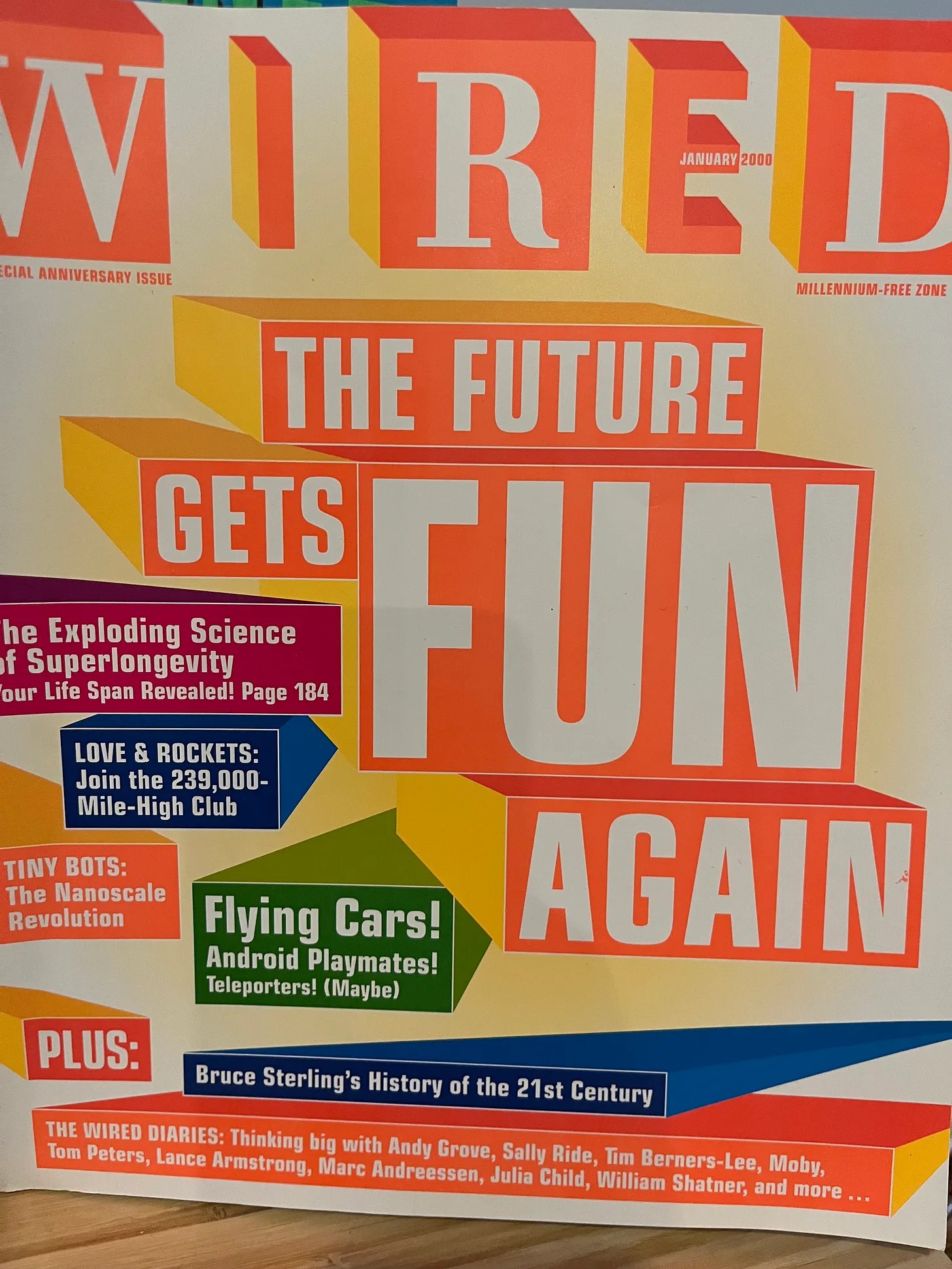
Professor and author Dave Karpf is re-reading the entire WIRED back catalog chronologically (for the second time) for a book project on the “history of the digital future.” A consideration of a 2000 issue devoted to the future has led him to a fascinating insight…
The January 2000 issue is themed around predictions. The magazine did the same thing in January 1999. They ask a ton of experts and celebrities to talk about what the future is going to be like. Some take it seriously, others make jokes. Some are prescient, others notsomuch. It’s a window into what the future looked like back then.
[Karpf reviews a number of the predictions, concluding with…]
…And then there’s this perfect Nathan Myrvhold quote “There won’t be TV per se in three decades. There will be video service over the Internet, but it will be as different from TV today as, say, MTV from the Milton Berle show of the 1950s or from radio plays of the 1940s.”
This is art. I want to frame Myrvhold’s quote and put it in a museum of lopsided tech futurist predictions.
The part that he gets right is the technological development curve. There he is, at the turn of the millennium, five years before the inception of YouTube, telling us that the future of television is going to be video service over the Internet. Yes, absolutely right!
But the part he gets wrong is the industrial, social, and economic impacts of this technological development. We’re seeing this right now, in 2023, as the various streaming services add advertising and strike content-sharing partnership deals with each other. We have these revolutionary new technological developments, and, for about a decade, they were supported by a stock market bonanza. But now that the stocks are no longer ridiculously overvalued, the companies driving these technological developments have settled on a vision of replacing old cable tv with new cable tv. (I wrote about this in July 2022, btw, back when this Substack had a much smaller readership. I think the piece holds up well.)
Technologically, it didn’t have to be this way. But, given all the existing incentive structures established by 21st century capitalism, it was all-but-certain that we would end up here.
I see this time and time again when reading predictions of social transformation from 90s- and 00s-era technologists [cough NicholasNegropontewasconstantlywrong cough]. And I see the same thing today, every time an artificial general intelligence true believer starts opining on the glorious future of education/entertainment/science/manufacturing/art.
I wrote about this phenomenon last year in The Atlantic, where I argued that we won’t be able to tell what the future of AI looks like until we have a sense of where the revenue streams come from. The trajectory of any emerging technology bends towards money.
…
I’m writing a whole book about the lopsided ways in which tech futurists always get their predictions wrong. And one major reason why is that they focus on what the technology could do, given time and mass adoption, rather than considering what capitalism will surely do to those technologies, unless we alter the incentives through regulations.
The trajectory of every emerging technology bends toward revenue streams. If you want to build a better future, you cannot ignore the shaping force of money…
A peek back at some tech predictions from January 2000: “From the WIRED archives: The trajectory of any emerging technology bends toward money,” by @davekarpf (referral account)
See also “The frantic battle over OpenAI shows that money triumphs in the end” (in which Robert Reich argues that, though the revenue streams aren’t yet obvious, protecting their emergence was at the core of the recent battle for control of what was, ostensibly, a not-for-profit) and the oddly apposite “Nerd culture is murdering intellectuals.”
And for more on Karpf’s march through WIRED’s history and what it can tell us about the ways that tech and our culture have changed, see “Notes from #WIRED30.”
* Deep Throat (as portrayed the film adaptation of All the President’s Men)
###
As we pay attention to the profit motive, we might recall that this is an important date in broadcast history. On this date in 1896, Guglielmo Marconi introduced “radio”: he amazed a group at Toynbee Hall in East London with a demonstration of wireless communication across a room. Every time Marconi hit a key beside him at the podium, a bell would ring from a box being carried around the room by William Henry Preece.
Then exactly five years later, on this date in 1901, Marconi confounded those who believed that the curvature of the earth would limit the effective range of radio waves when he broadcast a signal from Cornwall, England to Newfoundland, Canada– over 2,100 miles– and in so doing, demonstrated the viability of worldwide wireless communication.
In the earliest days of radio, when it was essentially a wireless telegraph, there were myriad predictions of what the technology might become– from an internet-like decentralized community of communicators to a provider of education, telemedicine, and other special services… in the event, of course, it followed the money.
“The Dunning-Kruger effect is the hemophilia of dynastic capitalism”*…

Anyone too scared to say Thanatos, Elizabeth Schambelan argues, might wind up with Theranos…
… Melinda Cooper thinks family capitalism is a useful term for comprehending our circumstances. The historian Steve Fraser proposes dynastic capitalism, which has a stronger sense of occasion. Either phrase seems like it could appease the nomenclatural martinets among us, the ones who think neo-feudalism is almost as vulgar a term as fascism, and that vulgar rubrics must be avoided as we strive to come to grips with such classy phenomena as private submarines that vaporize on their way to James Cameron’s favorite place, state officials obsessing about high school athletes’ menstrual cycles, children getting chemical burns while working the graveyard shift in slaughterhouses, and Sam Bankman-Fried paying somebody 700 million dollars to introduce him to Orlando Bloom. But I digress. With respect to family or dynastic capitalism, there is an incredible moment in The Inventor, the HBO documentary about Elizabeth Holmes, when one of her investors—the famous venture capitalist, the one in the cowboy hat, if that narrows it down, whose name is escaping me—defends his choice to give her millions of dollars by noting that one of her grandfathers ran a hospital and the other ran a bank (or something to that effect), “so you see, she came by it quite naturally!” Another of the VCs in the documentary is wearing a tie covered in Bitcoin logos, and says he invested in Theranos, Holmes’s company, because Holmes was friends with his daughter, and that if his gut cosigned, he’d be willing to invest in “a guy and a dog, or two girls and a cat,” though presumably only if at least one member of the team could claim friendship with his child or his labradoodle. The Dunning-Kruger effect is the hemophilia of dynastic capitalism. The dynasty is perhaps best understood expansively, as encompassing friends, and relatives’ friends, and loyal retainers with up to four legs, but nevertheless insular and exclusive, rarely open to true upstarts. Entrepreneurship in this system is a euphemism for a set of favors dispensed from above, from a consortium of patrons that might or might not include the innovator’s literal daddy.
Several years ago I read about a scientific study indicating that one out of three people have no internal monologue, no inner homunculus to offer a constant stream of unsolicited opinions and irritating queries. My guess is that a disproportionate number of dynastic scions enjoy this enviable yet hazardous self-congruence. There is no still small voice to muse, “Hmm, does Theranos sound kind of sinister” or “Does OceanGate sound like a Daytona Beach water park that opened in 1995?” Both Holmes and Rush evinced blasé contempt for regulatory agencies and accrediting organizations, because they stifle innovation, are run by bureaucrats, etc. And if a bureaucrat hadn’t shut Holmes down, Theranos would still be operating little slices of purgatory in Walgreens stores across the land. Holmes called them “wellness centers,” which is a weird name for a place where a person with syphilis has a thirty-five percent chance of getting a false negative on their syphilis test. Rush had a similar rhetorical bent. He said there were sensors all over the Titan to provide real-time monitoring of “hull health,” as if the hull were living tissue and the submersible perhaps a gigantic kernel of corn, which for all I know is the vibe his marketing team was going for—organic and plant-based, if a bit high-carb. More to the point, calling the sensors hull-health monitors is like calling a fire alarm a building-health monitor, except in this analogy if the fire alarm goes off, it means the building and everyone in it will cease to exist in two milliseconds.
…
I do think Holmes is a useful comparanda for Rush, but of course, she’s not the only one. Maybe she’s on my mind simply because of that recent profile that offered real-time monitoring of the health of her ability to gull journalists. Or maybe it’s because Theranos, the word, is a kind of twisted emblem for an entire ethos. Even if she never voiced it to herself, Holmes knew what the real namesake of her company was. I’m not the first person to comment on the similarities between the two words. The differences are typical of what is called taboo deformation—little changes to phonemes that permit a dangerous word to be safely said aloud. Persephone’s name was perilous to utter because she was queen of the underworld, so people used variations like Persephassa. Anyone too scared to say Thanatos might wind up with Theranos.
I’m sorry to speak ill of the dead and the recently incarcerated, but I just don’t have the energy for taboo deformations of my sentiments. I’m tired of the sensation of gradually sinking through an abyssopelagic murk where light is a memory kindled by queasy blips of bioluminescence. Lanternfish have bio-lamps attached to their heads by slim appendages; the orbs hang directly in front of their open mouths, attracting prey. But at least lanternfish aren’t pompous megalomaniacs who arrogate the right to steer us all into darkness and then expect to be thanked for letting us exist in the sickening phosphor of their tiny little privatized suns. That’s more than can be said for our era’s plutocratic class, as apotheosized by an unhinged emerald-mine heir who looks like he’s had a marginally successful face transplant—a chilling visage, once mystifying to me in its peculiar lifelessness, finally explicable as the mask of a psychopomp who’s here to usher all of us to the chthonic depths whence came his wealth and ego. On the scale of self-awareness, Stockton Rush was a veritable Socrates compared to the space captain who is currently the world’s richest man. As for the scale of the damage wreaked by each entrepreneur’s risky business—I am not going to engage in that calculus. It is hard to take much satisfaction in the knowledge that chaos agents are vulnerable to the chaos they create. I don’t think I could rejoice in mortal comeuppance even if the most richly deserving person were on the receiving end, and even if the circumstances were less horrific than what befell those aboard the Titan, and even if it really were comeuppance instead of the mere illusion of it. If there is going to be justice it will have to be in life, since death by definition just evens out the scales. Theranos is coming for us all…
Eminently worth reading and pondering in full: “Little Privatized Suns,” from @ESchambelan in @nplusonemag.
Via Ingrid Burrington‘s (@lifewinning) glorious newsletter, Perfect Sentences.
* Elizabeth Schambelan
###
As we reevaluate our esteem of estates, we might recall that it was on this date in 1834 that slavery was abolished in the British Empire, as the Slavery Abolition Act 1833 came into force (though it remained legal in the possessions of the East India Company until the passage of the Indian Slavery Act, 1843).

“Mounting a campaign against plutocracy makes as much sense to the typical Washington liberal as would circulating a petition against gravity”*…

Brad DeLong elaborates on Jonathan Kirshner‘s bracing review of Martin Wolf‘s important new book…
Jonathan Kirshner: Rigged Capitalism and the Rise of Pluto-populism: On Martin Wolf’s The Crisis of Democratic Capitalism: ‘The middle third of this book, “What Went Wrong,” should be required reading…. When it comes to solutions, unfortunately, The Crisis of Democratic Capitalism comes up short. Wolf, ever measured, is convincing in making the case for reform over revolution…. Yet it is disheartening that the sensible, reformist agenda of reasonable, practical measures that Wolf outlines already seems beyond the capacity of our politics…. Massive concentrations of wealth for a sliver of largely-above-the-law plutocrats, combined with stagnation and declining opportunities for the majority—leads to a basic political problem: “How, after all, does a political party dedicated to the material interests of the top 0.1 percent of the income distribution win and hold power in a universal suffrage democracy? The answer is pluto-populism”… [which] unleash[es] forces… [that] render liberal democracy unsustainable…. corruption, arbitrariness of justice, and fear for future prospects are poisonous to the body politic…. Its final sentence, “If we fail, the light of political and personal freedom might once again disappear from the world,” reads less like a call to action and more like an epitaph…
Martin Wolf’s The Crisis of Democratic Capitalism and Barry Eichengreen’s The Populist Temptation are, I think, the best books on theDover-Circle-Plus societies current Time of Troubles. And there is no clear way through.
It was James Madison who wrote, in 1787:
Democracies have ever been spectacles of turbulence and contention; have ever been found incompatible with personal security or the rights of property; and have in general been as short in their lives as they have been violent in their deaths…
And the death of real democracy does not have to be accompanied by the end of the form. The classic example here is the Jim Crow U.S. South from 1876-1965. It was less than half as rich as the rest of the United States for almost a complete century. It was ruled by an oligarchy uninterested in economic development and very interested in corruption. The oligarchy its power by focusing the electorate on the necessity of keeping the Black Man Down, and tarring anyone who wanted a government that was less corrupt or more pro-development with being a negro-lover. That it held rocksolid from 1876 to 1965 shows that the future of anything we could call prosperous democratic capitalism is not assured…
Bracing: “Pluto-Populism,” from @delong.
See also: Kishore Mahbubani‘s “Democracy or Plutocracy? – America’s Existential Question” (source of the image above).
###
As we get back to basics, we might recall that it was on this date in 1934 that Depression Era bandits Bonnie and Clyde were ambushed by police and shot to death in Bienville Parish, Louisiana. Bonnie Elizabeth Parker and Clyde Chestnut (Champion) Barrow were a criminal couple who traveled the Central United States with their gang during the Great Depression. The couple were known for their bank robberies, although they preferred to rob small stores or rural funeral homes. Their exploits captured the attention of the American press and its readership during what is occasionally referred to as the “public enemy era” between 1931 and 1934.
The 1967 hit film Bonnie and Clyde, directed by Arthur Penn and starring Warren Beatty and Faye Dunaway in the title roles, revived interest in the couple, who were treated somewhat sympathetically. The 2019 Netflix film The Highwaymen depicted their manhunt from the point of view of the pursuing lawmen but received mixed reviews.

“What is the matter with the poor is Poverty; what is the matter with the rich is Uselessness.”*…

Studying the display of personal wealth across time can help us better understand the history of socioeconomic inequality. Tim Brinkhof explains…
To ask what it was like to be rich in the past is about more than comparing the lifestyles of modern-day billionaires like Elon Musk to Mansa Musa or Marcus Licinius Crassus. When you study the history personal wealth, you are also learning about the history of income inequality, and the economic developments that allowed these upper-class individuals to build their private fortunes.
According to the historian Peter V. Turchin, who relies on mathematical modeling to make sense of the societies past and present, those developments turn out to be cyclical rather than linear, with patterns in the global financial system repeating themselves across centuries. In other words, Musa and Musk may have more in common than you’d think…
A fascinating account: “Here’s what being filthy rich in Europe looked like in 1000 BC, 1 AD, and 1000 AD,” in @bigthink.
* George Bernard Shaw
###
As we contemplate how the other half lives, we might spare a thought for a chronicler of upper class, Henry James; he died on this date in 1916. Considered by many to be among the greatest novelists in the English language, he was a successful purveyor of ghost stores (most notably, his novella The Turn of the Screw); but he best known for his novels dealing with the social and marital interplay between upper class emigre Americans, the English, and continental Europeans– e.g., The Portrait of a Lady, The Ambassadors, and The Wings of the Dove.
His later works were increasingly experimental. In describing the internal states of mind and social dynamics of his characters, James often wrote in a style in which ambiguous or contradictory motives and impressions were overlaid or juxtaposed in the discussion of a character’s psyche. (Perhaps not coincidentally, his brother was psychologist and philosopher William James.) For their unique ambiguity and other aspects of their composition, his late works have been compared to impressionist painting– and he is considered by many a key transitional figure between literary realism and literary modernism.

“I think inequality is fine, as long as it is in the common interest. The problem is when it gets so extreme, when it becomes excessive.”*…

Alvin Chang, with a beautifully-told (and beautifully-illustrated) primer on a startling unpacking of the fundamental logic of our market economy…
Why do super rich people exist in a society?
Many of us assume it’s because some people make better financial decisions. But what if this isn’t true? What if the economy – our economy – is designed to create a few super rich people?
That’s what mathematicians argue in something called the Yard-sale model…
Read it and reap: “Why the super rich are inevitable,” by @alv9n in @puddingviz.
* Thomas Piketty, A Brief History of Equality
###
As we ponder propriety, we might recall that it was on this date that Jane Austen‘s [and here] Pride and Prejudice was published. A novel of manners– much concerned with the dictates of wealth (and the lack thereof), it was credited to an anonymous authors “the author of Sense and Sensibility,” as all of her novels were.

Title page of the first edition (source)
You must be logged in to post a comment.