Posts Tagged ‘travel’
“Every solution tends to become the next problem”*…

Dingxin Zhao is sociologist who marshals history, historiography, and his own discipline to explain how ancient Chinese wisdom can shed light on the troubled times through which we’re living…
During a reading project I undertook to better understand the “third wave of democracy” — the remarkable and rapid rise of democracies in Latin America, Asia, Europe and Africa in the 1970s and 80s — I came to realize that this ascendency of democratic polities was not the result of some force propelling history toward its natural, final state, as some scholars have argued. Instead, it was the result of American political influence spreading around the world after the U.S. had established itself as the sole global superpower.
However, the U.S. endeavor to impose its political system in foreign lands where its policymakers did not have much knowledge facilitated the rise of many low-quality democracies, ethnic conflicts and refugee crises and triggered a global resurgence of authoritarianism and conservatism. Adding to such complexity, the crippled democratization movement, promoted under the banner of liberalism, inadvertently eroded the prominence of liberal ideologies — the very bedrock of enlightenment — across the world.
Upon arriving at this conclusion, I grappled with a sense of unease. I began to question whether I leaned too conservatively or possessed a certain authoritarian personality. Eventually, I realized that my conclusions were influenced by a Daoist perspective on history that had been imprinted on me during my upbringing in China.
Such a Daoist understanding of history contrasts with the teleological tenets found within the Judeo-Christian tradition and the symmetric cyclic interpretations that are also common in Western thought. And it could provide several insights in comprehending our increasingly intricate and uncertain world.
According to the Tao Te Ching, a succinctly composed text attributed to Laozi from the Warring States period (475-221 B.C.E.), history revolves around two pivotal elements. The first is that it unfolds in cycles that are characterized by perpetual transformations and negations. This cyclical perspective on historical development immediately sets the Daoist understanding of history apart from the linear and teleological understanding found in Judeo-Christian traditions, exemplified by narratives in the Bible and subsequently interpreted in diverse ways by theologians…
[Zhao explores the contrast, with both the teleological and the cyclical, using illuminating examples from St. Augustine, Hegel, Marx, Oswald Spengler, Neil Howe, Mancur Olson, Ibn Khaldun, and others]
… The second pivotal element within the Daoist understanding of historical development departs from this symmetry. The forces guiding each historical transformation and negation need not be the same: an “asymmetric cyclic theory.”
In the Tao Te Ching, Laozi famously wrote, “The Dao that can be stated cannot be the universal (or eternal) Dao.” This proclamation essentially asserts that symmetric cyclic theories cannot lay claim to universal or eternal truths. This is because the significance and function of any causal forces invariably change with different contexts.
In premodern China, Laozi’s precocious and highly sophisticated grasp of history often veered into mystical directions. Today, armed with the insights of modern social sciences, I would characterize the Daoist asymmetric cyclic theory of history as the “principle of reverse movement.”
This principle posits that as any organization, political system, idea, culture or institution gains ascendancy, the opposing, undermining forces concurrently intensify. In China, this has been visually conveyed through various forms of taiji diagrams. Among these diagrams, the one I believe best encapsulates the core of history’s asymmetric cyclical nature is also the simplest: Two forces of opposing nature undergo simultaneous change over time. As one force grows stronger, the other weakens, and vice versa.
To give some examples: In arenas of military and economic competition, entities that organize better and produce more efficiently tend to gain an edge. This nature of military and economic competition induces cumulative development — a form of societal change that bolsters humanity’s capacity to generate and accumulate wealth. In early modern Europe, heavily influenced by the linear historical outlook of Judeo-Christian traditions, thinkers often formulated theories that portrayed such cumulative developmental processes as progress toward a better future.
However, in the Daoist principle of reverse movement, as one actor in military or economic competition progressively secures the upper hand, opposing actors would also gather momentum. For instance, the dominant actor becomes increasingly susceptible to various errors — over-expansion, underestimating adversaries, disregarding internal vulnerabilities and potential crises. Meanwhile, weaker actors respond to their more formidable opponent by intensifying their desire to change, including learning from their opponent and striving for “self-strengthening.”…
[Zhao unpacks more examples]
… A Daoist understanding of history could contribute three key insights to the contemporary landscape of political theory and civilizational prosperity:
First, it asserts that historical transformations are not propelled by uniform forces, a perspective that challenges the concept of history being directed by a predestined end or ultimate purpose.
Second, it imparts a sense of humility upon influential social actors as their power ascends, encouraging them to gain insight into potential pitfalls and shifts that might undermine their status and avoid the fallacy of justifying their power supremacy by some teleological and thus moral rationale.
Third, it cautions us against the hubris of making linear predictions about upward-trending social tides and urges us to embrace the intricacies of complexity and acknowledge the multifaceted interplay of diverse forces. By doing so, we are compelled to appreciate the heterogeneous nature of historical change.
Belief in a linear or teleological understanding of history imparts a stronger sense of purpose in life, allows believers to create a more committed moral community and compels individuals within that community to act in a more principled manner. However, “true believers” can be convinced that they alone possess the correct beliefs and are aligned with the right course of history, that they hold a moral high ground to convert, exclude or even resort to violence against those deemed to be on the “wrong side.” Numerous times in centuries past, this belief has led to genocide, imperialism, racist governance, political purges and cultural conflict.
…
The Daoist principle of asymmetric reverse movement not only rejects the imposition of a direction onto history but also negates the existence of any specific, law-like forces underpinning the apparent cyclic patterns of historical events. Laozi’s concept of wuwei has prompted some scholars, like Charles Hucker, to interpret it as an ancient anarchist ideology that has “little to offer in the way of a governmental program.” However, in truth, Laozi is advocating for a form of statecraft characterized by profound humility. This humility is a rare trait, especially among powerful social actors — particularly very resourceful state actors. It becomes even scarcer within cultures dominated by a teleological comprehension of history…
Understanding the principle of reverse movement in history: “Daoist History” in Noema— eminently worth reading in full. And usefully accompanied by “A Daoist Take On The World Gone Sideways,” by Noema editor Nathan Gardels.
* your correspondent
###
As we honor humility, we might recall that it was on this date in 1890 that journalist Nellie Bly began her 72-day trip around the world.
In 1888, Bly suggested to her editor at the New York World that she take a trip around the world, attempting to turn the fictional Around the World in Eighty Days into fact for the first time. A year later, at 9:40 a.m. on November 14, 1889, with two days’ notice, she boarded the steamer Augusta Victoria, and began her 24,899-mile journey.
She brought with her the dress she was wearing, a sturdy overcoat, several changes of underwear, and a small travel bag carrying her toiletry essentials. She carried most of her money (£200 in English bank notes and gold in total as well as some American currency) in a bag tied around her neck.
Bly traveled through England, France (where she met Jules Verne in Amiens), Brindisi, the Suez Canal, Colombo (Ceylon), the Straits Settlements of Penang and Singapore, Hong Kong, and Japan. Just over seventy-two days after her departure from Hoboken, having used steamships and existing railway lines, Bly was back in New York; she beat Phileas Fogg‘s time by almost 8 days.

“Success is in making money, not in the size of the airline”*…

Airlines make more money from mileage programs than from flying planes—and it shows. Ganesh Sitaraman explains…
… From the late 1930s through the ’70s, the federal government regulated airlines as a public utility. The Civil Aeronautics Board decided which airlines could fly what routes and how much they could charge. It aimed to set prices that were fair for travelers and that would provide airlines with a modest profit. Then, in 1978, Congress passed a sweeping law deregulating the airline industry and ultimately abolishing the CAB. Unleashed from regulation, airlines devised new tactics to capture the market. American Airlines was one of the most aggressive. In the lead-up to the deregulation bills, it created discount “super saver” fares to sell off the final few remaining seats on planes. That meant cheap prices for last-minute travelers and more revenue for American, because the planes were going to take off whether or not the seat was filled. But these fares upset business travelers, who tended to buy tickets further in advance for higher prices. So in 1981, American developed AAdvantage, its frequent-flier program, to give them additional benefits. Other airlines followed suit.
In the early years, these programs were simple, like the punch card at a café where your 11th coffee is free. But three big changes transformed them into the systems we know today. First, in 1987, American partnered with Citibank to offer a branded credit card that offered points redeemable for flights on the airline. Second, in the ’90s, the airlines proliferated the number of fare classes, charging differential prices for tickets. With more complicated fare structures came the third change: Virgin America realized that the amount people spend on a flight, based on the fare class, is more important to their bottom line than the number of miles flown. So, in 2007, it introduced a loyalty program rewarding money spent rather than mileage accrued.
These three shifts fundamentally transformed the airline industry. They turned frequent-flier systems into the sprawling points systems they are today. And they turned airlines into something more like financial institutions that happen to fly planes on the side.
Here’s how the system works now: Airlines create points out of nothing and sell them for real money to banks with co-branded credit cards. The banks award points to cardholders for spending, and both the banks and credit-card companies make money off the swipe fees from the use of the card. Cardholders can redeem points for flights, as well as other goods and services sold through the airlines’ proprietary e-commerce portals.
For the airlines, this is a great deal. They incur no costs from points until they are redeemed—or ever, if the points are forgotten. This setup has made loyalty programs highly lucrative. Consumers now charge nearly 1 percent of U.S. GDP to Delta’s American Express credit cards alone. A 2020 analysis by the Financial Times found that Wall Street lenders valued the major airlines’ mileage programs more highly than the airlines themselves. United’s MileagePlus program, for example, was valued at $22 billion, while the company’s market cap at the time was only $10.6 billion.
Is this a good deal for the American consumer? That’s a trickier question. Paying for a flight or a hotel room with points may feel like a free bonus, but because credit-card-swipe fees increase prices across the economy—Visa or Mastercard takes a cut of every sale—redeeming points is more like getting a little kickback. Certainly the system is bad for Americans who don’t have points-earning cards. They pay higher prices on ordinary goods and services but don’t get the points, effectively subsidizing the perks of card users, who tend to be wealthier already.
…
The strange evolution of airlines into quasi-banks reflects how badly deregulation has gone. Regulation carefully set the terms under which airlines could do business. It was designed to ensure that they remained a stable business and a reliable mode of transportation. Deregulation, in turn, allowed the airlines to pursue profits in whatever way they could—including getting into the financial sector.
The proponents of deregulation made a few big promises. The cost of flying would go down once airlines were free to compete on price. The industry would get less monopolistic as hundreds of new players entered the market, and it would be stable even without the government guaranteeing profitable rates. Small cities wouldn’t lose service. In the deregulators’ minds, airlines were like any other business. If they were allowed to compete freely, the magic of the market would make everything better. Whatever was good for the airlines’ bottom line would be good for consumers.
They were wrong. As I explain in my forthcoming book, most of their predictions didn’t come true, because air travel isn’t a normal business. There are barriers to entry, such as the fixed supply of airport runways and gates. (And, for that matter, mileage programs, designed to keep customers from ditching an established airline for a rival.) There are network effects and economies of scale. There are high capital costs. (Airplanes aren’t cheap.) The idea that anyone could successfully start an airline and outcompete the big incumbents never made much sense.
After a relatively short period of fierce competition, the deregulated era quickly turned to consolidation and cost-cutting, as dozens of airlines either went bankrupt or were acquired. Service keeps getting worse, because the airlines, facing little competition, have nothing to fear from antagonizing passengers with cramped legroom, cancellations, and ever-multiplying fees for baggage and snacks. Worse still, without mandated service, cities and regions across the country have lost commercial air service, with serious consequences for their economies. And when a crisis like 9/11 or the coronavirus pandemic comes along, the airlines—which prefer to direct their profits to stock buybacks rather than rainy-day funds—need massive financial relief from the federal government.
Deregulation even failed to deliver the one thing it is sometimes credited with: lowering prices. Airfare did get cheaper in the years after the 1978 deregulation law. But the cost of flying had already been falling before deregulation, and it kept falling after at about the same rate.
The old system of airline regulation wasn’t perfect. Barred from competing directly on price, the airlines got into an amenities arms race that notoriously included in-flight piano bars. But the cure was worse than the disease. The industry went from being a regulated oligopoly, which had real problems, to an unregulated oligopoly, which we are now seeing is much worse…
Painful reading: “Airlines Are Just Banks Now” (gift article) from @GaneshSitaraman in @TheAtlantic.
* Gordon Bethune (Long-time chair of Continental Airlines)
###
As we pray for an aisle seat, we might console ourselves that at least we’re not boarding the S.S. Minnow; on this date in 1964 Gilligan’s Island premiered on CBS. Seven castaways– five paying passengers who’d booked a “three hour tour” from Honolulu, and their two-person crew– spent the next three seasons marooned on an uncharted island.

“We’re all pilgrims on the same journey but some pilgrims have better road maps”*…

Tis the season for road trips. These days, we tend to navigate via Google Maps; but for centuries, travelers relied on road atlases. From the Bodleian Library‘s Map Room, a wonderful example from the 18th century…
As a general rule we do not fold our atlases in half. It would be bad for them, and probably quite difficult. This is a rare example of an atlas that was designed to be folded in half.
It’s an early road atlas to be carried while traveling. When the soft, rather tattered brown leather covers are opened, it reveals that a previous owner has made some notes of place names and distances in the inside of the cover.
The book itself could be folded or rolled, making it smaller and more portable. It is Thomas Kitchin’s Post-chaise companion, and dates from 1767. It has clearly grown accustomed to being folded in half, as can be seen from the weights required to hold it open for photography:

The very earliest road atlases date from the seventeenth century. Previously travellers relied on road books, lists of names that would enable them to ask the way from one town to the next. Arguably the first road atlas was produced by Matthew Simmons in the 1630s, with triangular distance tables (like those sometimes found in modern road atlases) and very tiny maps. The big innovation was John Ogilby’s Britannia in 1675, which used strip maps to show the major roads throughout Great Britain in unprecedented detail; this design continued to be copied for over a century, as can be seen here. Britannia was however a large volume, too bulky to transport easily.
Perhaps surprisingly, it was around fifty years after the publication of Britannia before smaller, more portable versions were produced, and then rival versions by three different publishers appeared around the same time in the 1720s; one of these, by Emanuel Bowen, was reissued in multiple editions into the 1760s. Thomas Kitchin, who produced this work, had been apprenticed to Bowen, and had married Bowen’s daughter before setting up as an independent mapmaker, embarking on a long, prolific and successful career, and being appointed Hydrographer to George III.
Although many road atlases of this period survive, the binding is what makes this one unusual. Its appearance caused a certain amount of excitement in the Map Room as some of us had heard of road atlases being made to this design, but had never seen one before. Unsurprisingly the soft backed versions are less likely to have survived, being less robust and more heavily used than the hardbacks. The fact that this one has the notes relating to a previous owner’s journeys makes it additionally interesting…
A traveler’s companion: “On the road,” at @bodleianlibs.
* Nelson DeMille
###
As we plan a route, we might ponder a very specific path, recalling that today– and every June 16– is Bloomsday, a commemoration and celebration of the life of Irish writer James Joyce, during which the events of his novel Ulysses (a modern classic set on this date in 1904) are relived: Leopold Bloom goes about Dublin, James Joyce’s immortalization of his first outing with Nora Barnacle, the woman who would eventually become his wife.
The first Bloomsday was observed on the 50th anniversary of the events in the novel, in 1954, when John Ryan (artist, critic, publican and founder of Envoy magazine) and the novelist Brian O’Nolan organized what was to be a daylong pilgrimage along the Ulysses route. They were joined by Patrick Kavanagh, Anthony Cronin, Tom Joyce (a dentist who, as Joyce’s cousin, represented the family interest), and AJ Leventhal (a lecturer in French at Trinity College, Dublin).

“Personally, I would like to renounce speech altogether and, like organic nature, communicate everything I have to say visually”*…

Driving across America, one encounters a wide variety of cultures, landscapes, people, and animals. But the one consistent thing that will stay the same from Maine to California are the signs one passes on the highway. That’s because, as Jon Keegan explains, America’s roads and highways have a big, fat style guide…
First published in 1935, the Federal Highway Administration’s (FHWA) “Manual on Uniform Traffic Control” (MUTCD), is a hefty tome consisting of close to 900 pages that contains the federal standards for all traffic safety signs, roadway markings and other “traffic control devices” that a driver on a road in the U.S. might encounter.
The MUTCD states that it “shall be recognized as the national standard for all traffic control devices installed on any street, highway, bikeway, or private road open to public travel”. Exact specifications for the font, size, spacing of letters, background colors, reflectivity, mounting location and orientation help ensure that traffic signs are consistently readable at a glance while driving anywhere in the U.S…

The remarkable– and enlightening– story: “The Style Guide for America’s Highways: The Manual on Uniform Traffic Control Devices,” from @jonkeegan. TotH to @kottke.
* Johann Wolfgang von Goethe
###
As we read the signs, we might send elegantly-designed birthday greetings to Walter de Silva; he was born on this date in 1951. A car designer and automotive executive, he began as a designer at Fiat in 1972, then went on to lead design at Alfa Romeo, SEAT, Audi, and finally Volkswagen Group– where, in 2007, he became Chairman.

“Oh the places you’ll go”*…
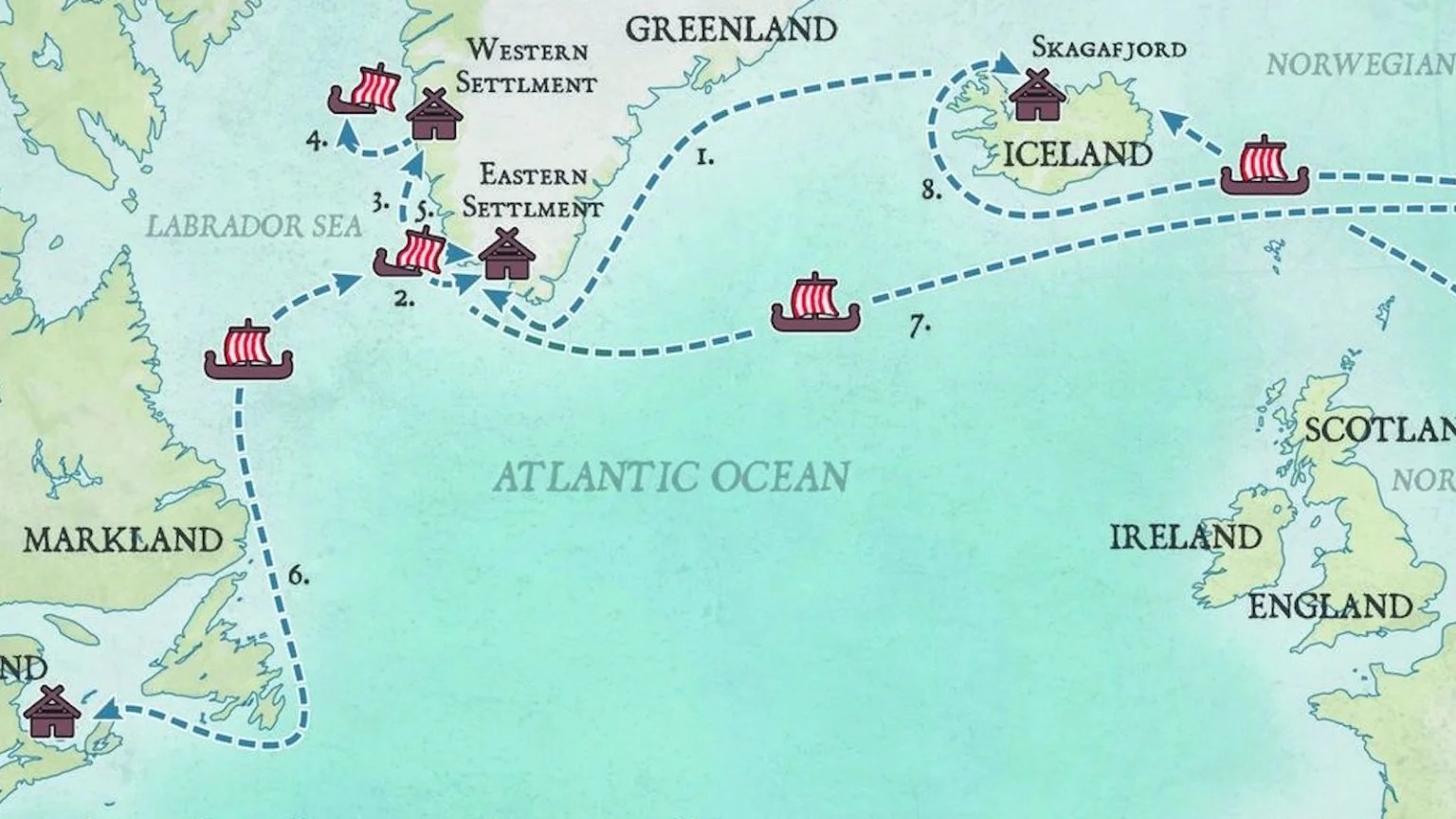
The amazing life of “Gudrid the Far-Traveled” has, Frank Jacobs argues, been unjustly overshadowed by her in-laws, Erik the Red and Leif Erikson…
She’s been called “the greatest female explorer of all time,” and the “best-traveled woman of the Middle Ages.” Just after the year 1000 AD, she gave birth to the first European baby in North America. And she concluded her global odyssey with a pilgrimage on foot to Rome. Yet few today can name this extraordinary Viking lady, even if they have heard of Erik the Red and Leif Erikson, her father- and brother-in-law…
An extraordinary story: “The Viking woman who sailed to America and walked to Rome,” from @VeryStrangeMaps in @bigthink.
* Dr. Seuss
###
As we tag along, we might recall that this date in 2014 was purportedly the date of the final battle in Ragnarök, a series of events (many natural disasters) culminating in a catastrophic battle and the end of the world-as-we-know-it: giants and demons approach from all points of the compass and attack the gods (Odin, Thor, Týr, Freyr, Heimdall, Loki, et al.), who meet them and face death like heroes. At the conflict’s end, the sun darkens, the stars vanish, and the earth sinks into the sea. (Happily, afterward, the earth rises again, the innocent Balder returns from the dead, and leads hosts of the just to a life in a hall roofed with gold.)
In the event, of course, the world did not end that day. The prediction had been promoted by the Jorvik Viking Centre in York, England, intended to draw attention to an event that the institution was to hold on that date. In an obvious lift from the 2012 Mayan Prophecy frenzy, the Centre attributed the claim to a “Viking Calendar,” though no such calendar is known to have existed. Authentic scholars were predictably (and understandably) irked, though as philologist Joseph Hopkins noted, the media response was an example of a broad revival of interest in the Viking Age and ancient Germanic topics.
(Historians believe that Gudrid did in fact exist and did make the journeys discussed above.)

You must be logged in to post a comment.