Posts Tagged ‘telegraph’
“Foresight begins when we accept that we are now creating a civilization of risk”*…
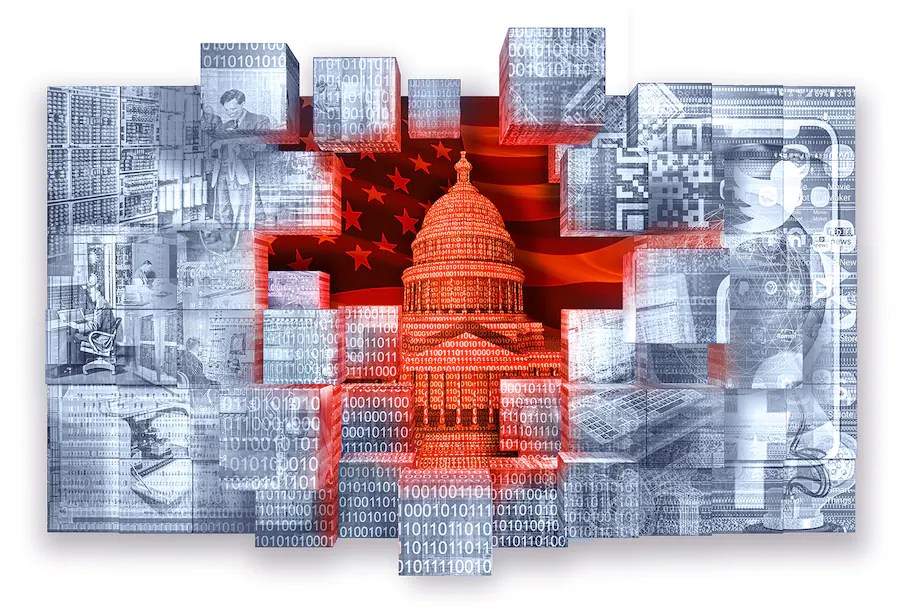
There have been a handful folks– Vernor Vinge, Don Michael, Sherry Turkle, to name a few– who were, decades ago, exceptionally foresightful about the technologically-meditated present in which we live. Philip Agre belongs in their number…
In 1994 — before most Americans had an email address or Internet access or even a personal computer — Philip Agre foresaw that computers would one day facilitate the mass collection of data on everything in society.
That process would change and simplify human behavior, wrote the then-UCLA humanities professor. And because that data would be collected not by a single, powerful “big brother” government but by lots of entities for lots of different purposes, he predicted that people would willingly part with massive amounts of information about their most personal fears and desires.
“Genuinely worrisome developments can seem ‘not so bad’ simply for lacking the overt horrors of Orwell’s dystopia,” wrote Agre, who has a doctorate in computer science from the Massachusetts Institute of Technology, in an academic paper.
Nearly 30 years later, Agre’s paper seems eerily prescient, a startling vision of a future that has come to pass in the form of a data industrial complex that knows no borders and few laws. Data collected by disparate ad networks and mobile apps for myriad purposes is being used to sway elections or, in at least one case, to out a gay priest. But Agre didn’t stop there. He foresaw the authoritarian misuse of facial recognition technology, he predicted our inability to resist well-crafted disinformation and he foretold that artificial intelligence would be put to dark uses if not subjected to moral and philosophical inquiry.
Then, no one listened. Now, many of Agre’s former colleagues and friends say they’ve been thinking about him more in recent years, and rereading his work, as pitfalls of the Internet’s explosive and unchecked growth have come into relief, eroding democracy and helping to facilitate a violent uprising on the steps of the U.S. Capitol in January.
“We’re living in the aftermath of ignoring people like Phil,” said Marc Rotenberg, who edited a book with Agre in 1998 on technology and privacy, and is now founder and executive director for the Center for AI and Digital Policy…
As Reed Albergotti (@ReedAlbergotti) explains, better late than never: “He predicted the dark side of the Internet 30 years ago. Why did no one listen?“
Agre’s papers are here.
* Jacques Ellul
###
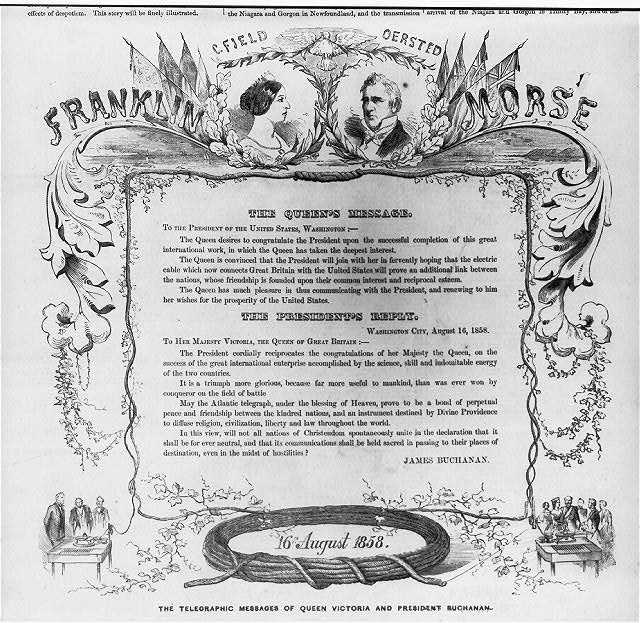
As we consider consequences, we might recall that it was on this date in 1858 that Queen Victoria sent the first official telegraph message across the Atlantic Ocean from London to U. S. President James Buchanan, in Washington D.C.– an initiated a new era in global communications.
Transmission of the message began at 10:50am and wasn’t completed until 4:30am the next day, taking nearly eighteen hours to reach Newfoundland, Canada. Ninety-nine words, containing five hundred nine letters, were transmitted at a rate of about two minutes per letter.
After White House staff had satisfied themselves that it wasn’t a hoax, the President sent a reply of 143 words in a relatively rapid ten hours. Without the cable, a dispatch in one direction alone would have taken rouighly twelve days by the speediest combination of inland telegraph and fast steamer.
“Gentlemen, you can’t fight in here! This is the War Room!”*

In “Dr. Strangelove Dr. Strangelove,” Kristan Horton imitates the glorious satirical film Dr. Strangelove, using common household objects to re-create the world created by Kubrick—silverware become an airplane, plastic and coffee grounds become the sky…


The sublime, recreated with the mundane: “Dr. Strangelove Dr. Strangelove,” via the ever-illuminating The Morning News.
See also the “3-D Rooms Project.”
* Peter Sellers as President Merkin Muffley, one of three roles he played in Dr. Strangelove or: How I Learned to Stop Worrying and Love the Bomb, produced, directed, and co-written (with Terry Southern, very loosely based on a novel by Peter George) by Stanley Kubrick
###
As we ride it down, we might recall that it was on this date in 1883 that the volcano at Krakatoa (Krakatau) erupted with full force. The sound was heard over 2,000 miles away (that’s over 7.5% of the earth’s surface– the equivalent of an explosion in New York City being heard in San Francisco); tsunamis caused by the great blast killed 36,000 people in Java and Sumatra.
But there was another sense in which Krakatoa was importantly “the sound heard ’round the world”: While news of Lincoln’s assassination (only 18 years earlier) had taken almost two weeks to reach London, Europe and the U.S. knew of Krakatoa in about four hours. In the years between 1865 and 1883, there had been three interrelated developments: the global spread of the telegraph, the invention of Morse Code, and the establishment of Reuter’s news agency… and the world had become much smaller. (C.F., Tom Standage’s marvelous The Victorian Internet for the details– both remarkable and altogether resonant with today.)
As big as the explosion was, it was not the biggest in history: experts suggest that Santorini’s eruption in 1628 BCE was three times as powerful.

“From the moment I picked up your book until I put it down, I was convulsed with laughter. Some day I intend reading it.”*…

Codex Sinaiticus (4th century, eastern Mediterranean)
“Codex” is just the Roman name for a book, made of pages, and usually bound on the left. Its predecessor was the scroll or book roll, which was unrolled as you read. The codex is manifestly superior: one can hold many volumes (from the Latin for book roll, volumen); codices have a built-in cover for protection; and pages that can be numbered for reference, from which arose a cornucopia of tables of contents and indices.
The codex didn’t catch on until surprisingly late in the ancient world. The early Christians, however, took to the codex with singular enthusiasm. Wider adoption of this form seems to have corresponded to Christianity’s spread. In the 4th century, no less a figure than St Augustine illustrates the difference between a codex and a roll – and the nagging ‘Christianity’ of the codex.
Not yet baptised, in his garden where he had been reading, Augustine tells us he heard a child’s voice chant: ‘Tolle Lege!’ (‘Take up and read’). So he grabbed his book and flipped to a random page. His eyes lit upon a passage in Paul’s ‘Letters to the Romans’. The words he found were the key to his conversion. The book couldn’t have been a roll: it was a codex of the Gospels. But many of his other, often non-Christian books, were rolls.
Virtually all ancient Christian texts were codices, and with each new scrap pulled from the Egyptian sands, this has been confirmed, rare exceptions ‘proving the rule’. Historians have concluded that, while Christians probably didn’t invent the codex, their scribes had gifted the general use of it to the Roman world and, in so doing, passed it, and much of what survives of Classical literature, on to us. But an inability to explain the exact origin and nature of this ‘Christian codex’ clouds every investigation, and for good reason: this conclusion is wrong. While nearly every early Christian text is a codex, not every early codex is Christian…
The fascinating story in full: “The birth of the book: on Christians, Romans and the codex.”
* Groucho Marx
###
As we turn the page, we might send speedy birthday greetings to Samuel Finley Breese Morse; he was born on this date in 1791. After establishing himself as a successful painter, Morse returned to a school-day obsession, electricity, and began to experiment with using it to communicate… sufficiently successfully that he is now less well remembered for his (then celebrated) art work, than for his success as contributor to the development of the single wire telegraph– which revolutionized global communications— and as the co-developer of Morse Code.

“The challenge for capitalism is that the things that breed trust also breed the environment for fraud”*…

WannaCry, a computer virus that encrypts data and demands a ransom to unscramble it, hit thousands of computers in May, causing several hospitals in Britain to close their doors. Hardly a week now goes by without a large company admitting that its systems have been breached: Yahoo recently confessed that 1bn accounts had been compromised in an attack in 2013. Cyber-attacks are a scourge of modern life, but their history goes back further than you might expect.
The world’s first national data network was constructed in France during the 1790s. It was a mechanical telegraph system, consisting of chains of towers, each of which had a system of movable wooden arms on top. Different configurations of these arms corresponded to letters, numbers and other characters. Operators in each tower would adjust the arms to match the configuration of an adjacent tower, observed through a telescope, causing sequences of characters to ripple along the line. Messages could now be sent much faster than letters, whizzing from one end of France to the other in minutes. The network was reserved for government use but in 1834 two bankers, François and Joseph Blanc, devised a way to subvert it to their own ends…
Nearly two centuries ago, France was hit by the world’s first cyber-attack. With a nod to Isaiah Berlin**, Tom Standage argues that it holds lessons for us today: “The crooked timber of humanity.”
* James Surowiecki
** Berlin’s title was a reference to a quote from Kant: “Out of the crooked timber of humanity, no straight thing was ever made.”
###
As we learn from history, we might recall that it was on this date in 1858 that two ships, the Niagara and the Agamemnon headed out from Keyham Dockyard in England to begin work on what would become the first operational Transatlantic cable, as previous attempts at laying a Transatlantic cable had failed. Designed for telegraph operation, the cable run was completed on August 5th; and the first test message was sent on August 12th.

The Niagara at work
“It seems a long time since the morning mail could be called correspondence”*…

A Curtiss Jenny carrying mail for Philadelphia, Pennsylvania, before take off from the polo grounds in Washington, D.C.
On May 15, 1918, as hundreds of thousands of American troops fought from the trenches of Western Europe, a small number of U.S. Army pilots took on a domestic mission. Though they worked in the skies above East Coast cities, far from the carnage of World War I, their task was life-threatening, and it was as crucial to the nation’s psyche as any conflict fought on foreign soil. While their peers carried bombs across the Atlantic, these men carried the mail.
On a gloomy Wednesday morning, thousands of spectators gathered in Washington, D.C.’s Potomac Park to witness what would be the world’s first regularly scheduled airmail service. As the crowd buzzed with excitement, president Woodrow Wilson stood with the pilot, Second Lieutenant George Leroy Boyle. The two men chatted for a few minutes, Wilson in a three-piece suit and bowler hat, Boyle in his leather flying cap, a cigarette in his mouth. The president dropped a letter in Boyle’s sack, and the pilot took off for his journey from Washington, D.C., to New York, with plans to stop in Philadelphia for delivery and refueling. The flight, however, never made it to the City of Brotherly Love.
With only a map laid across his lap to guide him on his northbound journey, Boyle turned southeast shortly after takeoff. Realizing his mistake, he landed in a soft field in Waldorf, Maryland, damaging his propeller. Officials from the United States Post Office Department, the predecessor to the United States Postal Service, drove the load of mail back to D.C., and unceremoniously put it on a train to New York. Two days later, after blowing a second chance to fly the mail north and making an emergency landing in Cape Charles, Virginia, Boyle’s time with the Post Office came to an inglorious end.
Boyle may not have been the Army’s best pilot, but his misadventures highlight just how bold of a decision it was to begin airmail service at a time when flight was still in its infancy. “There was a rather general feeling that aviation was not yet sufficiently advanced to maintain mail schedules by airplanes,” said Otto Praeger, the Second Assistant Postmaster General, in a 1938 interview. “Strangely enough, some well known aircraft manufacturers themselves doubted the advisability of embarking upon a regular airmail service, and a number of them came to Washington to urge me not to undertake the project.” But Praeger stayed the course, determined to make airmail “like the steamship and the railroad, a permanent transportation feature of the postal service.”
Unfortunately, indelibly changing the nature of mail delivery came with serious risk for the pilots involved. Of the roughly 230 men who flew mail for the Post Office Department between 1918 and 1927, 32 lost their lives in plane crashes. Six died during the first week of operation alone…
Smithsonian reports on a new exhibition at the National Postal Museum honoring the nation’s first airmail pilots: “Delivering the Mail Was Once One of the Riskiest Jobs in America.”
* Jacques Barzun
###
As we muse on our missives, we might recall that it was on this date in 1844 that inventor (and celebrated painter) Samuel F.B. Morse inaugurated the first technological competitor to the post when he sent the first telegraph message: “What hath God wrought?” Morse sent the famous message from the B&O’s Mount Clare Station in Baltimore to the Capitol Building. (The words were chosen by Annie Ellsworth, the daughter of the U.S. Patent Commissioner, from Numbers 23:23.)

Morse’s original apparatus
You must be logged in to post a comment.