Posts Tagged ‘telegraph’
“We expect more from technology and less from each other”*…

Replace these “wireless telegraphs” with smartphones, update the dress a little, and this vision from a 1906 issue of Punch magazine could easily be for 110 years in the future. Part of a series of “forecasts” for the year to come, the caption reads: “These two figures are not communicating with one another. The lady receives an amatory message, and the gentleman some racing results.” It’s a reminder that the idea of technology leading to a breakdown in “authentic” human interaction is a worry not solely limited to our age.
Punch seemed to have a knack for uncanny predictions of distant technologies to come. See for example this vision of the Skype-like “Telephonoscope” from 1879…
“A Vision of Isolating Technology from 1906,” from Public Domain Review. (The original is housed at the Internet Archive, from the University of Toronto Libraries.)
* Sherry Turkle, Alone Together
###
As we pull on the thread, we might recall that it was on this date in 1858 that Queen Victoria sent the first official telegraph message across the Atlantic Ocean from London to the U.S. (Test messages had been exchanged for the prior 10 days). Her message to President Buchanan, in Washington D.C., began transmission at 10:50am and was completed at 4:30am the next day, taking nearly 18-hrs to reach Newfoundland. With 99 words, consisting of 509 letters, it averaged about 2-min per letter. The message was forwarded across Newfoundland by an overhead wire supported on poles; across Cabot Strait by submarine cable to Aspy Bay (Dingwall), Cape Breton; then by an overhead wire across eastern Canada and Maine, via Boston to New York.
This earliest Transatlantic Cable went dead within a month.

“Certainly it constitutes bad news when the people who agree with you are buggier than batshit”*…
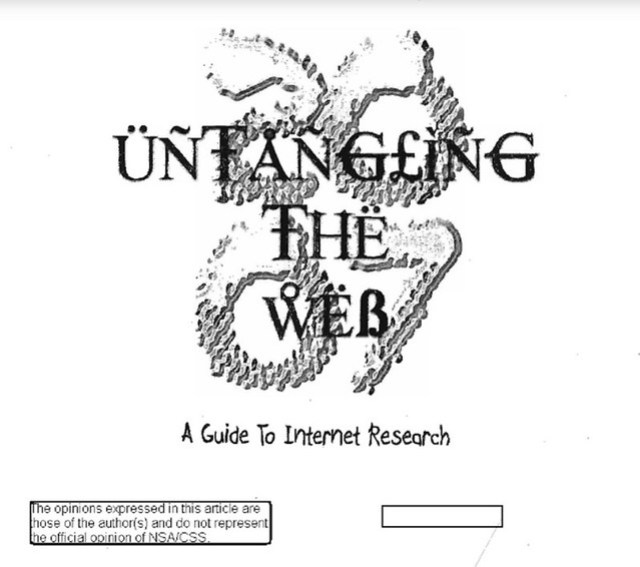
The NSA’s 2007 internal manual for research on the Internet is, well… mesmerizingly odd. On it’s way to a Dungeons-and-Dragons-as-reported-by-an-undergraduate-Classics-major-like depiction of life online, it cites Borges, Freud, and Ovid – and that’s just the preface…
The NSA has a well-earned reputation for being one of the tougher agencies to get records out of, making those rare FOIA wins all the sweeter. In the case of Untangling the Web, the agency’s 2007 guide to internet research, the fact that the records in question just so happen to be absolutely insane are just icing on the cake – or as the guide would put it, “the nectar on the ambrosia.”…
More of the backstory at “The NSA’s guide to the internet is the weirdest thing you’ll read today“; browse through the text in its extraordinary entirety here.
Quis custodiet ipsos custodes? (Who will guard the guards themselves?, or more familiarly, who will watch the watchers?)
– Juvenal
* Philip K. Dick
###
As we limber up our gaming fingers, we might recall this is an important anniversary in the pre-history of the Internet: on this date in 1837, Charles Wheatstone and William Fothergill Cooke patented the electric “Five Needle Telegraph” in London (U.K. No. 7390). They were subsequently granted a patent in the U.S. 10 days before Samuel Morse received his, but Morse was given priority by the U.S. PTO as the first inventor. Nonetheless, Wheatstone and Cooke had priority in the U.K.; their system served British railways, press, and law enforcement for decades, first as the service of an independent company, then as a nationalized part of the General Post Office.

Wheatstone (left) and Cooke
“We face neither East nor West; we face forward”*…

To the Western mind, “African Electronics,” the theme of this year’s annual Chale Wote street art festival in Ghana’s capital, might conjure up images of social media revolutions, telecommunications giants, farmers using smartphones, or other “tech solutions” to development. Not for artist Serge Attukwei Clottey.
Serge, like most artists participating at Chale Wote, views African Electronics as a call for African empowerment, and celebration of the innovation and energy which has been flowing through the continent for centuries. This was ever present throughout a festival that saw examples of both traditional and contemporary art forms: from colorful wall murals to performance art, interactive installations to stand alone sculptures, traditional drummers to electronic music DJs…
More at “‘African Electronics’ Takes a Spiritual Approach to Individual Power.” (Serge Attukwei Clottey will exhibit his performance installation, The Displaced, at Feuer Mesler gallery in Manhattan in October 2015.)
* Kwame Nkrumah
###
As we agree with Jaron Lanier that “You Are Not A Gadget,” we might recall that it was on this date in 1888 that Granville Tailer Woods– the first African-American electrical engineer working n the U.S. after the Civil War, whose many inventions (and 50 patents) earned him the moniker “the Black Edison”– patented the Multiplex Telegraph, a device that sent messages between train stations and moving trains, thus assuring a safer, better public transportation system.

“It is a miracle that one does not dissolve in one’s bath like a lump of sugar”*…

A professor of physiotherapy, Dr. Curran Pope’s practice embraced “diseases of the mind and nervous system”, which he treated with both electro-therapy, and hydrotherapy in his own sanatorium in Louisville, Kentucky. In 1909, he published Practical Hydrotherapy: A Manual for Students and Practitioners.
As the book’s contents list suggests, Pope considered hydrotherapy – treatment in which the temperature or pressure of water is used – as a viable method for curing anything from diabetes and heart disease to paranoia and alcoholism. The treatments are comprised of baths, douches, enemas, steam, and wet sheets, which are applied in various temperatures and orders depending on the ailment. Pope believed the body to heal itself and that water could aid the healing or indeed help to prevent diseases from occurring. He also believed in testing the methods on himself. He writes in the preface:
Much information and a clearer insight than mere description can give, is to note the physiological action of hydrotherapy by “putting yourself in his place.” One application of a cold jet douche to the spine gives more realistic information than pages of description. I therefore make the suggestion of “practice on yourself” first. Many experiments herein mentioned have had the author as principal party in interest.
Get wet at Public Domain Review, where one will find many more illustrations like the one above; then page through Dr. Pope’s book at the Internet Archive.
* Pablo Picasso
###
As we dip our toes, we might send temperate birthday greetings to William Thomson, 1st Baron Kelvin; he was born on this date in 1824. A physicist, mathematician, and engineer, he has been described as the Newton of his era: At the University of Glasgow, where he taught for over half a century, he did important work in the mathematical analysis of electricity and formulation of the first and second laws of thermodynamics, and did much to unify the emerging discipline of physics in its modern form. He worked closely with mathematics professor Hugh Blackburn in his work, especially the development and application of trigonometry. He had a side career as an electric telegraph engineer and inventor, which propelled him into the public eye (and ensured his wealth, fame, and honor– his work on the transatlantic telegraph project earned him a knighthood from Queen Victoria). And he had extensive maritime interests, among which he was most noted for his work on the mariner’s compass, which had previously been limited in reliability.
Absolute temperatures are stated in units of kelvin in his honor. While the existence of a lower limit to temperature (absolute zero) was known prior to his work, it was Lord Kelvin who determined its correct value as approximately −273.15 degree Celsius, or −459.67 degree Fahrenheit.


You must be logged in to post a comment.