Posts Tagged ‘society’
“The trouble with most folks isn’t so much their ignorance as knowing so many things that ain’t so”*…

From Kai Brach, in his nifty newsletter Dense Discovery, an appreciation of an Isaac Asimov essay from 1988: “The Relativity of Wrong” (a lovely riff on a point also taken up by Karl Popper)…
… it’s a welcome dose of nuance in this era of absolutist thinking. When knowingness tricks our brains into certainty, Asimov’s wonderfully nerdy piece demonstrates that right and wrong are far less binary than we may think.
The piece begins with Asimov addressing a young English literature student who’d written to scold him for his scientific arrogance. The student argues that every generation thinks they’ve got it sorted, and every generation gets proven wrong. Therefore, our current knowledge is just as flawed as flat-earth theory. But Asimov won’t have it:
“When people thought the Earth was flat, they were wrong. When people thought the Earth was spherical, they were wrong. But if you think that thinking the Earth is spherical is just as wrong as thinking the Earth is flat, then your view is wronger than both of them put together.”
He then makes his point clear through a series of delightful examples. Like spelling:
“How do you spell ‘sugar’? Suppose Alice spells it p-q-z-z-f and Genevieve spells it s-h-u-g-e-r. Both are wrong, but is there any doubt that Alice is wronger than Genevieve? For that matter, I think it is possible to argue that Genevieve’s spelling is superior to the ‘right’ one. Or suppose you spell ‘sugar’: s-u-c-r-o-s-e, or C₁₂H₂₂O₁₁. Strictly speaking, you are wrong each time, but you’re displaying a certain knowledge of the subject beyond conventional spelling.”
The same logic applies to mathematics: “Suppose you said: 2 + 2 = an integer. You’d be right, wouldn’t you? Or suppose you said: 2 + 2 = an even integer. You’d be righter. Or suppose you said: 2 + 2 = 3.999. Wouldn’t you be nearly right?”
The flat-earth idea is a great (and again timely?) case study for Asimov’s theory. The notion that the earth was flat wasn’t the product of ancient stupidity but reasonable observation given the tools available. The earth’s actual curvature is roughly 0.000126 per mile – practically indistinguishable from zero without sophisticated instruments.
“So although the flat-Earth theory is only slightly wrong and is a credit to its inventors, all things considered, it is wrong enough to be discarded in favour of the spherical-Earth theory.”
What he’s really arguing for is intellectual humility. Scientific theories don’t flip-flop wildly from flat earth to cubic earth to doughnut-shaped earth. Instead:
“What actually happens is that once scientists get hold of a good concept they gradually refine and extend it with greater and greater subtlety as their instruments of measurement improve. Theories are not so much wrong as incomplete.”
We seem to live in a world of zero-sum thinking, where nuance often gets steamrolled by the satisfying simplicity of being right. I want to remember Asimov’s framework the next time I’m certain someone else is wrong – that most disagreements aren’t between absolute truth and utter falsehood, but between different degrees of incompleteness…
On the dangers of “knowingness” and absolutism: Isaac Asimov’s “The Relativity of Wrong,” from @densediscovery.bsky.social.
Asimov’s essay is here.
See also: “There is nothing new to be discovered in physics now. All that remains is more and more precise measurement” and “The importance of experimental proof, on the other hand, does not mean that without new experimental data we cannot make advances.”
(Image above: source)
###
As we rethink, we might recall that this date in 1957 was “E Day,” the introduction of the Edsel automobile. Name for Edsel Ford, son of company founder Henry Ford, Edsels were developed in an effort to give Ford a fourth brand (beyond Ford, Mercury, and Lincoln) to gain additional market share from Chrysler and General Motors. It was the first new brand introduction by an American automaker since the 1939 launch of Mercury and 1956 launch of Continental (which ended and merged into Lincoln after 1957).
Introduced in a recession that catastrophically affected sales of medium-priced cars, Edsels were considered overhyped, unattractive, distinguished by a vertical grille said to resemble a horse collar, and low quality.
No automobile has been so widely anticipated nor so quickly rejected as the Ford Edsel (with the possible recent exception of the Tesla Cybertruck). Within two months of its highly publicized launch, the Edsel became a rolling joke– and has stood as a metphor for disastrous product launch failures since.
Recognizing this (and following a loss of over $250 million [equivalent to $2.66 billion in 2024 dollars] on development, manufacturing, and marketing on the model line), Ford quietly discontinued the Edsel brand before 1960.

“We don’t laugh because we’re happy – we’re happy because we laugh”*…

Emily Herring on Henri Bergson and the importance of laughter…
… Before Bergson, few philosophers had given laughter much thought. The pre-Socratic thinker Democritus was nicknamed the ‘laughing philosopher’ for espousing cheerfulness as a way of life. However, we know more about his thoughts on atomism than on laughter. Similarly, the section of Aristotle’s Poetics that dealt with comedy hasn’t come down to us. Other major thinkers who have offered passing, often humourless, reflections about humour include Thomas Hobbes and René Descartes, who believed that we laugh because we feel superior; Immanuel Kant and Arthur Schopenhauer who argued that comedy stems from a sense of incongruity; and Herbert Spencer and Sigmund Freud who suggested that comedians provide a form of much-needed relief (from, respectively, ‘nervous energy’ and repressed emotions). Bergson was unconvinced by these accounts. He believed that the problem of laughter deserved more than a few well-worded digressions. Although his theory retained elements of the incongruity and superiority theories of humour, it also opened entirely new perspectives on the problem…
… Why did a philosopher of such renown deviate from his more traditional and serious philosophical obsessions – the nature of time, memory, perception, free will and the mind-body problem – to focus on the apparently frivolous case-studies of slapstick, vaudeville and word play? And what was there to be gained from such analysis? The topic was a ticklish one. Laughter, wrote Bergson, had ‘a knack of baffling every effort, of slipping away and escaping only to bob up again, a pert challenge flung at philosophic speculation’. It was almost as though there was something unnatural about subjecting one of the most pleasurable and ubiquitous human experiences to dry philosophical speculation…
… He believed that laughter should be studied as ‘a living thing’ and treated ‘with the respect due to life’. His investigation was therefore more like that of a field zoologist observing frogs in the wild:
we shall not aim at imprisoning the comic spirit within a definition … We shall confine ourselves to watching it grow and expand.
Like all good metaphorical field zoologists, Bergson started his study by familiarising himself with his metaphorical frog’s natural habitat: in other words, the conditions under which laughter is most likely to appear and thrive. Following this method, Bergson arrived at three general observations.
The first one, according to Bergson, was so ‘important’ and ‘simple’ that he was surprised it hadn’t attracted more attention from philosophers: ‘The comic does not exist outside the pale of what is strictly human.’ When Bergson wrote these words, he couldn’t have foreseen that, a century later, through the power of the internet, one of the most popular forms of comedy would be provided by our own pets in the form of viral videos, memes and gifs. But, in a way, he anticipated it in what he wrote about laughter directed at non-humans:
You may laugh at an animal, but only because you have detected in it some human attitude or expression…
… Bergson’s second observation might appear counterintuitive to anyone who has been reduced to tears by a fit of uncontrollable giggles: ‘Laughter has no greater foe than emotion.’ But his point was that certain emotional states – pity, melancholy, rage, fear, etc – make it difficult for us to find the humour in things we might otherwise have laughed at (even anthropomorphic vegetables). We instinctively know that there are situations in which it is best to refrain from laughing. Those who choose to ignore these unspoken rules are immediately sanctioned…
… This is not to say that it’s impossible to laugh in times of hardship. In many cases, humour appears to serve as a coping mechanism in the face of tragedy or misfortune. In 1999, as he was being carried out of his house on a stretcher after a crazed fan stabbed him, the former Beatle George Harrison asked a newly hired employee: ‘So what do you think of the job so far?’ On his death bed, Voltaire allegedly told a priest who was exhorting him to renounce Satan: ‘This is no time for making new enemies.’ Following Bergson’s logic, perhaps in some cases humour is cathartic precisely because it forces us to look at things from a detached perspective.
Finally, laughter ‘appears to stand in need of an echo’, according to Bergson. Evolutionary theorists have hypothesised about the adaptive value of laughter, in particular in the context of social bonding. Laughter might have emerged as a prelinguistic signal of safety or belonging within a group. Laughter and humour continue to play an important role in our various social groups. Most countries, regions and cities share a wide repertoire of jokes at the expense of their neighbours. For example, this Belgian dig at my compatriots, the French: ‘After God created France, he thought it was the most beautiful country in the world. People were going to get jealous, so to make things fair he decided to create the French.’
Jokes need not be nationalistic or even derogatory in nature to facilitate social bonding. Most friends share ‘in-jokes’ that are meant to be understood only within the context of their particular social group, as do certain communities brought together by a football team, political opinions or shared specialist knowledge (‘Why are obtuse angles so depressed? Because they’re never right’). Our laughter ‘is always the laughter of a group’, as Bergson put it. Even in those cases when we are effectively laughing alone, to, or perhaps at ourselves, laughter always presupposes an imagined audience or community.
Bergson’s observations tell us where to find laughter, under which conditions it is possible for laughter to emerge, but they don’t tell us why we laugh. They do nonetheless provide us with important clues. It is no accident that we laugh exclusively at other humans, and that laughter is a communal experience: its purpose, or ‘function’, wrote Bergson, is social. In addition, it isn’t by chance that laughter requires a temporary shutdown of our emotions: though pleasurable, laughter is above all punitive. But what, or whom, is laughter punishing, and how does it do that?
Read on to find out how Bergson reached his conclusion that laughter solves a serious human conundrum– how to keep our minds and social lives elastic: “Laughter Is Vital,” from @emilyherring.bsky.social in @aeon.co.
For those finding it difficult to laugh in these troubled times, see this piece on the pessimisitic Schopenhauer‘s conoisseurship of very distinctive kinds of happiness: “The semi-satisfied life.”
###
As we chortle, we might send smiling birthday greetings to Ramón Valdés; he was born on this date in 1924. An actor and comedian, he is best known for the character he made iconic: “Don Ramón” in El Chavo del Ocho, a hugely-successful Mexican sitcom that aired for 8 seasons (31 episodes) across Latin America and in Spain.

“I once wanted to become an atheist, but I gave up – they have no holidays”*…
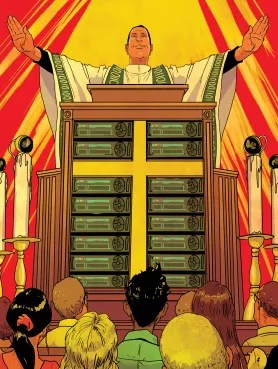
We used to relate to different spheres of our lives– and they to us– differently: we were consumers in the marketplace; citizens in the civic arena; worshipers in the spiritual; sudents in school; etc. We had expectations and obligations that were different, different in kind, from one to the next. The homogenizing logic of the marketplace is systematically taking over those other spheres… and we’re behaving– and being treated– more and more like consumers across them all. As this Wired article article from 1995 suggests, that’s been underway for a long time.
Case in point:
As of the end of last year, 63% of Americans identified as Christians; down roughly 12% over the last 20 years. As of 2024, 33% said they attended services in person at least monthly, with another 23% saying that they participated in virtual services at least once a month.
So it’s no surprise that churches are goosing their efforts to attract and keep worshipers, cultivating a more “experiential” (even “charismatic“) style– and turning to the same kind of CRM (customer relationship management) tools that Salesforce and others provide commercial ventures.
Alex Ashely reports on a purpose-driven (and purpose-built) vendor that means to enable churchs to “manage” their relationships with their parishioners in a way (and to an extent) that sounds more like Palantir than Salesforce…
On a Sunday morning in a Midwestern megachurch, worshippers step through sliding glass doors into a bustling lobby—unaware they’ve just passed through a gauntlet of biometric surveillance. High-speed cameras snap multiple face “probes” per second, isolating eyes, noses, and mouths before passing the results to a local neural network that distills these images into digital fingerprints. Before people find their seats, they are matched against an on-premises database—tagged with names, membership tiers, and watch-list flags—that’s stored behind the church’s firewall.
Late one afternoon, a woman scrolls on her phone as she walks home from work. Unbeknownst to her, a complex algorithm has stitched together her social profiles, her private health records, and local veteran outreach lists. It flags her for past military service, chronic pain, opioid dependence, and high Christian belief, and then delivers an ad to her Facebook feed: “Struggling with pain? You’re not alone. Join us this Sunday.”
These hypothetical scenes reflect real capabilities increasingly woven into places of worship nationwide, where spiritual care and technology converge in ways few congregants ever realize. Where Big Tech’s rationalist ethos and evangelical spirituality once mixed like oil and holy water, this unlikely amalgam has given birth to an infrastructure already reshaping the theology of trust—and redrawing the contours of community and pastoral power in modern spiritual life. The emerging nerve center of this faith-tech nexus is in Boulder, Colorado, where the spiritual data and technology firm Gloo has its headquarters.
Gloo is constructing a digital infrastructure meant to bring churches into the age of algorithmic insight.
The church is “a highly fragmented market that is one of the largest yet to fully adopt digital technology,” the company said in a statement by email. “While churches have a variety of goals to achieve their mission, they use Gloo to help them connect, engage with, and know their people on a deeper level.”…
… The company refers to itself as “a technology platform for the faith ecosystem.” Either way, this information is integrated into its “State of Your Church” dashboard—an interface for the modern pulpit.
Since its launch in 2013, Gloo has steadily increased its footprint, and it has started to become the connective tissue for the country’s fragmented religious landscape. According to the Hartford Institute for Religion Research, the US is home to around 370,000 distinct congregations. As of early 2025, according to figures provided by the company, Gloo held contracts with more than 100,000 churches and ministry leaders…
… [In March] Gloo… unveiled a strategic investment in Barna Group, the Texas-based research firm whose four decades of surveying more than 2 million people underpin its annual reports on worship, beliefs, and cultural engagement. Barna’s proprietary database—covering every region, age cohort, and denomination—has made it the go-to insight engine for pastors, seminaries, and media tracking the pulse of American faith…
… Barna’s troves of behavioral, spiritual, and cultural data offer granular insight into the behaviors, beliefs, and anxieties of faith communities. While the two organizations frame the collaboration in terms of serving church leaders, the mechanics resemble a data-fusion engine of impressive scale: Barna supplies the psychological texture, and Gloo provides the digital infrastructure to segment, score, and deploy the information…
… Gloo is also now focused on supercharging its services with artificial intelligence and using these insights to transcend market research. At a September 2024 event in Boulder called the AI & the Church Hackathon, Gloo unveiled new AI tools called Data Engine, a content management system with built-in digital-rights safeguards, and Aspen, an early prototype of its “spiritually safe” chatbot, along with the faith-tuned language model powering that chatbot, known internally as CALLM (for “Christian-Aligned Large Language Model”).
[Ashley describes the growth of Gloo (largely through acquisition), the advent and integration of biometric surveillance, and the Salesforce-like growth of third-party apps; he explores several use cases and raises the concerns– privacy and others– that arise in absence of any meaningful regulation or oversight…]
… With guardrails still scarce, though, faith-tech pioneers and church leaders are peering ever more deeply into congregants’ lives. Until meaningful oversight arrives, the faithful remain exposed to a gaze they never fully invited and scarcely understand.
In April, [Intel CEO until he was ousted last year, now Gloo’s executive chair and head of technology Phil] Gelsinger took the stage at a sold-out Missional AI Summit, a flagship event for Christian technologists that this year was organized around the theme “AI Collision: Shaping the Future Together.” Over 500 pastors, engineers, ethicists, and AI developers filled the hall, flashing badges with logos from Google DeepMind, Meta, McKinsey, and Gloo.
“We want to be part of a broader community … so that we’re influential in creating flourishing AI, technology as a force for good, AI that truly embeds the values that we care about,” Gelsinger said at the summit. He likened such tools to pivotal technologies in Christian history: the Roman roads that carried the gospel across the empire, or Martin Luther’s printing press, which shattered monolithic control over scripture. A Gloo spokesperson later confirmed that one of the company’s goals is to shape AI specifically to “contribute to the flourishing of people.”
“We’re going to see AI become just like the internet,” Gelsinger said. “Every single interaction will be infused with AI capabilities.”
He says Gloo is already mining data across the spectrum of human experience to fuel ever more powerful tools.
“With AI, computers adapt to us. We talk to them; they hear us; they see us for the first time,” he said. “And now they are becoming a user interface that fits with humanity.”
Whether these technologies ultimately deepen pastoral care or erode personal privacy may hinge on decisions made today about transparency, consent, and accountability. Yet the pace of adoption already outstrips the development of ethical guardrails. Now, one of the questions lingering in the air is not whether AI, facial recognition, and other emerging technologies can serve the church, but how deeply they can be woven into its nervous system to form a new OS for modern Christianity and moral infrastructure.
“It’s like standing on the beach watching a tsunami in slow motion,” Kriel says.
Gelsinger sees it differently.
“You and I both need to come to the same position, like Isaiah did,” he told the crowd at the Missional AI Summit. “‘Here am I, Lord. Send me.’ Send me, send us, that we can be shaping technology as a force for good, that we could grab this moment in time.”…
Spiritual care and technology are converging across the country, reshaping the theology of trust: “When tech gets religion: How churches use data and AI,” from @technologyreview.com.
* Henny Youngman
###
As we pray for guidance, we might recall that Henry VIII, King of England from 1509 until his death in 1547, known for his six marriages, attempted to have his first marriage (to Catherine of Aragon) annulled. His disagreement with Pope Clement VII over the issue led Henry to initiate the English Reformation, separating the Church of England from papal authority. He appointed himself Supreme Head of the Church of England and dissolved convents and monasteries– for which, on this date in 1535, he was excommunicated by (Clement’s successor) Pope Paul III.

“It’s not the voters picking their representatives; it’s the representatives picking their voters!”*…
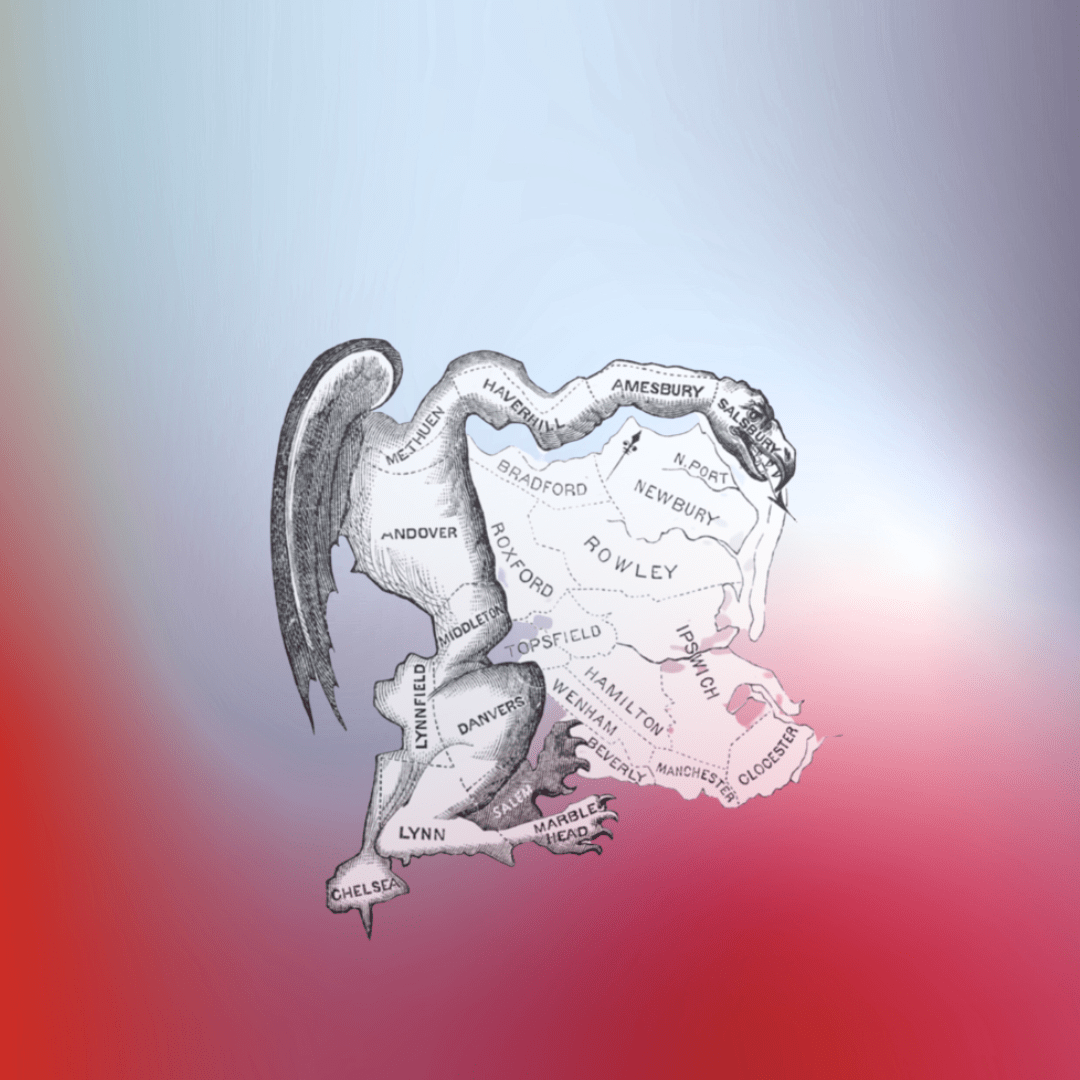
Gerrymandering has been a word since 1812 (when Elbridge Gerry signed a bill that created a partisan district in the Boston area [pictured above] that was compared to the shape of a mythological salamander); but the phenomenon has been an issue pretty much from our nation’s birth– first states, then congressional districts, drawn to favor the party doing the drawing. And, as researchers have shown, the result has been an increase in safe seats, occupied by representatives less responsive to constituents at large, and more atuned to the most vociferously-partisan elements in the disticts.
Redistricting every ten years, to reflect population changes detected in the census taken every decade, is mandated by the Constitution. But managing voting– and the drawing of district boundaries– are a state right and responsibility, usually exercised by a state’s legislature (though a few states have delegated the task to separate commissions). And while most states address the issue every ten years, following the census, the Supreme Court ruled in 2006 (in LULAC v Perry) that states could redistrict at other times and for other reasons as well.
Over three-quarters of Americans believe that gerrymandering is unfair and should be illegal; and so redistricting has typically been swathed in rhetoric that attempts to communicate fairness and obscures any partisan designs… at least until 2019, when the Supreme Court effectively gave states the right to redistrict for explicitly partisan reasons.
And now, with Texas’ newly-drawn maps enacted and other states both red and blue being pressured by the parties to “counter-plot,” gerrymandering is very much a “thing.” California is, of course, considering a response-in-kind. Republicans in Indiana, Missouri, and Florida have openly discussed the possibility of reworking their maps ahead of the 2026 midterms, while Democratic governors in Illinois, New York, and Maryland have also floated doing the same. Given that Texas’ move– creating five more “safe” Republican seats and making two of the remaining Democractic seats more competitive– looks to make the Democrats’ prospects of regaining control of now almost evenly-divided House much more difficult, California Democrats (even those opposed to gerrymandering) are, however reluctantly, lining up behind an attempt to off-set the impact of Texas’ rejiggering… which is increasing the pressure on Indiana, Missouri, and Florida to act… and on Illinois, New York, and Maryland to react (especially since, some believe, the Democrats might “win”)…
This is, one reckons, what happens when control matter more than governing. Put another way (and channeling the great James Carse, this is what happens when the winner of one round in an infinite game decides to change the rules in order to create a finite game in which they are the victor.
Of course, that rarely works in the long run. Historian Kevin Vrevich has some thoughts on what the onslaught that Texas has unleashed that might mean…
… The history of gerrymandering suggests that the current arms race of redistricting for short-term partisan gains is quite in line with the actions of those in the early republic, indicating a period of political instability akin to the Jacksonian period may be on the way…
[Vrevich unpacks the constitutional and political history of redistricting, culminating in 1812 event, outlined above, that gave the partisan practice its name…]
… The redistricting plans of the current political parties, especially their rapid response nature, feel very similar to the partisan machinations of the early republic and antebellum period. The usage of sophisticated tracking polls and predictive computer models does not change the fact that the goals of today are identical to those of the Massachusetts Republicans in 1812. That suggests that times of rapid party turnover, legitimate third parties, and increased political violence are all on the horizon…
“The Original Gerrymanders,” from @kevinvrevich.bsky.social in The Panorama (the online presence of the Journal of the Early Republic)
More background on (the more recent) history of partisan redistricting: “The Worst 10 Gerrymanders Ever.”
* Widely- (and accurately-)used critique of gerrymandering
###
As we regret regression to the mean (pun intended), we might recall that it was on this date in 1963 that an estimated 250,000 people attended the March on Washington for Jobs and Freedom in Washington D.C., which advocated for the civil and economic rights of African Americans. In addition to Martin Luther King Jr.’s “I Have a Dream” speech at the Lincoln Memorial calling for an end to racism, musicians Odetta, Mahalia Jackson, and Marian Anderson, Peter, Paul & Mary, Joan Baez, and Bob Dylan, performed.

“You don’t know what you’ve got ’til it’s gone”*…

Why is the most dangerous political crisis in modern American history being met with emotional denial, moral distortion, and cultural distraction? Mike Brock, with a bracing essay…
Two plus two equals four. There are twenty-four hours in a day. And the United States is experiencing a constitutional crisis that threatens to end our democratic experiment.
That sentence—stark, unqualified, devoid of hedging—causes a peculiar form of discomfort. It demands we confront a reality most of us are psychologically unprepared to process: We are living through a slow-motion collapse of constitutional democracy in the United States, and most people—not just average citizens but intellectuals, journalists, and elected officials—are emotionally and cognitively incapable of grasping the scale of this threat.
This is not merely a political problem. It is a moral and psychological crisis of coherence—a collective failure to align our emotional response with objective reality. The distance between the magnitude of what is happening and our capacity to feel its significance represents one of the most dangerous disconnects in American history.
We treat an existential threat to self-governance as if it were merely another election cycle. We discuss the potential end of constitutional democracy in the same register we might debate tax policy or infrastructure spending. We have normalized what should never be normal, accommodated what should never be accommodated, and rationalized what should have provoked immediate, sustained resistance.
The gap between the emergency and our feeling of emergency is not accidental. It is the product of specific psychological defenses, media failures, and deliberate manipulation—all combining to protect us from the emotional and moral burden of confronting our situation honestly…
[Brock unpacks the nature of the emergency and then enumerates the “defenses against reality” that are in play: denial (disguised as normalcy), deflection, bothsidesism and cynicism, performative objectivity, and moral equivalence. Having explained each of these, he locates them in what he calls “The Arendtian Frame: The Banality of Complicity” and explains the ways in which they create a series of “collapses in coherence” that keep us from feeling the gravity of the situation…]
… In the face of this psychological and moral crisis, clarity becomes not just an intellectual virtue but a form of resistance. We must name what is happening, without euphemism, without equivocation, and without the false comfort of neutrality.
This is fascism.
I understand the reluctance to use this word. I acknowledge that it has sometimes been misused by the left, applied too broadly to policies they simply dislike rather than to genuine authoritarian movements. This overuse has created an understandable allergic reaction among many thoughtful people.
But the misuse of a term doesn’t invalidate its proper application. The fact that some have incorrectly diagnosed pneumonia doesn’t mean pneumonia doesn’t exist. And what we face now—the cult of personality, the manipulation of law to serve power, the demonization of minorities, the glorification of strength over principle, the explicit rejection of constitutional constraints—these are the defining features of fascism as a political form.
To refuse this word is not moderation but evasion. It is not caution but complicity. It reflects not intellectual rigor but psychological denial—the desperate need to believe we remain within the bounds of normal politics when we have already crossed into darker territory.
Fascism doesn’t arrive announcing itself with swastikas and goose-stepping troops. It comes draped in familiar symbols, speaking the language of tradition, order, and national renewal. It maintains the forms of democratic governance while hollowing out their substance. It works through existing institutions rather than immediately abolishing them.
What makes our current moment particularly dangerous is how it combines traditional authoritarian features with technological capabilities for surveillance, propaganda, and control that previous fascist movements couldn’t imagine. The fusion of authoritarian intent with algorithmic power creates possibilities for sustained oppression that exceed historical precedents.
This is why clarity matters so urgently. Without the proper diagnosis, we cannot formulate the proper response. If we persist in treating an authoritarian movement as merely another iteration of conservative governance, we will deploy inadequate tools against an existential threat.
The appropriate response to fascism is not normal opposition but moral resistance. Not tactical accommodation but principled confrontation. Not private diplomacy but public witness.
This resistance begins with moral courage—the willingness to speak truth despite social costs, professional risks, or personal discomfort. It requires moral clarity—the capacity to distinguish between normal political disagreement and fundamental threats to democratic governance. And it demands civic resistance—the refusal to normalize or accommodate authoritarian consolidation.
In practical terms, this means:
Refusing to center the wrong stories. When media coverage focuses on trivia while constitutional violations go unremarked, we must insist on proper perspective. When commentators treat fascist rhetoric as merely “controversial” rather than dangerous, we must restore moral clarity.
Refusing to indulge fascist spectacles. The strategy of overwhelming our attention with constant outrages, contradictory claims, and manufactured controversies works only if we allow ourselves to be manipulated by it. We must maintain focus on the core threat rather than chasing each new distraction.
Refusing to treat a slow coup as normal politics. We must reject the pressure to discuss authoritarian consolidation as if it were merely another policy dispute. We must insist on the fundamental distinction between governance within constitutional boundaries and the systematic dismantling of those boundaries.
Most importantly, we must be witnesses—not passive observers but active participants in the maintenance of truth. When someone dismisses constitutional violations as mere politics, we must speak up. When someone equates democratic flaws with authoritarian assaults, we must correct them. When someone retreats into cynicism or bothsidesism, we must insist on moral distinction.
These acts of witness may seem small compared to the scale of our crisis. They may feel inadequate in the face of constitutional collapse. But they represent the essential foundation for any larger resistance. Without the maintenance of truth, without the preservation of moral clarity, no other form of opposition is possible…
… the center cannot hold through denial or deflection. It can only be held through clarity—through the painful but necessary acknowledgment of our true situation.
This clarity begins with saying what is true, even when others aren’t ready to hear it. It continues through the patient, persistent defense of coherence against the forces that would dissolve it. And it culminates in the courage to act on that truth, to align our response with the reality we face rather than the reality we wish existed.
The wire still holds—but only if we walk it. Only if we maintain the tension between truth and power, between principle and expediency, between the republic we’ve inherited and the responsibility to preserve it.
This is not about partisanship. It is not about policy preferences. It is about whether the American experiment in self-governance will continue or whether it will join history’s long list of failed republics—remembered not for what it achieved but for what it surrendered.
The emergency we cannot feel is no less real for our failure to feel it. The collapse we struggle to acknowledge is no less imminent for our reluctance to face it. And the responsibility to resist, to bear witness, to hold the center—that responsibility falls to each of us, whether we’re emotionally prepared for it or not.
Eminently worth reading– and contemplating– in full: “The Emergency We Cannot Feel: On the Psychological Unreadiness for American Collapse” from @brockm.bsky.social.
See also: “Courage versus Complicity” from the estimable Larry Lessig, and “The Nineteen-Thirties Novel That’s Become a Surprise Hit in the U.K.“
And for an extraordinary series of conversations about democracy and authorianism in our moment (and what we can do), visit The Civic Forum, created and moderated by Rory Truex. (TotH to MKM)
Finally, a philosphical (indeed, almost cosmic) perspective on the (broadest understanding of) the context in which the issues above are unfolding: “Reality is evil- Everything eats and is eaten. Everything destroys and is destroyed. It is our moral duty to strike back at the Universe”
* Joni Mitchell, “Big Yellow Taxi”
###
As we face reality, we might recall that it was on this date in 1775 that King George II of Great Britain issued the Proclamation of Rebellion (officially, A Proclamation for Suppressing Rebellion and Sedition), in repsonse to the news of the Battle of Bunker Hill at the outset of the American Revolutionary War. It declared elements of the American colonies in a state of “open and avowed rebellion” and ordered officials of the empire “to use their utmost endeavours to withstand and suppress such rebellion.”

You must be logged in to post a comment.