Posts Tagged ‘society’
“I think it would be a very good idea”*…

As we discuss global culture(s) or geo-politics, we often talk about “The West” (and the rest). In a review of Georgios Varouxakis‘ new book The West: The History of an Idea, Andrew Kaufmann reminds us that it’s important to interrogate that defining concept…
What is the West? Many take the idea for granted, but few can define it. In this meticulously researched, engaging, and sometimes bewildering new book, The West: The History of an Idea, intellectual historian Georgios Varouxakis takes readers on a two-centuries-long tour of the many uses, definitions, and redefinitions of the term. Along the way, readers may find their own long-held assumptions and stereotypes challenged and even undermined.
The book makes a number of arguments, but for the purposes of this review, it’s worth focusing on just a few major ones. The first and most innovative argument of the book is this: The idea of the West as a transnational sociopolitical community distinct from the rest of the world is more recent than we think. This idea received its first sophisticated and coherent articulation in the 1820s from French philosopher Auguste Comte.
While historians and other academics had long looked to past societies like ancient Athens or medieval Europe as representing the “West” against some “other,” Comte was the first to coherently put together a future-oriented political program to be adopted and followed. Most scholars locate the future-focused version of the West’s inauguration in the 1890s, when the idea was used to justify imperial and colonial expansion. By contrast, Varouxakis argues that Comte and his followers wanted to build a West that was anti-imperialist, committed to science and reason, liberated from dogmatic Christianity, and fueled by altruism and sympathy.
As a progressive positivist, Comte saw the “Western Republic” as a via media between a hyper nationalism (of the French variety) and an overly abstract universalism. He imagined a way station that transcended the parochialism of family and nation and would one day be realized and embraced all over the world, even if it would take a full seven centuries from his own writing to come to fruition (that was Comte’s timeline). Neither tied to a particular nation like France (although Paris would be the center of this Republic until Constantinople would replace it), nor embodied by an abstract and universal cosmopolitanism, the Western Republic (or l’Occident) would be set off against its Other—in particular, Russia and the Orient. Still, over time this republic would non-coercively welcome the rest of the world into its fold.
Contrary to a common conception of “the West,” it was not to be a society (or society of societies) committed to democracy, individualism, or liberalism. It was instead a rejection of the hyper-individualism of the modern period, and it was an attempt to recover an older other-centered ethic that had been lost to a prior age.
The second major argument Varouxakis presents is that despite this idea of a transnational West that had its origin in Comte’s work, and despite Comte’s legacy that his disciples clearly carried across continents and centuries, the history of the idea of the West since Comte is complicated and contested. Put another way, while the specter of Comte hovers over the entire narrative, his vision is not always fully realized, nor is the meaning of the term always stable. This complicated history manifests itself in a number of different ways and carries with it some significant implications…
… Many casual users of “Western Civilization” will often identify it as one and the same with liberal democracy. They often find that somehow and at some point Britain came to embrace the West as being just that—liberal and democratic. Varouxakis complicates this picture by showing that while a few liberal voices in Britain were certainly also champions of Western Civilization, the more consistent and coherent users of the term were disciples of Comte and therefore much more illiberal in their thinking…
… Or take the more familiar East vs. West framework we associate with the Cold War, where surely the fault lines of Eastern totalitarianism against Western liberal capitalism are clean and clear. But even here the history is complicated, as the period begins with the acknowledgement that it was indeed Soviet Russia that helped to save “western civilization.” Indeed, it took forty years of gradual evolution for the idea of the “West” to finally crystallize around the shared commitment to economic, religious, and political freedom over and against Soviet planned economies, state-sanctioned atheism, and one-party politics with no free and fair elections…
… Given the winding road of the history of the West, it is instructive that there seems to be something of a settlement on its meaning for today, even if there are differences in its application. This can be seen most clearly in Varouxakis’ penultimate chapter on the dispute between Samuel Huntington and Francis Fukuyama after the end of the Cold War. Fukuyama of course is well known for his view that the West—in its embrace of liberal democracy and capitalism—had now emerged triumphant over the defeated ideas of Marxist totalitarianism, which found its fullest expression in Soviet Russia of the East.
Samuel Huntington’s ideas of what the West embodied were not much different, but he diverged from Fukuyama in his vision of what the world’s future likely entailed. For Huntington, the coming years and decades would see a “clash of civilizations,” a conflict of the most basic sort between the West and the great civilizations of the world as we know it. He saw nothing certain about the global triumph of any particular civilizational expression, including the West. Indeed, Huntington contends that it is only the West that even believes in universal ideals, and that all of the non-Western civilizations—whether Chinese, Islamic, or otherwise—are all partial in their visions. Therefore, we see here in the latest debate about the West a return of the Comtean question: Will the West become a universal civilization, or will it endure as one of many civilizations forever in conflict with each other? While we may have some agreement on what the West stands for, we may have less confidence in its future in the world.
The history is complex, indeed. But Varouxakis also raises the question of whether Western Civilization—however one defines it—is something to defend in the first place. He considers this question several times in the book, but perhaps none more poignantly than in the Great War itself. For example, there were many who noted the hypocrisy of the “Western powers” that suddenly found common cause with the long-excluded Russia in their fight against Germany and the Central Powers. But perhaps more troubling is what it says about a civilization when it produces not the peace and altruism long promised by its founder, but instead destruction on a scale that had never been seen before in human history. One could likewise ask: What kind of civilization deliberately excludes and exploits the weakest members within its borders, such as in the treatment of African Americans in the United States and of those in the furthest regions of the colonial empires of Europe? This crisis of confidence and feeling of decline continued through the interwar years, as Oswald Spengler expresses in his Decline of the West, a fitting rejoinder to the optimism of Comte’s Western utopia.
And so, perhaps the best way to conclude for readers of all sorts—but especially Christians—is to offer two words of caution. The first is to those who would defend the “West” and “Western Civilization” as something either resonant with or even inspired by a Judeo-Christian worldview. And that word is simple: the origins of the idea of the West in one of its most dominant forms (the Comtean one) and in its subsequent historical uses is either non-Christian or even anti-Christian. Indeed, I went into the book expecting a heavy dose of Judeo-Christian connections to the idea of the West, and while the link is not completely absent, I was struck by its muted nature.
Besides the post-Christian progressive vision of Comte himself, consider the voice of Black writer Richard Wright as one representative example to follow in the Frenchman’s footsteps. As someone who identified with the West, he considered “the content of [his] Westernness [residing] fundamentally…in [his] secular outlook upon life.” The progress of the West would be realized the more it emancipated itself from the influence of “mystical powers” or the priests who would speak in their name. Armed with the tools of trial-and-error pragmatism, human life can be sustained without recourse to divine help. A West liberated from divine help is a West worth preserving, at least according to Wright.
Overall, the West as an idea has many champions who are quite open in their antipathy toward the Christian religion, and it would be foolish to ignore those influences on the meaning and use of the term for us today. Still, the second and final note I’d like to offer is a bit more optimistic. In the concluding chapter, Varouxakis urges readers to move from the parochialism of “Western” ideas to adopt a language that is universal in its appeal. What, after all, was so attractive about any of the Western projects that Varouxakis so painstakingly chronicles? It was always their global appeal.
Altruism, sympathy, love for others, freedom, individualism, democracy, capitalism. These are not ideals that belong to just a few but rightfully can be embraced by all of God’s creatures in different places, at different times, and in different ways. Certainly for Christians who embrace a global faith, the least we can do is see the inheritance of the “West,” however defined, as a mixed bag of common grace insights and ideas in rebellion against God, combined with the perspective that none of what is worth keeping in the West should ever be kept from those who would embrace its ideals…
Eminently worth reading in full: “The Idea of the West” from @mereorthodoxy.bsky.social.
For a look at the concept in current context/practice: “The Rest take on the West,” from @noemamag.com.
* Gandhi’s response when asked, “what do you think of western civilization?”
###
As we ponder perplexingly plastic paradigms, we might recall that it was on this date in 1957 that “Whole Lotta Shakin’ Going On” by Jerry Lee Lewis peaked at #3 on the US pop singles charts (though it topped the R&B and country charts shortly after). It was a cover of a 1955 release by Big Maybelle of a song written by Dave “Curlee” Williams (and sometimes also credited to James Faye “Roy” Hall). Lewis, with session drummer Jimmy Van Eaton and guitarist Roland Janes, had recorded the song at Sun Records in just one take.
“As if the main object were to talk fast and not to talk sensibly”*…

As Josie Harvey reports, unlimited access to “doomscrolling” and the resultant emotional toll of constant negative news has led to record-high news avoidance…
News has never been more accessible – but for some, that’s exactly the problem. Flooded with information and relentless updates, more and more people around the world are tuning out.
The reasons vary: for some it’s the sheer volume of news, for others the emotional toll of negative headlines or a distrust of the media itself. In online forums devoted to mindfulness and mental health, people discuss how to step back, from setting limits to cutting the news out entirely…
… Globally, news avoidance is at a record high, according to an annual survey by the Reuters Institute for the Study of Journalism published in June. This year, 40% of respondents, surveyed across nearly 50 countries, said they sometimes or often avoid the news, up from 29% in 2017 and the joint highest figure recorded.
The number was even higher in the US, at 42%, and in the UK, at 46%. Across markets, the top reason people gave for actively trying to avoid the news was that it negatively impacted their mood. Respondents also said they were worn out by the amount of news, that there is too much coverage of war and conflict, and that there’s nothing they can do with the information…
[Harvey reviews the dynamics at play– overabundance, challenges to mental health– concluding that limited, mindful access may be the key…]
… Benjamin Toff, director of the Minnesota Journalism Center at the University of Minnesota, studied the trend in his book Avoiding the News. He draws a key distinction between those who consistently avoid the news and those who simply limit their consumption – the latter, he says, is “perfectly healthy”.
“We live in a world in which you can access news 24/7 and be inundated with information at all times. But that doesn’t mean you should,” he said.
What worries him and his co-authors is when withdrawal turns into a cycle that deepens social divides, leaving some groups less likely to participate in political life.
“The more you disengage, disconnect from the news, the harder it becomes to try to make sense of what’s happening on any given story,” he explained.
The authors observed that consistent news avoidance tends to be more common among young people, women, and lower socioeconomic classes.
“If you believe as we do, that normatively, we want people to be able to have the same opportunities to engage politically, to vote, to be vocal about the political issues that matter, then we think it’s a problem that people are disengaging from news,” Toff said.
If “printer’s ink” is the lifeblood of democracy, we have an issue: “Why more and more people are tuning the news out: ‘Now I don’t have that anxiety’,” from @josieharvey.bsky.social in @theguardian.com.
* Henry David Thoreau, Walden
###
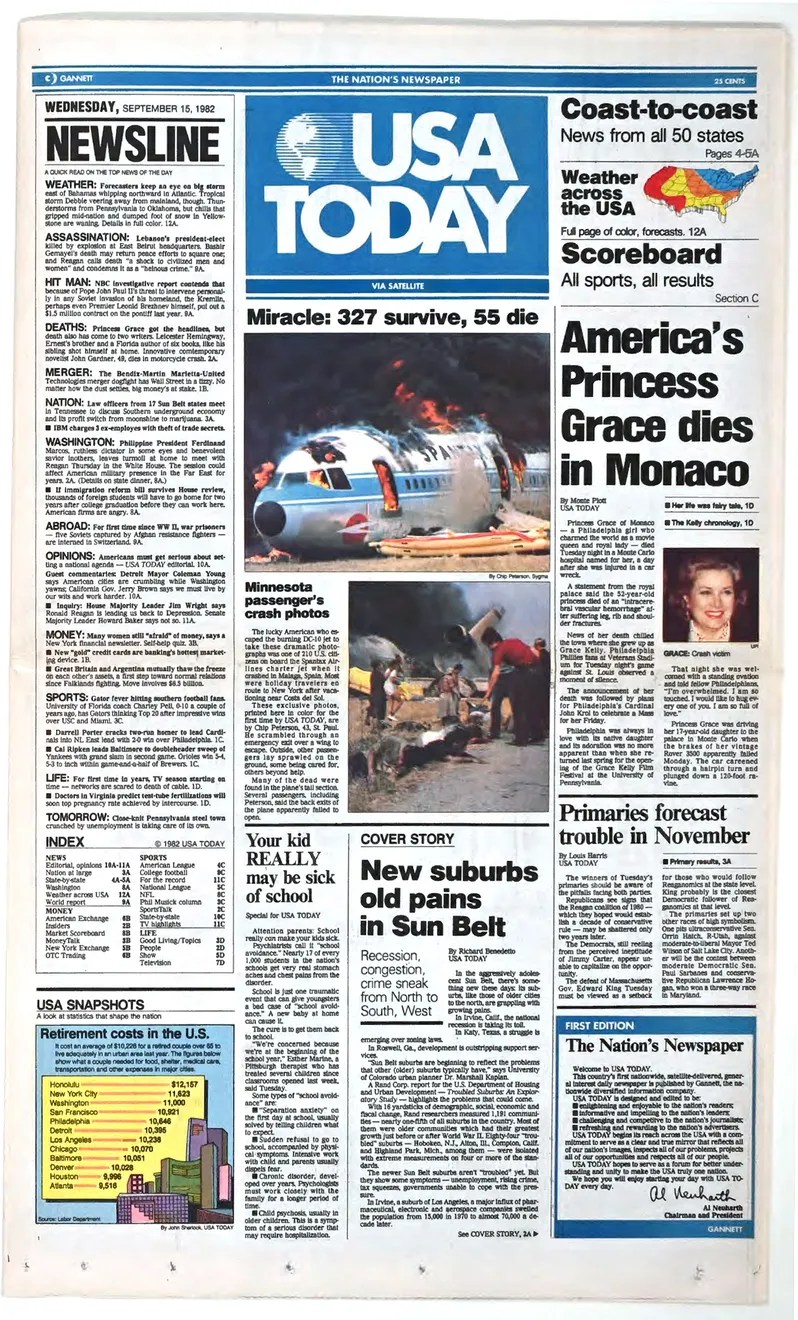
As we survive the surfeit, we might recall one of the larger steps toward the media environment in which we wallow was taken on this date in 1982: USA Today dropped its first issue.
The paper’s overall style– shorter articles, color photographs, an elevated use of graphics… and no longer, in-depth stories– was unique among newspapers at the time. Critics were largely unamused, referring to it as a “McPaper” or “television you can wrap fish in.” But as it succeeded, it changed the appearance and feel of newspapers around the world (in ways that anticipated the content and form/design of online jouranlism). Today, of course, while a print version survives, USA Today’s primary footprint is digital.
“The clearest way to show what the rule of law means to us in everyday life is to recall what has happened when there is no rule of law”*…

There’s rule-by-law, and then there’s rule-by-law (AKA, authoritarianism).
Long-time readers will know of your correspondent’s affection and respect for the artist Banksy. He’s “struck” again– and again, he’s hit a nerve…
From the AP…
… Unlike the elusive artist’s other provocative works that are sometimes stolen or carefully removed and displayed in galleries or sold at auction for millions, his latest mural was being erased Wednesday from the record.
The stenciled spray-painting of a protester lying on the ground holding a blood-splattered placard while a judge in a traditional wig and black gown beats him with a gavel was scrubbed from wall of the iconic Royal Courts of Justice…

More of the story: “Banksy mural of a judge beating a protester is scrubbed from London court,” from @apnews.com.
* Dwight D. Eisenhower
###
As we protect what’s precious, we might recall that it was on this date in 1935 that Adolf Hitler addressed the eighth Nuremberg Rally, the “Rally of Freedom.” Following Goebbels (who had declared that history would some day pass the verdict on Hitler that by overthrowing Bolshevism he saved Germany from an immediate catastrophe and thereby brought Western civilization back from the brink of complete destruction)…
In a speech to 120,000 political functionaries on the Zeppelinwiese [here] this afternoon, Herr Hitler expressed his appreciation of their loyalty, which had been inspired by faith in him and his ideals, and which had enabled him to achieve for Germany what he had.
In an address to several thousand “Hitler” girls and women Herr Hitler said that the National-Socialist movement was providing “braver and better husbands.”
He added:- We are training real men for the women, decent, brave, and honourable. When the women see the fine Labour Service boys, dressed only in trousers and with breasts all bare, they must say, “It is nice for the women and what fine fellows are here, and conscription, what marvellous training!”, There is no equality in giving women tasks where they were men’s inferiors. Whenever I picture a woman in Parliament, I feel that she is being degraded. She does not raise the general level. She is drawn down to it herself.
– source

“Enough is abundance to the wise”*…

The “new” idea of Abundance is having a moment. The estimable David Karpf worries that the folks behind it are blowing their opportunity…
I guess I would call myself “Abundance-curious.”
There is a version of the Abundance agenda that I quite vocally agree with. My interpretation of Ezra Klein and Derek Thompson’s central argument was something along these lines:
- Government should have a strong hand in establishing, directing, and funding social priorities.
- In the course of setting these priorities, government should endeavor to get out of its own way.
Klein and Thompson are pretty firmly in favor of government intervention and industrial policy. They aren’t just saying “growth is good and we should all cheer for developers!” They are instead saying something more along the lines of, if the government thinks something – housing, clean energy, etc – is a priority, then the government should proactively support that goal. Put money behind it. Don’t leave everything to the “will of the markets.” And, oh yeah, if the government wants to build high-speed rail or housing (etc etc) then the government should get out of its own damn way and make it can actually fulfill those promises.
I pretty enthusiastically agree with all of these points. We ought to rebuild administrative capacity and get back into having government make governance decisions. Government ought to be both proactive and responsive. And often the best way to make a better future possible is to devote public money towards promoting public goods.
I also quite like several of the people operating under that banner, and quite like some of their ideas as well. (Specifically: government should fund more things, we should have more administrative capacity, and the accretion of procedural checks-with-no-balance has had plenty of regrettable consequences.)
And hey, they’re having a moment. Good for them.The term is rapidly becoming an empty signifier, though. Tesla’s new master plan boasts of “sustainable abundance.” The Silicon Valley variant of the abundance agenda is just warmed-over techno-optimism — less “let’s rebuild the administrative state and make government work again!” and more “the government should hand big sacks of money to tech startups and exempt them from taxes and regulations. Let our genius builders build!”
The Abundance 2025 conference [happened] in DC [last] week, and the speakers range from pro-housing YIMBYs to a guy arguing for “deportation abundance.”
Yikes.
Steve Teles has taken a good-faith shot at sorting through the mess:
It would not be hard to conclude that the emergence of these various flavors of abundance betrays the inherent squishiness and incoherence of the concept. And it is true that abundance is not a systematic ideology attached to a specific political coalition, as are conservatism or democratic socialism. But that doesn’t mean that it is ideological vaporware. As someone who has been working on many of these ideas for a decade or more, I think it is time to nail down just what sort of idea abundance is.
Abundance stirs confusion in part because, unlike contemporary conservatism and progressivism, it is not an idea that emerged to justify a specific party-political, coalitional, material, or cultural project. Given that abundance has been embraced by post-colonial socialists, techno-futurist capitalists, and Democratic centrists, it is best conceptualized as an alternative dimension that cuts across existing ideologies without entirely superseding them, defined by a new set of problems and tools for addressing them.
Abundance is fundamentally “syncretic,” spreading by attaching itself to a variety of different cultural practices and political projects, rather than by preserving its doctrinal purity.
He goes on to define the central unifying idea:
At its base, Abundance is best understood as having one central aspiration that requires tackling two interlocking challenges. The aspiration is to escape from a political economy defined by artificial scarcity, to create a world in which we solve problems primarily by unlocking supply.
That’s it. That’s the whole thing. Abundance says “we should solve problems by creating more,” and invites the competing political coalitions to draw their own conclusions on what constitutes a problem. (And, also, more of what, exactly?)
Syncretic terms like this run the risk of falling apart though. If DOGE is part of the Abundance movement, and the people DOGE is illegally firing is also part of the Abundance movement… If the Green New Deal is Abundance but oh hey also the Claremont Institute is Abundance too, then Abundance ceases to mean anything at all. The term is already washed.
(Q: Are Curtis Yarvin, Balaji Srinivasan, and the other Network State neomonarchists part of the Abundance movement? A: yes, that’s “dark abundance.”)
I can empathize with the instinct to try to build the broadest possible coalition. I can see why making your new “movement” seem like the one big cross-partisan idea right now feels like a win. But it is a temporary, pyrrhic victory.
Strategy is a verb. The act of strategizing involves making choices that help you accomplish goals and wield power. The Abundance movement does not appear to be making any choices whatsoever. That’s the fast track to irrelevance.
Just saying, if *I* was part of the Abundance movement, I would be cautioning people that it sure would be nice to accomplish something, anything at all, before the idea gets entirely co-opted and loses all meaning. If the Abundance folks insist on advancing a syncretic proposal so broad that it pointedly has nothing to say about what problems ought to be solved, then they are quickly going to find that their clever-new-phrase means nothing at all.
The fate of every successful political movement is that they eventually face co-optation and counteraction. But usually you want to rack up some actual victories before it happens…
“What *Isn’t* Abundance?” from @davekarpf.bsky.social (in his valuable newsletter, The Future, Now and Then).
See also: “Varieties of Abundance” from @niskanencenter.bsky.social, and “How to Blow Up a Planet” from @nybooks.com.
[Edit: late add of a piece from the ever-insightful Rusty Foster that dropped just after this was first posted: “Abundance of What.”]
* Euripides
###
As we muse on more, we might send abundant bountiful greetings to William Bligh; he was born on this date in 1754. A British naval officer, over a 50 year career, he rose to the rank of Vice-Admiral and served as colonial governor of New South Wales. But he is remembered for his role in the most famous mutiny in history: in 1879, the first officer and crew “removed” Bligh from his command of (and set him and his few supporters adrift from) HMAV Bounty.

“The best way out is always through”*…

Adam Mastroianni (and here) with a diagnosis of the malaise (“Borg vibes,” as he calls them) that so many of us feel– and a remedy (or, at least, a constructive response)…
Everyone I know has given up. That’s how it feels, at least. There’s a creeping sense that the jig is up, the fix is in, and the party’s over. The Earth is burning, democracies are backsliding, AI is advancing, cities are crumbling—somehow everything sucks and it’s more expensive than it was last year. It’s the worst kind of armageddon, the kind that doesn’t even lower the rent.
We had the chance to prevent or solve these problems, the thinking goes, but we missed it. Now we’re past the point of no return. The world’s gonna end in fascists and ashes, and the only people still smiling are the ones trying to sell you something. It feels like we’re living through the Book of Revelation, but instead of the Seven Seals and the apocalyptic trumpeters, we have New York Times push notifications.
On the one hand, it’s totally understandable that these crises would make us want to curl up and die. If the world was withering for lack of hot takes, I’d assemble a daredevil crew and we’d be there in an instant. But if history is heading more in the warlords ‘n’ water wars direction, I’m out.
On other hand, this reaction is totally bonkers. If our backs are against the wall, shouldn’t we put up our dukes? For people supposedly facing the breakdown of our society, our response is less fight-or-flight and more freeze-and-unease, frown-and-lie-down, and despair-and-stay-there.
Maybe humanity has finally met its match, but even though people talk like that’s the case, the way they act is weirdly…normal. Every conversation has a dead-man-walking flavor to it, and yet the dead men keep on walking. “Yeah, so everything’s doomed and we’re all gonna die. Anyway, talk to ya later, I gotta put the lasagna in the oven.” If things are just about to go kaput, why is everyone still working 60 hours a week?
Something strange is going on here, and I’d like to offer an explanation in two parts: a wide circle, and a bullet with a foot in it…
Eminently worth the read: “Use this magic bullet to shoot yourself in the foot,” from @mastroianni.bsky.social.
Pair with: “Apocalypse 24/7” (an excerpt from Roy Scranton‘s Impasse: Climate Change and the Limits of Progress)… a deeper, darker– but sadly, all-too-credible– dive into the context that Mastrioanni sketches… while (as your correspondent reads it, anyway) it doesn’t contradict Mastroianni’s prescription (“pick up a sponge and start washing”), it reminds us just how much grime there is to get through… all the more reason to get started…
* Robert Frost
###
As we grapple, we might recall that it was on this date in 1965 that Bob Dylan’s “Positively 4th Street” was released. Dropping between Highway 61 Revisited and Blonde on Blonde, as the follow-up to Dylan’s hit single “Like a Rolling Stone“, it was not included on either album. But it reached No. 1 on Canada’s RPM chart, No. 7 on the U.S. Billboard Hot 100, and No. 8 on the UK Singles Chart, and has been ranked by Rolling Stone No. 203 in their 500 Greatest Songs of All Time list.

You must be logged in to post a comment.