Posts Tagged ‘society’
“Palantir is still not a data company”*…

Palantir, founded in 2003 by Peter Thiel, Stephen Cohen, Joe Lonsdale, and Alex Karp, has grown into a company with revenues approaching $3 Billion. It works for a number of giant corporations; but its power alley has, from the start, been insinuating itself into the U.S. government ever more intimately, becoming one of the few winners in the Trump administration’s cost-cutting push (and emerging as the chosen agent to compile data on all Americans).
Palantir has become a darling of the stock market, the top-performing stock in the S&P 500 for two years running. Its stock has risen nearly 150% this year and an incredible 2,000% since its 2020 debut.
But what’s fueling all of this? Is the company’s extraordinary valuation justified? Sustainable? But more fundamentally, what is it that Palantir actually does? Palantir is often called a data broker, a data miner, or a giant database of personal information. In reality, it’s none of these—but even former employees struggle to explain it. Caroline Haskins reports…
Palantir is arguably one of the most notorious corporations in contemporary America. Cofounded by libertarian tech billionaire Peter Thiel, the software firm’s work with Immigration and Customs Enforcement, the US Department of Defense, and the Israeli military has sparked numerous protests in multiple countries. Palantir has been so infamous for so long that, for some people, its name has become a cultural shorthand for dystopian surveillance.
But a number of former Palantir employees tell WIRED they believe the public still largely misunderstands what the company actually does and how its software works. Some people think it’s a data broker that buys information from private companies and resells it to the government. Others think it’s a data miner, constantly scanning the internet for unique insights it can collect and market to customers. Still others think it maintains a giant, centralized database of information collected from all of its clients. In reality, Palantir does none of these things, but the misconceptions continue to persist.
Palantir has tried to correct the record itself in a series of blog posts with titles like “Palantir Is Not a Data Company” and “Palantir Is Still Not a Data Company.” In the latter, Palantir explains that “misconceptions can arise because our products are complicated,” but nonetheless, “it is absolutely possible” to accurately describe them to “people who are curious.”
The problem, however, is that even ex-employees struggle to provide a clear description of the company. “It’s really hard to explain what Palantir works on or what it does,” says Linda Xia, who was an engineer at Palantir from 2022 to 2024. “Even as someone who worked there, it’s hard to figure out, how do you give a cohesive explanation?”
Xia was one of 13 former Palantir staffers who signed an open letter published in May arguing that the company risks being complicit in authoritarianism by continuing to cooperate with the Trump administration. She and other former Palantir staffers who spoke to WIRED for this story argue that, in order to grapple with Palantir and its role in the world, let alone hold the company accountable, you need to first understand what it really is.
It’s not that former employees literally don’t know what Palantir is selling. In interviews with WIRED, they spoke fluidly about how its software can connect and transform different kinds of data collected by government agencies and corporations. But when asked to, say, name its direct business competitors, two former Palantir employees who requested anonymity to speak freely about their experiences, struggled to come up with anything. “I still don’t know how to answer that question, to be honest,” says one.
Juan Sebastián Pinto, who worked as a content strategist at Palantir and also signed the open letter, says it sells software to other businesses, a category commonly referred to in Silicon Valley as B2B SaaS. Another former staffer says Palantir provides “really extravagant plumbing with data.”
Xia calls Foundry, one of Palantir’s flagship software platforms, “a collection of different applications” that customers use to “operationalize data.” A fourth ex-employee dubbed Foundry a “super-charged filing cabinet.” While all of these descriptions are technically accurate, they could also apply to products from hundreds of other tech companies. So what sets Palantir apart?
Part of the answer may lie in Palantir’s marketing strategy. Pinto says he believes that the company, which recently began using the tagline “software that dominates,” has cultivated its mysterious public image on purpose. Unlike consumer-facing startups that need to clearly explain their products to everyday users, Palantir’s main audience is sprawling government agencies and Fortune 500 companies.
What it’s ultimately selling them is not just software, but the idea of a seamless, almost magical solution to complex problems. To do that, Palantir often uses the language and aesthetics of warfare, painting itself as a powerful, quasi-military intelligence partner. “Palantir is here to disrupt and make the institutions we partner with the very best in the world,” Palantir CEO Alexander Karp says in a February 2025 earnings call, “And when it’s necessary, to scare enemies, and on occasion, kill them.”…
… Underneath the jargon and marketing, Palantir sells tools that its customers—corporations, nonprofits, government agencies—use to sort through data. What makes Palantir different from other tech companies is the scale and scope of its products. Its pitch to potential customers is that they can buy one system and use it to replace perhaps a dozen other dashboards and programs, according to a 2022 analysis of Palantir’s offerings published by blogger and data engineer Ben Rogojan.
Crucially, Palantir doesn’t reorganize a company’s bins and pipes, so to speak, meaning it doesn’t change how data is collected or how it moves through the guts of an organization. Instead, its software sits on top of a customer’s messy systems and allows them to integrate and analyze data without needing to fix the underlying architecture. In some ways, it’s a technical band-aid. In theory, this makes Palantir particularly well suited for government agencies that may use state-of-the-art software cobbled together with programming languages dating back to the 1960s.
Palantir began gaining steam in the 2010s, a decade when corporate business discourse was dominated by the rise of “Big Data.” Hundreds of tech startups popped up promising to disrupt the market by leveraging information that was now readily available thanks to smartphones and internet-connected sensors, including everything from global shipping patterns to the social media habits of college students. The hype around Big Data put pressure on companies, especially legacy brands without sophisticated technical know-how, to upgrade their software, or else risk looking like dinosaurs to their customers and investors.
But it’s not exactly easy or cheap to upgrade computer systems that may date back years, or even decades. Rather than tearing everything down and building anew, companies may want a solution designed to be slapped on top of what they already have. That’s where Palantir comes in.
Palantir’s software is designed with nontechnical users in mind. Rather than relying on specialized technical teams to parse and analyze data, Palantir allows people across an organization to get insights, sometimes without writing a single line of code. All they need to do is log into one of Palantir’s two primary platforms: Foundry, for commercial users, or Gotham, for law enforcement and government users…
… Since leaving Palantir, Pinto says he’s spent a lot of time reflecting on the company’s ability to parse and connect vast amounts of data. He’s now deeply worried that an authoritarian state could use this power to “tell any narrative they want” about, say, immigrants or dissidents it may be seeking to arrest or deport. He says that software like Palantir’s doesn’t eliminate human bias.
People are the ones that choose how to work with data, what questions to ask about it, and what conclusions to draw. Their choices could have positive outcomes, like ensuring enough Covid-19 vaccines are delivered to vulnerable areas. They could also have devastating ones, like launching a deadly airstrike, or deporting someone.
In some ways, Palantir can be seen as an amplifier of people’s intentions and biases. It helps them make evermore precise and intentional decisions, for better or for worse. But this may not always be obvious to Palantir’s users. They may only experience a sophisticated platform, sold to them using the vocabulary of warfare and hegemony. It may feel as if objective conclusions are flowing naturally from the data. When Gotham users connect disparate pieces of information about a person, it could seem like they are reading their whole life story, rather than just a slice of it.
“It’s a really powerful tool,” says one former Palantir employee. “And when it’s in the wrong hands, it can be really dangerous. And I think people should be really scared about it.”
“What Does Palantir Actually Do?” from @carolinehaskins.bsky.social in @wired.com.
See also: “Decoding Palantir, the Most Mysterious Company in Silicon Valley.”
And by way of context: “TESCREAL“
* Palantir blog post (linked above)
###
As we bow to Big Brother, we might note that it was on this date in 1981 that the Winklevoss twins, Cameron and Tyler, were born. As famously dramatized in The Social Network, the twins enlisted Harvard College classmate Mark Zuckerberg to help them with a social network project, but Zuckerberg peeled away, with the project that became Facebook. The Winklevosses agreed to a settlement (of $20 million cash and more than a million Facebook shares ), but then sued, claiming that Zuckerberg had misled them about the value of the shares (and that they were entitled to four times as many). After years of litigation, the agreement stood.
But the twins were not solely engaged in litigation. Starting with the cash stake in the original settlement, they went long on cryptocurrency, starting Winklevoss Capital Management (which invests across several asset classes, but heavily in Bitcoin and other cryptocurrencies) and Gemini (a cryptocurrency exchange). They have become major supporters of pro-cryto Republicans in general, and of Donald Trump in particular… which, one notes seems to be earning a return.

“If I am to be remembered, I hope it will not be primarily for my specialized scientific work, but as a generalist; one to whom, enlarging Terence’s words, nothing human and nothing in external nature was alien.”*…
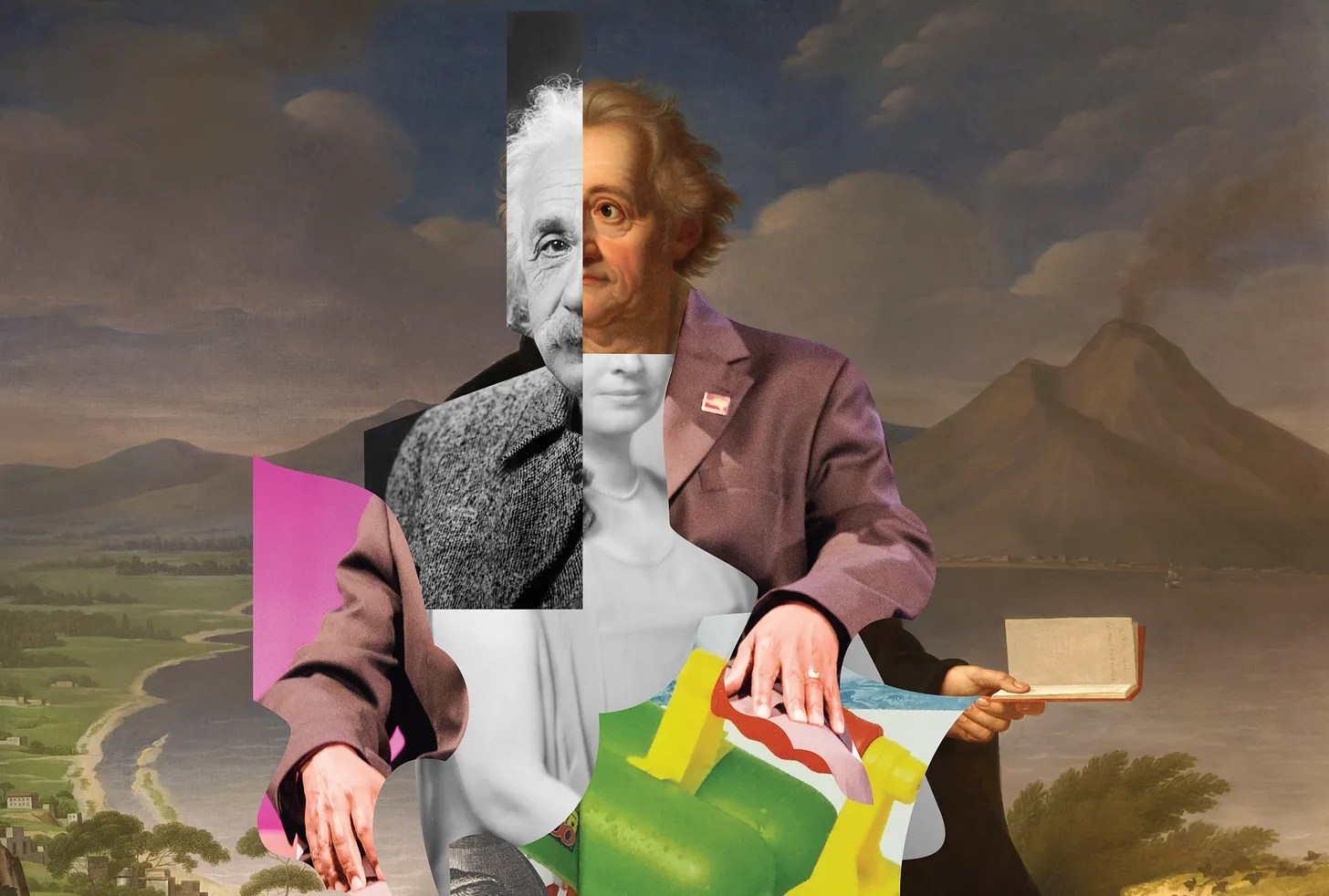
Interdisciplinary artist, writer, and musician Ross Simonini with 47 thoughts on the glory of looking– and living– beyond a specialty…
1. I was raised to believe that I was made to do one thing. Find that one pursuit that fills my life with meaning and empty all my energy into it. This is the realization of human potential: to excel with rigorous focus on a refined lifelong mission. This and only this will bring us to our greatest success and fulfillment.
For me, this was not something I even had to be told—though I was, many times, by many people—because I implicitly understood that this kind of teleology was woven into the fibers of my world. I also knew that rejecting a singular pursuit would be an insult to my very existence. Without this unifying reason for being alive, I would wander aimlessly into the barren void of nihilism. I’d heard about great artists who refused to create, who stepped away from their work to fritter away their time on leisure, and I knew this was a life of tragedy.
Likewise, I understood that sliding your attention across interests is a way to waste your gift. The more hours you put into a skill, the more skilled you become—right? To treat your gift with the proper deference, you must exhaust yourself into it.
Within this paradigm, the most unfortunate people are those who do not have a single, clear vocation. These types float from job to job without a trajectory; they are vagabonds who have given up on greatness.
This may sound a little dramatic, but somewhere inside me, these beliefs are there—and as a lifelong generalist, I spend every day rubbing up against them.
…
16. Let’s talk about mastery. Everyone wants to be a master, even if they are disgusted by the monstrous implications of the word. Mastery suggests dominance over something, but every true master knows that they are merely a supplicant at the mercy of their field, which existed long before them and will exist long after them. Anyone who believes in their own mastery likely suffers from hubris. Work hard enough at something and you watch your dominance slip ever further away.
Mastery is an illusion, a notion of a fictional purity that cannot be understood or measured in terms of time. Just look at those young savants who excel wildly after only a few years spent on their craft. For them, mastery cannot be the result of time plus work, as we all assume it is. In fact, maybe the newness of their skills is precisely what gives their work its value.
But these little wonders are exceptions, right? The rest of us have to dedicate our lives to something to achieve greatness, and anyone who doesn’t do this will likely be middling in their work. Most writers I know are immediately suspicious when an actor publishes a novel. We delight in calling the person a moonlighter. Literature is our territory, and the only way to live here is to put in the time and labor.
…
24. Isaiah Berlin, the political theorist, ethicist, philosopher, and historian, wrote a book called The Hedgehog and the Fox, in which he divides people into two types: hedgehogs, who see the entire world through one big thing, and foxes, who see the world as many things that cannot be reduced. According to Berlin, hedgehogs include Plato, Dostoyevsky, and Proust, while foxes include Aristotle, Shakespeare, and James Joyce.
“Everything I learned in my life, I learned because I decided to try something new,” said David Lynch (musician, filmmaker, painter, lamp maker, sculptor, writer, actor, and lecturer, mostly on meditation).
…
29. Sometimes history hides generalism to preserve a specialized agenda. Isaac Newton, a figure whom we consider the father of modern math, physics, and reasoned thinking, was also a dedicated alchemist. Alchemy, a generalist practice in itself, was a precursor to modern chemistry. It involves spirituality, myth, belief, and metallurgy, but its inclusion of belief stands in direct conflict with the scientific rationalism Newton now represents. Subsequent generations of historians and scientists buried Newton’s dedication to the occult, willfully ignoring the blow it deals to their obsessive, single-minded materialism. But Newton’s own records tell a different story. He wrote over a million words on alchemy in his lifetime, and his study of the subject helped inspire some of his most paradigm-shifting discoveries.
…
31. A filmmaker must understand aspects of sound design, photography, storytelling, music, acting, props, environment, finance, writing, and dialogue. In this way, some jobs are naturally suited to the generalist. A skilled homemaker, for example, understands everything from cooking to cleaning to healing to sociology. Acting, too, is a fairly generalist vocation. The practice of writing, what I am doing right now, is extremely broad, without consistent subject matter, form, or even mediums.
Generalism can be an approach of the neophyte or of the seasoned worker. Some entry-level positions (assistant, secretary, intern) are, in fact, compilations of micro-jobs, and some high-level positions—
managers, CEOs, directors, business owners, presidents—are positions of vast, nonspecific oversight. Sometimes the highest perch has the widest perspective.…
39. A generalist must engage with both sides of any argument: skepticism and belief, optimism and pessimism. So, for this essay, it would only be right to take a look at the dark side of generalism and the side effects of adopting it as a whole-life philosophy.
The glaring danger of general thinking in its extreme form is relativism, a sort of mushy non-position in which there are no universal standards: nothing can ever be condemnable or universally wrong. At the most dramatic levels, relativism might dismiss murder and genocide. It’s a slippery slope of open-mindedness.
Likewise, a generalist must contend with political centrism. In our bifurcated world, the center is one of the most reviled of all political positions, and a generalist will come to understand whether their own centrism is an evasion of choice or a refusal of unpalatable options.
Few things are more torturous than making decisions, and a mind will do anything to avoid such a relentlessly complex activity. Adherence to these vague philosophies, as I see them, can certainly be used as an excuse for escaping commitment. As a generalist, I must stay vigilant against this kind of laziness of mind and instead allow many fierce, contrary ideas to exist at once.
…
42. Generalism is not a thing. It’s definitely not an ism or some kind of doctrine. The general approach defies the nature of ideologies, which are characterized by the limits they place on understanding the world. There is no system of generalism. The general philosophy is to love variety.
For this reason, generalists don’t exist—not in the way that, say, Marxists do—because they can’t identify as generalists. I can call myself intra-, cross-, multi-, inter-, and trans-disciplinary—which, for some, are all legitimate and distinct prefixes—but that does more to distinguish and alienate me from others than to connect me with a community. There is no lineage of generalists, as there is for microbiologists or flutists, because every generalist works with their own complex bouquet of interests.
Probably this whole essay is my attempt to give a sense of unity to my life. Maybe I have to write a manifesto on “the art of doing many things”because I fear that if our culture doesn’t have a catchy keyword for my role, I’ll just fade away. So here I am, reducing generalism to a single, branded snap, just like a specialist.
After all, generalists are, in moments, great specialists. Likewise, a deep specialist can approach their niche from an ever-growing number of perspectives. A man with a repetitive job can endlessly engage with his work from fresh angles. And, of course, it’s all relative. A single task looked at from another angle is a plentiful cornucopia of individuated micro-tasks.
Some long-term generalists focus exclusively on a single activity for a number of years before moving on to the next. Rather than doing many things simultaneously, they do them sequentially.
Pure generalism and pure specialism are just intellectual games. Our minds drift between unified oneness and individuality without ever settling into either. Binary thinking is for computers.
These two states of being are not roles we need to inhabit but rather nodes to be considered. One situation requires diligent focus, but another benefits from a more diffuse form of attention. Certain qualities of engagement can occur only when you do multiple things at once. This is the value of the glance.
…
47. Generalism is not the opposite of specialism. It includes specialism. Everyone gets to experience both. Or maybe both approaches lead to the same place. Maybe the study of quantum physics brings a mind to the same conclusions as basketry. Maybe it’s like meditation: You can sit in open awareness and experience everything until you reach an unprejudiced understanding of life. Or you can unflinchingly focus on a single mantra for decades, repeating it with each breath, and as you plunge deeper toward a single infinite point, you discover that everything is already right there.
Eminently worth reading in full: “In praise of generalism” from @thebeliever.net.
###
As we widen our irises, we might send carefully-calculated birthday greetings to Pierre de Fermat; he was born on this date in 1601. While he is remembered as one of the two great mathematicians of the early 17th century (with Descartes), Fermat was (like Descartes) driven by wider interests. Fermat was a trained lawyer, who served as a councilor at the Parlement de Toulouse, one of the High Courts of Judicature in France. He was fluent in six languages and praised for his written verse in several of them; his advice was eagerly sought regarding the emendation of Greek texts… which is to say that mathematics was but one of his interests, and more a hobby than a profession at that. Still, Fermat made foundational contributions to analytical geometry, probability, number theory and calculus.

“What is the reward for knowing the worst?”*…

The estimable Adam Phillips on the (ultimately constructive) tension between psychoanalysis and (especially American) pragmatism…
When Richard Rorty wrote, in one of his many familiar pragmatist pronouncements, that the only way you can tell if something is true is if it helps you get the life you want, it sounded either like a provocative assertion or another advertisement, masquerading as epistemology, for consumer capitalism. How one feels about Rorty’s eloquent, deliberate and subtle brashness depends on one’s education and sensibility, on one’s cultural preferences and prejudices, and indeed on one’s politics. There may be a significant difference between getting the life I want and getting the life ‘we’ might want, between a certain kind of possessive, acquisitive individualism and a collective political project (the phrase ‘the life I want’ also implies a stability and a degree of certainty in myself; the idea of the life I want fixes the flux of myself). And there are also, by the same token, interesting difficulties in using Rorty’s pragmatist definition of truth in relation to psychoanalysis, which in a quite different way claims to have an interest in truth and in the lives people claim that they want. Rorty’s description of truth here, read in a psychoanalytic context, couldn’t easily be squared with, say, Lacan’s goal for psychoanalytic treatment, which, in the useful words of Slavoj Žižek, clearly seeks a different version of truth. Lacan’s goal for psychoanalytic treatment, Žižek writes, ‘is not the patient’s wellbeing, successful social life or personal fulfilment, but to bring the patient to confront the elementary co-ordinates and deadlocks of his or her desire’. It doesn’t sound as though helping the patient get the life he wants is among Lacan’s priorities (and ‘deadlocks’, of course, aren’t Rorty’s thing). This can’t help but make us wonder whether, or in what sense, Freud’s psychoanalysis has got anything to do with getting the life you want; and if it doesn’t, what it might be to do with. Freud does, after all, put wishing at the centre of his theory, but only to radically temper it; as if to say, what you think you want is where the problems start. And yet wanting is what, for both psychoanalysis and American pragmatism, there is, in William James’s words, ‘to be going on from’. Both Freud’s psychoanalysis and Rorty’s pragmatism tell us, in their different ways, why wanting matters, and also that wanting has become the thing we most want to know about, as though now we are simply our wants.
It is easy to forget that all accounts of the goals of psychoanalysis are prescriptions presented as descriptions. In the guise of telling us what the goal of psychoanalysis is – what the concept of cure is, what a successful treatment entails – theorists are simply giving us their own account of what they take a good life to be and what they assume a person wants (a person who walks into an analyst’s office walks into a vocabulary, and a vocabulary is always a vocabulary of wants). Psychoanalysts, to their credit, have been more than willing to tell us what the good is that we should seek; though not quite so willing to open up their proposed goods for discussion, or indeed to suggest that their proposed goods might be experiments in living and not absolute values. For Freud, the goal is recovering the capacity to love and work, or, rather more grimly, to turn hysterical misery into ordinary unhappiness. For Lacan it is ‘not giving ground relative to one’s desire’; for Klein it is reaching the Depressive Position; for Winnicott it is about enabling the patient to play and to surprise themselves; for Ferenczi the patient is not cured through free association, but cured when he can free associate, and so on and on and on. All the interesting psychoanalytic theorists are telling us what, in their view, constitutes a good life. Old-fashioned psychoanalysis always had a known destination.
What the Rortyan pragmatist wants us to ask is whether and in what way, say, Lacanian psychoanalysis helps us to get the life we want, understood in terms of the good we have been encouraged to seek. It does not need us to ask whether Lacanian theory and practice is in any sense true. Pragmatism wants us to ask, what is the life we want – or think we want? Whereas psychoanalysis wants us to ask, why do we not want to know what we want? (According to Michel Serres, the only modern question is: what is it you don’t want to know about yourself?) Psychoanalysis wants us to ask – against the grain of traditional philosophy – why do we obscure the good that we seek? Pragmatism takes for granted that the good we seek is what we want and asks us how we are going to go about getting it. Indeed, pragmatism tells us that we are good at knowing what we want and good at letting our wants change. In an implicit critique of, among other things, American pragmatism, Charles Taylor, in The Ethics of Authenticity, defines his notion of a moral ideal: ‘I mean a picture of what a better or higher mode of life would be where “better” and “higher” are defined not in terms of what we happen to desire or need, but offer a standard of what we ought to desire.’ Rorty’s work always runs the risk of seeming to promote a kind of capricious, impulsive egotism.
Clearly psychoanalysis and American pragmatism are uneasy bedfellows; they fall out over the phrase ‘knowing what you want’…
Read on to Phillips’ unpacking of that tension, and for his “resolution”: “On Getting the Life You Want,” from @lrb.co.uk.
(Image above: source)
* Donald Barthelme, Snow White
###
As we decipher desire, we might send experimental birthday greetings to Stanley Milgram; he was born on this date in 1933. A social psychologist, he is best known for his obedience experiment conducted at Yale University in 1961, three months after the start of the trial of German Nazi war criminal Adolf Eichmann in Jerusalem. The experiment found, unexpectedly, that a very high proportion of subjects (asked to administer painful electric shocks to “learners” they believed they were supervising) would fully obey the instructions, albeit reluctantly. Milgram first described his research in a 1963 article in the Journal of Abnormal and Social Psychology and later discussed his findings in greater depth in his 1974 book, Obedience to Authority: An Experimental View.
Among the most controversial of all psychology studies ever published, the experiment has been repeated many times around the globe, and with fairly consistent results; but its interpretations have been in dispute from the start.

“In science, it happens every few years that something that was previously considered a mistake suddenly reverses all views, or that an inconspicuous and despised idea becomes the ruler of a new realm of thought.”*…

Today’s post is, in essence, the recommendation of the current issue of of a publication referenced here often, Noema. It’s editor, Nathan Gardels, previews its contents…
When a concept that organizes our reality is replaced by an entirely different and incommensurate worldview, it is called a “paradigm shift.”
The theme of this edition of Noema was conceived in early 2024. At that time, we had in mind the epochal shift from the paradigm of globalization, in which markets, trade and technology cross borders, to “the Planetary,” where we recognize that the whole Earth system embeds and entangles human civilization in its habitat.
This deeper awareness has been enabled by the emergence of a technological exoskeleton of satellites, sensors and cloud computation that expands the heretofore limited scope of human understanding of the world, repositioning our place in the natural order. Neither above nor apart from nature, we have now come to realize we are part and parcel of one interdependent organism comprised of multiple intelligences striving for sustainable equilibrium.
The disclosure of climate change as a destabilizing consequence of human endeavor was enabled in the first place by planetary-scale computation. This capacity holds out the evolutionary prospect that human, machine and Earth intelligence might one day merge into a kind of planetary sapience that restores and maintains the ecological balance.
As we have written often in Noema, this conceptual reorientation would entail a redefinition of what realism means in geopolitics. This new condition calls not for the old “realpolitik” that seeks to secure the interests of nation-states against each other but for a “Gaiapolitik” aimed at securing a livable biosphere for all.
As logically compelling as this case for planetary realism may be, the paradigm shift underway is going in the opposite direction. Instead of the global interconnectivity forged in recent decades maturing into a planetary perspective, it is breaking up into a renewed nationalism more emphatically sovereigntist than before the advent of globalization.
In short, the prevailing political temperament around the world today is out of sync with the planetary imperative. This does not diminish its reality but, for the moment, eclipses and derails its emergence as the conscious organizing principle of human civilization.
The paradigm shift we are witnessing today not only marks a move away from a planetary awareness but also signals the last sigh of liberal universalism as the dominant governing philosophy of the postwar order since 1945.
The rules-based liberal international order, underwritten and guaranteed for decades by American might, has been consigned to the ash can of history by the summary defection of its founding architect from its terms and premises.
Under President Donald Trump and his allies, America has effectively joined the revisionist powers of China and Russia by baldly asserting sovereigntist self-interest unencumbered by rules that also encompass the interests of others.
Tariff walls, outright trade wars and unraveling alliances are supplanting the expansive web of global commerce, Western unity and cultural cross-fertilization that characterized times only recently. In a further break from the established order, Team Trump openly contemplates its own Anschluss of other people’s territory in Greenland, the Panama Canal and even Canada, instead of expressing outrage at China’s desire to take Taiwan, Russia’s bloody attempt to seize Ukraine or Israel’s increasing occupation of the Palestinian territories.
As Francis Fukuyama and Niall Ferguson discuss in a collage of commentary in this Noema edition, these developments portend the return to a world not unlike that of the 19th century, when the great powers carved out exclusive domains of influence.
The obvious great powers that would constitute a world apportioned in this way are China and Russia, both grasping at Eurasia, plus the United States and India. Whether Europe falls within the American sphere of influence depends on its capacity to cohere as a continental entity and find its identity as an alternative within a West that is fracturing under the strain of America’s revisionist turn.
Since the future appears to be taking us back to the 19th century, one cannot say we are in “uncharted territory.” On the contrary, we’ve been down this path before and know how it led to world wars that the global rules-based order, for all its well-known faults, was meant to avoid repeating.
On the American home front, and increasingly elsewhere in the West, it appears the “strong gods” of family, faith and nation are prevailing over the culturally liberal sentiments of an open society.
When there is no common agreement on what constitutes the good life, culture is politicized. As Alexandre Lefebvre argues in Noema, who gets to define “the good life” has become the central political question of our time. As in China, Russia, Iran or Turkey, governing authorities in the West are increasingly seeking to assign the moral substance of their vision to the state in place of the neutral proceduralism of liberal regimes that, at least in theory, embrace the diversity of all values without favor.
As the ascendant traditionalists see it, this rights-based liberalism grants a kind of converse moral substance to the state by virtue of the permissive openness it invites, nourishes and protects.
In many ways, liberalism was bound to fail just as Marxism did, and for the same reason. Marxism lacked a theory of politics that accommodated diverse constituencies because it assumed the universality of the interests of one class. Similarly, liberalism has falsely assumed its own universality, believing that there can be a consensus on only one conception of “the good life.” In reality, where some see declaring gender identity as the positive freedom to pursue self-realization, others see it as the corrosion of traditional Christian morality.
Like the British philosopher John Gray, Lefebvre suggests that the liberalism of the future may well entail a constitutionally grounded “modus vivendi” of autonomous jurisdictions as one way to keep the civil peace in diverse societies.
What is stunning in this context is how rapidly the America that elected Trump has tilted toward illiberal democracy under his tumultuous reign. Team Trump has robustly pursued retribution against political enemies, scorned universities as “the enemy,” moved to dismantle the administrative state and climate policies, demeaned the judicial system and cultivated crony corruption. Moreover, in the Orwellian name of free speech, Trump insists on ideological conformity across the board, from college students to corporate law firms.
To base the idea of democracy solely on elections invites this kind of illiberalism because it implies that majoritarian rule is all that is necessary for legitimacy. But, as the American founding fathers well understood, the will of the majority does not embrace all interests in a society, which must be protected equally. That is the reason for constitutional rule as the founding principle of a liberal polity.
In constitutional theory, the imposition of limitations and restraints — the “negative” — is what prevents the majority from absolute domination. It is the negative that makes the Constitution and the “positive” that makes government. One is the power of acting, the other the power of amending or arresting action. The two combined make a constitutional government.
It is this governing arrangement that made America great. The biggest danger of Making America Great Again is that a movement that believes it is the embodiment of the will of the majority will cast aside any constraints on its power as a contrivance by the elites of the ancien régime to keep the masses down.
In Niall Ferguson’s contribution to Noema, the historian raises the specter that “history was always against any republic lasting 250 years. This republic is in its late republican phase, with the intimations of empire much more visible.”…
… As politicized cultural battles and the churning geopolitical economy further unfold, a paradigm shift of a significance similar to planetary awareness is taking place that will redefine what it means to be human.
Across the sciences, we are coming to understand the self-organizing principle of “computation” as the building block of all forms of budding intelligence, from primitive cells to generative AI. This process involves learning from the environment, assembling information and arranging it by sharing functional instructions through “copying and pasting” code, so that an organism can develop, reproduce and sustain itself.
As Google’s Blaise Agüera y Arcas and James Manyika write in this issue, “computing existed in nature long before we built the first ‘artificial computers.’ … Understanding computing as a natural phenomenon will enable fundamental advances not only in computer science and AI, but also in physics and biology.”
More than half a century ago, they note, pioneering computer scientists had the intuition that organic and inorganic intelligence follow the same set of rules for development. “John von Neumann,” write the authors, “realized that for a complex organism to reproduce, it would need to contain instructions for building itself, along with a machine for reading and executing those instructions.” The technical requirements for that “universal constructor” in nature — the tape-like instructions of DNA — “correspond precisely to the technical requirements for the earliest computers.”
“Life,” they continue, “is computational because its existence over time depends on growth, healing or reproduction, and computation itself must evolve to support these essential functions.”
Grasping the correspondence with natural computation and learning from it, they believe, will render AI “brainlike” as it further evolves along the path from mimicking neural computation to predictive intelligence, general intelligence and, ultimately, collective intelligence. “Brains, AI agents and societies can all become more capable through increased scale. However, size alone is not enough. Intelligence is fundamentally social, powered by cooperation and the division of labor among many agents.”
In short, as philosopher of technology Tobias Rees also argues in this issue, the evolution of computation as a symbiosis of human and machine will cause us to rethink what it means to be human as, for the first time in history, a “more than human” intelligence emerges on our planet.
These contradictions and crosscurrents of the profound paradigm shifts we are living through all at once mark what future historians will surely describe as the Age of Upheaval…
FWIW, I worry that the diagnosis of our current political/cultural morass is maybe not dark enough. And as to AI, I’m no wide-eyed believer in the current cycle of hype. Indeed, I worry that AI could contribute to our social ills in the short term both by increasing and amplying the atomization and misinformation that we suffer and by challenging the economy if, as seems all too plausible, current over-enthusisam/over investment occasions a crash. That said, I honor the wisdom of Roy Amara: “We tend to overestimate the effect of a technology in the short run and underestimate the effect in the long run.”
In any case, every link above is eminently worth clicking/reading; better yet, buy the issue.
All change: “Paradigm Shifts,” from @noemamag.com.
[Image above: source]
* Robert Musil, The Man Without Qualities
###
As we buckle up, we might recall that it was on ths date in 1944 that IBM dedicated the first program-controlled calculator, the Automatic Sequence Controlled Calculator (known best as the Harvard Mark I)– one of the earliest, if not the earliest, general-purpose electromechanical computers, and the one that laibd the base for subsequent development… and thus a catalyst for the string of developments– technical, social, and political with which we’re wrestling now.
Designer Howard Aiken had enlisted IBM as a partner in 1937; company chairman Thomas Watson Sr. personally approved the project and its funding. On completion it was put to work on a set war-related tasks, including calculations– overseen by John von Neumann— for the Manhattan Project.
The Mark I was the industry’s largest electromechanical calculator… and it was large: 51 feet long, 8 feet high, and 2 feet deep; it weighed about 9,445 pounds The basic calculating units had to be synchronized and powered mechanically, so they were operated by a 50-foot (15 m) drive shaft coupled to a 5 horsepower electric motor, which served as the main power source and system clock. It could do 3 additions or subtractions in a second; a multiplication took 6 seconds; a division took 15.3 seconds; and a logarithm or a trigonometric function took over a minute… ridiculously slow by today’s standards, but a huge advance in its time.

“A strange idea was pecking at his brain like a chicken in the egg, and very, very much absorbed him”*…

The estimable Brad DeLong shares the prose outline of one of his lectures…
[In] my “roots of property, exchange, and the division of labor” lecture [I try] to make novel and strange the idea people think that they “own” things: to impress students with how just plain weird that is. And then there are the next steps: That people enter into reciprocal gift-exchange relationships with or using things they “own” is really weird. That reciprocal gift-exchange transforms into cash-on-the-barrelhead one-shot economic “trade” is perhaps the weirdest of all. Where do these things come from? And what are the chances that any Turing-Class intelligent social creature would ever develop them? And how much less efficient and functional as an action-taking anthology-intelligence could the East African Plains Ape possibly be without these social-institutional things that underpin the global-scale societal coördination mechanism we call the “market economy”?
What if we see the idea of “owning” something is one of humanity’s strangest inventions? Before markets, before money, there was a peculiar leap: the belief that things could be “mine” even when I’m not looking. Explore how property and exchange, far from being “natural”, are peculiar to the East African Plains Ape, are societal-scale technologies that turned us into a market-making species, and how that leap—property and exchange—became the foundation of our economic world and of a great deal of our success as an action-taking anthology-intelligence.
That we believe in property and exchange is absolutely key to the “market” institutional mode of organizing the practical-action coördination side of humanity as a successful anthology intelligence. And that is not all that property is key to, for spheres of ownership, action, and control that can be readjusted are very important parts of our conceptual map for a great deal of our additional collective modes and mechanisms of societal organization. And these ideas—not just “I will growl and bite you if you try to drag this zebra carcasse I am eating right now away from me”, but that this is mine and it stays mine even if I am not right here growling—is really weird.
Where and how does it originate?
And why did it make sense for the first of the homines erecti who added this to their shared conceptual maps?…
Touching on the thinking of Doug Jones (who locates the cultural emergence of “property” in the development of the hand-axe), Adam Smith, Aristoteles of Stagire, John Locke, Jean-Jacques Rousseau, and Friedrich Engels, DeLong concludes…
However, once we have constructed this jenga tower on top of its foundations of reciprocity and ownership, one of very key pieces of humanity’s glory and power as an action-taking coördinated anthology-intelligence has fallen into place.
The true genius of the market system lies in its capacity to decentralize decision-making, to push choices and authority out to the periphery—out to the individuals and enterprises who are closest to the ground, who possess the granular, local knowledge that no distant central planner or bureaucratic committee could ever hope to match. In this way, the market harnesses and aggregates the dispersed intelligence of society, transforming millions of individual judgments, preferences, and bits of information into a coherent pattern of production and allocation.
The result is an astonishingly adaptive and responsive system, one that can, at its best, direct resources toward their most valued uses with a minimum of wasted effort. But, and this is crucial, this remarkable coördination is only truly effective for rival and excludible commodities—goods and services for which one person’s consumption precludes another’s, and for which access can be limited to those who pay. In these domains, the market’s invisible hand is real and powerful, allocating goods through the interplay of supply, demand, and price.
When markets are functioning well—when property rights are secure, when contracts are enforced, when information is sufficiently available—they become the central nervous system of a vast, intricate organism. They coordinate sprawling networks of production and exchange, linking together farmers, manufacturers, merchants, workers, and consumers in a web of mutual interdependence. It is the division of labor, enabled and deepened by the existence of wide and deep markets, that serves as the engine of productivity and prosperity. As Adam Smith observed, the specialization of tasks allows individuals to become more skilled and efficient, unleashing a flood of innovation and output that no autarkic household or command economy could hope to rival.
Yet—and this is a point too often ignored—the benefits of this productivity are not distributed evenly or automatically. Who gets what, and how much, is determined by the prevailing structure of bargaining power and the existing arrangements of property. The market does not guarantee justice, only efficiency; it delivers abundance, but it apportions that abundance according to the rules of the game, rules that are themselves the product of history, law, and politics. Thus, while the market is a marvel of coordination, it is never a substitute for vigilance about the distributional consequences it generates…
How ownership and trade have made us truly weird: “‘Property’ & ‘Exchange’ as a Coördination Mechanism at Societal Scale,” from @delong.social.
Apposite (and in the spirit of both DeLong’s concluding observation and Aristotle’s injunction: “Property should be in a general sense common, but as a general rule private… In well-ordered states, although every man has his own property, some things he will place at the disposal of his friends, while of others he shares the use of them.”): “Think LIke a Commoner“
* Fyodor Dostoyevsky, Crime and Punishment
###
As we ponder property, we might send insightful birthday greetings to one of its most sardonic observers, William Makepeace Thackeray; he was born on this date in 1811. A novelist and illustrator, he is best known for his satirical works, particularly his 1847–1848 novel Vanity Fair, a panoramic– and piercing– portrait of British society, and the 1844 novel The Luck of Barry Lyndon (which was, of course, adapted for a 1975 film by Stanley Kubrick.

You must be logged in to post a comment.