Posts Tagged ‘edsel’
“The trouble with most folks isn’t so much their ignorance as knowing so many things that ain’t so”*…

From Kai Brach, in his nifty newsletter Dense Discovery, an appreciation of an Isaac Asimov essay from 1988: “The Relativity of Wrong” (a lovely riff on a point also taken up by Karl Popper)…
… it’s a welcome dose of nuance in this era of absolutist thinking. When knowingness tricks our brains into certainty, Asimov’s wonderfully nerdy piece demonstrates that right and wrong are far less binary than we may think.
The piece begins with Asimov addressing a young English literature student who’d written to scold him for his scientific arrogance. The student argues that every generation thinks they’ve got it sorted, and every generation gets proven wrong. Therefore, our current knowledge is just as flawed as flat-earth theory. But Asimov won’t have it:
“When people thought the Earth was flat, they were wrong. When people thought the Earth was spherical, they were wrong. But if you think that thinking the Earth is spherical is just as wrong as thinking the Earth is flat, then your view is wronger than both of them put together.”
He then makes his point clear through a series of delightful examples. Like spelling:
“How do you spell ‘sugar’? Suppose Alice spells it p-q-z-z-f and Genevieve spells it s-h-u-g-e-r. Both are wrong, but is there any doubt that Alice is wronger than Genevieve? For that matter, I think it is possible to argue that Genevieve’s spelling is superior to the ‘right’ one. Or suppose you spell ‘sugar’: s-u-c-r-o-s-e, or C₁₂H₂₂O₁₁. Strictly speaking, you are wrong each time, but you’re displaying a certain knowledge of the subject beyond conventional spelling.”
The same logic applies to mathematics: “Suppose you said: 2 + 2 = an integer. You’d be right, wouldn’t you? Or suppose you said: 2 + 2 = an even integer. You’d be righter. Or suppose you said: 2 + 2 = 3.999. Wouldn’t you be nearly right?”
The flat-earth idea is a great (and again timely?) case study for Asimov’s theory. The notion that the earth was flat wasn’t the product of ancient stupidity but reasonable observation given the tools available. The earth’s actual curvature is roughly 0.000126 per mile – practically indistinguishable from zero without sophisticated instruments.
“So although the flat-Earth theory is only slightly wrong and is a credit to its inventors, all things considered, it is wrong enough to be discarded in favour of the spherical-Earth theory.”
What he’s really arguing for is intellectual humility. Scientific theories don’t flip-flop wildly from flat earth to cubic earth to doughnut-shaped earth. Instead:
“What actually happens is that once scientists get hold of a good concept they gradually refine and extend it with greater and greater subtlety as their instruments of measurement improve. Theories are not so much wrong as incomplete.”
We seem to live in a world of zero-sum thinking, where nuance often gets steamrolled by the satisfying simplicity of being right. I want to remember Asimov’s framework the next time I’m certain someone else is wrong – that most disagreements aren’t between absolute truth and utter falsehood, but between different degrees of incompleteness…
On the dangers of “knowingness” and absolutism: Isaac Asimov’s “The Relativity of Wrong,” from @densediscovery.bsky.social.
Asimov’s essay is here.
See also: “There is nothing new to be discovered in physics now. All that remains is more and more precise measurement” and “The importance of experimental proof, on the other hand, does not mean that without new experimental data we cannot make advances.”
(Image above: source)
###
As we rethink, we might recall that this date in 1957 was “E Day,” the introduction of the Edsel automobile. Name for Edsel Ford, son of company founder Henry Ford, Edsels were developed in an effort to give Ford a fourth brand (beyond Ford, Mercury, and Lincoln) to gain additional market share from Chrysler and General Motors. It was the first new brand introduction by an American automaker since the 1939 launch of Mercury and 1956 launch of Continental (which ended and merged into Lincoln after 1957).
Introduced in a recession that catastrophically affected sales of medium-priced cars, Edsels were considered overhyped, unattractive, distinguished by a vertical grille said to resemble a horse collar, and low quality.
No automobile has been so widely anticipated nor so quickly rejected as the Ford Edsel (with the possible recent exception of the Tesla Cybertruck). Within two months of its highly publicized launch, the Edsel became a rolling joke– and has stood as a metphor for disastrous product launch failures since.
Recognizing this (and following a loss of over $250 million [equivalent to $2.66 billion in 2024 dollars] on development, manufacturing, and marketing on the model line), Ford quietly discontinued the Edsel brand before 1960.

A rose by any other name…

In the Fall of 1955, the Ford Motor Company had dedicated two plants to produce the new “E-car” that was to anchor its future… but hadn’t yet settle on the new auto’s name. Stumped, Ford called on one of America’s foremost poets, Marianne Moore to come up with “inspirational names.” Ms. Moore obliged, submitting a list that included: “Resilient Bullet,” “Ford Silver Sword,” “Mongoose Civique,” “Varsity Stroke,” “Pastelogram,” “Andante con Moto,” and “Utopian Turtletop.”
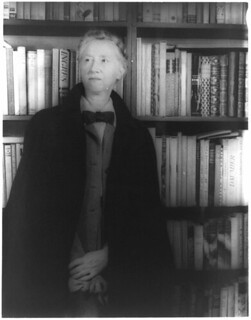
Ford settled on “Edsel.”
[TotH to Edsel Pages; faux ad via; Carl Van Vechten’s portrait of Moore via]
###
As we ruminate on nomination, we might send speedy birthday greetings to Ferruccio Lamborghini; he was born on this date in 1916. After World War II, Lamborghini built a smal engineering and manufacturing empire, starting with tractors made from reconfigured surplus military vehicles, then air-conditioning and heating systems. As his wealth grew, he began to buy luxury sports cars, ultimately a Ferrari, the pinnacle of the day. But Lamborghini found his Ferrari (especially its clutch) wanting, so decided to start a rival sports car company, Automobili Lamborghini, in 1963. That same year he debuted its first car, the Lamborghini 350 GTV, a two-seater coupe with a V12 engine– and a killer clutch.

Pack up all your cares and woes…

If you were committed to a psychiatric institution, unsure if you’d ever return to the life you knew before, what would you take with you? That sobering question hovers like an apparition over each of the Willard Asylum suitcases. From the 1910s through the 1960s, many patients at the Willard Asylum for the Chronic Insane left suitcases behind when they passed away, with nobody to claim them. Upon the center’s closure in 1995, employees found hundreds of these time capsules stored in a locked attic. Working with the New York State Museum, former Willard staffers were able to preserve the hidden cache of luggage as part of the museum’s permanent collection.
Photographer Jon Crispin has long been drawn to the ghostly remains of abandoned psychiatric institutions. After learning of the Willard suitcases, Crispin sought the museum’s permission to document each case and its contents. In 2011, Crispin completed a successful Kickstarter campaign to help fund the first phase of the project, which he recently finished. Next spring, a selection of his photos will accompany the inaugural exhibit at the San Francisco Exploratorium’s new location…
Read the whole remarkable story, “Abandoned Suitcases Reveal Private Lives of Insane Asylum Patients,” and see more of Crispin’s remarkable photos, at Collectors Weekly.
[TotH to Rudy Rucker]
###
As we remember to “roll, not fold,” we might recall that it was on this date in 1959 that the Ford Motor Company announced that it would discontinue it’s Edsel line of cars. Introduced to great fanfare on September 4, 1957– “E Day”– total Edsel sales were only about 84,000– less than half the company’s projected break-even point.

You must be logged in to post a comment.