Posts Tagged ‘Shakespeare’
“Our research universities are the best in the world. But a leadership position is easy to lose and difficult to regain.”…

Revisiting a key topic that we’ve touched before…
The modern U.S. research universities arose in the late 19th century. Their work has laid the foundation for major advances in health and medicine, technology, communications, agriculture/food, economics, energy, and national security at the same time that they have educated students to be scientific, technical, commerical, and cultural leaders and innovators.
Today, as a product of what historians have called a “virtuous circle of incentives and resources,” American academic research institutions are top of the pops… and not at all coincidentally, so is the U.S economy:

… But that dominance is under attack, both by the Trump Administration and by state governments around the country actively undermining the work of their state universities.
It’s worth remembering that, into the early twentieth century, German Universities– the original models for the American approach— dominated the list.

As the U.S. increasingly models the behavior of German authorities in the 1930s, the vital contributions of research univerisities are at risk.
When Hitler rose to power in the 1930s, the leaders of America’s most august universities didn’t all comport themselves as one might have wished. We can only hope that this time– as the threat is aimed directly at them– they will respond more strongly and directly.
Meantime, we can all add our voices to the defense of academic freedom and support for vital research.
* Research Universities and the Future of America, a report from The National Research Council, 2012 (Page 68)
###
As we cease self-sabotage, we might spare a thought for a professorial paragon of the virtues of the institutions in question (in his case, on the cultural as opposed to the scientific/technical front), George Lyman Kittredge, a professor at Harvard; he died on this date in 1941. Kittredge’s edition of Shakespeare’s work was the scholarly standard in the early 20th century; he promoted the study of folklore and folk songs (encouraging students like John A. Lomax, and thus Lomax’s son, Alan); and he was instrumental in the formation and management of the Harvard University Press.

“February is the uncertain month, neither black nor white, but all shades between by turns. Nothing is sure.”*…

Yeah, but why is it shorter than all of the other months? Timothy Taylor has the story…
I understand why the calendar adds an extra day to February every four years. The revolution of the earth around the sun is approximately 365 and one-quarter days. Every four years, that adds up to one additional day, plus some extra minutes. The modest rounding error in this calculation is offset by steps like dropping the extra day of leap year for years ending in “00.”
But my question is why February has only 28 days in other years. After all, January has 31 days and March has 31 days. If those two months each donated a day to February, then all three months could be 30 days long, three years out of four, and February could be 31 days in leap years. Every other month is either 30 or 31 days. Why does February only get 28 days?…
… The answer to such questions leads to a digression back into the history of calendars. In this case, Jonathan Hogeback writing at the Britannica website tells me, it seems to settle on the Roman king Numa Pompilius back around 700 BCE, before the start of the Roman Empire. The ancient Roman calendar of that time had a flaw: it didn’t have nearly enough days. As Hogeback writes:
The Gregorian calendar’s oldest ancestor, the first Roman calendar, had a glaring difference in structure from its later variants: it consisted of 10 months rather than 12. In order to fully sync the calendar with the lunar year, the Roman king Numa Pompilius added January and February to the original 10 months. The previous calendar had had 6 months of 30 days and 4 months of 31, for a total of 304 days. However, Numa wanted to avoid having even numbers in his calendar, as Roman superstition at the time held that even numbers were unlucky. He subtracted a day from each of the 30-day months to make them 29. The lunar year consists of 355 days (354.367 to be exact, but calling it 354 would have made the whole year unlucky!), which meant that he now had 56 days left to work with. In the end, at least 1 month out of the 12 needed to contain an even number of days. This is because of simple mathematical fact: the sum of any even amount (12 months) of odd numbers will always equal an even number—and he wanted the total to be odd. So Numa chose February, a month that would be host to Roman rituals honoring the dead, as the unlucky month to consist of 28 days.
This discussion does explain why February would be singled out, since it was the month of rituals honoring the dead. In Numa’s calendar, the 355-day year would be made up of 11 months that had the lucky odd numbers of 29 or 31 days, plus unlucky February.
The discussion also explains why months that start with the prefix “Oct-” or eight, “Nov” or nine, and “Dec-” or ten, are actually months 10, 11, and 12 in the calendar. Those names were originally part of a 10-month calendar year.
But questions remains unanswered: Why did the Romans of that time view odd numbers as lucky, compared with unlucky even numbers? I suppose that explaining any superstition is hard, but I’ve never seen a great explanation. A Dartmouth course on “Geometry in Art and Architecture” describes Pythagorean feelings about odd and even numbers. For those of you keeping score at home, Pythagoras lived about two centuries after Numa Pompilius. The Dartmouth course material summarizes aspects of “Pythagorean Number Symbolism”:
Odd numbers were considered masculine; even numbers feminine because they are weaker than the odd. When divided they have, unlike the odd, nothing in the center. Further, the odds are the master, because odd + even always give odd. And two evens can never produce an odd, while two odds produce an even. Since the birth of a son was considered more fortunate than birth of a daughter, odd numbers became associated with good luck…
[Taylor recounts the recurrence of this theme, from Virgil to Shakespeare…]
… While I acknowledge this history of a belief in odd numbers, as a person born on an even day of an even month in an even year, I’m not predisposed to accept it. But it’s interesting that modern photographers have a guideline for composing photographs called the “rule of odds.” Rick Ohnsman at the Digital Photography School, for example, describes it this way:
This is where the rule of odds comes into play, a deceptively simple yet powerful tool in your photographic arsenal. It’s all about arranging your subjects in odd numbers to craft compositions that are naturally more pleasing to the eye. Unlike more static guidelines, the rule of odds offers a blend of structure and organic flow, making your images both aesthetically pleasing and impressively compelling.
The revised calendar of Numa Pompilius couldn’t last. With only 355 days, it didn’t reflect the actual period of the earth revolving around the sun, and thus led to further revisions which are a story in themselves.
But when you think about it, the question of February having 28 days all goes back to Numa Pompilius and the superstitions about odd numbers. The modern calendar has 365 days in a typical year. You might think that the obvious way to divide this up would be to start off with 12 months of 30 days, and then add five days. Indeed, the ancient Egyptians had a calendar of this type, with five “epagomenal” or “outside the calendar days added each year.
The preference over the last two millennia, at least since the time of Julius Caesar, is to have 12 months, with a few of them being a day longer. But even so, why not in a typical year have five months of 31 days, and the rest with 30? The “problem,” I think, is that most months would then have unlucky totals of an even number of days. By holding February to 28 days rather than 30, you can redistribute two days from February and have 31 days in January and March. Thus, you can have only four months with an even total of 30 days every year (“Thirty days hath September, April, June, and November …”), and seven months always with the luckier odd total of 31 days. In leap years, when February has 29 days, then eight months have an odd number of days. I think this makes February 29 a lucky day?…
“Why Does February (Usually) Have 28 Days?” from @TimothyTTaylor.
###
As we muse on the marking of months, we might recall that it was on this date in 1692 that a doctor in Salem, Massachusetts (generally believed to have been William Griggs), was unable to find a physical explanation for the ailments (fits, pins-and-needles) of three young girls. As other young women in Salem began to evince the same symptoms, the local preacher declared them “bewitched”… and the stage was set for The Salem Witch Trials.

“It’s not those who write the laws that have the greatest impact on society. It’s those who write the songs”*…
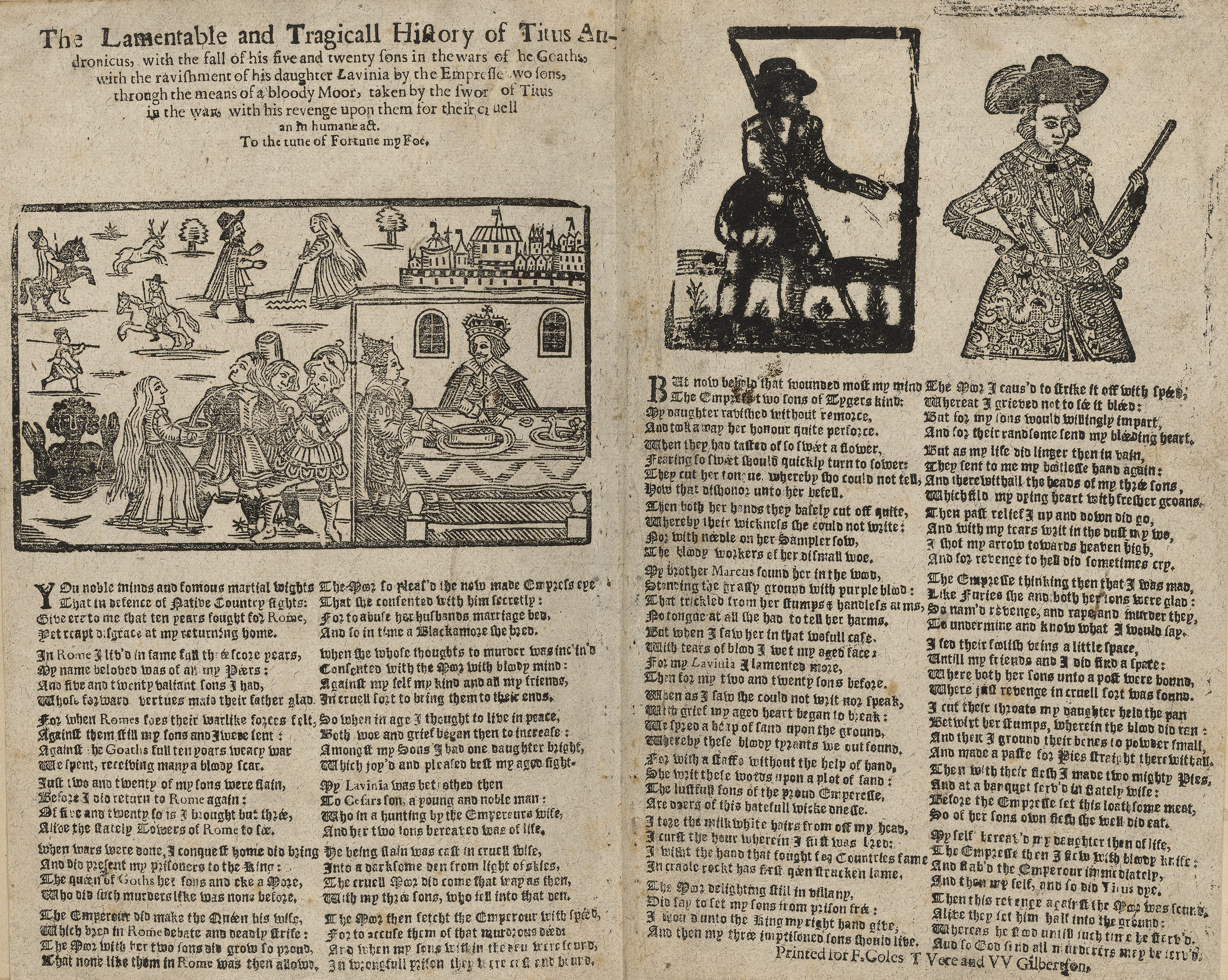
Broadside ballads were single-sheet songs that emerged with the spread of printing and sold for a penny a piece; the most popular of them were the 16th and 17th century equivalent of the Hit Parade. Christopher Marsh and Angela McShane have put together an extraordinary rich collection…
We here identify and present a body of the biggest hits from seventeenth-century England…
This website concentrates on over 100 resoundingly successful examples that you can investigate through recordings, images and a wealth of other materials. Whether you are interested in music, art, love, gender, tragedy, politics, family life, crime, history, humour or death, you will find something to engage you here…
For example, the ballad pictured above:
The Lamentable and Tragicall History of Titus Andronicus seems certain to have been written in c. 1594 as a spin-off from Shakespeare’s play about the fictional general whose final months in late-imperial Rome were even more bloody than the decades of military service that went before. Plays for the stage and songs for the street cross-fertilised throughout the early-modern period, and several of our hit songs reveal the relationship (see, for example, The Lamentation of Master Pages wife and An Excellent Ballad of George Barnwel).
The ballad, like the play, was highly successful. Of the two forms, it was perhaps the ballad that maintained its popularity more consistently after Titus’ first phase of marketability in the Elizabethan and Jacobean periods. There were numerous editions of the ballad in the seventeenth and eighteenth centuries. More occasionally, it was also included in printed song-collections such as Richard Johnson’s Golden garland of princely pleasures (1620).
…
To the tune of ‘Fortune my Foe’ (standard name)
‘Fortune my foe’ was so well known that notation appears in dozens of sources, both printed and manuscript. There are instrumental settings for lute, virginals, cittern and lyra viol, and several of the period’s most celebrated composers – John Dowland and William Byrd, for example – applied their talents to the tune. This was a remarkably solid melody, and renditions are striking in their consistency over time and space…
[Here it here]
99 other Tops of the Pops in the 17th century: “100 Ballads” @100ballads.
* Blaise Pascal
###
As we belt it out, we might recall that on this date in 1994, a different ballad was #1 on the pop charts: Celine Dion singing “The Power of Love”– a cover of its author Jennifer Rush‘s version, which had itself reached the top of the chart nine years earlier.
“Thou art a monument without a tomb, / And art alive still while thy book doth live / And we have wits to read and praise to give”*…

400 years ago this month, seven years after Shakespeare’s death, his friends John Heminge and Henry Condell published The First Folio, containing 36 of Shakespeare’s plays, (an endeavor which they financed with a bequest that he had left them).
Although 19 of Shakespeare’s plays had been published in quarto before 1623, the First Folio is arguably the only reliable text for about 20 of the plays, and a valuable source text for many of those previously published. Eighteen of the plays in the First Folio, including The Tempest, Twelfth Night, and Measure for Measure among others, are not known to have been previously printed.
It is considered one of the most influential books ever published. Of perhaps 750 copies printed, 235 are known to remain, most of which are kept in either public archives or private collections. More than one third of the extant copies are housed at the Folger Shakespeare Library in Washington, D.C., which is home to a total of 82 First Folios.
It is also, as Alicia Andrzejewski and Carole Levin explain, one of the most stolen…
Late at night on July 13th, 1972, an unknown person entered the University of Manchester’s Library and violently smashed the plate glass top of an exhibition case, stealing the contents. Inside was one of the most famous, most valuable books in existence: the library’s near-perfect edition of one of Shakespeare’s First Folios. This theft is the most mysterious of all the stolen First Folios. More than fifty years have passed, and this First Folio—one of the 750 printed in 1623 and of the estimated 232 known copies across the globe today—is still missing.
This year, 2023, marks the 400th year anniversary of the printing of Shakespeare’s First Folio, deemed one of the most significant books in the English language, “a coveted treasure,” to quote Eric Rasmussen, an expert on the First Folios and author of The Shakespeare Thefts: In Search of the First Folios. Without the First Folio, we would not have many of Shakespeare’s most famous plays, the half that were not printed in his lifetime, including The Taming of the Shrew, Macbeth, Twelfth Night, and The Tempest. In collecting and printing these plays, Shakespeare’s two close friends and fellow actors, John Heminge and Henry Condell, validated that plays are more than entertainment—they have literary value.
The First Folios still in existence are mainly housed in public institutions—their significance is underscored by their rarity, as copies are almost never available for sale, and the most recent one sold in 2020 for almost ten-million dollars. Even in the seventeenth century, when the First Folios were first printed, they were only available to elite members of society: earls, lords, knights, admirals, and the occasional lawyer. To this day, ownership is limited to, and a fetish among, the super wealthy. Because of their elite status, Rasmussen speculates that, of the copies that cannot be located, most “have probably been stolen.”
For some, as Rasmussen suggests, the First Folio is coveted because of its monetary value, an object to steal and eventually attempt to sell. Three First Folios were stolen in the 20th century alone, including the Manchester Library’s copy, and the thieves in the latter two cases are characters as strange as some of those in Shakespeare’s plays, the heists as thrilling as some of his plots. The thefts we describe, and the desires that inspire them, speak to Shakespeare’s foothold in Western civilization—the reverence and awe so many people have for him, that imbue the First Folio with an almost religious power…
Some of the most brazen heists of a historic volume: “Shakespeare’s First Folio has been Stolen Many, Many Times,” in @CrimeReads.
* Ben Jonson, “To the Memory of My Beloved the Author, Mr. William Shakespeare” (in the First Folio)
###
As we linger on literary larceny, we might recall that it was on this date fifty years ago that then-President Richard Nixon made his famous declaration of character:
On Nov. 17, 1973, President Richard M. Nixon held a news conference before Associated Press managing editors in Orlando, Fla., in which he defended himself against a number of allegations. Most of the questions related to the Watergate break-in, which had become even more of a scandal a month earlier with the “Saturday Night Massacre.” Other questions focused on reports that he had cheated on his tax returns.
The Nov. 18 New York Times outlined President Nixon’s many assertions, concluding that the president had acquitted himself well: “The president seemed composed and on top of the subject throughout the session, faltering perceptibly only during the discussion of his taxes. In contrast with some of his recent appearances he did not berate his critics or his political enemies.”
The best-remembered part of the news conference came as the president defended himself against claims that he had illicitly profited from his years in public service. “I made my mistakes, but in all of my years of public life, I have never profited, never profited from public service — I earned every cent,” he said. “And in all of my years of public life, I have never obstructed justice. And I think, too, that I could say that in my years of public life, that I welcome this kind of examination, because people have got to know whether or not their president is a crook. Well, I am not a crook. I have earned everything I have got.”
The news conference did little to end questions over Mr. Nixon’s honesty. His declaration “I’m not a crook” was used against him — and the line would forever be associated with the Watergate era.
In April 1974, the Internal Revenue Service ordered that the president pay more than $400,000 in back taxes for making improper deductions. And the Watergate investigation continued to uncover misconduct. In August 1974, with the House Judiciary Committee having recommended impeachment and the release of a “smoking gun” tape showing that he had approved a cover-up, the president resigned…
“Nixon Declares ‘I Am Not a Crook’”

“Suit the action to the word, the word to the action, with this special observance, that you o’erstep not the modesty of nature”*…

In 1982, the BBC ran a glorious nine-part series developed and hosted by John Barton, co-founder and director of the Royal Shakespeare Company. A master class in playing Shakespeare, it features RSC members and alumni including Judi Dench, Ben Kingsley, Peggy Ashcroft, Ian McKellen, Patrick Stewart, David Suchet, Sinéad Cusack, Susan Fleetwood, Sheila Hancock, Alan Howard, Donald Sinden, Michael Williams, and more…
Indispensable for thespians, the series is every bit as rich a resource for those of us who want simply to enrich our appreciation of the Bard. All nine episodes can be streamed on Acorn or You Tube.
* Shakespeare, Hamlet, Act III, Scene 2
###
As we declaim, we might recall that it was on this date in 1967 that Tom Stoppard’s Rosencrantz and Guildenstern Are Dead premiered at London’s Old Vic Theatre. A glorious piece of metatheater, the play expands on the exploits of two minor characters from Shakespeare’s Hamlet, the courtiers Rosencrantz and Guildenstern.
The action of Stoppard’s play takes place mainly “in the wings” of Shakespeare’s, with brief appearances of major characters from Hamlet who enact fragments of the original’s scenes. Between these episodes, the two protagonists voice their confusion at the progress of events occurring onstage without them in Hamlet.
The title is taken directly from the final scene of Hamlet. In an earlier scene, Prince Hamlet has been exiled to England by the treacherous King of Denmark (his uncle Claudius, who of course has murdered Hamlet’s father to obtain the throne). En route to England, Hamlet discovers a letter from King Claudius which is being carried to England by Hamlet’s old but now untrusted friends Rosencrantz and Guildenstern. The letter commands that Hamlet be put to death upon his arrival in England. Hamlet rewrites the letter to command that instead, Rosencrantz and Guildenstern be put to death. He then escapes back to Denmark. By the end of Shakespeare’s play, Prince Hamlet, Laertes, Ophelia, Polonius, King Claudius, and Queen Gertrude all lie dead.

You must be logged in to post a comment.