Posts Tagged ‘Folk music’
“Listening is like running down a mountain on a switchback trail, the sound of surprise generating its own momentum. There’s a punk glee inside the bluegrass craft– and a punk vehemence inside the bluegrass smile.”*…
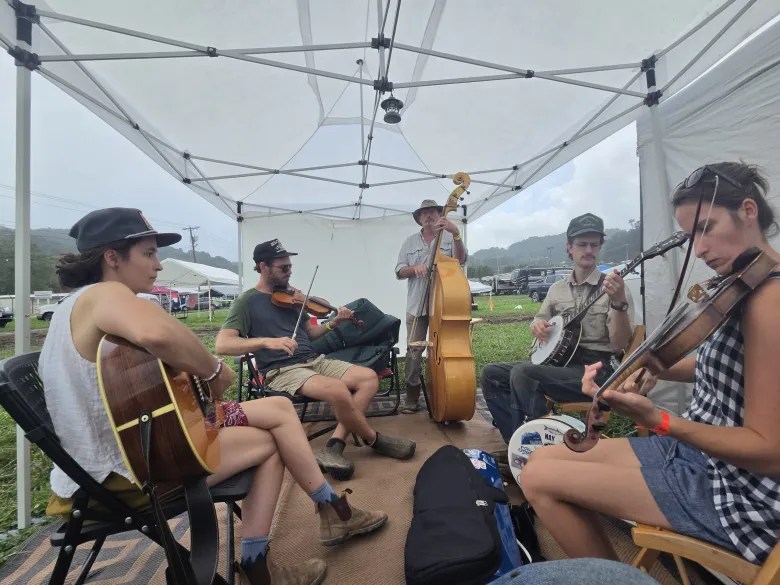
On the heels of Hardy Strictly Bluegrass [and here], Warren Hellman‘s gift to San Francisco, the most recent annual installment of which was last weekend, a lovely piece by David Alm on a more traditional event…
I got off Interstate 81 to give my soul a break. The back roads of southwest Virginia wind, crest, and plunge through lush valleys of oak, poplar, birch, and maple trees. It’s easy to lose track of time and distance there. People drive slower. Cows graze in pastures. And there are no placards festooned with Motel 6 and Starbucks logos, flattening the American landscape into a homogeneous blur. Any signs you might see are low to the ground and handmade, protesting a data center, for instance, or thanking Jesus.
I’d gone to this rural pocket of the country for the 90th annual Old Fiddler’s Convention in Galax, an independent city of just under 7,000 near the North Carolina border whose population, for six days in early August, balloons to around four times that. They arrive in RVs and Casitas, camper vans and cars to stake out 20-by-35-foot plots in Felts Park, a 28-acre fairground in the heart of Galax, transforming it into a massive, muddy parking lot sprinkled with portable toilets and a cluster of food trucks, offering loaded potatoes, funnel cake, and blooming onions.
The Old Fiddler’s Convention—or just Galax, as the diehards call it—is the oldest and largest fiddlers’ convention in the world, a place where banjo pickers, guitar players, and other maestros of old-time strings gather to see how they stack up. Founded in 1935, Galax has been canceled only twice since then: once during World War II, due to travel restrictions, and again in 2020, due to the COVID-19 pandemic. Many Galaxers have been going every year for decades, some for as long as they’ve been alive.
There are scads of rules: If you play clawhammer-style banjo in the bluegrass band competition, you will get disqualified. Same if you play bluegrass-style banjo in the old-time competition. If you break a string while performing, you must stop immediately. Playing time during competition is limited to two minutes and 30 seconds. And, crucially, no electric instruments of any kind are allowed, either on stage or in the tightly packed fairgrounds, where self-described hillbillies, accountants, firefighters, and session musicians pick day and night in blistering, impromptu jams amid the RVs.
One does not merely attend Galax. It’s not a music festival. There are no headliners, and no full-set performances. There is a single stage, and over the course of six days, contestants take it one after another to play one song for a panel of judges and a smattering of spectators. There are more than a dozen categories, little changed in the past century: old-time fiddle, guitar, dulcimer, folk song. Cash prizes for individual players range from $35 to $285; a campsite and contestant pass together cost $175. “The prestige of being judged a ‘winner at Galax,’ and the respect for one’s musical talent that goes along with it, far outweighs any monetary award,” wrote Fred Burton in the March 1984 issue of Bluegrass Unlimited…
…
… An old-time jam goes something like this: Anywhere from two to umpteen musicians gather in a circle, knee-to-knee, and someone—usually the fiddler—calls a tune. Before you know it, you’re carried away by a cyclone of fiddles, mandolins, banjos, and guitars, all locked into a swirling rhythm that can, when it’s good, take you to church.
The tradition dates to the mid-1700s, when Scots-Irish immigrants first settled in Appalachia. Even then, coastal property was for the elite, forcing poorer immigrants inland and south, through the Shenandoah Valley to southwest Virginia, where land was plentiful and cheap. Their music quickly took root. “The Scots brought fiddles and liquor,” Ted McAllister, one of my neighbors in Felts Park, told me. “The Germans brought church music and beer.”
Over time, Scottish fiddle tunes evolved, as oral traditions do, and began to mix with the musical traditions of enslaved Africans, who had brought with them gourd instruments that would evolve into the American banjo, along with rhythms the Scots had never heard before. Old-time music, in other words, is the music of diasporas, fed into a blender and then worked into a froth. A lot of traditional folk songs came out of this period, too. One that I learned at Galax, “Going to the West,” tells the story of a young man who leaves the mountains of his birth, “where labor is in vain,” to seek the fertile plains out west. It’s the story of my own Scottish forebears, who settled in South Dakota before moving to what is now suburban Chicago, and later, Florida.
Bluegrass, by contrast, was born in the 1940s, when Bill Monroe and The Blue Grass Boys took those mountain sounds, combined them with Southern church music and blues, and tightened it all into something you might call an uncle of rock ’n’ roll. There’s a reason that Billy Strings plays to sold-out arenas and pickers from around the world can play classics like “Blue Ridge Cabin Home” at the drop of a one-chord.
Where bluegrass is punchy and clean, designed for the stage, old-time is ecstatic, designed for participation. Bluegrass jams attract spectators who marvel at the players’ pyrotechnics; old-time jams get people on their feet. At Galax, some folks drag big pieces of plywood around the fairgrounds looking for old-time jams, where they’ll lay the board down at the edge of the circle and dance. Flatfooters they’re called: the percussion section…
Eminently worth reading in full.
In a southwest Virginia fairground, thousands of musicians gather every August to keep a centuries-old tradition from flickering out: “A Place Among the Fiddlers,” from @longreads.com.
###
As we pick, we might recall that it was on this date in 1939 that George D. “Judge” Hay, the creator and producer of The Grand Ole Opry, invited Bill Monroe and the Blue Grass Boys to audition for a spot on the prestigious radio broadcast. The audition was a success, and Monroe chose “Muleskinner Blues” for their debut. According to observers, when the curtain went up, the audience and Opry regulars alike (including stars such as Roy Acuff, Uncle Dave Macon, and Pee Wee King) were awed by the furious tempo of the Blue Grass Boys. Band member Cleo Davis later observed that the audience “couldn’t think as fast as we played.”
Monroe quickly scored a recording contract, and switched personnel to establish the line-up that became famous, surrounding himself (on mandolin) with Lester Flatt (guitar), Earl Scruggs (banjo), Chubby Wise (fiddle), and Cedric Rainwater (bass). Together, they polished the traditional mountain music celebrated at Galax into a genre that took its name from their group. and Monroe is remembered as “the Father of Bluegrass.”

“Music is liquid architecture and architecture is frozen music”*…
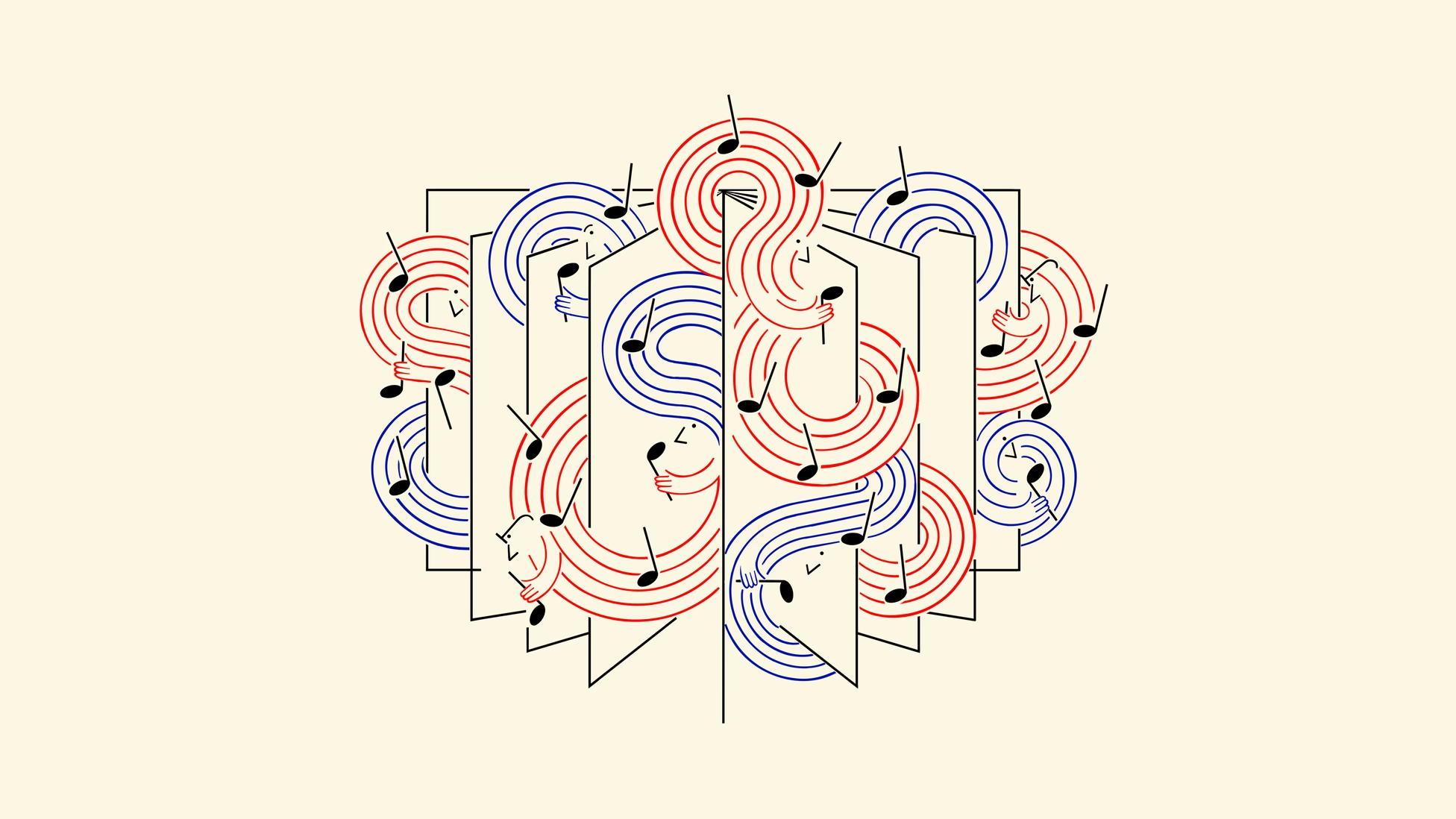
“Classical music” is a label applied to radically different compositions across more than 1,000 years of history. Composer, conductor, writer, pianist, and 2018 MacArthur Fellow Matthew Aucoin that we need a better definition…
… What is classical music, whom is it for, and what about it is worth defending?
Our answers to these questions will depend on what exactly we love about this music, and what we care about preserving, enriching, and expanding. Claiming that classical music deserves a prominent place in American culture merely because we want to safeguard a particular sound, style, or cultural or ethnic lineage—“music that sounds like Brahms,” or “music from one of three Central European countries”—would be a losing cause.
But a better answer is out there. Rather than defend the “classical” in classical music, I want to champion a particular creative process. What links Hildegard von Bingen and Kaija Saariaho, Johann Sebastian Bach and George Benjamin, is not a specific sound or aesthetic but a shared technology of transmission. At its core, classical music isn’t “classical.” It is written music.
By “written music,” I mean music that comes into being through the act of composition. Music from practically any tradition can, of course, be written down. If you’re a Beatles fan, you can buy a collection of Beatles sheet music, and if you want to plunk out your favorite jazz standard, you can order a copy of The Real Book, which contains the essential harmonic and melodic information for hundreds of well-traversed tunes. (Both a Real Book and a 1,136-page tome called The Beatles: Complete Scores are sitting on my piano as I write this.)
Though all music can be documented and experienced in multiple ways—scores, recordings, live performances—one approach to distinguishing musical traditions is to ask which form a given tradition treats as authoritative. It would be odd, for instance, to claim that a collection of printed scores constitutes a definitive document of the Beatles canon, because the unquestioned reference point is the band’s studio albums. My Beatles compendium proudly declares its own contingency: Printed on the front cover is an all-caps proclamation that its pages contain FULL TRANSCRIPTIONS FROM THE ORIGINAL RECORDINGS.
In other words: albums first, scores later. Taylor Swift’s 2019 decision to rerecord her earlier albums was a potent gesture, even a radical one, precisely because in pop music, the studio album typically possesses an authority upon which all subsequent iterations—whether live performances or written transcriptions—are based. Only by returning to the studio could Swift achieve control over her master recordings and literally set the record(s) straight.
Jazz musicians and aficionados tend to have a different perspective. Even though certain albums (Kind of Blue, A Love Supreme ) have attained the status of holy relics in the minds of many listeners, I think most jazz lovers would agree that the genre is not defined by the worship of specific studio recordings. Fans are more likely to value the evanescent moment of live performance, with its potential for spontaneous expression, for the very reason that a familiar tune can sound different every time it’s performed. A major artist such as Miles Davis might have performed and recorded a certain song—“My Funny Valentine,” for example—many times throughout his career, and there’s no reason to automatically treat a particular performance as the authoritative version. In spite of The Real Book’s name, jazz musicians rarely consider the printed score to be “the real thing” either. No self-respecting jazz musician would play a Real Book score exactly as written.
Western classical music is an unusual case. The reference point for a given piece of music is the score, rather than a studio recording or a live performance. Beethoven’s symphonies have been recorded hundreds—if not thousands—of times, and they’ve been performed many more times than that, but every one of those performances and recordings refers to the same score. For a composer, the score is the foundational site of creativity, and the act of score-making links together artists who could hardly sound more different from one another—say, an Italian composer of the late Renaissance and early Baroque period like Claudio Monteverdi and a 20th-century American avant-gardist like John Cage. Even an extreme case, such as Cage’s famous 4’33”—a work in which performers refrain from playing their instrument for four minutes and 33 seconds—depends on its score, a simple and playful set of written instructions. (In fact, to a greater degree than most notated music, 4’33” is inconceivable as a work of art without those directions.)
If we let ourselves be guided by this basic question—which musical artists regard the score as a creative starting point?—we arrive at the broadest and most welcoming definition of “classical” music. All kinds of unexpected affiliations and affinities emerge beyond music that’s typically thought of as belonging to the tradition. Many of the big-band masterpieces of Duke Ellington and Billy Strayhorn, for instance, strike me as indistinguishable, in their creative genesis, from orchestral works by Igor Stravinsky and Aaron Copland that were being written around the same time: They are notated in exquisite detail, usually for large ensembles, and Strayhorn’s gorgeously balanced wind and brass voicings remind me in particular of Stravinsky’s. To my ear, Strayhorn is a symphonist at heart. His work—in its fundamental writtenness—has more to do with that of many so-called classical composers than it does with, for example, that of an artist like Ornette Coleman, a free-jazz master who ostensibly hails from a tradition that is continuous with Strayhorn’s, but whose method could hardly be more different.
Written music matters for the same reason written langauge does: To write is to free oneself from the constraints of memory. It’s possible, in a novel or an essay or a nonfiction narrative or a book of poems, to devise an aesthetic structure full of details, depths, and digressions that would be far harder to construct in a purely oral storytelling tradition, one in which verbal transmission works through either memorization or improvisation. When you write, you don’t simply set down your thoughts; in the process of writing, your thoughts are transformed, and allowed to assume a newly complex shape—the miraculous scaffolding that emerges from the accumulation of thoughts on the page.
Our world is awash in written language, but not written music. The musical genres that dominate mainstream American culture are all more or less oral traditions….
… Musical literacy is a highly specialized skill; to become a fluent reader of music, a student needs to be given the kind of focused instruction that not all public schools have the funding to provide. Exposure to music education, beyond the rudiments, all too often becomes a question of whose family can afford expensive private lessons. We can react to this fact by feeling guilty about it, and letting notated music be tainted by its association with elitism, or we can push for an expansion of musical education. We all understand that to teach a child to read and write is to endow them with potent means of expression and self-discovery. Why should musical literacy be any different? Even a basic grounding in musical notation can transform a child’s sense of what can be communicated to another human being, especially—and this is crucial—if notation is treated as a tool of creativity rather than simply an unpleasant test of the ability to play all the right notes or else.
If we understand that writing, in music as in language, has the potential to be a force for liberation, and that it can transcend localized questions of style and aesthetic, we might come to a fuller sense of what music can be in our lives—the many forms it can take, the many truths it can tell. And if I could prescribe one thing for our world at this moment, it would be to deepen and expand our understanding of what it is to listen…
Eminently worth reading in full: “Do You Actually Know What Classical Music Is? Does Anyone?” (gift article) from @theatlantic.com.
* Johann Wolfgang von Goethe (though we might recall that Martin Mull observed that “writing about music is like dancing about architecture”)
###
As we read and write, we might recall that this date– National Opera Day— is the anniversary of the premiere in 1874 of Modest Mussorgsky‘s (and here) Boris Godunov at the Mavrinsky Theater in St. Petersburg. (Some sources give the date as January 27 of that year.) Mussorgsky’s only completed opera, it is considered his masterpiece.
Mussorgsky composed the work, based on Pushkin‘s 1825 play Boris Godunov (and here), between 1868 and 1873. By the 1980s In the 1980s, Boris Godunov had moved closer to the status of a repertory piece than any other Russian opera, even Tchaikovsky‘s Eugene Onegin, and is the most recorded Russian opera.

“Our research universities are the best in the world. But a leadership position is easy to lose and difficult to regain.”…

Revisiting a key topic that we’ve touched before…
The modern U.S. research universities arose in the late 19th century. Their work has laid the foundation for major advances in health and medicine, technology, communications, agriculture/food, economics, energy, and national security at the same time that they have educated students to be scientific, technical, commerical, and cultural leaders and innovators.
Today, as a product of what historians have called a “virtuous circle of incentives and resources,” American academic research institutions are top of the pops… and not at all coincidentally, so is the U.S economy:

… But that dominance is under attack, both by the Trump Administration and by state governments around the country actively undermining the work of their state universities.
It’s worth remembering that, into the early twentieth century, German Universities– the original models for the American approach— dominated the list.

As the U.S. increasingly models the behavior of German authorities in the 1930s, the vital contributions of research univerisities are at risk.
When Hitler rose to power in the 1930s, the leaders of America’s most august universities didn’t all comport themselves as one might have wished. We can only hope that this time– as the threat is aimed directly at them– they will respond more strongly and directly.
Meantime, we can all add our voices to the defense of academic freedom and support for vital research.
* Research Universities and the Future of America, a report from The National Research Council, 2012 (Page 68)
###
As we cease self-sabotage, we might spare a thought for a professorial paragon of the virtues of the institutions in question (in his case, on the cultural as opposed to the scientific/technical front), George Lyman Kittredge, a professor at Harvard; he died on this date in 1941. Kittredge’s edition of Shakespeare’s work was the scholarly standard in the early 20th century; he promoted the study of folklore and folk songs (encouraging students like John A. Lomax, and thus Lomax’s son, Alan); and he was instrumental in the formation and management of the Harvard University Press.

“All history must be mobilized if one would understand the present”*…

… especially, one might conclude, when it comes to understanding civilizational challenges like climate change. But as Deborah Coen explains, that’s not so straightforward…
Never before in human history has Earth experienced a change in climate as rapid as the shift we’re living through today. Can history hold clues to an upheaval without precedent? That depends on how we frame the question. Scientists tend to have two questions. They want to know how past societies have been impacted by less dramatic episodes of climate variability, and they want to know what has motivated societies to switch from one fuel source to another. Over the past 20 years, historians’ answers have influenced the reports of major international scientific bodies, including the Intergovernmental Panel on Climate Change and the Anthropocene Working Group of the International Union of Geological Sciences. And yet, following the lead of scientists has constrained how climate historians think about drivers of change. Scientists like to think that change comes from bold new theories and technological breakthroughs. The chemist Paul Crutzen, for instance, popularized the term “Anthropocene” in part to underscore his faith that the solution to the environmental crisis would come from human ingenuity. Today, scientists seek funding for massive projects, from shoring up a melting glacier to constructing climate research centers on the scale of the Manhattan Project. In this spirit, climate historians have tended to tell dramatic stories in which societies fail or succeed according to their ability to impose top-down change. What these accounts miss are the humble drivers of change that unfold at the scale of everyday life and grow bottom-up rather than top-down. Indeed, a third question is emerging for historians today: what small-scale mechanisms might trigger a transition to a more equitable and sustainable future?…
…
The appeal of both historical frameworks—collapse and resilience—lies ultimately in their framing of human societies as complex systems that can be modeled much like other components of the “Earth system.” In this respect, historians have dutifully answered the question posed by scientists, and they have done so in scientists’ terms. They have thereby made it possible to integrate the human factor into the models that scientists use to study and predict global change. As one 2018 paper put it, “the idea of building a forecasting engine for societal breakdown is too tempting to resist.”
Such “integrated assessment models,” which incorporate demographic and economic trajectories into forecasts of environmental change, gained currency in the 1990s with the rise of international diplomacy around global warming. The models raised the second thorny question mentioned above: How do energy transitions unfold? What motivates a society to replace one fuel source with another?
Again, the framing of the question conditioned the answers. Implicit is the assumption that human history has inevitably marched towards increasingly energy-dense fuel sources. With the onset of industrialization, animal power, wind power, and waterpower were replaced by coal and peat, which in turn gave way to gas and oil. The task of the historian became a narrow search for the factors that induced a fuel switch in the past—and which, by extension, might motivate a transition to “clean” energy in the future…
…
Morris and McNeill [Ian Morris’s 2015 Foragers, Farmers, and Fossil Fuels: How Human Values Evolve and J. R. McNeill’s Something New Under the Sun: An Environmental History of the Twentieth-Century World] gave the scientists what they were looking for: a universal, quantitative version of human history. And yet, these historians obscured what I would call the most important feature of history: contingency. The problem stems, first, from their reliance on historical sources—such as bureaucratic records and monumental remains—that tell history from the point of view of states and their elites. Secondly, these histories constrain their field of view by adopting the language of science and policy. The very concept of “sustainability,” much like its partner, “development,” implies that the goal is to continue along the path that got us here. Reading Morris and McNeill, it is hard even to imagine what an alternative would look like—let alone how we could bring it about.
Fortunately, other historians have shown us that the course of industrialization was by no means inevitable. Energy transitions did not go unchallenged. Recent histories of coal mining (Victor Seow, Thomas G. Andrews) and fracking (Conevery Valencius) reveal that ordinary people objected to the extraction of these fuels due to the risks they posed to local communities. Dismissing past critics as shortsighted or irrational misses the point: history could have gone differently…
…
David Graeber and David Wengrow build on Scott’s insights [James Scott’s Against the Grain: A Deep History of the Earliest States] in their monumental synthesis, The Dawn of Everything: A New History of Humanity (2021). They argue that what has looked to archaeologists like the remains of collapsed early states might be evidence of a conscious decision to abandon the experiment. In sharp contrast to the inevitability of the evolutionist narrative, Graeber and Wengrow stress that humans have repeatedly exercised their freedom to opt out of hierarchical societies and live otherwise. Their message: We might do the same. Our values need not be dictated by the economic choices made by our forebears…
… Morris’s critical review of The Dawn of Everything claims that its attention to exceptions cannot disprove his model. Well then, what can? For a scholar so concerned with scientific credibility, Morris is remarkably unconcerned that his theory fails to pass Popper’s falsifiability test. He closes his review by chiding the authors for their utopianism: “It would be uplifting to think that whatever we dislike about our own age only persists because we have hitherto lacked the imagination and courage to put something better in its place.” One has to wonder: who is this “we” who lacks imagination and courage? Clearly, Morris has missed their point. “Something better” has been put in place again and again, flourishing at smaller or larger scales throughout human history.
Environmental historians Ian Jared Miller and Paul Warde diagnose the problem this way: “Purely quantitative or global approaches to energy” tend to overlook the experiences of those who are not making the decisions but whose lives are affected by them. This oversight is a result of methods that make it “difficult to grasp everyday experience as a prompt to action and an agent of change.” Otherwise put, historians miss a great deal when they rely on the quantitative tools of scientists.
History will never provide a crystal ball, and that’s not what we should ask of it. Nor should we be limited by theories of historical change that consider “events” only as unusual occurrences that were recognized as such by contemporaries. Change can also be the result of an accumulation of small disruptions that goes unnoticed by mainstream observers. Climate historians know this well, since the variability they study was often unremarked upon by those living through it. And yet, climate historians have taken little interest in processes of change that run bottom-up rather than top-down.
This is why climate historians have much to learn from historians of disenfranchised populations…
These histories show that human feelings and values are not dictated by the economic system in which we happen to find ourselves. On the contrary, emotions are unruly and uncontainable; they cannot be quantified and will never serve as input for Earth system models. They can, however, point towards alternative ways of living and relating. Where those alternatives lead, no one can know. But the very fact that human relations are emergent and unpredictable is grounds for hope.
Eminently worth reading in full: “What’s Next for Histories of Climate Change,” from @LAReviewofBooks.
* Fernand Braudel
###
As we include, we might send grateful birthday greetings to a historian with a different focus, but that same urge to inclusion– Alan Lomax; he was born on this date in 1915. A historian, folklorist, musician, and ethnomusicologist, he collected, archived, and distributed recordings of vernacular American music that would surely have otherwise been lost.
The many, many artists Lomax is credited with discovering and bringing to a wider audience include blues guitarist Robert Johnson, protest singer Woody Guthrie, folk artist Pete Seeger, country musician Burl Ives, Scottish Gaelic singer Flora MacNeil, and country blues singers Lead Belly and Muddy Waters. Lomax recorded thousands of songs and interviews for the Archive of American Folk Song (of which he was the director) at the Library of Congress; and he produced recordings, concerts, and radio shows in the US and in England, which played an important role in preserving folk music traditions in both countries and helped start both the American and British folk revivals of the 1940s, 1950s, and early 1960s.

“I daydream about a high school where everybody plays the harmonica”*…

In the late 1960s, as the general manager of Don Wehr’s Music City in San Francisco, Reese Marin sold guitars, drums, keyboards, and amps to the biggest psychedelic rock bands of the late 1960s. His customers ranged from Big Brother and the Holding Company and Quicksilver Messenger Service to Jefferson Airplane and The Grateful Dead. Guitarists as musically diverse as Carlos Santana and Steve Miller could find what they were looking for at Don Wehr’s; so did jazz virtuosos George Benson and Barney Kessel, who would walk down Columbus Avenue from Broadway in North Beach—where the jazz clubs competed with strip joints for tourists—whenever they were in town.
These legends were some of the most demanding and finicky musicians on the planet. So it should have been easy for Marin to sell a couple of $5 harmonicas to Lee Oskar, whose melodic riffs on hits like “Cisco Kid,” “The World is a Ghetto,” and “Low Rider” gave one of the biggest bands of the 1970s, WAR, its signature sound. Oskar, however, heard imperfections in his chosen instrument that Marin didn’t know existed. Oskar was not tentative in his quest for what he considered a “gig-worthy” harmonica. “I spent all my money on harmonicas,” Oskar told me recently, “just to find 1 out of 10 that was any good.”
Marin says Oskar was exaggerating, but not by much. He was actually behind the counter when Oskar made his first of many visits to Don Wehr’s and asked to play all of the harmonicas the store had in stock in C, A, F, G, and E—the keys where rock bands live and die. On any given day, Marin maintained an inventory of 10 to 20 harmonicas in each key for each model they sold. That was a lot of harmonicas for Oskar to put his mouth on, so Marin decided to be firm. “I said, ‘You can’t play ’em unless you buy ’em,’” Marin told me, “and he said, ‘I don’t mind.’”
Shrugging, Marin rang him up, then Oskar proceeded to play every single harmonica on the sales counter, which he then divided into two piles—one for the gig-worthy harmonicas and another for the rejects, which were 80 to 90 percent of the total. “When he was done, I said, ‘Lee, what do you want me to do with all these harmonicas?’ and he said, ‘I don’t really care. I can’t use them.’” Marin ended up giving away a lot of used Lee Oskar-played harmonicas. “Lee did this over and over, every time he was in town,” says Marin. “It was crazy.”
Until relatively recently, playing a harmonica was sort of crazy, too, since doing so was essentially the same thing as destroying it. For harmonicas like the Hohner Marine Bands Oskar road-tested that day at Don Wehr’s, a player’s saliva would soak into the wood inside the instrument, causing it to swell. At the end of a gig, the wood would dry out and shrink. This process would repeat itself over and over, until the wood had swelled and shrunk so many times it would split and splinter, often causing a player’s lips to bleed. “I used to hack off the ends of the combs on my harmonicas with a carpet knife,” recalls Steve Baker, a London-born harmonica player and an authority on the Marine Band. Most players would never do that, of course, content to just toss their worn-out wrecks in the trash.
For Hohner, this must have seemed like a very good business model. After all, the Marine Band had been Hohner’s most popular harmonica brand almost since 1896, the year it was introduced. In the United States, in the first half of the 20th century, American folk musicians and blues artists alike embraced the Marine Band as their own, giving the instrument originally designed to play traditional German folk tunes an aura of cool. With sales soaring after World War II, Hohner found itself making an instrument everybody wanted, even though it needed to be replaced regularly. How could a manufacturer’s product get any better than that?
Well, answered harmonica players and a small but influential community of harmonica customizers, how about an instrument that doesn’t wear out, is built to be serviced and tuned to a musician’s needs, and is made out of materials that don’t cause our lips to bleed?
In the 1970s, Lee Oskar and Steve Baker were at the forefront of a movement to get those questions answered…
In the 1970s, Hohner, the world’s largest harmonica manufacturer, changed its flagship model– and in the process, its signature sound. A few musicians and harp customizers waged a quiet rebellion. And they won. The full (and elegantly told) story: “The Return of the Harmonica.”
* Richard Brautigan
###
As we blow, we might recall that it was on this date in 1979 that the classic film Rock and Roll High School was first publicly shown. (Some sources report that the movie opened on August 4 or August 24 of that year– and “officially,” one of those dates is likely right. But according to director Allan Arkush, in an interview with The Village Voice, the movie played in April in Texas and New Mexico, and did not reach New York City– and national consciousness– until August.)
A Roger Corman production featuring a remarkable cast, it is nonetheless probably best remembered as “the movie with The Ramones.” Amusingly, Corman originally wanted Cheap Trick or Todd Rundgren to play the band, but schedules didn’t mesh, so he was forced to find an alternative… at which point Paul Bartel (who played a key role in the film) suggested The Ramones.

You must be logged in to post a comment.