Posts Tagged ‘smoking gun’
“When the gods want to punish us, they answer our prayers”*…

… So, the estimable Rana Foroohar suggests, American business leaders should be careful what they wish for…
For months now, I’ve been watching with alarm how many top business leaders in the US are buying the line that Donald Trump II would somehow be just like the last time around — loud, but laissez-faire. It was so depressing to see some of America’s top CEOs giggling as the former president joked at his recent Business Roundtable event in Washington. Trump said that he’d polled waitresses and caddies (presumably at Mar-a-Lago) about removing taxes on tips and they were in favour. Sure, there were reports of some grumbling about hardline tariff talk, Trump’s inability to stay on point and his general blow-hardness. But for the most part, tax cuts, deregulation and an utter lack of imagination about political risk seems to be driving business sentiment around him.
It’s not just American business that has the blinders on. I did a Lunch with the FT [gift link] with Lloyd’s of London chief executive John Neal, and I was amazed that when I asked him to think about his top US political risks, he spoke first about Joe Biden’s money printing — rather than the risk to, say, the rule of law under Trump. When I pressed him on the Trump risk, his biggest worry seemed to be the differing policies of the two candidates around things like electric vehicle production, and the decision risk that this might introduce for companies.
Really folks? Let’s have a refresher course on Trumpian economics.
In 2016, Trump talked tough about Made in America and helping working people, but most of his economic policies (aside from tariffs on China) were basically business as usual. He rolled back regulation and lowered taxes on big corporations. Much of the money went to stock buybacks, not Main Street investment. That buoyed short-term stock prices, which were also helped along by low interest rates.
But, it’s VERY unlikely we would see the same phenomenon in a second Trump administration. His tenure marked the apex of financialised growth, which is now largely tapped out. As the Federal Reserve’s End of an Era paper from June 2023 laid out, more than 40 per cent of real corporate profit growth between 1989 and 2019 came from the secular fall in interest rates, and corporate tax rates being cut. That’s what has propelled so much growth in equities in recent years.
Today, the S&P is by some measures more overvalued than it was when the housing bubble burst. In this environment, it’s difficult to see equities rising even if the Fed were to begin cutting rates in the face of a recession. It’s much more likely they’d fall, despite any new Trump tax cuts. And that is the more benign scenario. A more likely possibility is that we’d get a harder-edged, even more insular, xenophobic and paranoid version of Trump this time around.
For starters, few of the more moderate business types that served with him the first time would be willing to come into a second administration given the January 6 2021 Capitol riots and Trump’s ongoing election-loss denial. Some smart people in the business community have concerns about his propensity for fiscal profligacy at a time when rising US deficit levels are worrying investors. It’s fascinating to me that people think about Biden when they think about debt, rather than Trump. Biden’s White House has made record fiscal investment, sure, but it is investing in the real economy, while Trump’s legacy was a classic Republican formula of boosting asset markets with financialisation.
Add to that the prospects of a 10 per cent tariff on imports across the board, and 60 per cent levy on China. This goes to what has been one of the biggest problems with Trump’s trade and economic strategies from the beginning — a tendency to blame China and employ tariffs as a standalone solution to the big, complex problem of slower secular growth and growing inequality in the US. Not that Trump seems to think in such nuanced terms. The fact is that America’s economic and political problems are only partly about the failings of globalisation and the neoliberal trading system in particular. They are also about a lack of investment at home, in basic infrastructure, skills and education, as well as core research and development.
I haven’t seen anything yet that makes me think that Trump or anyone in his orbit has a plan for a multipolar world, or any sense of how to manage complex supply chain de-risking or the politics of friendshoring. And yet, 10 or 60 per cent tariffs depending on the locale would require some kind of reshoring approach. None of that will square with an asset boom, but rather quite the opposite…
A warning to business leaders supporting Trump, from @RanaForoohar @FT.
(Image above: source)
* Oscar Wilde
###
As we study self-interest, we might recall that it was on this date in 1972 that an 18-1/2-minute gap appears in the tape recording of the conversations between U.S. President Richard Nixon and his advisers regarding the recent arrests of his operatives while breaking into the Watergate complex.
Still, the tapes were damming. The White House released the subpoenaed tapes on August 5. One tape, later known as the “Smoking Gun” tape, documented the initial stages of the Watergate coverup. On it, Nixon and Haldeman are heard formulating a plan to block investigations by having the CIA falsely claim to the FBI that national security was involved.
It’s a measure of how different those times were from ours that, once the “Smoking Gun” transcript was made public, Nixon’s political support practically vanished: the ten Republicans on the House Judiciary Committee who had voted against impeachment in committee announced that they would now vote for impeachment once the matter reached the House floor.

“Thou art a monument without a tomb, / And art alive still while thy book doth live / And we have wits to read and praise to give”*…

400 years ago this month, seven years after Shakespeare’s death, his friends John Heminge and Henry Condell published The First Folio, containing 36 of Shakespeare’s plays, (an endeavor which they financed with a bequest that he had left them).
Although 19 of Shakespeare’s plays had been published in quarto before 1623, the First Folio is arguably the only reliable text for about 20 of the plays, and a valuable source text for many of those previously published. Eighteen of the plays in the First Folio, including The Tempest, Twelfth Night, and Measure for Measure among others, are not known to have been previously printed.
It is considered one of the most influential books ever published. Of perhaps 750 copies printed, 235 are known to remain, most of which are kept in either public archives or private collections. More than one third of the extant copies are housed at the Folger Shakespeare Library in Washington, D.C., which is home to a total of 82 First Folios.
It is also, as Alicia Andrzejewski and Carole Levin explain, one of the most stolen…
Late at night on July 13th, 1972, an unknown person entered the University of Manchester’s Library and violently smashed the plate glass top of an exhibition case, stealing the contents. Inside was one of the most famous, most valuable books in existence: the library’s near-perfect edition of one of Shakespeare’s First Folios. This theft is the most mysterious of all the stolen First Folios. More than fifty years have passed, and this First Folio—one of the 750 printed in 1623 and of the estimated 232 known copies across the globe today—is still missing.
This year, 2023, marks the 400th year anniversary of the printing of Shakespeare’s First Folio, deemed one of the most significant books in the English language, “a coveted treasure,” to quote Eric Rasmussen, an expert on the First Folios and author of The Shakespeare Thefts: In Search of the First Folios. Without the First Folio, we would not have many of Shakespeare’s most famous plays, the half that were not printed in his lifetime, including The Taming of the Shrew, Macbeth, Twelfth Night, and The Tempest. In collecting and printing these plays, Shakespeare’s two close friends and fellow actors, John Heminge and Henry Condell, validated that plays are more than entertainment—they have literary value.
The First Folios still in existence are mainly housed in public institutions—their significance is underscored by their rarity, as copies are almost never available for sale, and the most recent one sold in 2020 for almost ten-million dollars. Even in the seventeenth century, when the First Folios were first printed, they were only available to elite members of society: earls, lords, knights, admirals, and the occasional lawyer. To this day, ownership is limited to, and a fetish among, the super wealthy. Because of their elite status, Rasmussen speculates that, of the copies that cannot be located, most “have probably been stolen.”
For some, as Rasmussen suggests, the First Folio is coveted because of its monetary value, an object to steal and eventually attempt to sell. Three First Folios were stolen in the 20th century alone, including the Manchester Library’s copy, and the thieves in the latter two cases are characters as strange as some of those in Shakespeare’s plays, the heists as thrilling as some of his plots. The thefts we describe, and the desires that inspire them, speak to Shakespeare’s foothold in Western civilization—the reverence and awe so many people have for him, that imbue the First Folio with an almost religious power…
Some of the most brazen heists of a historic volume: “Shakespeare’s First Folio has been Stolen Many, Many Times,” in @CrimeReads.
* Ben Jonson, “To the Memory of My Beloved the Author, Mr. William Shakespeare” (in the First Folio)
###
As we linger on literary larceny, we might recall that it was on this date fifty years ago that then-President Richard Nixon made his famous declaration of character:
On Nov. 17, 1973, President Richard M. Nixon held a news conference before Associated Press managing editors in Orlando, Fla., in which he defended himself against a number of allegations. Most of the questions related to the Watergate break-in, which had become even more of a scandal a month earlier with the “Saturday Night Massacre.” Other questions focused on reports that he had cheated on his tax returns.
The Nov. 18 New York Times outlined President Nixon’s many assertions, concluding that the president had acquitted himself well: “The president seemed composed and on top of the subject throughout the session, faltering perceptibly only during the discussion of his taxes. In contrast with some of his recent appearances he did not berate his critics or his political enemies.”
The best-remembered part of the news conference came as the president defended himself against claims that he had illicitly profited from his years in public service. “I made my mistakes, but in all of my years of public life, I have never profited, never profited from public service — I earned every cent,” he said. “And in all of my years of public life, I have never obstructed justice. And I think, too, that I could say that in my years of public life, that I welcome this kind of examination, because people have got to know whether or not their president is a crook. Well, I am not a crook. I have earned everything I have got.”
The news conference did little to end questions over Mr. Nixon’s honesty. His declaration “I’m not a crook” was used against him — and the line would forever be associated with the Watergate era.
In April 1974, the Internal Revenue Service ordered that the president pay more than $400,000 in back taxes for making improper deductions. And the Watergate investigation continued to uncover misconduct. In August 1974, with the House Judiciary Committee having recommended impeachment and the release of a “smoking gun” tape showing that he had approved a cover-up, the president resigned…
“Nixon Declares ‘I Am Not a Crook’”

“Knowledge of means without knowledge of ends is animal training”*…

According to a March 1967 report entitled “Views on Trained Cats [Redacted] for [Redacted] Use,” the CIA stuffed a real, live cat with electronic spying equipment and attempted to train it to spy on America’s Cold War rivals. The report states that Acoustic Kitty (as the project is commonly known) was a “remarkable scientific achievement.” Unfortunately, the report also states that the continued use of live cats as eavesdropping devices “would not be practical.”
According to Victor Marchetti [an ex-Deputy Director of the CIA]: “A lot of money was spent. They slit the cat open, put batteries in him, wired him up. The tail was used as an antenna. They made a monstrosity. They tested him and tested him. They found he would walk off the job when he got hungry, so they put another wire in to override that. Finally they’re ready. They took it out to a park and pointed it at a park bench and said, ‘Listen to those two guys…’ They put him out of the van, and a taxi comes and runs him over. There they were, sitting in the van with all those dials, and the cat was dead!”…
For more on animal training adventures in the security services, see “The CIA’s Most Highly-Trained Spies Weren’t Even Human.”
###
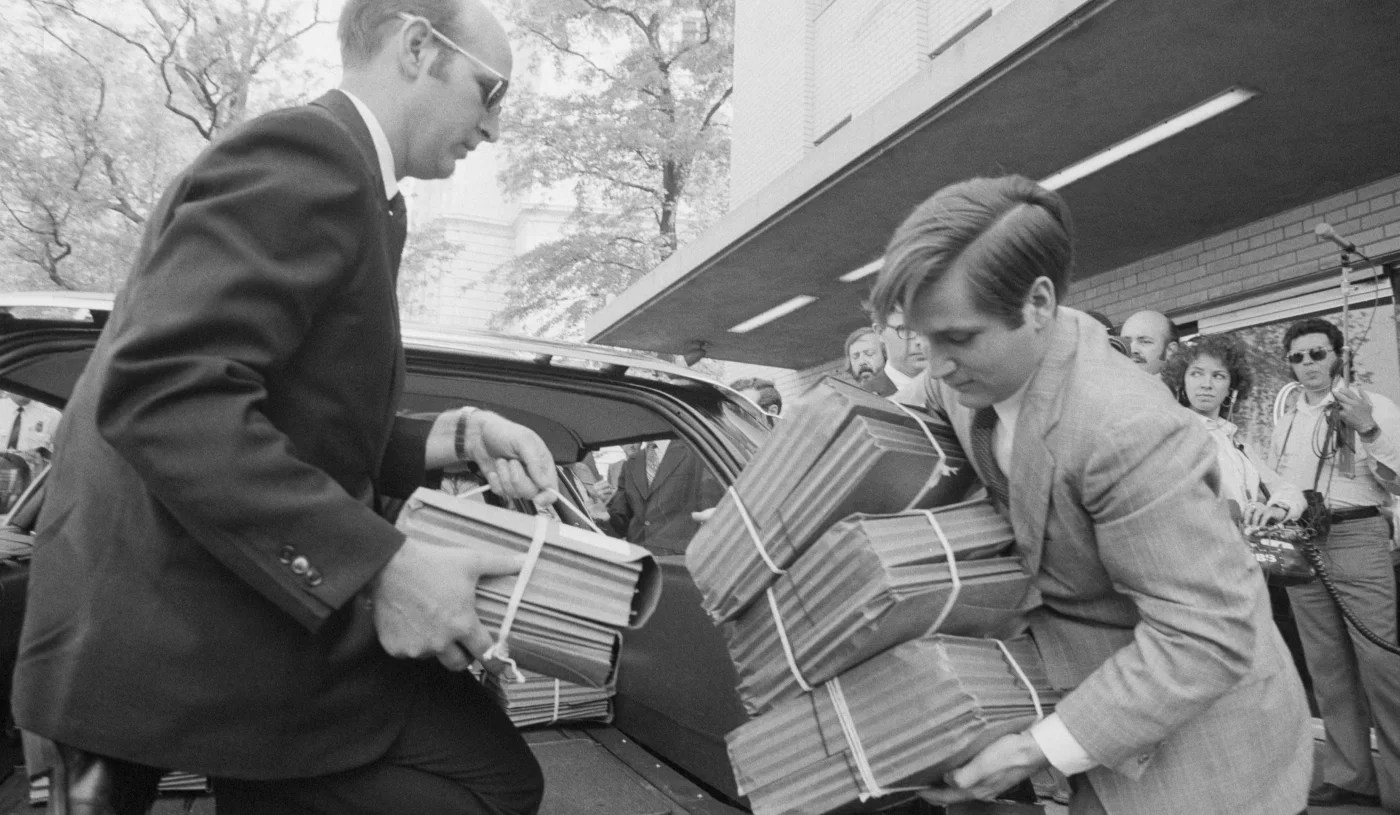
As we study subterfuge, we might recall that it was on this date in 1974 that transcripts of the audiotaped White House conversations between President Richard Nixon and Chief of Staff Bob Haldeman were released to the public. Considered at the time a “smoking gun,” the transcripts confirmed Nixon’s involvement in the Watergate cover-up– and precipitated Nixon’s resignation three days later.
You must be logged in to post a comment.