Posts Tagged ‘songs’
“Life is like a sewer – you get out of it what you put into it”*…

Frances Beckett on the mystery of the great Tom Lehrer: in the 1950s and 60s, his songs stunned and delighted listeners with their irreverence, wit, and nihilism. Then he gave it all up to teach mathematics.
Beckett begins by recounting his own introduction to Lehrer, in 1959, at the “snobbish [British] Jesuit boarding school” to which his parents had sent him…
… Tom Lehrer’s songs burst upon my consciousness like a clown in a cathedral. Days there began with mass, and ended with an uplifting homily in the chapel from an elderly and skeletal priest, generally about death. “Your best friends will desert you leaving you nothing but a winding sheet,” was one of his more cheerful messages. Between the two there was catechism, rugby, occasional bullying and fairly frequent beatings.
But we had the “playroom”, where we could relax and listen to records, and one day an American boy called Ed Monaghan turned up clutching a Lehrer LP. It was a medicinal dose of the irreverence, nihilism and rebellion that I craved. To this day, I am word perfect in many of the songs I first heard then. There was Poisoning Pigeons in the Park, all about the joys of spring, and as darkly funny as its title suggests. There was the American football song Fight Fiercely, Harvard, which seemed to make cruel mock of those cold, dreary afternoons I was forced to spend watching my school play rugby. It was all done with such bouncing musicality that I doubt whether the Jesuits ever realised the subversive nature of what we were listening to.
Lehrer made my life bearable. I have never been able to tell him so, and it might not please him, for he has been quoted as saying: “If, after hearing my songs, just one human being is inspired to say something nasty to a friend, or perhaps to strike a loved one, it will all have been worthwhile.”
I didn’t know then that Lehrer had started out, six years earlier, by paying to have his own record cut because the record companies were shocked by his songs, and selling the LP to fellow students at Harvard. This early samizdat recording was the underground success of the decade with almost no publicity effort from Lehrer – “My songs spread slowly, like herpes, rather than Ebola,” he later recalled.
At that time, Lehrer’s principal accomplishment was that he was a mathematics prodigy who had entered Harvard aged 15, in 1943, taken a first class degree aged 18 and a master’s a year later. Born into a New York Jewish family in 1928, Lehrer had, he has said, every advantage: piano lessons, an expensive school that could get him into Harvard, and “the Broadway of Danny Kaye and Cole Porter.
In the next year or two, Ed Monaghan introduced me to other comedians who were turning the complacent world of American comedy on its head: Mort Sahl, Shelley Berman, Dick Gregory, Lenny Bruce. “What these so-called ‘sickniks’ dispense,” wrote Time magazine in July 1959, “is partly social criticism liberally laced with cyanide, partly a Charles Addams kind of jolly ghoulishness, and partly a personal and highly disturbing hostility toward all the world.”
But in 1960, the year after I discovered him, Lehrer stopped writing and performing, although he briefly re-emerged in 1965 to write new songs for the US version of the satirical British show That Was the Week That Was. The new songs were made into a live LP, and it was even more wonderful than the old one. They included The Vatican Rag – a Catholic hymn set in ragtime: “There the guy who’s got religion’ll / Tell you if your sin’s original.” Although I was by then a confirmed atheist, I probably still thought that making fun of the Catholic church would release a thunderbolt from heaven, and The Vatican Rag cured me.
The album also included three songs condemning nuclear weapons. “There’ll be no more pain and misery / When the world is our rotisserie …” They were so much better than those whiny folk songs of the era, which Lehrer rather despised. “You had to admire these folk singers,” he says on the live LP. “It takes courage to get up in a coffee house or a student auditorium and come out in favour of the things everyone else is against, like peace and justice and brotherhood, and so on.”
In this far more political new record, he satirised the Americans teaming up with West Germany against the USSR (“Once all the Germans were warlike and mean / But that couldn’t happen again / We taught them a lesson in 1918 / And they’ve hardly bothered us since then”), and was horrified that Hitler’s chief rocket scientist was now working for Washington, singing: “‘When the rockets go up who cares where they come down? / That’s not my department,’ says Wernher von Braun.”
And then he gave it up again, and he has spent the rest of his life as an obscure mathematics lecturer. He lives in the house he has occupied for decades, in Cambridge, Massachusetts, and he was 96 last month…
The quest to understand: “‘My songs spread like herpes’: why did satirical genius Tom Lehrer swap worldwide fame for obscurity?” from @francisbeckett in @guardian.
A reminder: in 2020, Lehrer his lyrics, and free streaming and downloadable versions of all of his albums– a satirical gold mine: “Songs and Lyrics by Tom Lehrer.”
* Tom Lehrer
###
As we appreciate art, we might recall that it was on this date in 1972, amid Queen Elizabeth II’s Silver Jubilee celebrations, that the Sex Pistols threw a party aboard a boat called The Queen Elizabeth, inviting friends, journalists, and a film crew to sail along London’s River Thames– a promotion for the band’s new single, “God Save the Queen.” As the sun went down and the boat floated near the Houses of Parliament, the band lit up their amps and performed “Anarchy in the UK,” followed by “God Save the Queen,” “No Feelings,” and “Pretty Vacant.” Upon docking, the band and their fellow partygoers were met by police.
“It’s not those who write the laws that have the greatest impact on society. It’s those who write the songs”*…
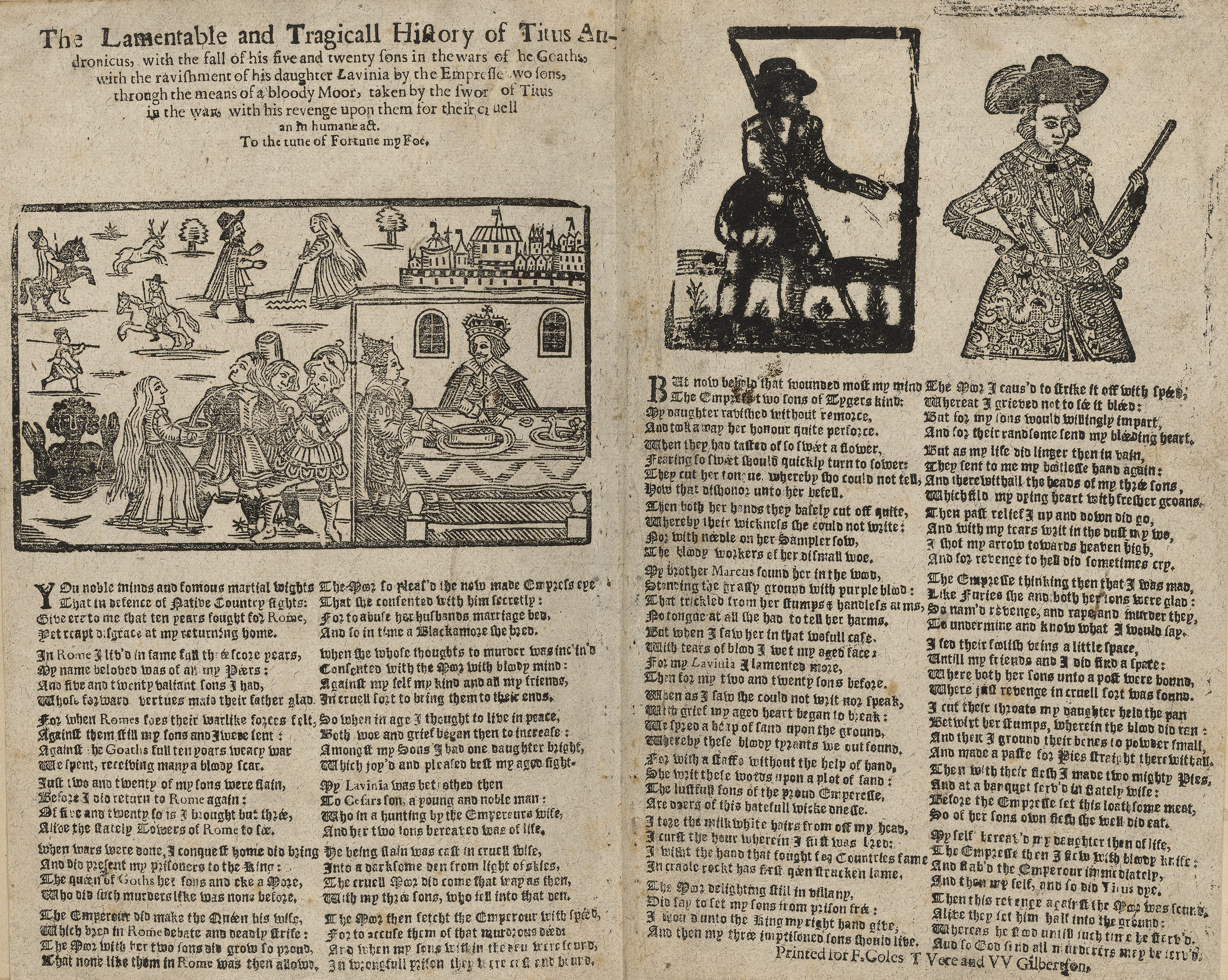
Broadside ballads were single-sheet songs that emerged with the spread of printing and sold for a penny a piece; the most popular of them were the 16th and 17th century equivalent of the Hit Parade. Christopher Marsh and Angela McShane have put together an extraordinary rich collection…
We here identify and present a body of the biggest hits from seventeenth-century England…
This website concentrates on over 100 resoundingly successful examples that you can investigate through recordings, images and a wealth of other materials. Whether you are interested in music, art, love, gender, tragedy, politics, family life, crime, history, humour or death, you will find something to engage you here…
For example, the ballad pictured above:
The Lamentable and Tragicall History of Titus Andronicus seems certain to have been written in c. 1594 as a spin-off from Shakespeare’s play about the fictional general whose final months in late-imperial Rome were even more bloody than the decades of military service that went before. Plays for the stage and songs for the street cross-fertilised throughout the early-modern period, and several of our hit songs reveal the relationship (see, for example, The Lamentation of Master Pages wife and An Excellent Ballad of George Barnwel).
The ballad, like the play, was highly successful. Of the two forms, it was perhaps the ballad that maintained its popularity more consistently after Titus’ first phase of marketability in the Elizabethan and Jacobean periods. There were numerous editions of the ballad in the seventeenth and eighteenth centuries. More occasionally, it was also included in printed song-collections such as Richard Johnson’s Golden garland of princely pleasures (1620).
…
To the tune of ‘Fortune my Foe’ (standard name)
‘Fortune my foe’ was so well known that notation appears in dozens of sources, both printed and manuscript. There are instrumental settings for lute, virginals, cittern and lyra viol, and several of the period’s most celebrated composers – John Dowland and William Byrd, for example – applied their talents to the tune. This was a remarkably solid melody, and renditions are striking in their consistency over time and space…
[Here it here]
99 other Tops of the Pops in the 17th century: “100 Ballads” @100ballads.
* Blaise Pascal
###
As we belt it out, we might recall that on this date in 1994, a different ballad was #1 on the pop charts: Celine Dion singing “The Power of Love”– a cover of its author Jennifer Rush‘s version, which had itself reached the top of the chart nine years earlier.
“I know that there are people who do not love their fellow man, and I hate people like that!”*…
After this post, your correspondent begins his annual Holiday Hiatus, so let me pass along a gift. Regular service will resume on January 2; meantime, thanks to you all for reading– and Happy Holidays!

Ladies and Gentlemen, the remarkable Tom Lehrer…
Between the… Weird Al biopic and and Kelly Bachman and Dylan Adler’s new comedy album, Rape Victims Are Horny Too, parody songsters have rarely been such a central part of the cultural zeitgeist. Yet comedy musicians have been trailblazing for much longer than we may realize, and before the popularity of Weird Al, or even Bo Burnham, Adam Sandler, and Steve Martin, there was Tom Lehrer.
Lehrer is perhaps best known for “The Elements,” an impossibly fast and impossibly tongue-twisty song that consists of all the periodic elements put to the tune of a “Major-General’s Song” from Pirates of Penzance. This is a classic Tom Lehrer song, so classic in fact that Daniel Radcliffe’s rendition of it on The Graham Norton Show helped score him the role of Weird Al, who has noted Lehrer as a major comedic influence. This full circle loop only emphasizes how important Lehrer was and continues to be in the musical comedy scene, and diving into his diverse oeuvre solidifies just how innovative he was…
“Tom Lehrer Deserves Your Attention” (source of the photo above)
And it’s now easier than ever for you to pay him that attention: the remarkable Mr. Lehrer is also remarkably generous. Last month, a new web site appeared, the home page of which explains…
I, Tom Lehrer, and the Tom Lehrer Trust 2007, hereby grant the following permissions:
All copyrights to lyrics or music written or composed by me have been relinquished, and therefore such songs are now in the public domain. All of my songs that have never been copyrighted, having been available for free for so long, are now also in the public domain.
The latter includes all lyrics which I have written to music by others, although the music to such parodies, if copyrighted by their composers, are of course not included without permission of their copyright owners. The translated songs on this website may be found on YouTube in their original languages.
Performing and recording rights to all of my songs are included in this permission. Translation rights are also included….
The site contains all of his lyrics, and free streaming and downloadable versions of all of his albums– a satirical gold mine: “Songs and Lyrics by Tom Lehrer.”
* Tom Lehrer
###
As we soak ourselves in satire, we might recall that it was on this date in 1986 that Fran Oz’s film Little Shop of Horrors premiered. Based on the Off-Broadway musical adaptation of the 1960 original Roger Corman movie, it was a huge success with critics and a modest success with audiences on release, but has since become cult film.
As Oz’s friend and Muppet colleague Jim Henson said, “the lip sync on the plant in that film is just absolutely amazing.”

“Christmas may not bring a single thing; still, it gives me a song to sing”*…

At the same time, as Mahalia Jackson said, “if you want me to sing this Christmas song with feeling and the meaning, you better see if you can locate that check.”
Novelist and publisher Tariq Goddard reviews this year’s crop of seasonal songs, for example…
Kelly Clarkson and I at least meet as equals, neither of us having heard of the other, although 25 million album sales mean more people have heard of her than they have me. Her handle on Christmas is not that much more assured than mine – she knows only what the seasonal songs that use the same formulas as hers tell her, which is of course a game of diminishing returns. There is the odd nod on When Christmas Comes Around to modernity (‘Christmas Isn’t Cancelled (Just You)’), but her trite take on tradition, if heard in a public space while experiencing another of life’s seasonal setbacks, may just bring the number of shopping trips down this Yuletide. Meghan Trainor, A Very Trainor Christmas, is more evidence that reality is multi dimensional, a Christmas euphemism for, ‘Are they all fucking mad or are we?’ Meghan is a hyperbolically successful young American whose version of ‘Rockin’ Around The Christmas Tree’ makes Kim Wilde and Mel Smith’s version sound like Bitches Brew-era Miles Davis — which is unfortunate as her frightened and life-denying version of the track is also by far the best thing on the record.
Billy Idol‘s Happy Holidays was the record I was most looking forward to, and like the later odes of Holderlin, is a lot stranger than you might expect. Idol starts in the only way the voice behind ‘Rebel Yell’ would be expected to, bullishly, going for broke on ‘Frosty The Snowman’ like he wants him to cry more, more, more. Eschewing howling axes for triangles and bells, the song is a Carry On Christmas-style piss take with a wink to music hall, full of fruity nudge nudges and spoken asides, which – unlike the awkward office party singalong it could have been – works because Idol sounds like he is having fun. He is a Bill Sykes that plays to the gallery and not to his demons. Unfortunately by track two he is beginning to grow a little more jaded, as if it is slowly occurring to him that just because we all grow old and still need something to do, that something doesn’t actually need to be this. Still, the realisation that a whole album of this stuff is going to be overkill, does not stop his version of ‘God Rest Ye Merry Gentlemen’ from keeping Richard Harris company in the astral bar that never closes, and ‘Auld Lang Syne’, a risk if ever there was one, is genuinely spooky, more Fagin watching the gallows being built from his cell than a new beginning in January.
So much more at “Jingle Hell: Tariq Goddard Reviews Christmas Music,” from @theQuietus. Via always-illuminating The Browser.
* Charles Dickens
###
As we hum along, we might on the other hand recall that it was on this date in 1955 that Carl Perkins recorded “Blue Suede Shoes,” at Memphis Recording Service (later known, for the record label with which it shared a building, as Sun Studios). Written by Perkins and produced by Sam Phillips, it combined elements of blues, country, and pop music– and is thus considered one of the first rockabilly records.

“Pop music has been exhausted”*…

… and so it becomes the subject of art.
A year ago, local artist Elle Luna challenged artists from around the world with her “100-Day Project,” an idea with a simple premise: do the same thing every day for a hundred days — draw a doodle, write a poem, whatever — and document the results.
San Francisco–based designer Katrina McHugh responded by making infographics based on popular song lyrics that reference the natural world, mirroring the style of vintage encyclopedias she inherited from her grandfather. The project, titled “100 Days of Lyrical Natural Sciences,” is a gorgeous and hilarious exercise in taking metaphor too literally…
Try your hand at identifying the songs in question at “Classic Pop Songs, Reimagined as Infographics.”
* Brian Wilson
###
As we tap our toes, we might spare a thought for Cabell “Cab” Calloway III; he died on this date in 1994. A master of scat singing and led one of the United States’ most popular big bands from the start of the 1930s to the late 1940s, regularly performing at the Cotton Club in Harlem. His band featured performers including trumpeters Dizzy Gillespie and Adolphus “Doc” Cheatham, saxophonists Ben Webster and Leon “Chu” Berry, New Orleans guitar ace Danny Barker, and bassist Milt Hinton. His “Minnie the Moocher” was the first jazz record to sell 1 million copies.
email readers click here for video
You must be logged in to post a comment.