Posts Tagged ‘Library of Congress’
“…When fascism comes to the United States it will be wrapped in the American flag and will claim the name of 100-percent Americanism”*…
Sinclair Lewis sent up a warning flare in 1935. 90 years later, Richard Ovenden (Oxford’s librarian and author of the important– and terrific— Burning the Books: A History of Knowledge Under Attack) smells smoke…
In the space of three short months, the Archivist of the United States, Colleen Shogan, and the Librarian of Congress, Carla Hayden, have both been fired by the Trump administration. Both of these institutions have suffered setbacks before, and have come back stronger. One of the most severe attacks came at the hands of the British. In 1814 a British expeditionary force besieged Washington and set fire to the Capitol building. Officials had already recognised the threat and commandeered every cart they could find to move the National Archives outside the city.
The Capitol building also housed the Library of Congress, and its 3,000 volumes of highly combustible material could not be moved so quickly. The volumes were ignited by British troops. The whole building, and much of the city, was consumed by flames.
News of the destruction of the library reached Thomas Jefferson, whose presidency had ended five years before. In a letter published in a Washington newspaper, he expressed his outrage at the “barbarism” of the British, and offered to make good the losses from his own private library. Congress purchased 7,000 volumes from the former president; with Jefferson’s books, the Library was reborn.
The Library of Congress serves two functions simultaneously. It is both the national library and the library of the legislature. It is as if the British Library was the same organisation as the libraries of the House of Commons and the House of Lords. The irony of course is that unlike its predecessor in 1814, the 119th US Congress has done nothing to protect its own library.
Trump’s press secretary, Karoline Leavitt, stated in a press briefing that Hayden had been dismissed because the Library had been providing “inappropriate books for children”. It was another senior Trump aide, Kellyanne Conway, who in 2017 introduced the world to the notion that there could be “alternative facts”. This reason for firing Hayden — who has, since 2016, greatly strengthened the institution she inherited — is another “alternative fact”.
The Library of Congress is a reference-only research library and has no lending library for children or adults, its collections being built through legal deposit legislation, passed by Congress in 1909 and updated as recently as 2016.
Shogan was dismissed as Archivist of the United States and replaced by Marco Rubio — who clearly has so much free time alongside his dual role as Secretary of State and national security adviser that he can also run the world’s largest National Archives.
One role that archives play is to preserve documents for legal and evidential reasons. After his last presidency, Trump’s illegal removal of classified documents, stored in a guest bathroom at Mar-a-Lago, resulted in their eventual retrieval by the National Archives under the provisions of the Presidential Records Act.
The removal of Hayden and Shogan demonstrates the exercise of arbitrary power, asserting control over knowledge. Both are the first women to lead their respective institutions, and both committed to reaching all parts of the nation they were appointed to serve. If the ideologically motivated censorship of collections and the recent mass deletion of government websites is anything to go by, the Trump administration is intent on removing swaths of knowledge from public circulation.
In a famous letter of 1813, Thomas Jefferson compared the spread of ideas to the way one candle is lit from another: “He who receives an idea from me”, he wrote, “receives instruction without lessening mine; as he who lights his taper at mine, receives light without darkening me”. Instead of Trump lighting the candles of knowledge in the US today, they are being systematically snuffed out…
An institution that survived British torching in 1814 is now facing a new onslaught: “The US Library of Congress is under attack,” from @richove.bsky.social in @financialtimes.com.
For more on why the attack on the LoC (and the Archive): “Trump Is Trying to Take Control of Congress Through Its Library“- “admin is trying to take over the Library of Congress, ‘a major component of the legislative branch” that confidentially advises lawmakers’.”
And related: “Chaos At The Copyright Office: Trump’s Firing Of Register Shira Perlmutter Came After AI Report’s Release, Leaving Industry Wondering What’s Next“- “speculation about the role that a long-awaited report on [on the use of copyrighted materials to train generative AI models] may have played in his action.”
Apposite, Human Smoke by Nicholson Baker: as Hamilton Nolan explains:
… a history of the years leading up to World War 2. The entire book takes the form of short, stylized, factual items of a few paragraphs or less, presented in chronological order, which taken together tell the story of societies sliding—often unwittingly—into very dark places.
While reading the book, I found over and over again that certain entries would vividly remind me of things happening today. The experience was so vivid that I decided to present a few of them to you here—first, Baker’s entry in his book, and then the modern thing that it made me think of. I make no sweeping claims that one thing is just like the other, or that this time is equivalent to that time. I’m only a curious reader, not a professional historian. I make no sweeping claims at all. It’s just interesting. “History doesn’t repeat itself,” Mark Twain said, “but it often rhymes.”…
And per William Faulkner (“”The past is never dead. It’s not even past”)…

* Sinclair Lewis
###
As we listen carfully for echoes, we might celebrate International Museum Day.

“We are not to judge what is possible and what is not, according to what is credible and incredible to our apprehension”*…

Jason Rhode on the signature work of the Renaissance philosopher Michel de Montaigne…
… In 1571, a skeptical nobleman retires to his tower. He dictates 107 short pieces over 20 years. He calls them “essais” (“attempt,” in French). The “Essays” bear titles like “Of Drunkenness.”
They are informal, conversational. Montaigne begins on-topic, but his mind wanders. You’ll be reading an essay about rapid speech, but he’ll veer off to tell us “I am not a very collected and deliberate person” or he’ll hit you with the dankest shit ever about how to consider death.
His learning is so great, his insights so keen, that again and again he shocks us: What if the indigenous people of the Americas are superior to Europeans? What if culture’s relative; are our values real? What if we’re wrong about God? What if learning doesn’t matter that much? And over and over again, What do I know? A twist, then another. This is a mind forever in the process of finding itself…
If he had just been a clever 16th-century chronicler, that would’ve been enough. If he had merely written frankly and fearlessly, that would have been enough. If he had just invented the essay, that would have been enough.
But this book is something more: the “Essays” are the imprinting of a consciousness in a book, as no consciousness has ever been so imprinted. I’ll be plain: this work contains a mortal soul. It forever bears the real essence of its maker—like Sauron’s ring, but for a great and good man…
Eminently worth reading in full (before you turn Essays itself): “Essays, by Michel de Montaigne, (1570-1592)” from @iamthemaster.
* Michel de Montaigne
###
As we essay, we might recall that it was on this date in 1732 that the Library Company of Philadelphia signed a contract with its first librarian. Founded by Benjamin Franklin and friends in November 1731, the library enrolled members for a fee of forty shillings but had to wait for books to arrive from England before beginning full operation.
Many subscription libraries—founded to benefit academies, colleges, and other groups—were established from the late seventeenth through the nineteenth centuries. The Library Company of Philadelphia grew out of the needs of the Leather Apron Club, also known as the “Junto,” of which Franklin was a member. In addition to exchanging business information, these merchants discussed politics and natural philosophy, contributing to their requirements for books to satisfy their widespread interests. Volumes were purchased with the annual contributions of shareholders, building a more comprehensive library than any individual could afford.
Directors of the Library Company made their holdings available to the first Continental Congress when it convened in Philadelphia in September 1774. After independence, the third session of the new Federal Congress convened in Philadelphia in January 1791, and the Library Company directors again tendered use of their facility. In essence, the Library Company served as the de facto Library of Congress until 1800 when the fledgling legislature moved to its permanent Washington, D.C., location and the Library of Congress was founded.
Today, the Library Company of Philadelphia is a research center and museum.

“The blues are the roots and the other musics are the fruits”*…

We recently lost an audio pioneer: Ben Manilla, an award-winning radio and podcast producer, audio entrepreneur, pioneering disc jockey, and broadcast journalism educator, passed away at the end of last month. In his long and storied career, he won awards (the Peabody, Columbia University’s Edward Howard Armstrong Award, RTNDA Edward R. Murrow Award, and the Scripps Howard Award among others) for everything from Philosophy Talk (from Stanford University) to The Loose Leaf Book Company (with Tom Bodett).
But Ben had a long suit in programming about the Blues. His work with Martin Scorcese and the Experience Music Project helped lead the year-long, nation-wide multimedia event, “The Blues.” It included Ben’s thirteen-hour radio documentary, The Blues with Keb’ Mo’, the most widely distributed special in the history of Public Radio International (PRI). His long running Elwood’s BluesMobile with Dan Aykroyd (nee, House of Blues) was recently inducted into the Library of Congress.

Here in tribute both to Ben and to the Blues, the series’ induction ceremony at the Library of Congress:
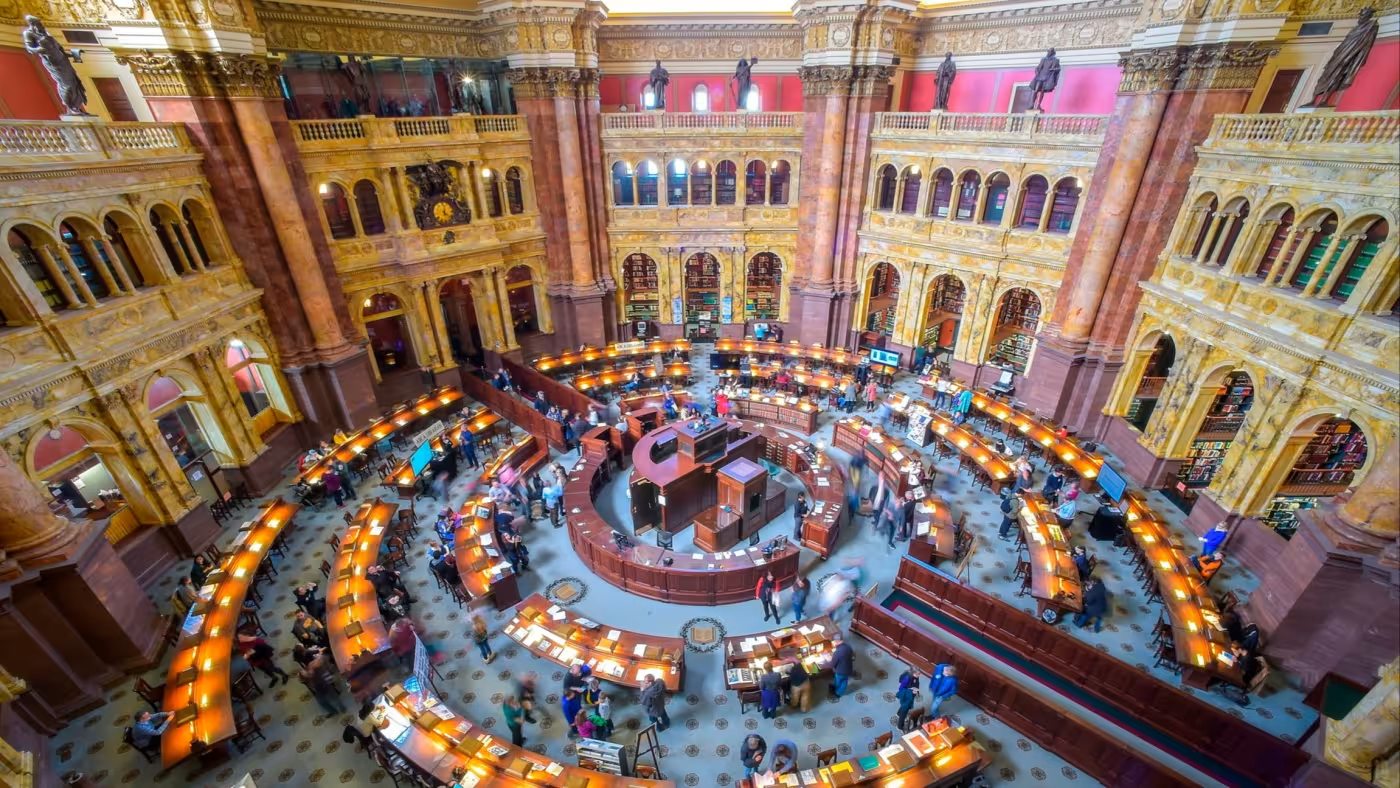
(Image at the top: source)
* “The blues are the roots and the other musics are the fruits. It’s better keeping the roots alive, because it means better fruits from now on. The blues are the roots of all American music. As long as American music survives, so will the blues.” – Willie Dixon
###
As we feel it, we might recall that it was on this date in 1997 that Bo Diddley, Keb’ Mo’, Buddy Guy, and a host of others performed at a tribute at the Kennedy Center to the “father of Chicago Blues,” Muddy Waters.
“Google will bring you back 100,000 answers. A librarian will bring you back the right one.”*…

Stephen Akey remembers the time before online search…
How do you find the life expectancy of a California condor? Google it. Or the gross national product of Morocco? Google it. Or the final resting place of Tom Paine? Google it. There was a time, however—not all that long ago—when you couldn’t Google it or ask Siri or whatever cyber equivalent comes next. You had to do it the hard way—by consulting reference books, indexes, catalogs, almanacs, statistical abstracts, and myriad other printed sources. Or you could save yourself all that time and trouble by taking the easiest available shortcut: You could call me.
From 1984 to 1988, I worked in the Telephone Reference Division of the Brooklyn Public Library. My seven or eight colleagues and I spent the days (and nights) answering exactly such questions. Our callers were as various as New York City itself: copyeditors, fact checkers, game show aspirants, journalists, bill collectors, bet settlers, police detectives, students and teachers, the idly curious, the lonely and loquacious, the park bench crazies, the nervously apprehensive. (This last category comprised many anxious patients about to undergo surgery who called us for background checks on their doctors.) There were telephone reference divisions in libraries all over the country, but this being New York City, we were an unusually large one with an unusually heavy volume of calls. And if I may say so, we were one of the best. More than one caller told me that we were a legend in the world of New York magazine publishing.
“How do you people know all this stuff?” a caller once asked me. “What are you, some kind of scholars or wordsmiths or something?”
“No,” I replied. “Just us libarians.”
Actually, we didn’t know all that stuff; we just knew how to find it. I myself rarely remembered any of the facts I divulged to our callers, but I remembered the reference sources where I found the facts. Personal knowledge was inadmissible. I could reel off by heart the names of the four Dead Boys (Cheetah Chrome, Stiv Bators, Jimmy Zero, and Johnny Blitz—but didn’t everyone know that?), but unless I could track them down and—rule number one—cite the source (in this case, probably the Rolling Stone Encyclopedia of Rock and Roll), I had no information to impart and no answer to give to anyone who might need that information for whatever reason. But we almost always found the right source.
The progenitor and enforcer of rule number one was our department head, whose managerial style recalled that of Vince Lombardi, if Vince Lombardi had had no interest in football. I do wish Milo had been a tad less heavy-handed; he tended to reduce unsatisfactory initiates to tears before driving them from the department for keeps. Nevertheless, his grinding relentlessness, which often entailed instructions barked into one ear while one’s other ear might be dealing with a difficult and demanding caller, was in the service of professionalism and competence—necessary qualities in a small, claustrophobic office where the pressure from our backlog of callers never let up.
“Are you that nice young man who always goes out of his way to find me exactly the answers I need to the questions I ask?” a caller once asked me as a prelude to her inquiry.
“Doesn’t sound like me,” I said.
There was always psychology involved. In this case, the caller thought that by flattering me she might induce me to break or bend our rule of five minutes or three questions max, which we routinely disregarded anyway. The opposite psychological ploys—bullying, intimidating, insulting, threatening—were far more common. Contrary to the popular perception of librarianship as a serene, leisurely vocation for the bookishly inclined, the Telephone Reference Division was a high-stress environment, and most staffers, myself included, burned out within a few years. Now that reference librarianship is a shadow of its former self, psychological gamesmanship rarely takes place. You look up your information in a bland, seemingly (seemingly) trustworthy source like Wikipedia, and that’s that. Librarians have other things to do, principally programming a never-ending stream of ostentatiously unlibrary-like events, but none will ever be so interesting or so much fun as the kind of thing we did in Telephone Reference before the Internet swept it all away.
Did Charon row or pole the souls of the dead across the River Styx? Can you give me the names and addresses of manufacturers of prosthetic devices in Massachusetts? Where are the manuscripts of the composer Marc Blitzstein to be found? (The person asking that question, much to the excitement of my balletomane boss Milo, identified herself as a certain Agnes de Mille.) What was the first language ever spoken? (“Anywhere? At any time?” I asked the caller. “Yes,” she replied, before I suggested that we might try to reformulate the question.) On and on it went. Of course, what we were doing, millions of others were doing on their own without the intercession of any librarian. All of us were negotiating an informational world without algorithmic search engines. Although I hang on to some battered dictionaries and reference books, I resort to Google as readily as anyone else. Undoubtedly, much more has been gained than lost in the transformation of laborious research into something immediate, accessible, and available to everyone. Still, a world that has tossed out the scholarly, comprehensive, and authoritative print edition of the Encyclopaedia Britannica in favor of the colorless, death-by-a-thousand-edits mediocrity of Wikipedia is not necessarily a richer one.
Even without my nostalgia for certain antiquated and specialized reference books (Kane’s Famous First Facts, the Encyclopedia of Associations, Brewer’s Dictionary of Phrase and Fable), I do think certain advantages accrued to analog ways of gathering information. The many hundreds of reference sources that we were trained to use in Telephone Reference had their biases, their blind spots, their inaccuracies. In the apprenticeship each of us endured under Milo’s exhausting tutelage before getting anywhere near a telephone, we learned not merely how to find information but how to think about finding information. Don’t take anything for granted; don’t trust your memory; look for the context; put two and three and four sources together, if necessary. Sometimes it was difficult to communicate such variables to our callers, who just wanted a quick answer rather than a disquisition on the mistaken assumption that the transmission of information was a straightforward matter. How many laundromats were owned and operated by women in California and Oregon in the 1930s? To answer that question, someone would have had to gather and compile that information at the time, and there was no reason to believe that anyone would have thought to do so. Maybe some obscure state agency did tabulate all those female laundromat owners and I simply fumbled an answerable inquiry, but if so, that agency would have been thinking like a gender-conscious individual from the 1980s rather than a government bureaucracy from the 1930s.
“Think like a librarian,” Milo used to urge us, which might sound less impressive than “Think like a philosopher,” “Think like a psychologist,” or even “Think like a lawyer,” but it did make the point that information wasn’t given, that it had to be actively sought…
…
… A certain esprit de corps facilitated the work and even diffused tensions in that pressure cooker of an office. I knew a lot about rock-and-roll and spoke Spanish. Aaron had a law degree and took all the questions about legal research that stumped us. (He also dispensed free legal advice on occasion, until Milo put a stop to it.) Milo knew theater; Paul was francophone; Kathleen knew movies and pop culture. (Our preferences skewed arty left-of-center, which was inevitable in our milieu.) Sometimes we worked backward, pooling what we already knew to find the reference sources that would confirm (and occasionally contradict) the foregone conclusion. Another rule: Don’t hide your ignorance. There was no Google to cover up the gaps in our knowledge. Sally Jessy Raphael might have been the prime minister of New Zealand or she might have been an exceedingly unctuous talk show host. Unless I asked who she was (the latter, not the former), I wouldn’t know the best sources to check to find her place of birth. As expected, the caller who asked about Ms. Raphael spent a certain amount of time insulting me for my ignorance, but she got her answer.
Many of our callers were historical novelists. Some of them identified themselves as such, but it was usually obvious even when they didn’t. They tended to ask questions like “What time was low tide in Boston Harbor on May 14, 1932?”
If today I were writing a historical novel set in the 1980s, I might ask, “How did people find information in those days?” There would no longer be any telephone reference librarians to help me, so I’d have to trust to luck—and a search engine—and answer that question myself: They used logic, inference, imagination, and a tall pile of reference books…
Dispatches from the telephone reference desk: “The Department of Everything,” in @hedgehogreview.
* Neil Gaiman
###
As we stroll down memory lane, we might send thoughtfully-retrieved birthday greetings to we might send learned birthday greetings to Daniel Boorstin; he was born on this date in 1914. As a Rhodes Scholar, Boorstin took first-class honors in jurisprudence at Oxford and was admitted as a barrister to the Inner Temple in 1937. Two years later, he returned to the US to teach history, first at Harvard, then at the University of Chicago. He left Chicago in 1969 to become the director of the National Museum of American History at the Smithsonian Institution. He’s probably best-known for his three-volume history, The Americans, the third volume of which, The Americans: The Democratic Experience, won the Pulitzer Prize in 1974.
In 1975 Boorstin became the Librarian of Congress, a post he held until 1987. The de facto national library of the United States, the LoC is the oldest federal cultural institution in the U.S. It executes its primary mission of informing legislation through researching inquiries made by members of Congress via its version of (an enhanced) reference desk, the Congressional Research Service. (The library is open to the public for research, although only members of Congress, Congressional staff, and library employees may borrow books and materials for use outside of the library.)

“A map does not just chart, it unlocks and formulates meaning; it forms bridges between here and there, between disparate ideas that we did not know were previously connected”*…

Readers may recall an earlier post on John B. Sparks’ Histomap, a well-known 1931 attempt to visualize the 4,000 year history of global power. Public Domain Review takes a look at Histomap‘s ancestor/inspiration, Friedrich Strass’ Der Strom der Zeiten (published in 1803), and its influence…
In his foundational textbook Elements, the Alexandrian mathematician Euclid defined a line as “breadthless length” — a thing with only one dimension. That’s what lines can do to history when used to plot events: they condense its breadth into pure motion, featuring only those people and places that serve as forces thrusting it forwards along an infinite axis. Early in the nineteenth century, Friedrich Strass proposed a different way to visualize time’s flow. A Prussian historian and schoolteacher, he published his chronological chart in 1803, a massive diagram titled Der Strom der Zeiten oder bildliche Darstellung der Weltgeschichte von den altesten Zeiten bis zum Ende des achtzehnden Jahrhunderts (The stream of the times or an illustrated presentation of world history from the most ancient times until the eighteenth century). The linear timelines that Strass resisted, like those inspired by Joseph Priestley, “implied a uniformity in the processes of history that was simply misleading”, write Anthony Grafton and Daniel Rosenberg. Strass’ stream, by contrast, allowed historical events to “ebb and flow, fork and twist, run and roll and thunder.” It would spawn several imitations as the century drew on…
Capturing history in its organic unfolding: “The Stream of Time,” from @PublicDomainRev. See the original at the David Rumsey Map Collection.
* Reif Larsen
###
As we contemplate chronology, we might recall that it was on this date in 1800 that the Library of Congress was established. James Madison has first proposed a national library in 1783. But it wasn’t until 1800, when (on this date) President John Adams signed signed an act of Congress providing for the transfer of the seat of government from Philadelphia to the new capital city of Washington, that the deed was done. The Act appropriated $5,000 “for the purchase of such books as may be necessary for the use of Congress … and for fitting up a suitable apartment for containing them.” Books were ordered from London, creating a collection consisting of 740 books and three maps, which were housed in the new United States Capitol.
But in 1814, during the War of 1812, British forces burned the Capitol Building, and with it, the the collection (by then, around 3,000 volumes). The Library as we know it was created from those ashes. Thomas Jefferson offered to sell his personal library– 6,487 books– as a replacement, Congress accepted, and the Library of Congress grew from there.

You must be logged in to post a comment.