Posts Tagged ‘language’
“This place is weird as f*ck”*…

In an excerpt from his book, The F-Word, Lexicographer Jesse Sheidlower on the f-bomb, its origins and development, and its illimitable uses…
In all of English there are few words rich enough in their history and variety of use to warrant a dedicated dictionary that runs to hundreds of pages and multiple editions. That fuck is at the same time one of the most notorious, popular, and emotive words in the language makes it all the more fascinating…
… How has this word, which has been around for many hundreds of years, maintained both its intense interest and its uncommon power?
There is no simple answer to this question; too many factors come into play. Sex is certainly one factor. The vast majority of uses of fuck in modern English are nonsexual, but it has retained its sexual meanings and connotations across many centuries, and sex is something that’s always hovering around our consciousness. The word has amassed a great many other uses, though, and so the reasons for its singular force and appeal are likewise diverse and complex.
Fuck has an enormous range of uses across many parts of speech, as this dictionary details: sexual and nonsexual, positive and negative, literal and figurative, funny and violent. For any situation, there’s probably some sense, some expression or catchphrase, some proverb, some intonation that can be brought to the table.
And it just feels good to say. It feels good in the mouth, giving shape to catharsis; it can also feel good in the brain, satisfying a strong emotional need or a desire for personal expression. It can help us bond with peers, gain or direct attention, persuade listeners, and establish or test intimacy.
Psycholinguistic research shows that using certain kinds of swear words can even improve the body’s physical strength and resistance to pain. (But the more you swear in daily life, the smaller the analgesic effect.)
Words such as fuck are often criticized for being “bad,” or we are told that we should avoid them. But what is appropriate depends on context—and sometimes we want to be inappropriate. This word is an important part of our culture, our vocabulary, and our heritage, and that is always something worth knowing more about…
[Sheidlower explores its etymology (where it’s from), its cultural history (especially its taboo status), and its current status…]
… In its recent reports, older people are more likely to rate the F-word as a strong swear, while middle-aged people consider it moderate, and young people see it as becoming more acceptable in public use. Equivalent research in New Zealand shows “significant declines in unacceptability of fuck– words” even from 2018 to 2022.
While a few publications still refuse to print fuck regardless of the circumstances, most have no such qualms. The more literary magazines have printed the word for some time, and by the early 2000s even Newsweek and Time had started to do so; the publication of the Starr Report in the New York Times, and a notable comment from Vice President Dick Cheney in the Washington Post, has meant that even the proper papers consider fuck fit to print.
Even commercial television, though still subject to Federal Communications Commission (FCC) regulations, is becoming more open in its use…
Eminently worth reading in full: “A Brief History of the Most Famous Swear Word in the World,” from @jessesheidlower in @lithub.
Vaguely related (but interesting in any case): “Ouch! Study investigates pain vocalizations and interjections across 131 languages.”
* Margaret Atwood
###
As we ponder profanity, we might spare a thought for Albert Francis Blakeslee; he died on this date in 1954. A botanist, he is best remembered for his discovery (while still a graduate student) that Mucors (bread molds), thought at the time to be homothallic (that’s to say, had a single “mating type” that replicated asexually) actually had two mating types and reproduced sexually. His findings revolutionized the understanding of the sexual reproduction of the lower plants. In fact, his discovery was so influential that the fungi Phycomyces blakesleeanus and Blakeslea trispora were named after him.

“A different language is a different vision of life”*…

Damián Blasi delves into historic and current efforts to catalog the planet’s 7,000-plus languages…
As a scientist who has researched language diversity for a decade and a half, I recently joined a team to work on a task that even some linguists think is “ultimately unobtainable”: helping catalog and count the world’s complex and ever-changing languages. I am part of an international team of experts assembled by UNESCO to create a World Atlas of Languages. This catalog will hopefully generate updated estimates of the number of active languages and information on how these languages are being used.
Typically, when I present research, one of my gimmicks is to begin with a rough estimate of the number of natural languages in use today: between 7,000 and 8,000. My point is to communicate that there are many languages and, therefore, an incredible diversity of ways humans think, reason, and feel. But pinpointing a more precise number opens the door to all sorts of problems.
For example, the Central African Republic hosts about 70 languages. The speakers of many of these languages live deep within roadless rainforests in villages that are very difficult for government representatives and other researchers to access. It’s hard to fathom how resource-intensive it would be to form an accurate linguistic picture of this country alone.
Of course, our project is far from the first to attempt to categorize and quantify languages. Many groups and individuals have done this in the past and continue to do so.
My task set me on a path to understanding the history and craft of counting languages. While I expected to read a dull sequence of estimates, I instead found a riveting tale involving Christian missionaries, post-war idealists, a colonialist opium agent, and more. I also gained even more appreciation for the potentially impossible task of counting languages…
A fascinating read: “Tackling the Impossibility—and Necessity—of Counting the World’s Languages,” from @blasi_lang and @WennerGrenOrg.
Apposite: “Disappearing languages“
* Federico Fellini
###
As we total up tongues, we might spare a thought for Søren Kierkegaard; he died on this date in 1855. a Danish theologian, philosopher, poet, social critic, and religious author widely considered to be the first Christian existentialist philosopher, he wrote critical texts on organized religion, Christianity, morality, ethics, psychology, and the philosophy of religion, all displaying a fondness for metaphor, irony, and parables. Among his major works: Either/Or, Fear and Trembling, and The Sickness unto Death. It may come as no surprise that he was a major influence on Dostoevsky.
Kierkegaard wrote in Danish and the reception of his work was initially limited to Scandinavia, but by the turn of the 20th century his writings were translated into French, German, and other major European languages. By the mid-20th century, his thought exerted a substantial influence on philosophy, theology, and Western culture in general.

“I want to make a long journey”*…
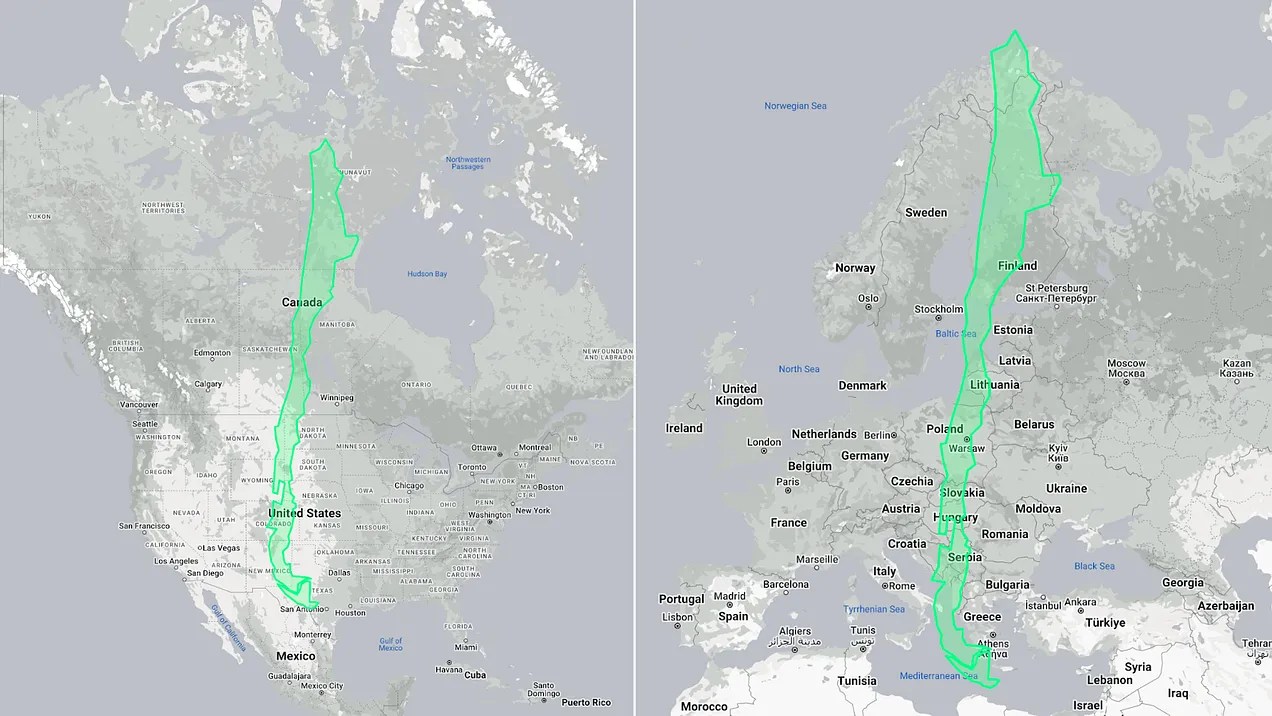
Thomas Pueyo on how geography shaped the longest (and proportionately thinnest) country in the world…
Chile is as long as the [vertical dimensions of]US and Canada combined.
Chile is as long as all of Europe!Chile is so long, it’s curved.

How long is it?
Why not longer?
Why is no other country as thin?
How does that make Chileans incomprehensible?
These questions (and more) answered: “Why Is Chile So Long?” from @tomaspueyo
* (Chilean poet) Pablo Neruda
###
As we stretch, we might recall that it was on this date in 1730 that the Valparaíso earthquake occurred. (As Pueyo explains, Chile’s unique geography and geology have frequently seismic implications.)
The quake had an estimated magnitude of 9.1–9.3 and triggered a major tsunami with an estimated magnitude of Mt 8.75, that inundated the lower parts of Valparaíso and caused severe damage from La Serena to Chillan; the tsunami affected more than 620 mi of Chile’s coastline.
While damage was widespread, only a few deaths were recorded due to the earthquake, reportedly because a strong foreshock had prompted people to leave their homes. Similarly, the subsequent tsunami: inhabitants ran to higher ground after seeing the water recede, so that only a few were killed.

“Like everything metaphysical, the harmony between thought and reality is to be found in the grammar of the language”*…

Hunter Dukes in Public Domain Review, on how scholars and pedagogues in the U.S. began to illustrate the principles of grammar, more specifically, how they began to diagram sentences…
“Once you really know how to diagram a sentence, really know it, you know practically all you have to know about English grammar”, Gertrude Stein once claimed. “I really do not know that anything has ever been more exciting than diagramming sentences. . . I like the feeling the everlasting feeling of sentences as they diagram themselves.” While one student’s lexical excitement is surely another’s slow death by gerund, Stein cuts to the heart of the grammatical pull. Is grammar prescriptive and conventional, something one learns to impose on language through trial and error? Or do sentences, in a sense, diagram themselves, revealing an innate logic and latent structure in language and the mind? More than a century before Noam Chomsky popularized the idea of a universal grammar, linguists in the United States began diagramming sentences in an attempt to visualize the complex structure — of seemingly divine origins — at their mother tongue’s core.
The history of diagramming sentences in the United States begins with James Brown’s American Grammar (1831). “Language is an emanation from God”, he writes. “As a gift, it claims our servitude; as a science, it demands our highest attention.” Accordingly, the student of grammar can lift himself up (educationally, devotionally) by knuckling down. “The mind becomes a passenger; the body his chariot; ideas his baggage; the earth his inn; hope his food; and another world his destination.” It was in American Grammar that Brown debuted construing as a method for parsing sentences using a system of square and round brackets to isolate major and minor sections. Major sections are “mechanically independent”; minor sections are “mechanically dependent”. Brown called this form of analysis close reading, but construing was only one half of the system. “As construing is a critical examination of the constructive relation between the sections of a sentence, so scanning is a critical investigation of the constructive relation between the words of a section.” Scanning involves ranking minor sections in ascending numerical order based on their relational distance from the major section. Playing a kind of grammarian god, Brown uses John 1 to demonstrate how his system can cleave sentential flesh. (In the beginning) [was the word] (and the word was) (with God) (and the word was God)…

Dukes goes on to trace, with wonderful examples, those who followed Brown into the syntactical thicket; for example…


More mesmerizing examples at “American Grammar: Diagraming Sentences in the 19th Century,” from @hunterdukes in @PublicDomainRev, with links to the original texts at the invaluable Internet Archive (@internetarchive).
* Ludwig Wittgenstein
###
As we parse, we might spare a thought for a man whose sentences were eminently diagrammable, Kenneth Grahame; he died on this date in 1932. A career officer at the Bank of England–he retired as its Secretary– he is better remembered as the author of tales he created to delight his son Alastair, The Wind in the Willows and The Reluctant Dragon (both of which were made into films by Disney: The Adventures of Ichabod and Mr. Toad and The Reluctant Dragon).

“X marks the spot”*…

A reprise (because it’s just so much fun): the challenge facing pre-20th century alphabet book authors…
In 1895, the physicist Wilhelm Röntgen discovered X-rays, a groundbreaking moment in medical history which would lead to myriad improvements to people’s health. Perhaps one overlooked benefit though was in relation to mental health, specifically of those tasked with making alphabet books. How did they represent the letter X before X-rays? Xylophones, which have also been a popular choice through the twentieth century to today, are mysteriously absent in older works. Perhaps explained by the fact that, although around for millennia, the instrument didn’t gain popularity in the West (with the name of “xylophone”) until the early twentieth century. So to what solutions did our industrious publishers turn?
As we see… in addition to drawing on names — be it historical figures, plants, or animals, all mostly of a Greek bent (X being there much more common) — there’s also some more inventive approaches. And some wonderfully lazy ones too…

Many more amusing examples: “X is for...” from @PublicDomainRev.
###
As we wrestle with representation, we might spare a thought for Thomas Young; he died on this date 1829. A polmath described as “the last man who knew everything,” he made notable contributions to the fields of vision, light, solid mechanics, energy, physiology, musical harmony, and Egyptology. His work influenced that of William Herschel, Hermann von Helmholtz, James Clerk Maxwell, and Albert Einstein. Young is credited with establishing Christiaan Huygens’ wave theory of light (in contrast to the corpuscular theory of Isaac Newton).
Further, Young was an astute student of languages. He noticed eerie similarities between Indic and European languages. He went further, analyzing 400 languages spread across continents and millennia and proved that the overlap between some of them was too extensive to be an accident. A single coincidence meant nothing, but each additional one increased the chance of an underlying connection. In 1813, Young declared that all those languages belong to one family. He named it “Indo-European.”
And Young was instrumental in the deciphering of Egyptian hieroglyphs, specifically the Rosetta Stone.

You must be logged in to post a comment.