Posts Tagged ‘X’
“X marks the spot”*…

A reprise (because it’s just so much fun): the challenge facing pre-20th century alphabet book authors…
In 1895, the physicist Wilhelm Röntgen discovered X-rays, a groundbreaking moment in medical history which would lead to myriad improvements to people’s health. Perhaps one overlooked benefit though was in relation to mental health, specifically of those tasked with making alphabet books. How did they represent the letter X before X-rays? Xylophones, which have also been a popular choice through the twentieth century to today, are mysteriously absent in older works. Perhaps explained by the fact that, although around for millennia, the instrument didn’t gain popularity in the West (with the name of “xylophone”) until the early twentieth century. So to what solutions did our industrious publishers turn?
As we see… in addition to drawing on names — be it historical figures, plants, or animals, all mostly of a Greek bent (X being there much more common) — there’s also some more inventive approaches. And some wonderfully lazy ones too…

Many more amusing examples: “X is for...” from @PublicDomainRev.
###
As we wrestle with representation, we might spare a thought for Thomas Young; he died on this date 1829. A polmath described as “the last man who knew everything,” he made notable contributions to the fields of vision, light, solid mechanics, energy, physiology, musical harmony, and Egyptology. His work influenced that of William Herschel, Hermann von Helmholtz, James Clerk Maxwell, and Albert Einstein. Young is credited with establishing Christiaan Huygens’ wave theory of light (in contrast to the corpuscular theory of Isaac Newton).
Further, Young was an astute student of languages. He noticed eerie similarities between Indic and European languages. He went further, analyzing 400 languages spread across continents and millennia and proved that the overlap between some of them was too extensive to be an accident. A single coincidence meant nothing, but each additional one increased the chance of an underlying connection. In 1813, Young declared that all those languages belong to one family. He named it “Indo-European.”
And Young was instrumental in the deciphering of Egyptian hieroglyphs, specifically the Rosetta Stone.

“I got stood up by the letter Y, he was hanging around with his X”*…

It’s perhaps not pornography’s fault that it’s cashing in on a global crisis. As, around the world, whole societies confine themselves to their quarters, traffic to major porn sites has been spiking everywhere, telling us all we need to know about how humans with a broadband connection tend to deal with exceptional levels of boredom and anxiety. From the point-of-view of page views, the season of self-isolation might well be the porn industry’s historical high point — but in terms of reputational damage, it also marks a new low for one of Western culture’s most enigmatic figures.
Once, the letter X was the holiest of all alphabetic symbols, standing for nothing less than the triumph of Christendom itself. The Roman emperor Constantine I imposed his adopted religion on Europe and the Middle East, with armies marching under the banner of an “X,” and for centuries, Latin scribes used it as shorthand for “Christ.”
But at the present moment… the 24th letter of the English alphabet is synonymous not even with professionally lit kissy porn, but rather the explicitier, extremier world of hardcore sharing platforms.
It’s a remarkably stratospheric fall from grace, especially for such a shy and retiring character — X is the second-least-common letter in written English (after Z), and the one that begins by far the fewest number of words. Oh X, what happened to you? Where did it all go so badly wrong that you’re hanging out in NSFW corners of the internet…?
From holiest hallmark to horniest sex symbol — the X-treme, X-haustive story of how the wild child of the alphabet lost its way: “How Did X Become the Edgiest Letter?”
See also: “What’s So Fascinating About the Letter X?” and “Before X Was X: The Dark Horse Story Of The 24th Letter.”
* Norah Jones
###
As we mark the spot, we might recall that it was on this date 1397 that Geoffrey Chaucer “told” (read aloud his ribald, if not X-rated) The Canterbury Tales for the first time at the court of Richard II.
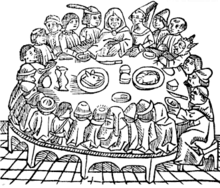
A woodcut from William Caxton‘s second edition of The Canterbury Tales, printed in 1483
“X marks the spot”*…

The Lu Lu Alphabet (1867) by Pamela Atkins Colman [source]
In 1895, the physicist Wilhelm Röntgen discovered x-rays, a groundbreaking moment in medical history that would lead to myriad improvements to people’s health. Perhaps one overlooked benefit though was in relation to mental health, specifically of those tasked with making alphabet books. What did they do before X-rays? Xylophones, which have also been a popular choice through the twentieth century to today, are mysteriously absent in older works. Perhaps explained by the fact that, although around for millennia, the instrument didn’t gain popularity in the West (with the name of “xylophone”) until the early twentieth century. So to what solutions did our industrious publishers turn?…
A collection of historical figures, plants, animals, and more: “X is for…”
* an old saying of manifold derivation. One origin story references pirate maps, where “x” marked the location of buried treasure (and of other maps, where “x” marked less dramatic locations); another cites the British army practice of marking a piece of paper with a black “x” and pinning it on the heart of someone sentenced to death-by-firing-squad. The presiding officer would say “X marks the spot” and the firing squad would aim for the “x.”
###
As we examine exemplary examples, we might send thoughtful birthday greetings to Giambattista Vico; he was born on this date in 1668. A political philosopher, rhetorician, historian, and jurist, Vico was one of the greatest Enlightenment thinkers. Best known for the Scienza Nuova (1725, often published in English as New Science), he famously criticized the expansion and development of modern rationalism and was an apologist for classical antiquity.
He was an important precursor of systemic and complexity thinking (as opposed to Cartesian analysis and other kinds of reductionism); and he can be credited with the first exposition of the fundamental aspects of social science, though his views did not necessarily influence the first social scientists. Vico is often claimed to have fathered modern philosophy of history (although the term is not found in his text; Vico speaks of a “history of philosophy narrated philosophically”). While he was not strictly speaking a historicist, interest in him has been driven by historicists (like Isaiah Berlin).

Good evening, ladies and gentlemen; this is your Captain screaming…

Bruce Dickinson is known for belting out “Bring Your Daughter to the Slaughter,” “Die With Your Boots On,” and “Holy Smoke.” So who better to become head of marketing at an airline business than the Iron Maiden frontman known as The Air-Raid Siren?
Mr Dickinson, 51, has landed the job at the Gatwick-based Astraeus Airlines, which leases planes and crews to carriers including British Airways, BMI and easyJet… He is already well known to Astraeus. Between gigs, Mr Dickinson flies its aircraft – running up 7,000 hours on Boeing 737 and 757 jets.
Read the full story in The Telegraph (and learn of Dickinson’s humanitarian relief flights here).
Dickinson and Iron Maiden, “Tailgunner”
As we buckle our seat belts, we might recall that it was on this date in 1990 that the Motion Picture Association of America replaced it’s “X” rating with “NC-17.” The MPAA’s (self-regulated) film rating system was created in 1968 to replace the Hays Code, which had been in force since the 30’s; the original version of the ratings assigned an “X” to films with content deemed to strong for non-adult audiences– e.g., Midnight Cowboy, Last Tango in Paris. But with the rise of the pornography industry, which often released its films with “X” (or “XXX”) badges, the “X” became synonymous with smut. When newspapers began to refuse to carry ads for any film with an “X” rating, films like The Cook, the Thief, His Wife & Her Lover and Henry: Portrait of a Serial Killer found it very hard, their positive reviews notwithstanding, to get release. And so, the MPAA jettisoned the “X.” Henry and June was the first film to be released with an NC-17 rating.


You must be logged in to post a comment.