Posts Tagged ‘language’
“‘When I use a word,’ Humpty Dumpty said in rather a scornful tone, ‘it means just what I choose it to mean — neither more nor less.'”*…
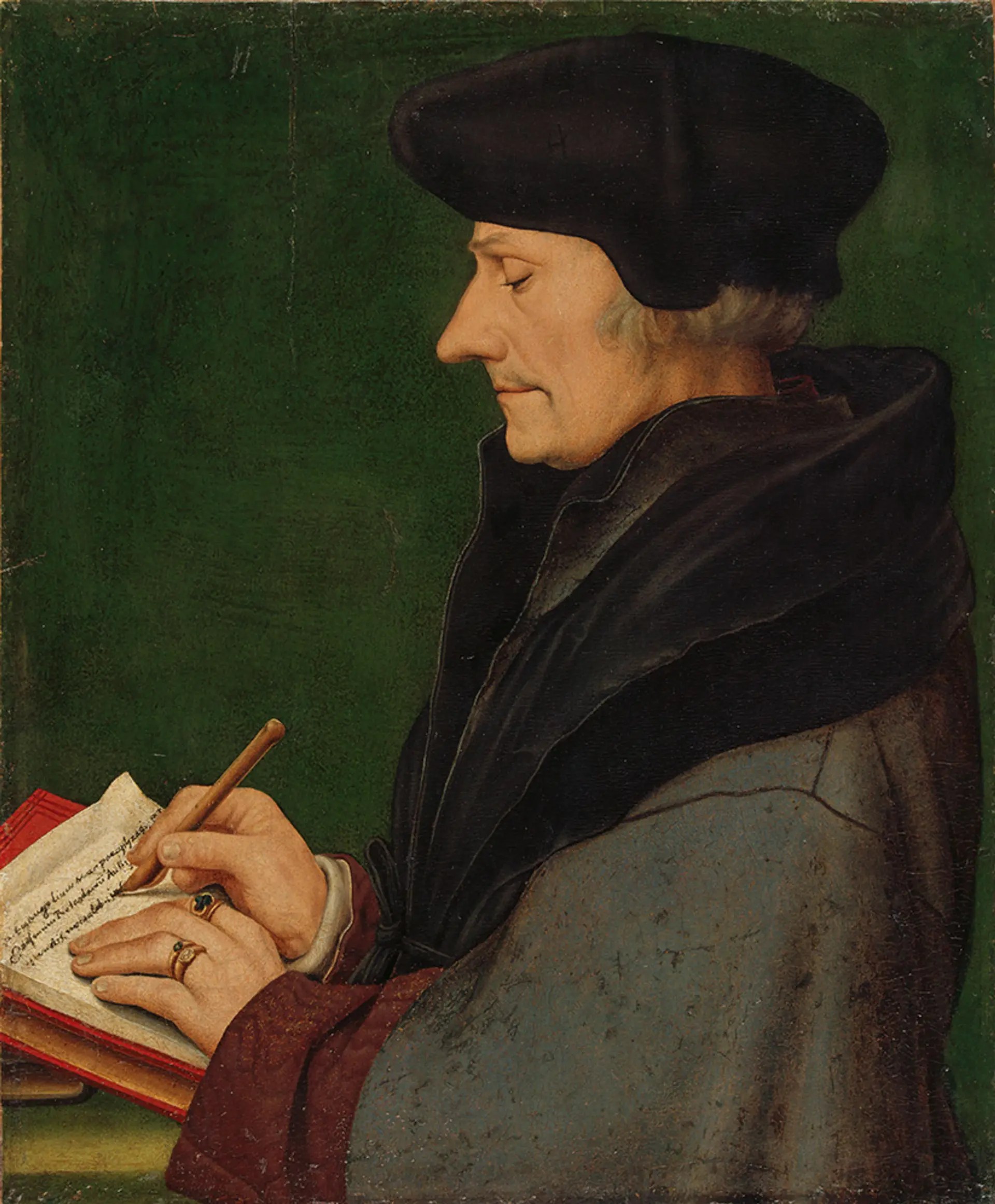
Like today’s large language models, some 16th-century humanists (like Erasmus) had techniques to automate writing. But as Hannah Katznelson explains, others (like Rabelais) called foul…
The Renaissance scholar and educator Erasmus of Rotterdam opens his polemical treatise The Ciceronian (1528) by describing the utterly dysfunctional writing process of a character named Nosoponus. The Ciceronianis structured as a dialogue, withtwo mature writers, Bulephorus and Hypologus, trying to talk Nosoponus out of his paralysing obsession with stylistic perfection. Nosoponus explains that it would take him weeks of fruitless writing and rewriting to produce a casual letter in which he asks a friend to return some borrowed books. He says that writing requires such intense concentration that he can do it only at night, when no one else is awake to distract him, and even then his perfectionism is so intense that a single sentence becomes a full night’s work. Nosoponus goes over what he’s written again and again, but remains so dissatisfied with the quality of his language that eventually he just gives up.
Nosoponus’s problem might resonate. Who has not spent too long going over the wording of a simple email, at some point or another? Today there is an easy fix: we have large language models (LLMs) to write our letters for us, helpfully proffering suggestions as to what we might say, and how we might phrase it. When I input Nosoponus’s intended request into GPT-4, it generated the following almost instantly:
Hey [Friend’s Name],
Hope you’re doing well! I just realised I never got those books back that I lent you a while ago. No rush, but whenever you get a chance, I’d love to get them back. Let me know what works for you! Thanks!
Nosoponus
But there was a solution in the 16th century, too. A humanist education on the Erasmian model could train its students to produce letters of any length, on any topic – quickly, easily and eloquently. The French humanist François Rabelais, a contemporary of Erasmus, appears to have understood these compositional techniques as automating the creating of text in a way that, retrospectively, looks a lot like how LLMs function. If we want to understand LLMs, and what they are and aren’t capable of, we can look at earlier versions of the same technology – like Erasmian humanism. We can also read authors like Rabelais, who is already thinking about automatic text-generation along these lines, as someone who appreciates the effectiveness of Erasmian generative technology, but at the same time sees it as vitiating the social force of language and, ultimately, ruining language as a tool for moral and political life…
[Katznelson recounts Erasmus’s efforts, Rabelais’s response, and unpacks the important differences between our own authentic speech language created to speak for us and their practical and moral implications…]
What lessons from the 16th century can tell us about AI and LLMs: “Methodical banality,” from @aeon.co.
* Lewis Carroll, Through the Looking Glass
###
As we honor authenticity, we might recall that it was on this date in 1886 that three U.S. patents were issued to Alexander Graham Bell’s Volta Labs for “recording and reproducing speech and other sounds.” The Graphophone, was an improved (and the first practical) version of the Edison phonograph (from 1877), and became the foundation on which the speech recording (e.g., dictaphone) and recorded music (and spoken word) industries began to grow.

“Wild above rule or art, enormous bliss”*…

What greater joy than that of creation? John Crace on the all-time champion coiner of English words…
To many scholars he is still the sublime English poet. To the rest of us, he’s the blind bloke who wrote the scarily long and difficult epic about heaven, hell and the failure of the English revolution we were made to read at school. But John Milton… deserves to be remembered for rather more than Paradise Lost. Step aside Martin Amis, Will Self et al; Milton is in a league of his own for neologisms.
According to Gavin Alexander, lecturer in English at Cambridge university and fellow of Milton’s alma mater, Christ’s College, who has trawled the Oxford English Dictionary (OED) for evidence, Milton is responsible for introducing some 630 words to the English language, making him the country’s greatest neologist, ahead of Ben Jonson with 558, John Donne with 342 and Shakespeare with 229. Without the great poet there would be no liturgical, debauchery, besottedly, unhealthily, padlock, dismissive, terrific, embellishing, fragrance, didactic or love-lorn. And certainly no complacency.
The OED does tend to privilege famous writers with first usage,” Alexander admits, “and early-modern English – a composite of Germanic and Romance languages – was ripe for innovation. If you couldn’t think of a word, you could just make one up, ideally based on a term from French or Latin that others educated in those languages would understand. Yet, by any standards, Milton was an extraordinary linguist and his freedom with language can be related to his advocacy of personal, political and religious freedoms.”
Milton’s coinages can be loosely divided into five categories. A new meaning for an existing word – he was the first to use space to mean “outer space”; a new form of an existing word, by making a noun from a verb or a verb from an adjective, such as stunning and literalism; negative forms, such as unprincipled, unaccountable and irresponsible – he was especially fond of these, with 135 entries beginning with un-; new compounds, such as arch-fiend and self-delusion; and completely new words, such as pandemonium and sensuous.
Not that Milton got things all his own way. Some of his words, such as intervolve (to wind within each other) and opiniastrous (opinionated), never quite made it into regular usage – which feels like our loss rather than his…
“John Milton – our greatest word-maker,” from @mrjohncrace.bsky.social in @theguardian.com.
For an appreciation of the revolutionary afterlife of Milton’s masterwork, Paradise Lost, see Orlando Reade‘s What In Me Is Dark. (TotH to PN)
* John Milton, Paradise Lost
###
As we reach for the right word, we might send articulate birthday greetings to Anthony Burgess; he was born on this date in 1917. An author primarily of comic fiction (e.g., the Enderby quartet), he strayed to other turf (like Earthly Powers, one of your correspondent’s faves). He is, of course, best known for his dystopian satire A Clockwork Orange— for which he invented a slang argot (“Nadsat“) that, while it added little to the vernacular, certainly had an impact on those of us who read the book or saw Stanley Kubrick’s film adaptation.

“Human society, the world, and the whole of mankind is to be found in the alphabet”*…

… and so we endeavor to teach the alphabet to young children. Hunter Dukes on an amusing– and revealing– example from the 18th century…
It’s as easy as ABC! It’s as easy as pie! In an abecedarium titled The Tragical Death of a Apple-Pye, both idioms come true, as children learn an alphabet whose letters greedily gorge on pastry.
The edition featured here was published by John Evans, a major contender in late eighteenth- and early nineteenth-century children’s literature. His formula was simple: undercut the competition, including John Newbery’s firm, by selling unprecedentedly affordable books. He captured an emerging market: children’s books for hard up families who had managed, against the odds, to acquire literacy. And while his competitors targeted a middle-class audience, Evans “stayed true to the street literature tradition in which he had been brought up”, writes literary historian Jonathan Cooper, who gives 1793–1796 as the likely date for Apple-Pye. It was printed on a press at No. 41 Long Lane, West Smithfield, and sold for a halfpenny, like Evans’ other sixteen-page chapbooks — a tiny format, roughly measuring 3.5 inches tall by 2.25 inches wide.
The book is really three texts in one. First comes an ABC list in which the “life and death” of an apple pie plays out across the alphabet. “Apple Pye, Bit it, Cut it, Dealt it, Eat it . . . Took it, View’d it, Wanted it, X, Y, Z, and &, they all wish’d for a piece in hand.” With so many letters vying for a slice, they decide together on an equitable solution: “They all agreed to stand in order / Round the Apple Pye’s fine border / Take turn as they in hornbook stand, / From great A, down to &”.
Next we encounter “A Curious Discourse That Passed Between the Twenty Five Letters at Dinner-Time”. The abecedarian order repeats, but now the letters speak. “Says A, give me a good large slice. . . . Says I, I love the juice the best.” Finally, Evans includes some self-promotion — “if my little readers are pleased with what they have found in this book, they have nothing to do but to run to Mr. Evans’s” — and a woodcut picture of “the old woman who made the Apple Pye”, which transitions abruptly into Christian pedagogy: “Grace before meat”, “Grace after meat”, “The Lord’s Prayer”. Like in other eighteenth-century children’s books, such as The Renowned History of Giles Gingerbread, learning here is figured as a kind of gustatory consumption: children eat up the alphabet lesson, while its glyphic personifications wolf down their slices. (The link between sweets and syllabaries is more ancient still: Horace recorded teachers bribing pupils with letter-shaped biscuits to encourage their alphabetical uptake.)
Evans’ edition was published in the late eighteenth century — reworking a primer by Richard Marshall from the 1760s — but The Tragical Death of a Apple Pye is perhaps an even older story, first published, according to some scholars, in 1671. For a modern reader, it preserves English paleography as it existed in an earlier state: across the sections, U and V are used interchangeably, like I and J, and “&” is the ultimate letter, after Z. In an attempt to offset the ampersand’s semiotic difference, teachers well into the nineteenth century instructed students to pronounce the final letters of the alphabet as “x, y, z, and per se &”, hiving off the ampersand with the Latin by itself…

“Peckish Alphabetics: The Tragical Death of a Apple-Pye,” from @hunterdukes.bsky.social in @publicdomainrev.bsky.social.
More on (and many more illustrations, including the image at the top, from) TTDoaAP here, via “The Gentle Author.”
* Victor Hugo
###
As we learn our letters, we might send instuctive birthday greetings to a woman still hoeing this row: Denise Fleming; she was born on this date in 1950. An award-winning illustrator and creator of children’s books, she has written dozens of volumes for the very young, among which was her contribution to the tradition of which Evans was a part…

“The bond of our common humanity is stronger than the divisiveness of our fears and prejudices”*…
Inanna Hamati-Ataya on the importance of understanding our place in the world…
In the 1990s, an entire generation was robbed of its historical consciousness by a powerful and seemingly unprecedented tale. This story, crafted as the Cold War came to an end, declared that real or imagined boundaries had stopped working as they once had. Humans were no longer contained within their old geographies or identities. They now inhabited a new world that appeared to be unhinged from the normal evolution of human society.
The concept chosen to capture this transformational moment in human history was ‘globalisation’. It described how new technologies and networks of connectivity had suddenly brought human communities closer together and made them permeable to an uncontrollable flow of people, ideas, goods and cultural practices, which all moved freely across the integrated markets of the world economy. In the wake of this transformation, new jargon emerged, expressing new anxieties: the world had truly become the ‘global village’ that Marshall McLuhan anticipated in the 1960s, but it was a world shaped by multinational corporations and ‘elite globalisers’, who spoke a common, hegemonic ‘global English’, and were spearheading a destructive ‘homogenisation’ (or ‘McDonaldisation’) of human cultures that national borders were too fragile to withstand.
During the past three decades, more people have begun viewing our ‘global’ world as a cursed fate. With its suffocating time-space compression, globalisation seems to have uncoupled us from the logic and flow of history. Our suspicious, bastard identities – patched together from a mishmash of cultures – appear incompatible with our ancestors’ ‘authentic’ traditions and ways of life. We have become strangers to the places they called home, to the ways they dressed, ate or communicated with one another. And, with no template for how to live and no experience to learn from, the deafening siren songs of anti-globalisation movements are now luring us back into the safer identities and boundaries of a lost, golden past.
This tale of globalisation is the most successful scare story of our times. And like all scare stories, it stimulates our fear of an overwhelming unknown.
But it’s all an illusion. There is no new global world.
Our present appears that way only because we have forgotten our common past. Globalisation didn’t begin in the 1990s, or even in the past millennia. Remembering this older shared history is a path to a different tale, which begins much, much earlier – long before the arrival of international supply chains, ocean-going sailing ships, and continent-spanning silk roads. The tale of globalisation is written across human history. So why do we keep getting the story so wrong?…
[She unpacks the answer to her questions, then turns to it implications…]
… In our own contemporary era, anti-globalisation movements have recently shifted from the far Left to the far Right of national and global politics. Justified resentment against the locally experienced injustices of the global economy and the growing disruptive effect of global climate change are now couched in resentment for the social and cultural dimensions of globalisation. Identitarianism, a political ideology that stresses the preservation of narrowly conceived ‘Western’ ethnicities and cultures, has accordingly become the easiest and most efficient strategy to mobilise local grievances, and direct them at whatever is perceived as a threat to the wellbeing of those suffering within. The ugly age of nationalism is back.
Is nationalist identitarianism the ethos we will now deploy to confront the common existential threats that await us in the coming century? Why wouldn’t it be? Does anyone doubt that national borders will be turned, once again, into sacred physical boundaries and fiercely defended against those fleeing the environmental, economic or military devastation of their homes? Do we doubt that eloquent voices animated by the most (ig)noble intentions will rise to justify patriotic bullets being aimed at ‘alien migrants’ and climate refugees? And that leaders will say these displaced people cannot be accommodated because of their numbers and cultures, and the threat they pose to our secure lives – to our ‘identity’?
Such scenarios are far too likely given the rise of xenophobic worldviews, such as the conspiratorial idea of a ‘Great Replacement’, in which elites – imagined to be Jews and other minorities – have begun executing a plan to replace so-called indigenous white Europeans with other populations of apparently greater and threatening reproductive vitality. These racialist worldviews dangerously converge with a public misunderstanding of ‘race’ as reflected in the recent craze for DNA ‘ancestry tests’. DNA has little to do with ‘identity’, as social and political ideologies have constructed it, and much to do with physical and social geography. Our genes are a result of human adaptive mobility, and the journeys, rich encounters and kin-making that our freedom of movement made possible over tens of thousands of years. Our genome does not tell our whole story, but the story it does tell shows how past globalisations made us what we are today.
As we search for ways of communing with one another beyond the stubborn ideology of difference, we should also prepare for vicious future distortions and manipulations of our current scientific and historical understanding of identity. Some humans today carry a few genes that their Pleistocene ancestors inherited from intercourse with our Eurasian Neanderthalian and Denisovan cousins, whom some communities of Homo sapiens encountered on their journeys of cosmopolitan expansion. How might such a genetic difference among us be interpreted and used in the future by those intent on pursuing identitarianism to its silliest or most murderous conclusions? Might they declare that some humans are not ‘pure’ enough to enjoy the full freedom, security and dignity we recognise as the natural rights of humankind? Or might they, on the contrary, elevate the Neanderthalian or Denisovan gene as a marker of Eurasian ‘distinction’ to recreate narratives of racial superiority, similar to those that once plagued archaeological thinking about the allegedly more ‘advanced’ nature of those human fossils laying the farthest away from the species’ original African homes?
Palaeontologists who insist on ascribing the label ‘humans’ to the entire Homo genus while reserving that of ‘modern humans’ to the surviving representatives of the lineage (ie, us) probably understand better than most the dangers of ideological manipulations of scientific taxonomies. But in the open marketplace where ideas freely flow in the name of freedom of thought and expression, how can we protect ourselves and one another from such dangers, if we still perceive plurality as a threat to survival, and cannot see the richness of our shared human culture?
The wars we wage against one another are all civil wars. Until we recognise them as such, they will remain tragedies we accept as natural – or horrors we cheer on in the name of grand notions sold to us by loud voices who know our fears too well (and know too little of the richness of our world and our history). We have always been global, and this is our shared identity. It is our unique way of being and remaining in the world as one family. Whatever we cherish in our humanity and culture has been crafted by our global journeys and encounters. Through them, we will continue to write the story of how we become us…
All of our religions, stories, languages, and norms were muddled and mixed through mobility and exchange throughout history: “There are no pure cultures,” from @berytia.bsky.social in @aeon.co.
Still, as Venkatesh Rao reminds us, the “vacuous over-large abstractions like “globalization” make us underestimate the horizontal historicity of the world.”
* Jimmy Carter
###
As we go with the flow, we might recall that it was on this date in 1690 (or so musicologists believe) that Johann Christoph Denner, inspired by a reeded recorder-like instrument called the chalumeau, designed and created a longer and keyed (so more widely-ranged) instrument that was quickly copied and modified by other makers– and became what we know as the clarinet. By 1791, Mozart was composing for the instrument; by Beethoven’s time, the clarinet was a staple member in the orchestra.
To the point of the essay above, it’s worth noting that the chalumeau– and thus the clarinet– were direct descendants of ancient Greek and ancient Egyptian reeded pipes… that may themselves have been modeled on similar instruments from Central and East Asia.

The clarinet, as depicted in Diderot’s Encyclopedia, 1776 (source)
“Two countries separated by the same language”*…

The contentious times in which we live are perhaps nowhere more obvious than in the language we use… or perhaps better said, in the way we use language. MIT’s Center for Constructive Communication is here to help…
In our highly polarized society, it’s not surprising that we see significant differences in how words are used by those with opposing political and cultural viewpoints. The Bridging Dictionary, an interactive web-based prototype developed by MIT’s Center for Constructive Communication, identifies the different way words and phrases are used by different constituencies and–similar to a traditional dictionary or thesaurus–gives meanings and also attempts to suggest less polarized (bridging) alternatives.
Utilizing natural language processing, the Bridging Dictionary compares how two media outlets on the opposite sides of the US political spectrum–foxnews.com on the right, and msnbc.com on the left–differ in the meanings assigned to the same words or phrases. This involved gathering approximately 18,000 articles from foxnews.com and 13,000 from msnbc.com published since 2021. The content was then split into millions of sentences for analysis. The first analysis measured the differences in usage frequency and sentiment. For those terms that show significant differences, a further qualitative comparison was done using a large language model (LLM) to describe the way the usage varies between the two outlets. The LLM was then prompted to provide evidence for its conclusions by citing specific references, as well as alternative “bridging” terms…
How words common in American political discourse are used differently across the political divide: “Bridging Dictionary.”
Learn more about its current challenges, and possible future potential at (CCC advisor and former CBS News head) Andrew Heyward’s post— then explore it.
* Bertrand Russell, speaking of the difference between England and America, though the observation is only too apt here. (Russell may well have been paraphrasing Oscar Wilde…)
###
As we watch our tongues, we might recall that it was on this date in 2012 that The Disney Channel premiered Frenemies, an anthology TV film that follows three pairs of teenage friends who go from friends to enemies and back again. The ensemble cast featured Zendaya (who went on to win two Emmys for her leading role in the HBO series Euphoria, and then to success in features like Dune, Spiderman, and Challengers) and Bella Thorne (who has continued to work successfully in television and film, and has authored successful novels, but is perhaps best known these days as the first person to earn $1 million in the first 24 hours of joining the platform OnlyFans in 2020).

You must be logged in to post a comment.