Posts Tagged ‘Chile’
“I want to make a long journey”*…
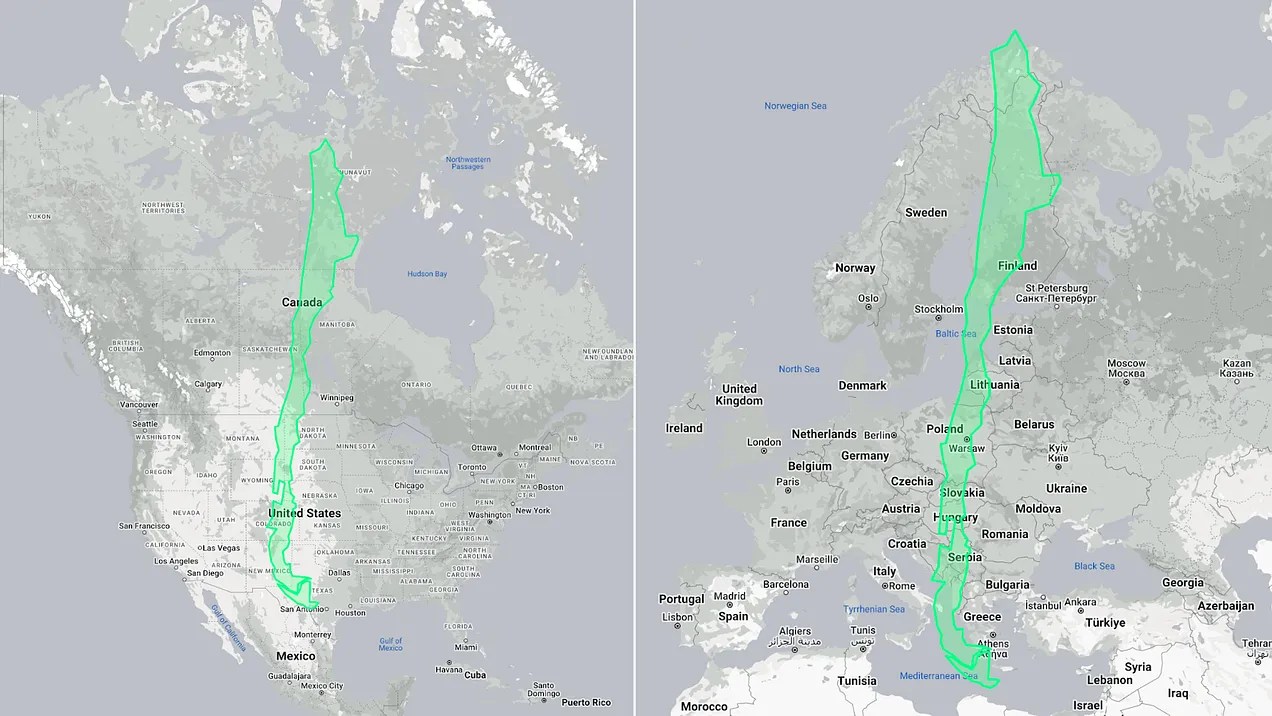
Thomas Pueyo on how geography shaped the longest (and proportionately thinnest) country in the world…
Chile is as long as the [vertical dimensions of]US and Canada combined.
Chile is as long as all of Europe!Chile is so long, it’s curved.

How long is it?
Why not longer?
Why is no other country as thin?
How does that make Chileans incomprehensible?
These questions (and more) answered: “Why Is Chile So Long?” from @tomaspueyo
* (Chilean poet) Pablo Neruda
###
As we stretch, we might recall that it was on this date in 1730 that the Valparaíso earthquake occurred. (As Pueyo explains, Chile’s unique geography and geology have frequently seismic implications.)
The quake had an estimated magnitude of 9.1–9.3 and triggered a major tsunami with an estimated magnitude of Mt 8.75, that inundated the lower parts of Valparaíso and caused severe damage from La Serena to Chillan; the tsunami affected more than 620 mi of Chile’s coastline.
While damage was widespread, only a few deaths were recorded due to the earthquake, reportedly because a strong foreshock had prompted people to leave their homes. Similarly, the subsequent tsunami: inhabitants ran to higher ground after seeing the water recede, so that only a few were killed.

“It is impossible to contemplate the spectacle of the starry universe without wondering how it was formed”*…

Paul Constance on how Chile, a country riven by inequality and political conflict, has become a global sanctuary for the long science that drives astronomical discovery, and on the questions that raises…
… The next era of astronomy will depend on instruments so complicated and costly that no single nation can build them. A list of contributors to the James Webb Space Telescope, for example, includes 35 universities and 280 public agencies and private companies in 14 countries. This aggregation of design, engineering, construction and software talent from around the planet is a hallmark of “big science” projects. But large telescopes are also emblematic of the outsized timescales of “long science.” They depend on a fragile amalgam of trust, loyalty, institutional prestige and sheer endurance that must sustain a project for two or three decades before “first light,” or the moment when a telescope actually begins to gather data.
“It takes a generation to build a telescope,” Charles Alcock, director of the Harvard-Smithsonian Center for Astrophysics and a member of Giant Magellan Telescope (GMT) board, said some years ago. Consider the logistics involved in a single segment of the GMT’s construction: the process of fabricating its seven primary mirrors, each measuring 27 feet in diameter and using 17 metric tons of specialized Japanese glass. The only facility capable of casting mirrors this large (by melting the glass inside a clam-shaped oven at 2,100 degrees Fahrenheit) is situated deep beneath University of Arizona football stadium. It takes three months for the molten glass to cool. Over the next four years, the mirror will be mounted, ground and slowly polished to a precision of around one millionth of an inch. The GMT’s first mirror was cast in 02005; its seventh will be finished sometime in 02027. Building the 1,800-ton steel structure that will hold these mirrors, shipping the enormous parts by sea, assembling the telescope atop Cerro Las Campanas, and then testing and calibrating its incommunicably delicate instruments will take several more years.
Not surprisingly, these projects don’t even attempt to raise their full budgets up front. Instead, they operate on a kind of faith, scraping together private grants and partial transfers from governments and universities to make incremental progress, while constantly lobbying for additional funding. At each stage, they must defend nebulous objectives (“understanding the nature of dark matter”) against the claims of disciplines with more tangible and near-term goals, such as fusion energy. And given the very real possibility that they will not be completed, big telescopes require what private equity investors might describe as the world’s most patient risk capital.
Few countries have been more successful at attracting this kind of capital than Chile. The GMT is one of three colossal observatories currently under construction in the Atacama Desert. The $1.6 billion Extremely Large Telescope, which will house a 128-foot main mirror inside a dome nearly as tall as the Statue of Liberty, will be able to directly image and study the atmospheres of potentially habitable exoplanets. The $1.9 billion Vera T. Rubin Telescope will use a 3.500 megapixel digital camera to map the entire night sky every three days, creating the first 3-D virtual map of the visible cosmos while recording changes in stars and events like supernovas. Two other comparatively smaller projects, the Fred Young Sub-millimeter Telescope and the Cherenkov Telescope Array, are also in the works.
Chile is already home to the $1.4 billion Atacama Large Millimeter Array (ALMA), a complex of 66 huge dish antennas some 16,000 feet above sea level that used to be described as the world’s largest and most expensive land-based astronomical project. And over the last half-century, enormous observatories at Cerro Tololo, Cerro Pachon, Cerro Paranal, and Cerro La Silla have deployed hundreds of the world’s most sophisticated telescopes and instruments to obtain foundational evidence in every branch of astronomy and astrophysics.

By the early 02030s, a staggering 70 percent of the world’s entire land-based astronomical data gathering capacity is expected to be concentrated in a swath of Chilean desert about the size of Oregon.
Collectively, this cluster of observatories represents expenditures and collaboration on a scale similar to “big science” landmarks such as the Large Hadron Collider or the Manhattan Project. Those enterprises were the product of ambitious, long-term strategies conceived and executed by a succession of visionary leaders. But according to Barbara Silva, a historian of science at Chile’s Universidad Alberto Hurtado, there has been no grand plan, and no one can legitimately take credit for turning Chile into the global capital of astronomy…
“Stumbling Toward First Light,” from @presentbias and @longnow.
* Henri Poincaré
###
As we look up, we might recall that it was on this date in 2001 that NASA launched the Mars Odyssey, sending back stunning images from its tv cameras during its fiery ascent. Odyssey traveled 286 million miles before entering orbit around the red planet the following October.
Its mission was (and is– at 22-and-a-half years, it’s the longest-serving spacecraft at Mars) to use its spectrometers and a thermal imager to detect evidence of past or present water and ice, as well as study the planet’s geology and radiation environment in a quest to help answer the question of whether life once existed on Mars and to create a risk-assessment of the radiation that future astronauts on Mars might experience. (As a bonus, it acts as a relay for communications between the Curiosity rover [and previously the Mars Exploration Rovers and Phoenix lander] and Earth.)

“Note, to-day, an instructive, curious spectacle and conflict”*…

States within the global political economy today face a twin insurgency, one from below, another from above. From below comes a series of interconnected criminal insurgencies in which the global disenfranchised resist, coopt, and route around states as they seek ways to empower and enrich themselves in the shadows of the global economy. Drug cartels, human traffickers, computer hackers, counterfeiters, arms dealers, and others exploit the loopholes, exceptions, and failures of governance institutions to build global commercial empires. These empires then deploy their resources to corrupt, coopt, or challenge incumbent political actors.
From above comes the plutocratic insurgency, in which globalized elites seek to disengage from traditional national obligations and responsibilities. From libertarian activists to tax-haven lawyers to currency speculators to mineral-extraction magnates, the new global super-rich and their hired help are waging a broad-based campaign to limit the reach and capacity of government tax-collectors and regulators, or to manipulate these functions as a tool in their own cut-throat business competition.
Unlike classic 20th-century insurgents, who sought control over the state apparatus in order to implement social reforms, criminal and plutocratic insurgents do not seek to take over the state. Nor do they wish to destroy the state, since they rely parasitically on it to provide the legacy goods of social welfare: health, education, infrastructure, and so on. Rather, their aim is simpler: to carve out de facto zones of autonomy for themselves by crippling the state’s ability to constrain their freedom of (economic) action…
From Nils Gilman (@nils_gilman), a sadly prophetic 2014 piece– the postmodern state is under siege from plutocrats and criminals who compound each other’s insidiousness: “The Twin Insurgency.”
For a more current– but altogether resonant– take (one that arrives at a similar conclusion from a different point of origin), see Harvard Law School professor and Berkman Center co-director Yochai Benkler‘s “The Real Reason the GOP Suppresses the Vote.
(This is being written the day before the election; sadly, the issues raised here will be with us regardless of the outcome…)
* Walt Whitman
###
As we watch our flanks, we might recall that it was on this date in 1970 that Salvador Allende took office after being elected President of Chile. He was deposed in a military coup, actively supported by the U.S. CIA, in 1973.

Chile today, hot tamale!…

In 2007, the Naga Bhut Joloki or “Ghost chile” was named the hottest pepper on earth. Then in 2010 the Naga Viper stole the title. And in 2012 the Trinidad Scorpion Moruga Blend moved into the lead. And for good reason.
The Scorpion ranks at round 2 million heat units on the Scoville scale. (For comparison, tabasco sauce has 2,500–5,000 Scoville heat units or SHU.) What exactly does that mean? When the scale was invented in 1912 by pharmacist Wilbur Scoville in search of a heat-producing ointment, it was based on human taste buds. The idea was to dilute an alcohol-based extract made with the given pepper until it no longer tasted hot to a group of taste testers. The degree of dilution translates to the SHU. In other words, according to the Scoville scale, you would need as many as 5,000 cups of water to dilute 1 cup of tobacco sauce enough to no longer taste the heat.
And while the Scoville scale is still widely used, says Dr. Paul Bosland, professor of horticulture at New Mexico State University and author or several books on chile peppers, it no longer relies on the fallible human taste bud…
For the reason “Ghost chile” is so named– and for more about the valiant folks who ponder peppers for our protection, the techniques they use, and links to the Chile Pepper Institute (at New Mexico State University), where readers can acquire a nifty chile tasting wheel— see “How Hot is That Pepper? Unpacking the Scoville Scale.”
[photo: “WhisperToMe“]
###
As we remind ourselves that water doesn’t quell the heat, it spreads it, we might recall that it was on this date in 1556 that the deadliest earthquake in history (and the third deadliest natural disaster in history) occurred in Shaanxi Province, China; it killed an estimated 830,000 people. Modern estimates, based on geological data, give the earthquake a magnitude of approximately 7.9-8 on the moment magnitude scale (the successor to the Richter scale). Its epicenter was in the Wei River Valley, near the cities of Huaxian, Weinan and Huayin. In Huaxian, every single building and home was demolished, killing more than half the residents of the city.

It’s later than you think…

The earthquake that killed more than 700 people in Chile on Feb. 27 probably shifted the Earth’s axis and shortened the day, a National Aeronautics and Space Administration scientist said.
Earthquakes can involve shifting hundreds of kilometers of rock by several meters, changing the distribution of mass on the planet. This affects the Earth’s rotation, said Richard Gross, a geophysicist at NASA’s Jet Propulsion Laboratory in Pasadena, California, who uses a computer model to calculate the effects.
“The length of the day should have gotten shorter by 1.26 microseconds (millionths of a second),” Gross, said today in an e-mailed reply to questions. “The axis about which the Earth’s mass is balanced should have moved by 2.7 milliarcseconds (about 8 centimeters or 3 inches).”
…
“It’s what we call the ice-skater effect,” David Kerridge, head of Earth hazards and systems at the British Geological Survey in Edinburgh, said today in a telephone interview. “As the ice skater puts when she’s going around in a circle, and she pulls her arms in, she gets faster and faster. It’s the same idea with the Earth going around if you change the distribution of mass, the rotation rate changes.”
Read the whole story in this Bloomberg filing reprinted on BusinessWeek.com.
As we re-synchronize our watches, we might recall that it was on this date in 1977 that the rings around Uranus were discovered. In fact, in 1789 William Herschel had discussed possible rings around the seventh planet. But it was only 23 years ago that, using the Kuiper Airbourne Observatory, the rings– 13 bands of extremely dark particles, varying in size from micrometers to a fraction of a meter– were definitively observed.
 Hubble Space Telescope photo of Uranus, its rings, and its moons
You must be logged in to post a comment.