Posts Tagged ‘peppers’
“The food of the true revolutionary is the red pepper”*…
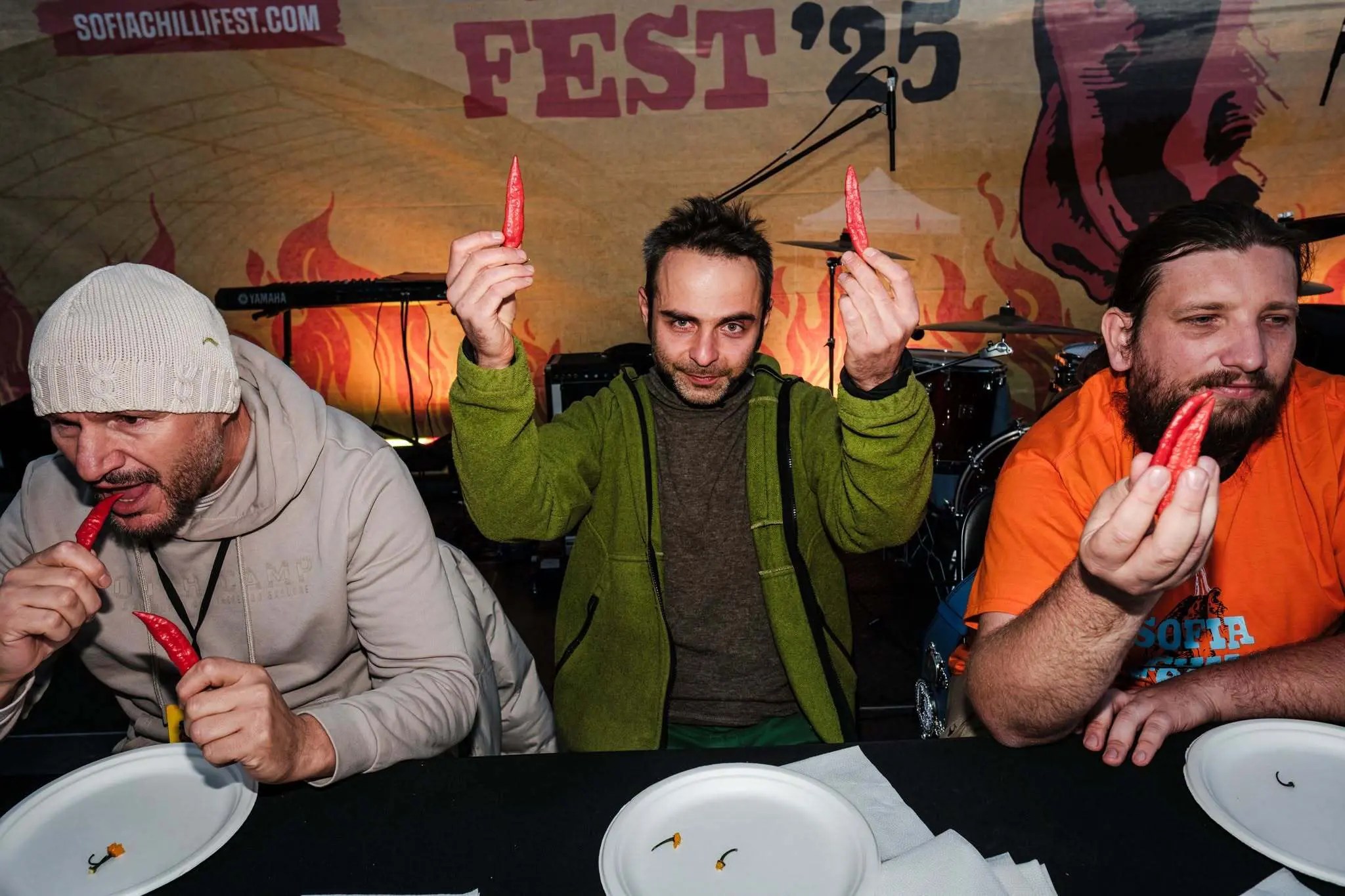
… and a favorite of many others. Hannah Bentley explores the growing number of extreme enthusiasts– chiliheads– who are competing across the globe, devouring millions of Scoville units, and fighting off agonizing capsaicin cramps in the process…
“I’m not like normal people,” declares Stephen Curgan, better known in the chilli-eating world as Fiery Redd. “Not many people can say they’ve achieved world status at something.”
The 37-year-old corporate engineering manager from South Carolina currently holds the League of Fire’s (LoF) World Champion Belt Title – the highest honour in competitive chilli [the more common spelling of “chili” in the UK] eating. Last March, he travelled to Cape Town, South Africa and beat Gary ‘Scorpion Slayer’ Conar, revelling in the rapturous applause as he hoisted the red-trimmed leather belt above his head.
Achieving such a feat means enduring roughly 10 punishing rounds of chomping down on the hottest chillies on earth. Bouts usually begin with Carolina Reapers – which measure around 1.8 million Scoville Heat Units (roughly 300 times hotter than a jalapeño) – before escalating to even more brutal chillies like Pepper X (over 2 million SHU), and sometimes spoonfuls of concentrated chilli extract reaching as high as 16 million SHU.
During a match, competitors consume around 50 superhot chillies, many of which aren’t readily available to the public because of how dangerously potent they are. And to break a tie, the contest ends in a speed round, where whoever wolfs down the most peppers is hailed the winner. The LoF is the sport’s governing body, sanctioning professional matches and maintaining an international ranking system…
… But the sport comes with a serious occupational hazard: capsaicin cramps. Capsaicin, the compound responsible for a chilli’s heat, binds to pain receptors throughout the digestive tract, triggering violent muscle spasms as the human body tries to cope with what it interprets as a threat.
Competitors have compared the pain to ranging from a heart attack to childbirth, with each successive chilli only escalating the intensity. “I’ve broken my femur before,” Stephen says, with subtle terror flashing across his eyes, “but those cramps are the most painful thing I’ve ever experienced.”
To stave off the inevitable reckoning, Stephen – like all pro athletes – sticks to a strict nutrition plan, lining his stomach with “lots and lots of mashed potatoes” before every competition. “I need something heavy and starchy to clog the pipes and hold those cramps off for as long as possible.”
And as an extra precaution, once that final pepper has been choked down, competitors scatter to the nearest bin or bathroom to make themselves sick, expelling the capsaicin from their systems and hopefully shortening the hours of agony that may follow. That’s assuming the chillies didn’t make a surprise reappearance on stage – vomiting means instant disqualification…
… “I really love the psychological aspect of the sport,” Stephen explains. “It shows you can achieve anything you set your mind to. I think pepper eating is a good way to test yourself and see how well you can set the physical aside and maintain focus.”…
… This show of “mental fortitude” is one of the reasons Shahina Waseem, the undefeated 97-time UK Chilli Queen, co-founded the League of Fire alongside her partner Paul Ouro and fellow British competitor Matt Tangent. After outgrowing the previously limited competition circuit, she wanted to build the chilli-eating scene into something bigger than simply novelty entertainment at food festivals.
Since its launch in 2019, the LoF has expanded internationally, hosting competitions across four continents, attracting sponsors and bringing together chilli growers, craft hot sauce makers and competitive eaters under a simple ethos: everyone is respected, recognised and welcome…
The League of Fire: “Inside the searing, strangely wholesome world of competitive chili eating,” from @huckmag.com.
Pair with: “All Day I Dream Of Curry Fries“
* Mao Zedong (quoted in an article on the history of fiery peppers in Chinese cuisine)
###
As we turn up the heat, we might celebrate peppers in one of their natural habitats, noting that today is National Fajita Day. While the marque ingredients are chicken or steak, sweet peppers, and onions, spicy peppers are the key…
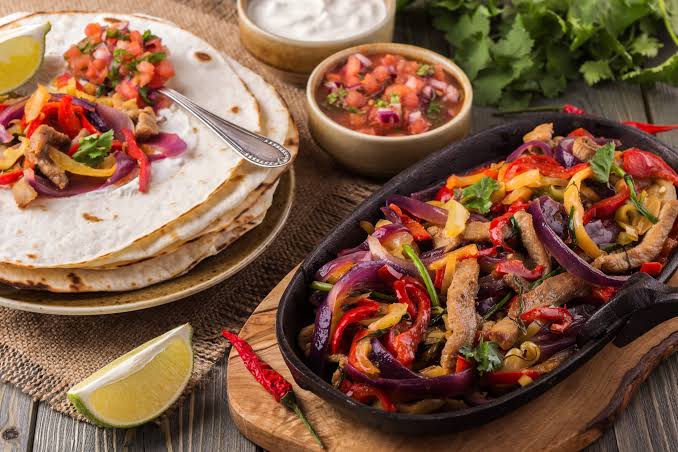
Chile today, hot tamale!…

In 2007, the Naga Bhut Joloki or “Ghost chile” was named the hottest pepper on earth. Then in 2010 the Naga Viper stole the title. And in 2012 the Trinidad Scorpion Moruga Blend moved into the lead. And for good reason.
The Scorpion ranks at round 2 million heat units on the Scoville scale. (For comparison, tabasco sauce has 2,500–5,000 Scoville heat units or SHU.) What exactly does that mean? When the scale was invented in 1912 by pharmacist Wilbur Scoville in search of a heat-producing ointment, it was based on human taste buds. The idea was to dilute an alcohol-based extract made with the given pepper until it no longer tasted hot to a group of taste testers. The degree of dilution translates to the SHU. In other words, according to the Scoville scale, you would need as many as 5,000 cups of water to dilute 1 cup of tobacco sauce enough to no longer taste the heat.
And while the Scoville scale is still widely used, says Dr. Paul Bosland, professor of horticulture at New Mexico State University and author or several books on chile peppers, it no longer relies on the fallible human taste bud…
For the reason “Ghost chile” is so named– and for more about the valiant folks who ponder peppers for our protection, the techniques they use, and links to the Chile Pepper Institute (at New Mexico State University), where readers can acquire a nifty chile tasting wheel— see “How Hot is That Pepper? Unpacking the Scoville Scale.”
[photo: “WhisperToMe“]
###
As we remind ourselves that water doesn’t quell the heat, it spreads it, we might recall that it was on this date in 1556 that the deadliest earthquake in history (and the third deadliest natural disaster in history) occurred in Shaanxi Province, China; it killed an estimated 830,000 people. Modern estimates, based on geological data, give the earthquake a magnitude of approximately 7.9-8 on the moment magnitude scale (the successor to the Richter scale). Its epicenter was in the Wei River Valley, near the cities of Huaxian, Weinan and Huayin. In Huaxian, every single building and home was demolished, killing more than half the residents of the city.

You must be logged in to post a comment.