Posts Tagged ‘fajita’
“The food of the true revolutionary is the red pepper”*…

… and a favorite of many others. Hannah Bentley explores the growing number of extreme enthusiasts– chiliheads– who are competing across the globe, devouring millions of Scoville units, and fighting off agonizing capsaicin cramps in the process…
“I’m not like normal people,” declares Stephen Curgan, better known in the chilli-eating world as Fiery Redd. “Not many people can say they’ve achieved world status at something.”
The 37-year-old corporate engineering manager from South Carolina currently holds the League of Fire’s (LoF) World Champion Belt Title – the highest honour in competitive chilli [the more common spelling of “chili” in the UK] eating. Last March, he travelled to Cape Town, South Africa and beat Gary ‘Scorpion Slayer’ Conar, revelling in the rapturous applause as he hoisted the red-trimmed leather belt above his head.
Achieving such a feat means enduring roughly 10 punishing rounds of chomping down on the hottest chillies on earth. Bouts usually begin with Carolina Reapers – which measure around 1.8 million Scoville Heat Units (roughly 300 times hotter than a jalapeño) – before escalating to even more brutal chillies like Pepper X (over 2 million SHU), and sometimes spoonfuls of concentrated chilli extract reaching as high as 16 million SHU.
During a match, competitors consume around 50 superhot chillies, many of which aren’t readily available to the public because of how dangerously potent they are. And to break a tie, the contest ends in a speed round, where whoever wolfs down the most peppers is hailed the winner. The LoF is the sport’s governing body, sanctioning professional matches and maintaining an international ranking system…
… But the sport comes with a serious occupational hazard: capsaicin cramps. Capsaicin, the compound responsible for a chilli’s heat, binds to pain receptors throughout the digestive tract, triggering violent muscle spasms as the human body tries to cope with what it interprets as a threat.
Competitors have compared the pain to ranging from a heart attack to childbirth, with each successive chilli only escalating the intensity. “I’ve broken my femur before,” Stephen says, with subtle terror flashing across his eyes, “but those cramps are the most painful thing I’ve ever experienced.”
To stave off the inevitable reckoning, Stephen – like all pro athletes – sticks to a strict nutrition plan, lining his stomach with “lots and lots of mashed potatoes” before every competition. “I need something heavy and starchy to clog the pipes and hold those cramps off for as long as possible.”
And as an extra precaution, once that final pepper has been choked down, competitors scatter to the nearest bin or bathroom to make themselves sick, expelling the capsaicin from their systems and hopefully shortening the hours of agony that may follow. That’s assuming the chillies didn’t make a surprise reappearance on stage – vomiting means instant disqualification…
… “I really love the psychological aspect of the sport,” Stephen explains. “It shows you can achieve anything you set your mind to. I think pepper eating is a good way to test yourself and see how well you can set the physical aside and maintain focus.”…
… This show of “mental fortitude” is one of the reasons Shahina Waseem, the undefeated 97-time UK Chilli Queen, co-founded the League of Fire alongside her partner Paul Ouro and fellow British competitor Matt Tangent. After outgrowing the previously limited competition circuit, she wanted to build the chilli-eating scene into something bigger than simply novelty entertainment at food festivals.
Since its launch in 2019, the LoF has expanded internationally, hosting competitions across four continents, attracting sponsors and bringing together chilli growers, craft hot sauce makers and competitive eaters under a simple ethos: everyone is respected, recognised and welcome…
The League of Fire: “Inside the searing, strangely wholesome world of competitive chili eating,” from @huckmag.com.
Pair with: “All Day I Dream Of Curry Fries“
* Mao Zedong (quoted in an article on the history of fiery peppers in Chinese cuisine)
###
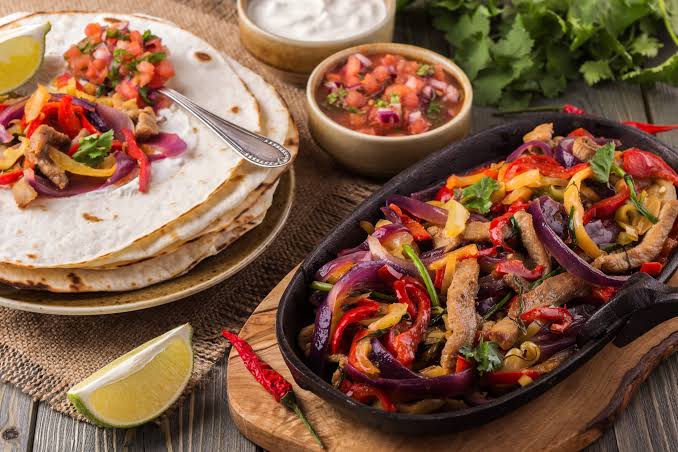
As we turn up the heat, we might celebrate peppers in one of their natural habitats, noting that today is National Fajita Day. While the marque ingredients are chicken or steak, sweet peppers, and onions, spicy peppers are the key…
“Hot, Hot, Hot”*…

Chili peppers thrive in hot and dry conditions. But, as Katherine J. Wu explains, even they have their limits…
For more than a year, life for many sriracha lovers has been an excruciating lesson in bland. Shortages of red jalapeños—the key ingredient in the famous hot sauce—have gotten bleak, in particular for the ultra-popular version of the condiment made by Huy Fong Foods. Grocery stores have enforced buying limits on customers. Bottles on eBay, Craigslist, and Amazon are selling for eye-watering prices—as much as $50 or more. A few Americans have grown so desperate for their flavor fix that they’ve started pilfering the sauce from local restaurants.
A big part of the shortage can be blamed on Huy Fong’s fragile supply chain. The red jalapeños that give the sauce its citrusy-sweet heat are finicky about temperatures and are usually laboriously picked by hand. A huge portion of the peppers are also grown in particularly dry parts of northern Mexico, where many fields are irrigated with water from the Colorado River—itself a strained and highly contested resource. But all of that was just a teeing up, experts told me, for a final climatic blow: the punishing drought that has gripped Mexico in recent years, draining reservoirs so low that even water destined for agriculture has largely been cordoned away.
The sriracha shortage is hardly the worst crop crisis that’s being fueled by climate change. For years, Michigan cherries have been suffocating in too-high temperatures, while Florida citrus have been obliterated by hurricanes; India’s wheat crops have roasted, while rice around the world has been double-teamed by floods and heat waves. But to now see peppers in peril is its own special burn. Bred in some of the world’s warmest regions, chilis have long been a poster child of heat tolerance. They, more than so many other plants, were supposed to be okay. Now, though, as temperatures get more scorching and droughts continue to parch the planet, “I think we are going to see this more often,” Guillermo Murray-Tortarolo, a climate scientist at the National Autonomous University of Mexico, told me. Sriracha’s troubles may turn out to be a bellwether for even more flavorless times to come…
“The Sriracha Shortage Is a Very Bad Sign” (or here), from @KatherineJWu in @TheAtlantic.
* Buster Poindexter (David Johansen)
###
As we savor the sauce, we might note that today is National Fajita Day.
… The term fajita means “little band” or “little belt”. The meat was probably labeled this way by a butcher who was selling skirt steak and, because this cut is typically rather tough, it was precut into small strips. But the way this little cut of meat made its way into the heart of Tex-Mex cuisine culture has an interesting background story.
Probably created around the late 1930s, fajitas were introduced by vaqueros and Mexican workers on ranches in the Texas Rio Grande Valley. These workers were often paid their wages in meat, sometimes the less wanted parts of the animal. So these workers learned that if they marinated the meat in certain juices, it would become more tender and flavorful, and could easily be eaten on tortillas.
Probably due to convenience, the popularity of fajitas increased in the 1940s. It developed into a sort of backyard, easy to eat, on the go dish that was passed down from one generation to the next.
It wasn’t until the 1960s that fajitas began to make their way into restaurants. One of the first may have been in 1969 when a meat market manager at a grocery store set up a fajita stand at a summer festival. Fajitas gained even more traction in the 1970s and the recipe changed a bit, using finer cuts of meat. With the launching of On the Border, Chili’s and other chain restaurants in the US that boasted Tex-Mex cuisine, the idea of the sizzling fajita served on a grill platter right at the table became an attractive – and delicious – experience…
National Fajita Day

You must be logged in to post a comment.