Posts Tagged ‘Isaac Newton’
“The pursuit of science is a grand adventure, driven by curiosity, fueled by passion, and guided by reason”*…
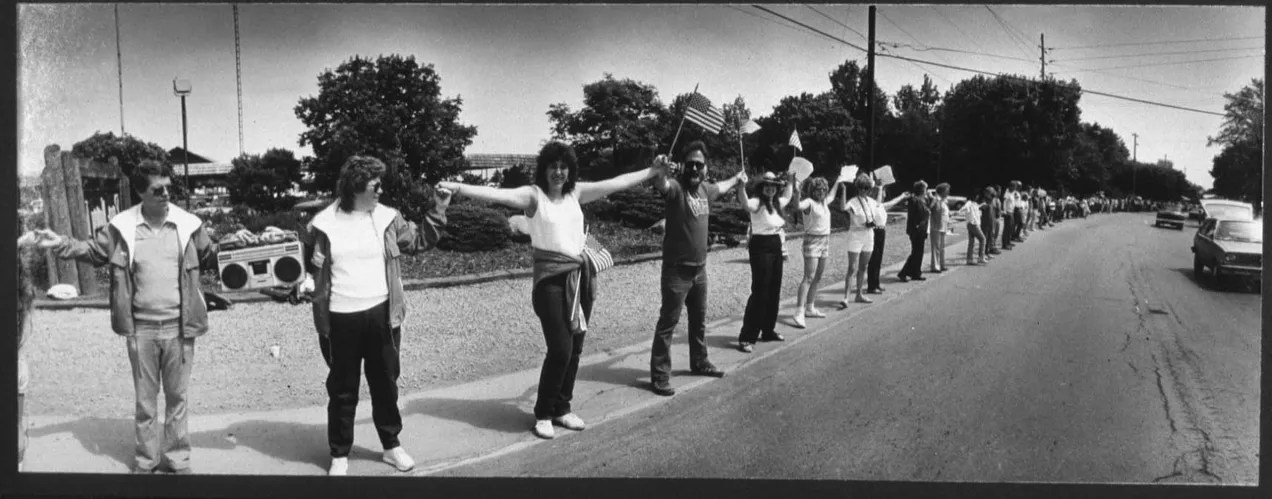
Adam Mastroianni on how science advances (and how it’s held back), with a provocative set of suggestions for how it might be accelerated…
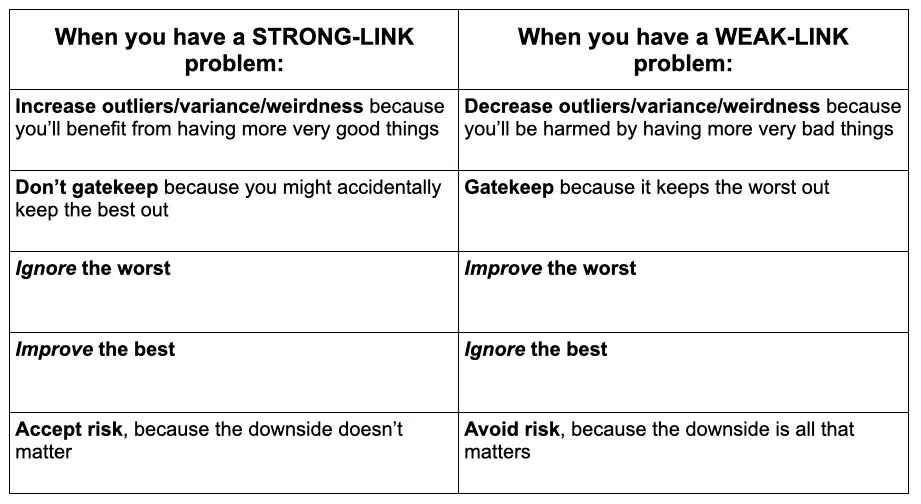
There are two kinds of problems in the world: strong-link problems and weak-link problems.
Weak-link problems are problems where the overall quality depends on how good the worst stuff is. You fix weak-link problems by making the weakest links stronger, or by eliminating them entirely.
Food safety, for example, is a weak-link problem. You don’t want to eat anything that will kill you. That’s why it makes sense for the Food and Drug Administration to inspect processing plants, to set standards, and to ban dangerous foods…
…
Weak-link problems are everywhere. A car engine is a weak-link problem: it doesn’t matter how great your spark plugs are if your transmission is busted. Nuclear proliferation is a weak-link problem: it would be great if, say, France locked up their nukes even tighter, but the real danger is some rogue nation blowing up the world. Putting on too-tight pants is a weak-link problem: they’re gonna split at the seams.
It’s easy to assume that all problems are like this, but they’re not. Some problems are strong-link problems: overall quality depends on how good the best stuff is, and the bad stuff barely matters. Like music, for instance. You listen to the stuff you like the most and ignore the rest. When your favorite band releases a new album, you go “yippee!” When a band you’ve never heard of and wouldn’t like anyway releases a new album, you go…nothing at all, you don’t even know it’s happened. At worst, bad music makes it a little harder for you to find good music, or it annoys you by being played on the radio in the grocery store while you’re trying to buy your beetle-free asparagus…
Strong-link problems are everywhere; they’re just harder to spot. Winning the Olympics is a strong-link problem: all that matters is how good your country’s best athletes are. Friendships are a strong-link problem: you wouldn’t trade your ride-or-dies for better acquaintances. Venture capital is a strong-link problem: it’s fine to invest in a bunch of startups that go bust as long as one of them goes to a billion…
In the long run, the best stuff is basically all that matters, and the bad stuff doesn’t matter at all. The history of science is littered with the skulls of dead theories. No more phlogiston nor phlegm, no more luminiferous ether, no more geocentrism, no more measuring someone’s character by the bumps on their head, no more barnacles magically turning into geese, no more invisible rays shooting out of people’s eyes, no more plum pudding…
Our current scientific beliefs are not a random mix of the dumbest and smartest ideas from all of human history, and that’s because the smarter ideas stuck around while the dumber ones kind of went nowhere, on average—the hallmark of a strong-link problem. That doesn’t mean better ideas win immediately. Worse ideas can soak up resources and waste our time, and frauds can mislead us temporarily. It can take longer than a human lifetime to figure out which ideas are better, and sometimes progress only happens when old scientists die. But when a theory does a better job of explaining the world, it tends to stick around.
(Science being a strong-link problem doesn’t mean that science is currently strong. I think we’re still living in the Dark Ages, just less dark than before.)
Here’s the crazy thing: most people treat science like it’s a weak-link problem.
Peer reviewing publications and grant proposals, for example, is a massive weak-link intervention. We spend ~15,000 collective years of effort every year trying to prevent bad research from being published. We force scientists to spend huge chunks of time filling out grant applications—most of which will be unsuccessful—because we want to make sure we aren’t wasting our money…
…
I think there are two reasons why scientists act like science is a weak-link problem.
The first reason is fear. Competition for academic jobs, grants, and space in prestigious journals is more cutthroat than ever. When a single member of a grant panel, hiring committee, or editorial board can tank your career, you better stick to low-risk ideas. That’s fine when we’re trying to keep beetles out of asparagus, but it’s not fine when we’re trying to discover fundamental truths about the world…
The second reason is status. I’ve talked to a lot of folks since I published The rise and fall of peer review and got a lot of comments, and I’ve realized that when scientists tell me, “We need to prevent bad research from being published!” they often mean, “We need to prevent people from gaining academic status that they don’t deserve!” That is, to them, the problem with bad research isn’t really that it distorts the scientific record. The problem with bad research is that it’s cheating.
I get that. It’s maddening to watch someone get ahead using shady tactics, and it might seem like the solution is to tighten the rules so we catch more of the cheaters. But that’s weak-link thinking. The real solution is to care less about the hierarchy…
Here’s our reward for a generation of weak-link thinking.
The US government spends ~10x more on science today than it did in 1956, adjusted for inflation. We’ve got loads more scientists, and they publish way more papers. And yet science is less disruptive than ever, scientific productivity has been falling for decades, and scientists rate the discoveries of decades ago as worthier than the discoveries of today. (Reminder, if you want to blame this on ideas getting harder to find, I will fight you.)…
…
Whether we realize it or not, we’re always making calls like this. Whenever we demand certificates, credentials, inspections, professionalism, standards, and regulations, we are saying: “this is a weak-link problem; we must prevent the bad!”
Whenever we demand laissez-faire, the cutting of red tape, the letting of a thousand flowers bloom, we are saying: “this is a strong-link problem; we must promote the good!”
When we get this right, we fill the world with good things and rid the world of bad things. When we don’t, we end up stunting science for a generation. Or we end up eating a lot of asparagus beetles…
“Science is a strong-link problem,” from @a_m_mastroianni in @science_seeds.
* James Clerk Maxwell
###
As we ponder the process of progress, we might spare a thought for Sir Christopher Wren; he died on this date in 1723. A mathematician and astronomer (who co-founded and later served as president of the Royal Society), he is better remembered as one of the most highly acclaimed English architects in history; he was given responsibility for rebuilding 52 churches in the City of London after the Great Fire in 1666, including what is regarded as his masterpiece, St. Paul’s Cathedral, on Ludgate Hill.
Wren, whose scientific work ranged broadly– e.g., he invented a “weather clock” similar to a modern barometer, new engraving methods, and helped develop a blood transfusion technique– was admired by Isaac Newton, as Newton noted in the Principia.

“Romanticism is precisely situated neither in choice of subject, nor exact truth, but in the way of feeling”*…

The estimable Ted Gioia is exploring the possibility that we are at the cusp of a major change in the zeitgeist– the beginning of a new age of Romanticism…
I made a flippant remark a few months ago. It was almost a joke.
But then I started taking it seriously.
I said that technocracy had grown so oppressive and manipulative it would spur a backlash. And that our rebellion might resemble the Romanticist movement of the early 1800s.
We need a new Romanticism, I quipped. And we will probably get one.
A new Romanticism? Could that really happen? That seems so unlikely.
Even I didn’t take this seriously (at first). I was just joking. But during the subsequent weeks and months, I kept thinking about my half-serious claim.
I realized that, the more I looked at what happened circa 1800, the more it reminded me of our current malaise.
- Rationalist and algorithmic models were dominating every sphere of life at that midpoint in the Industrial Revolution—and people started resisting the forces of progress.
- Companies grew more powerful, promising productivity and prosperity. But Blake called them “dark Satanic mills” and Luddites started burning down factories—a drastic and futile step, almost the equivalent of throwing away your smartphone.
- Even as science and technology produced amazing results, dysfunctional behaviors sprang up everywhere. The pathbreaking literary works from the late 1700s reveal the dark side of the pervasive techno-optimism—Goethe’s novel about Werther’s suicide, the Marquis de Sade’s nasty stories, and all those gloomy Gothic novels. What happened to the Enlightenment?
- As the new century dawned, the creative class (as we would call it today) increasingly attacked rationalist currents that had somehow morphed into violent, intrusive forces in their lives—an 180 degree shift in the culture. For Blake and others, the name Newton became a term of abuse.
- Artists, especially poets and musicians, took the lead in this revolt. They celebrated human feeling and emotional attachments—embracing them as more trustworthy, more flexible, more desirable than technology, profits, and cold calculation.
That’s the world, circa 1800.
The new paradigm shocked Europe when it started to spread. Cultural elites had just assumed that science and reason would control everything in the future. But that wasn’t how it played out.
Resemblances with the current moment are not hard to see.
These considerations led me, about nine months ago, to conduct a deep dive into the history of the Romanticist movement. I wanted to see what the historical evidence told me.
…
I’m now structuring my research in chronological order—that’s a method I often use in addressing big topics.
I make no great promises for what I share below. These are just notes on what happened in Western culture from 1800 to 1804—listed year-by-year.
Sharing these is part of my process. I expect this will generate useful feedback, and guide me on the next phase of this project…
Because music is always my entry point into cultural changes, it plays a key role here in how I analyze past (and present) events. I firmly believe that music is an early indicator of social change. The notes below are offered as evidence in support of that view…
[There follows a fascinating– and compelling– account of those five years, featuring Napoleon, Haydn, Beethoven, Woodsworth, Coleridge, Herder, Schelling, the Marquis de Sade, Novalis, Ann Radcliffe, and others]
… Beethoven turns against Napoleon—and this is emblematic of the aesthetic reversal sweeping through Europe. Not long ago, Beethoven and other artists looked to French rationalism as a harbinger of a new age of freedom and individual flourishing. But this entire progress-obsessed ideology is unraveling.
It’s somehow fitting that music takes the lead role in deconstructing a tyrannical rationalism, and proposing a more human alternative.
Could that happen again?
- Imagine a growing sense that algorithmic and mechanistic thinking has become too oppressive.
- Imagine if people started resisting technology as a malicious form of control, and not a pathway to liberation, empowerment, and human flourishing—soul-nurturing riches that must come from someplace deeper.
- Imagine a revolt against STEM’s dominance and dictatorship over all other fields?
- Imagine people deciding that the good life starts with NOT learning how to code.
If that happened now, wouldn’t music stand out as the pathway? What could possibly be more opposed to brutal rationalism running out of control than a song?
But what does that kind of music sound like? In 1800, it was Beethoven. And today?…
Why it may be 1800 all over again: “Notes Toward a New Romanticism,” from @tedgioia in his terrific newsletter, The Honest Broker.
* Charles Baudelaire
###
As we review vibes on the verge, we might send rational birthday greetings to an avatar of the Enlightenment against which the Romantics rebelled, Francois-Marie Arouet, better known as Voltaire; he was born on this date in 1694. The Father of the Age of Reason, he produced works in almost every literary form: plays, poems, novels, essays, and historical and scientific works– more than 2,000 books and pamphlets (and more than 20,000 letters). He popularized Isaac Newton’s work in France by arranging a translation of Principia Mathematica to which he added his own commentary.
A social reformer, Voltaire used satire to criticize the intolerance, religious dogma, and oligopolistic privilege of his day, perhaps nowhere more sardonically than in Candide.

“A new scientific truth does not triumph by convincing its opponents and making them see the light, but rather because its opponents eventually die, and a new generation grows up that is familiar with it”*…
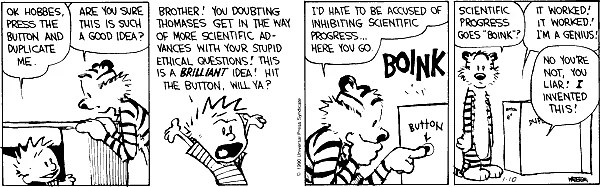
It’s very hard, historian of science Benjamin Breen explains, to understand the implications of a scientific revolution as one is living through it…
2023 is shaping up to be an important year in the history of science. And no, I’m not talking about the reputed room-temperature semiconductor LK-99, which seems increasingly likely to be a dud.
Instead, I’m talking about the discoveries you’ll find in Wikipedia’s list of scientific advances for 2023. Here are some examples:
• January: Positive results from a clinical trial of a vaccine for RSV; OpenAI’s ChatGPT enters wide use.
• February: A major breakthrough in quantum computing; announcement of a tiny robot that can clean blood vessels; more evidence for the ability of psychedelics to enhance neuroplasticity; major developments in biocomputers.
• March: OpenAI rolls out GPT-4; continued progress on mRNA vaccines for cancer.
• April: NASA announces astronaut crew who will orbit the moon next year; promising evidence for gene therapy to fight Alzheimer’s.
• May: Scientists use AI to translate brain activity into written words; promising results for a different Alzheimer’s drug; human pangenome sequenced (largely by a team of UCSC researchers — go Banana Slugs!); more good news about the potential of mRNA vaccines for fighting cancer.
And skipping ahead to just the past two weeks:
• nuclear fusion ignition with net energy gain was achieved for the second time
• a radical new approach to attacking cancer tumors entered Phase 1 trials in humans
• and — announced just as I was writing this [in August, 2023] — one of the new crop of weight loss drugs was reported to cut rates of heart attack and stroke in high-risk individuals by 20% (!).
Also in January of 2023: the New York Times asked “What Happened to All of Science’s Big Breakthroughs?”
The headline refers to an article published in Nature which argues that there has been a steady drop in “disruptive” scientific and technological breakthroughs between the years of 1945 and 2010. Basically, it’s a restatement of the concept of a “Great Stagnation” which was proposed by the economist Tyler Cowen in 2011. Though the paper cites everyone from Cowen to Albert Einstein and Isaac Newton, it’s worth noting that it doesn’t cite a single historian of science or technology (unless Alexandre Koyré counts)…
Naturally, as a historian of science and medicine, I think that there really are important things to learn from the history of science and medicine! And what I want to argue for the rest of this post boils down to two specific lessons from that history:
- People living through scientific revolutions are usually unaware of them — and, if they are, they don’t think about them in the same way that later generations do.
- An apparent slowdown in the rate of scientific innovation doesn’t always mean a slowdown in the impacts of science. The history of the first scientific revolution — the one that began in the famously terrible seventeenth century — suggests that the positive impacts of scientific innovation, in particular, are not always felt by the people living throughthe period of innovation. Periods when the pace of innovation appears to slow down may also be eras when society becomes more capable of benefitting from scientific advances by learning how to mitigate previously unforeseen risks.
[… There follows a fascinating look back at the 1660s– the “original” scientific revolution– at Boyle, Newton, at what they hoped/expected, and at how that differed for what their work and that of their colleagues actually yielded. Then the cautionary tale of Thomas Midgley..]
As we appear to be entering a new era of rapid scientific innovation in the 2020s, it is worth remembering that it often takes decades before the lasting social value of a technical innovation is understood — and decades more before we understand its downsides.
In the meantime, I’m pretty psyched about the cancer drugs…
As Thomas Kuhn observed, “The historian of science may be tempted to exclaim that when paradigms change, the world itself changes with them.”
On the difficulty of knowing the outcomes of a scientific revolution from within it: “Experiencing scientific revolutions: the 1660s and the 2020s,” from @ResObscura.
* Max Planck
###
As we try to see, we might spare a thought for William Seward Burroughs; he died on this date in 1898. And inventor who had worked in a bank, he invented the world’s first commercially viable recording adding machine and pioneered of its manufacture. The very successful company that he founded went on to become Unisys, which was instrumental in the development of computing… the implications of which we’re still discovering– and Burroughs surely never saw.
Nor, one reckons, did he imagine that his grandson, William Seward Burroughs II, would become the cultural figure that he did.

“Speed and acceleration are merely the dream of making time reversible”*…

In the early 20th century, there was Futurism…
The Italian Futurists, from the first half of the twentieth century… wanted to drive modernisation in turn-of-the-century Italy at a much faster pace. They saw the potential in machines, and technology, to transform the country, to demand progress. It was not however merely an incrementalist approach they were after: words like annihilation, destruction and apocalypse appear in the writings of the futurists, including the author of The Futurist Manifesto, Filippo Tomasso Marinetti. ‘We want to glorify war – the only cure for the world…’ Marinetti proclaimed – this was not for the faint hearted! That same Marinetti was the founder of the Partito Politico Futuristo in 1918, which became part of Mussolini’s Fascist party in 1919. Things did not go well after that.
“Beautiful Ideas Which Kill: Accelerationism, Futurism and Bewilderment“
And now, in the early 21st century, there is Accelerationism…
These [politically-motivated mass] killings were often linked to the alt-right, described as an outgrowth of the movement’s rise in the Trump era. But many of these suspected killers, from Atomwaffen thugs to the New Zealand mosque shooter to the Poway synagogue attacker, are more tightly connected to a newer and more radical white supremacist ideology, one that dismisses the alt-right as cowards unwilling to take matters into their own hands.
It’s called “accelerationism,” and it rests on the idea that Western governments are irreparably corrupt. As a result, the best thing white supremacists can do is accelerate their demise by sowing chaos and creating political tension. Accelerationist ideas have been cited in mass shooters’ manifestos — explicitly, in the case of the New Zealand killer — and are frequently referenced in white supremacist web forums and chat rooms.
Accelerationists reject any effort to seize political power through the ballot box, dismissing the alt-right’s attempts to engage in mass politics as pointless. If one votes, one should vote for the most extreme candidate, left or right, to intensify points of political and social conflict within Western societies. Their preferred tactic for heightening these contradictions, however, is not voting, but violence — attacking racial minorities and Jews as a way of bringing us closer to a race war, and using firearms to spark divisive fights over gun control. The ultimate goal is to collapse the government itself; they hope for a white-dominated future after that…
“Accelerationism: the obscure idea inspiring white supremacist killers around the world” (and source of the image above)
See also: “A Year After January 6, Is Accelerationism the New Terrorist Threat?“
For a look at the “intellectual” roots of accelerationism, see “Accelerationism: how a fringe philosophy predicted the future we live in.”
For a powerful articulation of the dangers of Futurism (and even more, Acclerationism), see “The Perils of Smashing the Past.”
And for a reminder of the not-so-obvious ways that movements like these live on, see “The Intentionally Scandalous 1932 Cookbook That Stands the Test of Time,” on The Futurist Cookbook, by Futurist Manifesto author Filippo Tommaso Marinetti… which foreshadowed the “food as fuel” culinary movements that we see today.
* Jean Baudrillard
###
As we slow down, we might send a “Alles Gute zum Geburtstag” to the polymathic Gottfried Wilhelm Leibniz, the philosopher, mathematician, and political adviser, who was important both as a metaphysician and as a logician, but who is probably best remembered for his independent invention of the calculus; he was born on this date in 1646. Leibniz discovered and developed differential and integral calculus on his own, which he published in 1684; but he became involved in a bitter priority dispute with Isaac Newton, whose ideas on the calculus were developed earlier (1665), but published later (1687).
As it happens, Leibnitz was a wry and incisive political and cultural observer. Consider, e.g…
If geometry conflicted with our passions and our present concerns as much as morality does, we would dispute it and transgress it almost as much–in spite of all Euclid’s and Archimedes’ demonstrations, which would be treated as fantasies and deemed to be full of fallacies. [Leibniz, New Essays, p. 95]

“Nothing in life is certain except death, taxes and the second law of thermodynamics”*…

The second law of thermodynamics– asserting that the entropy of a system increases with time– is among the most sacred in all of science, but it has always rested on 19th century arguments about probability. As Philip Ball reports, new thinking traces its true source to the flows of quantum information…
In all of physical law, there’s arguably no principle more sacrosanct than the second law of thermodynamics — the notion that entropy, a measure of disorder, will always stay the same or increase. “If someone points out to you that your pet theory of the universe is in disagreement with Maxwell’s equations — then so much the worse for Maxwell’s equations,” wrote the British astrophysicist Arthur Eddington in his 1928 book The Nature of the Physical World. “If it is found to be contradicted by observation — well, these experimentalists do bungle things sometimes. But if your theory is found to be against the second law of thermodynamics I can give you no hope; there is nothing for it but to collapse in deepest humiliation.” No violation of this law has ever been observed, nor is any expected.
But something about the second law troubles physicists. Some are not convinced that we understand it properly or that its foundations are firm. Although it’s called a law, it’s usually regarded as merely probabilistic: It stipulates that the outcome of any process will be the most probable one (which effectively means the outcome is inevitable given the numbers involved).
Yet physicists don’t just want descriptions of what will probably happen. “We like laws of physics to be exact,” said the physicist Chiara Marletto of the University of Oxford. Can the second law be tightened up into more than just a statement of likelihoods?
A number of independent groups appear to have done just that. They may have woven the second law out of the fundamental principles of quantum mechanics — which, some suspect, have directionality and irreversibility built into them at the deepest level. According to this view, the second law comes about not because of classical probabilities but because of quantum effects such as entanglement. It arises from the ways in which quantum systems share information, and from cornerstone quantum principles that decree what is allowed to happen and what is not. In this telling, an increase in entropy is not just the most likely outcome of change. It is a logical consequence of the most fundamental resource that we know of — the quantum resource of information…
Is that most sacrosanct natural laws, second law of thermodynamics, a quantum phenomenon? “Physicists Rewrite the Fundamental Law That Leads to Disorder,” from @philipcball in @QuantaMagazine.
* “Nothing in life is certain except death, taxes and the second law of thermodynamics. All three are processes in which useful or accessible forms of some quantity, such as energy or money, are transformed into useless, inaccessible forms of the same quantity. That is not to say that these three processes don’t have fringe benefits: taxes pay for roads and schools; the second law of thermodynamics drives cars, computers and metabolism; and death, at the very least, opens up tenured faculty positions.” — Seth Lloyd
###
As we get down with disorder, we might spare a thought for Francois-Marie Arouet, better known as Voltaire; he died on this date in 1778. The Father of the Age of Reason, he produced works in almost every literary form: plays, poems, novels, essays, and historical and scientific works– more than 2,000 books and pamphlets (and more than 20,000 letters). He popularized Isaac Newton’s work in France by arranging a translation of Principia Mathematica to which he added his own commentary.
A social reformer, Voltaire used satire to criticize the intolerance, religious dogma, and oligopolistic privilege of his day, perhaps nowhere more sardonically than in Candide.

You must be logged in to post a comment.