Posts Tagged ‘history of science’
“Am I as admirable as that ant?”*…
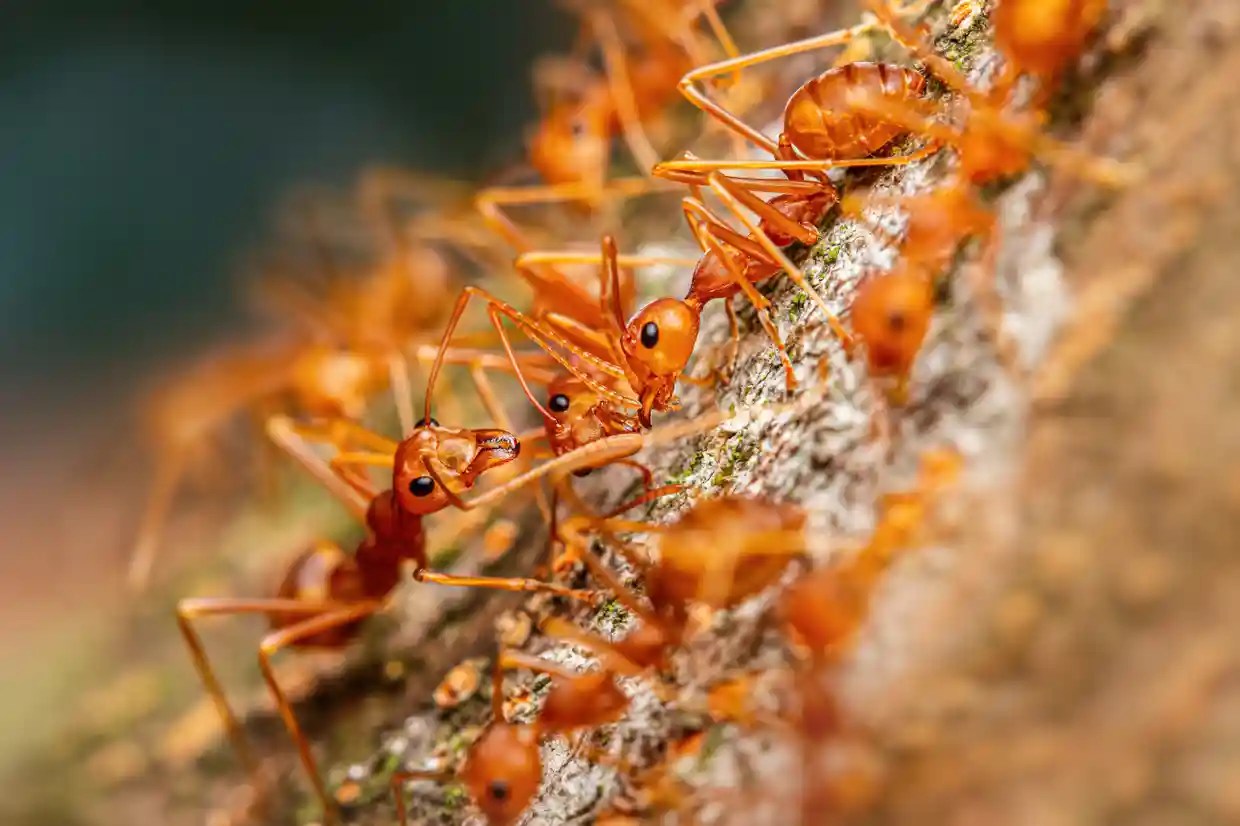
There are lots of ants on earth. And, as Anna Turns explains, they play a big role as ecosystem engineers– as well as providing insights on everything from the climate to aging…
To most of us, they are small, uninteresting and sometimes annoying, but 2022 revealed just how ubiquitous ants are and how indispensable they are to the planet. Scientists revealed in September that there are an estimated 20 quadrillion (or 20 million billion) ants globally – that’s 2.5 million for every person on the planet.
More than 12,000 known species of ant live in all sorts of habitats, from the Arctic to the tropics and they represent one of the most diverse, abundant and specialist groups of animals on the planet. Leafcutter ants are fungus farmers, slave-making ants capture broods to increase their work force, while wood ants herd aphids to the juiciest parts of a plant to harvest their honeydew sap…
Experts agree that ants are ecosystem engineers because they play a crucial role in decomposing organic matter, recycling nutrients, improving soil health, removing pests and dispersing seeds. But, historically, ants haven’t attracted as much attention as crop pollinators, such as bees, which perhaps have more of an obvious economic value. That bias could soon change. Ants have been used as a biological pest control on citrus crops in China for centuries, and research published in August indicates that the pest control potential of some predatory ants could work better than some agricultural chemicals.
The wonders of ant biology throw up plenty of other possibilities for real-world applications. Queen ants that live more than 30 years – yet have the same genetic material as a short-lived worker ant – could teach us something about senescence. Nobody understands how queens store sperm for decades inside their bodies without any degradation, despite colonies living in different climates. Meanwhile, Schultheiss’ [Dr Patrick Schultheiss, of the University of Würzburg] research into ant navigation – how they find food and how they behave when they get lost – could help build mathematical models that instruct a robot searching for missing people.
Looking back at how ants evolved can shed light on a huge array of other plants and animals, too. Butterflies that rely on ants to tend to their caterpillars could disappear if those ants are wiped out, says Corrie Moreau, a professor at Cornell University: “Nature is this intricate woven tapestry and if you pull one thread, you’ll never know which is the critical thread that makes the whole thing fall apart.”…
“Insects and us: a mind-blowing 20 quadrillion ants and what they mean for the planet,” from @AnnaTurns in @guardian.
###
As we get antsy, we might spare a thought for Swedish botanist Carl Linné, better known as Carolus Linnaeus, “the Father of Taxonomy,” died on this date in 1778. Historians suggest that the academically-challenged among us can take heart from his story: at the University of Lund, where he studied medicine, he was “less known for his knowledge of natural history than for his ignorance of everything else.” Still, he made is way from Lund to Uppsala, where he began his famous system of plant and animal classification– still in use today.

“Nearly all the grandest discoveries of science have been but the rewards of accurate measurement”*…

… and, as Christie Aschwanden explains in her consideration of James Vincent‘s new book, Beyond Measure, that progress has been hard won– and has had cultural consequence…
… [Swiss meteorologist Jean-André de Luc] set out to find the true boiling point of water, but instead of finding a single answer to the question, de Luc instead found “only a multitude of phenomena forced into homogeneity by this single, restrictive term,” Vincent writes. (Scientists eventually turned to the steam produced by boiling water as a more reliable measure of temperature.)
And so it has gone with many types of measurements, Vincent observes. “The quest for precision — the desire to burrow ever more closely into the weft of reality — unveils only irregularity on a far greater scale.” The same might be said of science writ large, and Vincent’s recounting of the development of some science’s most well-used measures are classic tales in the history of scientific discovery. The meter, for instance, was originally intended as a unit of distance based on the Earth’s meridian until careful surveys showed that these meridians weren’t as perfect and unchanging as previously believed.
“Beyond Measure”offers engrossing accounts of the role that measurement has played in scientific progress, including its roles in medicine, math, and quantum mechanics, but the book is about much more than science. Vincent also presents a deep history of measurement’s role in society. “Measurement is not an intrinsic feature of the world, but a practice invented and imposed by humanity,” he writes.
Throughout human history, measurement has often provided a means for exerting power. For instance, the Roman Empire created a method for measuring land called the centuriatio that divided territory into grids. The system “not only simplified property rights and tax collection,” but also provided a way to portion out farmland to veterans and make roads amenable for marching troops, Vincent writes: “The survey, in other words, helped fund, direct, and reward Rome’s imperial war machine.”…
How the quest to quantify has shaped scientific progress and human society: “The Surpisingly Imprecise History of Measurement“- @cragcrest on @jjvincent in @undarkmag.
[Image above: source]
* Lord Kelvin
###
As we contemplate quantification, we might send carefully-measured birthday greetings to Malcolm Purcell McLean; he was born on this date in 1914. A transportation entrepreneur, he parlayed his experience as a trucker into the development of the modern shipping container— which revolutionized transport and international trade in the second half of the twentieth century. Containerization led to a significant reduction in the cost of freight transportation by eliminating the need for repeated handling of individual pieces of cargo, and also improved reliability, reduced cargo theft, and cut inventory costs (thus, working capital needs) by shortening transit time.
When McLean died in 1987, then Secretary of Transportation Norm Minetta said:
Malcom revolutionized the maritime industry in the 20th century. His idea for modernizing the loading and unloading of ships, which was previously conducted in much the same way the ancient Phoenicians did 3,000 years ago, has resulted in much safer and less-expensive transport of goods, faster delivery, and better service. We owe so much to a man of vision, “the father of containerization,” Malcolm P. McLean.
In an editorial shortly after his death, the Baltimore Sun wrote that “he ranks next to Robert Fulton as the greatest revolutionary in the history of maritime trade,” and Forbes Magazine called McLean “one of the few men who changed the world.” On the morning of McLean’s funeral, container ships around the world blew their whistles in his honor.

“Science is a way of thinking much more than it is a body of knowledge”*…

Geoff Anders unpacks the the social, cultural, and political dilemma facing science…
In November of 1660, at Gresham College in London, an invisible college of learned men held their first meeting after 20 years of informal collaboration. They chose their coat of arms: the royal crown’s three lions of England set against a white backdrop. Their motto: “Nullius in verba,” or “take no one’s word for it.” Three years later, they received a charter from King Charles II and became what was and remains the world’s preeminent scientific institution: the Royal Society.
Three and a half centuries later, in July of 2021, even respected publications began to grow weary of a different, now constant refrain: “Trust the science.” It was a mantra everyone was supposed to accept, repeated again and again, ad nauseum.
This new motto was the latest culmination of a series of transformations science has undergone since the founding of the Royal Society, reflecting the changing nature of science on one hand, and its expanding social role on the other.
The present world’s preeminent system of thought now takes science as a central pillar and wields its authority to great consequence. But the story of how that came to be is, as one might expect, only barely understood…
How “science” has become a political and cultural lightning rod, and what we can do about it: “The Transformations of Science,” from @geoffanders in @palladiummag.
Apposite (and sad): RIP, Bruno Latour.
* Carl Sagan
###
As we excavate epistemology, we might recall that it was on this date in 1916 that Margaret Sanger, her sister, Ethel Byrne, both nurses, and an associate, Fania Mindell opened the Brownsville Clinic in Brooklyn– the first family planning and birth control clinic in the United States. (The first such clinic in the world opened in Amsterdam in 1885.) The police quickly closed the facility; Sanger served 30 days in jail. But she and her colleagues gamely re-opened; and in 1917, Sanger helped organize the National Birth Control League, which would later become the Planned Parenthood Federation of America.

“What is the pattern that connects the crab to the lobster and the primrose to the orchid, and all of them to me, and me to you?”*…

Crab-like body plans have evolved independently at least five times. As Jason P. Dihn explains, biologists are still trying to figure out exactly why…
In 1989, paleontologist Stephen Jay Gould proposed a thought experiment: What would the world look like if we turned back time and replayed the evolutionary tape? “I doubt that anything like Homo sapiens would ever evolve again,” he concluded. Maybe not. But crabs might.
Evolution just can’t stop creating crabs. Believe it or not, the flat-and-wide body plan has evolved at least five different times. The process is called carcinization, and it’s inspired comics, memes and entire subreddits.
Still, biologists don’t know why crabs keep evolving. Figuring it out would satisfy the online masses, sure, but it would also be a step toward solving other important scientific mysteries. For instance, why some species share evolutionary paths while others forge unique ones (looking at you, platypus)…
Convergent evolution: “Evolution Only Thinks About One Thing, and It’s Crabs,” from @JasonPDinh in @DiscoverMag.
Will crabs need to (re-)evolve a sixth time? “Alaska’s snow crabs have disappeared. Where they went is a mystery.”
(Image above: source)
* Gregory Bateson
###
As we fiddle with phylogeny, we might spare a thought for Walter Rothschild, 2nd Baron Rothschild; he died on this date in 1937. A British banker, politician and soldier, he is best remembered for his pursuit of his passion— zoology and his collection of species. At its largest, Rothschild’s collection included 300,000 bird skins, 200,000 birds’ eggs, 2,250,000 butterflies and 30,000 beetles, as well as thousands of specimens of mammals, reptiles, and fishes. They formed the largest zoological collection ever amassed by a private individual (and are now part of the Natural History Museum). He named dozens of animal taxa, published Novitates Zoologicae, and authored or co-authored scores of scientific papers.
Related: “How Bird Collecting Evolved Into Bird-Watching.”

“Simplicity is the ultimate sophistication”*…

Sometimes less is more…
Scientists have identified evolutionary modifications in the voice box distinguishing people from other primates that may underpin a capability indispensable to humankind – speaking.
Researchers said… an examination of the voice box, known as the larynx, in 43 species of primates showed that humans differ from apes and monkeys in lacking an anatomical structure called a vocal membrane – small, ribbon-like extensions of the vocal cords.
Humans also lack balloon-like laryngeal structures called air sacs that may help some apes and monkeys produce loud and resonant calls, and avoid hyperventilating, they found.
The loss of these tissues, according to the researchers, resulted in a stable vocal source in humans that was critical to the evolution of speech – the ability to express thoughts and feelings using articulate sounds. This simplification of the larynx enabled humans to have excellent pitch control with long and stable speech sounds, they said.
…
Sound production mechanisms in people and nonhuman primates are similar, with air from the lungs driving oscillations of the vocal cords. Acoustical energy generated this way then passes through the pharyngeal, oral and nasal cavities and emerges in a form governed by the filtering of specific frequencies dictated by the vocal tract.
“Speech and language are critically related, but not synonymous,” said primatologist and psychologist Harold Gouzoules of Emory University in Atlanta, who wrote a commentary in Science accompanying the study. “Speech is the audible sound-based manner of language expression – and humans, alone among the primates, can produce it.”
Paradoxically, the increased complexity of human spoken language followed an evolutionary simplification.
“I think it’s pretty interesting that sometimes in evolution ‘less is more’ – that by losing a trait you might open the door to some new adaptations,” Fitch said…
“Pivotal evolutionary change helped pave the way for human speech,” from Will Dunham @Reuters.
[Image above: source]
* Leonardo da Vinci
###
As we simpify, we might send thoughtfully-analyzed birthday greetings to Karl Gegenbaur; he was born on this date in 1826. An anatomist and professor, he was the first to demonstrate that the field of comparative anatomy offers important evidence supporting of the theory of evolution— of which, he became one of Europe’s leading proponents.
Gegenbaur’s book Grundzüge der vergleichenden Anatomie (1859; English translation: Elements of Comparative Anatomy) became the standard textbook, at the time, of evolutionary morphology, emphasizing that structural similarities among various animals provide clues to their evolutionary history. In a way that prefigured the research featured above, Gegenbaur noted that the most reliable clue to evolutionary history is homology, the comparison of anatomical parts which have a common evolutionary origin.

You must be logged in to post a comment.