Posts Tagged ‘health’
“Dust to dust”*…
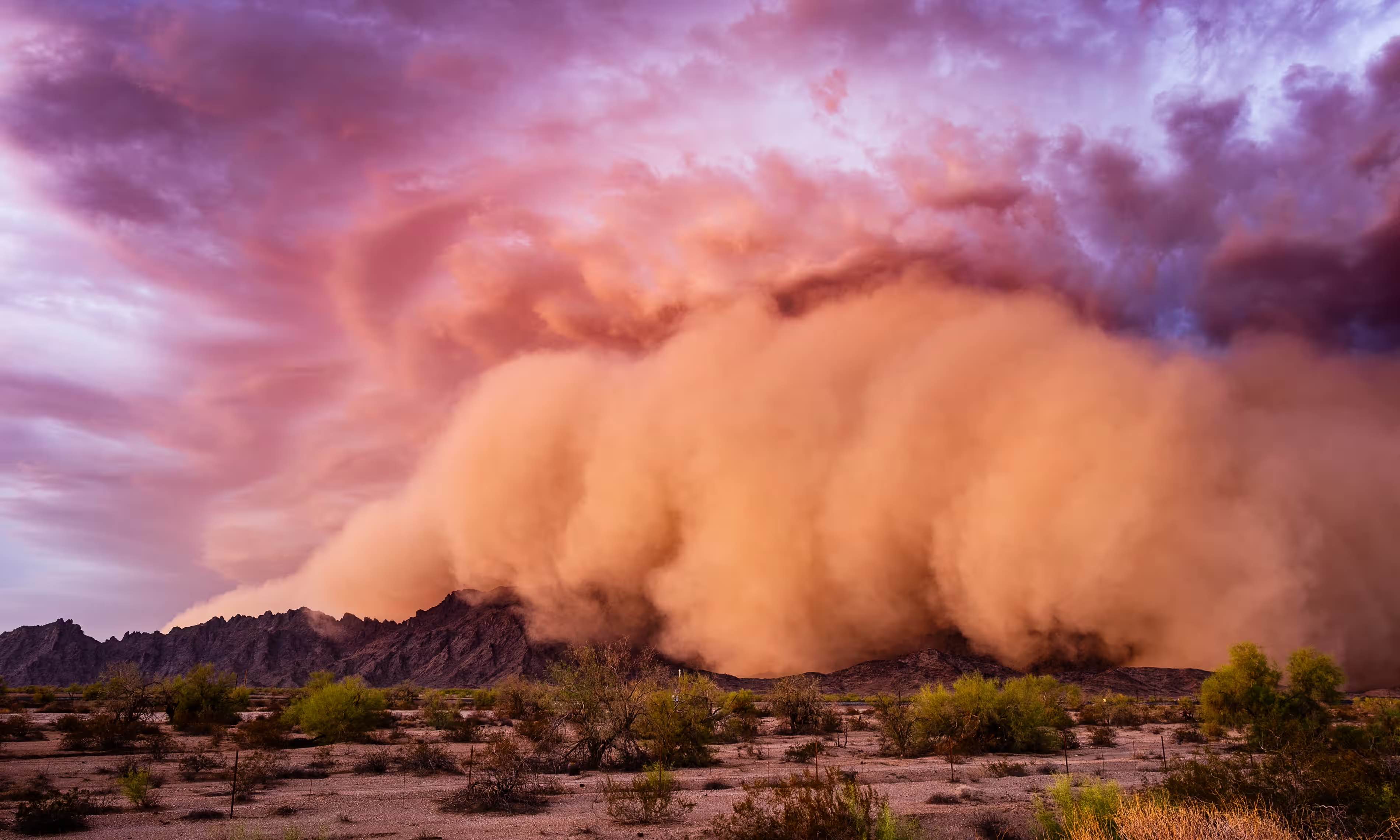
Back in 2016, we visited Jay Owens and his fascinating newsletter on dust… which went silent a couple of years later. Those of us who missed it, and were worried about its author were relieved to learn that he’d pulled back in order to turn his thinking into a book. That book is now here: Dust: The Modern World in a Trillion Particles, and The Guardian is here with an excerpt…
… Nobody normally thinks about dust, what it might be doing or where it should go: it is so tiny, so totally, absolutely, mundane, that it slips beneath the limits of vision. But if we pay attention, we can see the world within it.
Before we go any further, I should define my terms. What do I mean by dust? I want to say everything: almost everything can become dust, given time. The orange haze in the sky over Europe in the spring, the pale fur that accumulates on my writing desk and the black grime I wipe from my face in the evening after a day traversing the city. Dust gains its identity not from a singular material origin, but instead through its form (tiny solid particles), its mode of transport (airborne) and, perhaps, a certain loss of context, an inherent formlessness. If we knew precisely what it was made of, we might not call it dust, but instead dander or cement or pollen. “Tiny flying particles,” though, might suffice as a practical starting definition…
…
Dust is simultaneously a symbol of time, decay and death – and also the residue of life. Its meaning is never black or white, but grey and somewhat fuzzy. Living with dust – as we must – is a slow lesson in embracing contradiction: to clean, but not identify with cleanliness; to respect the material need for hygiene while distrusting it profoundly as a social metaphor…
A fascinating sample of a fascinating book: “Empire of dust: what the tiniest specks reveal about the world,” from @hautepop in @guardian.
Pair with: “Nothing is built on stone; all is built on sand” and “In every grain of sand there is the story of the earth.”
* from the burial service in the Book of Common Prayer
###
As we examine the elemental, we might send exploratory birthday greetings to Friedrich Wilhelm Heinrich Alexander von Humboldt; he was born on this date in 1769. The younger brother of the Prussian minister, philosopher, and linguist Wilhelm von Humboldt, Alexander was a geographer, geologist, archaeologist, naturalist, explorer, and champion of Romantic philosophy. Among many other contributions to human knowledge, his quantitative work on botanical geography laid the foundation for the field of biogeography; he surveyed and collected geological, zoological, botanical, and ethnographic specimens, including over 60,000 rare or new tropical plants.
As a geologist, Humboldt made pioneering observations of geological stratigraphy, structure (he named the Jurassic System), and geomorphology; and he understood the connections between volcanism and earthquakes. His advocacy of long-term systematic geophysical measurement laid the foundation for modern geomagnetic and meteorological monitoring.
For more, see: The Invention of Nature: Alexander Von Humboldt’s New World.

“Leaves of Three, Leave Them Be”*…

Gabrielle Emanuel on the one of climate change’s winners– the hiker’s scourge, poison ivy…
Over a decade ago, when Peter Barron started removing poison ivy for a living, he decided to document his work.
“Every year I always take pictures of the poison ivy as it’s blooming,” said Barron, who is better known as Pesky Pete, of Pesky Pete’s Poison Ivy Removal.
He still remembers the photos he took of the very first tiny, red, shiny poison ivy leaves popping out in Massachusetts and southern New Hampshire.“
When I first started, it was May 10 or May 11,” he remembered. “I was so excited. I was like, ‘Wow, the season is here’.”
Now, if he lines up all his photos from 14 years, the first sighting comes almost a month earlier. In 2023, his first glimpse was on April 18.
Barron may have unwittingly documented an effect of climate change.
Poison ivy is poised to be one of the big winners in this global, human-caused phenomenon. Scientists expect the dreaded three-leafed vine will take full advantage of warmer temperatures and rising levels of carbon dioxide in the atmosphere to grow faster and bigger — and become even more toxic.
Experts who have studied this plant for decades warn there are likely to be implications for human health. They say hikers, gardeners, landscapers and others may want to take extra precautions — and get better at identifying this plant — to avoid an itchy, blistering rash…
Ugh: “Bigger, earlier and itchier: Why poison ivy loves climate change,” from @gabrieman and @WBUR.
* Adage
###
As we cache cortisone cream, we might send carefully-calibrated birthday greetings to Guillaume Amontons; he was born on this date in 1663. A physicist and scientific instrument inventor, he developed the air thermometer – which relies on increase in volume of a gas (rather than a liquid) to measure temperature – and used it (in 1702) to measure change in temperature in terms of a proportional change in pressure. This observation led to the concept of absolute zero in the19th century.
Deaf from childhood, Amontons worked on inventions for the hearing impaired, among them the first telegraph, which relied on a telescope, light, and several stations to transmit information over large distances. And Amontons’ laws of friction, relied upon by engineers for 300 years, state that the frictional force on a body sliding over a surface is proportional to the load that presses them together and is independent of the areas of the surfaces.

“Thousands have lived without love, not one without water”*…

Katherine LaGrave with the story of America’s first water sommelier believes that the more we think about what we drink, the more we will care about the planet. But first, he has to get people to take him seriously…
… Martin Riese, is America’s first water sommelier, curating menus and tastings around what he calls “the most important beverage on the planet.”…
Riese is taking cues from the element he considers most beloved, going with the flow and flowing where he’s able, taking opportunities as they come, and sharing why we should care about water with anyone who cares to listen.
“Water is not just water,” he says to me one sunny October afternoon, shining bright from Los Angeles via laptop with the urgency of a theater attendant walking you to your seat just before the lights dim and the show starts. OK, I think. Off we go. Down into waterworld…
A trip worth taking- Riese’s story and his provocative thoughts on that most crucial substance: “Waterworld,” from @kjlagrave in @AFARmedia.
* W. H. Auden
###
As we get wet, we might recall that on this date in 1993, after weeks of flooding elsewhere in the state (dramatically, in Ames), efforts to protect Valley Junction in West Des Moines from flooding failed, forcing 5,000 people from their homes. The Court Avenue district in downtown Des Moines was awash. By the next day, more than 250,000 people were without water after flooding shut down the Des Moines Water Works. In addition, An estimated 35,000 to 40,000 people were without electricity. Then-Sec Taylor Stadium, now the Iowa Cubs’ Principal Park, was underwater. The entire state was declared a disaster area.

“A cigarette is a pinch of tobacco rolled in paper with fire at one end and a fool at the other”*…

Any number of social and culture issues that one might have thought resolved, have come unraveled over the last decade or so; issues thought resolved are again open. Max Read suggests (in a not altogether tongue-in-cheek way) that smoking might be next…
One way of thinking about this newsletter (Read Max) is as equities analysis for the discursive marketplace, answering important questions for the armchair take trader: What discourses have peaked? What concepts should you short? How are you balancing your take portfolio?
My longtime professional and personal experience as a poster has left me adept at seeing the hidden structures that lurk behind the peaks and valleys of “the discourse”; paid subscribers in particular are well-positioned to profit from the insight offered by Read Max’s sophisticated and proprietary models.
For a while now, Read Max analysts have been intrigued by what is often called on Twitter “smoking discourse,” as in “cigarettes.” Now, following certain recent events on Twitter, we’re prepared to advise clients that we believe strong “pro-smoking” positions grounded in socio-political identities are poised to have a “moment” soon. Our analysis indicates that certain structural factors are in place to encourage arguments like “smoking is good for society, actually” and “anti-smoking laws are bad science/policy” to move past “trolling” and be adopted as common sense by a loose confederation of IDW [“intellectual dark web”] Substackers, trad nutritionists, and downtown cool kids, building on the ties formed between these groups around the COVID-19 pandemic…
Read on for a too-plausible take on the future of public debate: “The coming pro-smoking discourse,” from @readmaxread.
* George Bernard Shaw
###
As we brush away the ashes, we might recall that it was on this date in 1962 that recently-appointed Surgeon General Luther L. Terry announced that he would convene a committee of experts to conduct a comprehensive review of the scientific literature on the smoking question. In June 1961, the American Cancer Society, the American Heart Association, the National Tuberculosis Association, and the American Public Health Association had addressed a letter to President John F. Kennedy, in which they called for a national commission on smoking, dedicated to “seeking a solution to this health problem that would interfere least with the freedom of industry or the happiness of individuals.” The Kennedy administration responded the following year (after prompting from a widely circulated critical study on cigarette smoking by the Royal College of Physicians of London).
Terry issued the commission’s report– highlighting the deleterious health consequences of tobacco use– on January 11, 1964, choosing a Saturday to minimize the effect on the stock market and to maximize coverage in the Sunday papers. As Terry remembered the event, two decades later, the report “hit the country like a bombshell. It was front page news and a lead story on every radio and television station in the United States and many abroad.”

“I don’t believe in astrology; I’m a Sagittarius and we’re skeptical.”*…

(Roughly) Daily has looked at almanacs before (e.g., here and here), but never with an eye to their astrological underpinnings. Livia Gershon plugs that gap…
Some Christians today see astrology as a clear affront to their beliefs, and possibly a dangerous manifestation of the occult. And yet, as historian T.J. Tomlin writes, through the eighteenth century, it was a central aspect of the almanacs that were ubiquitous in Protestant American homes.
By 1800, Tomlin writes, U.S. printers produced enough almanacs to provide one to every household in the country. People turned to the books for a clear, simple idea of how the universe worked. Their astrological calculations helped readers gain practical know-how about agricultural management, weather, and personal health.
…
Like the study of the natural world in general in that time and place, almanacs were rooted in Protestantism. They presented simple, widely held religious ideas—God’s power, redemption through Christ, the promise of heaven—to an increasingly literate public. “This was the liturgy of early American popular culture,” Tomlin writes.
But there were debates about what sort of astrology was compatible with this religious belief. “Natural astrology,” using the movements of heavenly bodies to draw conclusions about agriculture, medicine, and the weather, was widely regarded as “a way to illuminate God’s creative impulse in the universe,” Tomlin writes. But “judicial astrology,” predicting the events of individual lives or political affairs, might be seen as blasphemous…
Wildly popular, almanacs helped people understand farming and health through the movement of the planets, in a way compatible with their faith: “The Protestant Astrology of Early American Almanacs,” from @LiviaGershon in @JSTOR_Daily.
* Arthur C. Clarke
###
As we study the stars, we might send multi-faceted birthday greetings to the painter, sculptor, architect, musician, mathematician, engineer, inventor, physicist, chemist, anatomist, botanist, geologist, cartographer, and writer– the archetypical Renaissance Man– Leonardo da Vinci. Quite possibly the greatest genius of the last Millennium, he was born on this date in 1452.
While Leonardo’s attention (and thus his notebooks) extended to astronomy, there’s no evidence that he believed in astrology. That said, his chart has been cast myriad times (e.g., here).

Self-portrait in red chalk, circa 1512-15 [source]
You must be logged in to post a comment.