Posts Tagged ‘health’
“Energy is essential for development, and sustainable energy is essential for sustainable development”*…

Adam Tooze on the challenges of a transition to clean energy…
As far as we are currently able to judge, our best chance to halt the further escalation of the climate crisis through decarbonization of the economy depends on electricity and electrification. Given the current horizon of technological expectations, electric power and electric technology offer us the best chance of reconciling the insatiable desire for energy with the stretched and frayed environmental envelope.
Electricity today is still a major driver of environmental disaster. This is because it is overwhelmingly generated by burning fossil fuels and coal in particular. It is in fact, the largest single source of pollution, more than fossil-fueled powered transport or agriculture. Not only do they contribute to climate change, emissions from coal-fired power stations around the world are so toxic that they kill millions of people annually. But electricity is one form of energy that we do know how to generate without CO2 emissions, most obviously by solar, wind, hydro or nuclear generation. So, the path to a low-carbon future depends on greening the electricity generation system and at the same time expanding the total volume of electric power generated so that we can apply clean electric power to more purposes than we currently do.
This will involve accelerating and redirecting the process of electrification that has proceeded unevenly across the globe for one hundred and forty years…
“Repowering the world- the challenge of electrification,” from @adam_tooze in his newsletter Chartbook.
See also Electrify- An Optimist’s Playbook for Our Clean Energy Future, by Saul Griffith (@GriffithSaul) and “Mapped: Asia’s Biggest Sources of Electricity by Country.”
* Tim Wirth
###
As we plug in, we might spare a thought for Hans Christian Ørsted; he died on this date in 1851. A physicist and chemist, he discovered that electric currents create magnetic fields– the first connection found between electricity and magnetism… the foundation on which electric motors operate. Considered the “father of electromagnetism,” Oersted’s law and the oersted unit (Oe) are named after him.

“I like coffee because it gives me the illusion that I might be awake”*…

It’s Monday morning, an occasion to contemplate the favored fuel of the workday. Here, a late 18th century treatise..
How did coffee become so popular in the Middle East, turning the Yemeni port city of Mokha into a global marketplace of beans for nearly three centuries? Benjamin Moseley, eighteenth-century physician and early anti-vaxxer, offers an origin story for coffee culture in the expanded fifth edition of his Treatise Concerning the Properties and Effects of Coffee (1792). Noting that the account is a “ludicrous tale”, he nevertheless reproduces it in full. One night a Yemeni goat herder found his flock restless. They would not sleep, but “jumped and frisked about as if they had been infatuated”. The herder summons a religious official from the local mosque, who notices that the goats had foraged on “shrubs and berries [that] had always been considered among the wild and useless productions of the earth”. Intrigued, the holy man goes home and steeps himself a cup, which he “supped off hot”. Soon he too “began to dance and frisk about as the goats had done”. After the jitters wane, the man’s thoughts turn back to God, and he realizes that this concoction would “be an excellent thing to keep the Dervishes awake, when their duty obliged them to pray after dinner”. The experiment was an “utmost success” and soon the drink spread through every nearby nation and “among all the religious of the East.”
Moseley was the eighteenth-century precursor to today’s third-wave connoisseur. He had strong opinions on roasting that might still hold water — “the closer it is confined at the time of roasting, and till used, the better will its volatile pungency, flavour, and virtues, be preserved” — and high standards of taste: following François Bernier, he relates that only two people in 1650s Cairo were capable of making a proper brew. As a practicing physician, Moseley’s interest in coffee was mostly medical and, although these debates still continue, he had little time for the uncaffeinated. In a terribly-aged analogy, he compares coffee alarmists to those who raise “declamations against mercury” and “nonsense against tobacco” — equally bunk. Some of the proclaimed benefits of coffee are familiar. It combats “lethargy, catarrh, and all disorders of the head”. It “accelerates the process of digestion”, affects “the gastric powers”, and “diffuses a genial warmth that cherishes the animal spirits, and takes away the listlessness and languor”. It also helps hangovers: that “disorderly condition brought on by drinking bad fermented liquors, and new rum, to excess”. Other benefits are perhaps less well-known today. If bedridden with “bloody flux” or dysentery, drink four cups of hot coffee and cover yourself with heavy bed clothes — you will soon be cured through perspiration; for messengers commuting long distances, “the alternate effects of opium and coffee” can sooth “their tedious journies”. Aside from a caution to pregnant women and those with serious illnesses, the only negative account of coffee in this hundred-page treatise comes from a person Moseley met in Leyden: he “seldom drank much coffee, or continued the use of it for several days successively, without having a hæmorrhage from the nose.”
When the first edition of Moseley’s treatise appeared in the 1780s, Europe’s urbanites had been hooked on coffee for more than a century. London’s original coffee house opened in 1652; the French, who “knew nothing of it until 1645”, could enjoy a public café in Marseilles come 1671. As Matthew Green details, these were intoxicating spaces where strangers mingled and discussed news, politics, scholarship, and everything in between…
[Indeed, the London Stock Exchange was born in Jonathan’s Coffee House (later, Garraway’s coffee house), as stock trading was not allowed in the Royal Exchange. Until the LSE went fully electronic, the clerks who carried orders and papers to and from brokers were still called “waiters,” the title by which they are still known at Lloyds of London, which had a similar genesis.]
A 1792 appreciation: “A Treatise Concerning the Properties and Effects of Coffee,” from @PublicDomainRev. Read the Treatise at the Internet Archive (@internetarchive).
On a more modern note: “Nope, coffee won’t give you extra energy. It’ll just borrow a bit that you’ll pay for later.”
(Image above: source)
* Lewis Black
###
As we contemplate the cuppa, we might spare a thought for Prospero Alpini; he died on this date in 1617. A Venetian physician and botanist, he wrote several botanical treatises, many based on his travels in the Middle East, which covered exotic plants of economic and medicinal value. Because his description of coffee and banana plants are considered the oldest in European literature, he is said to have introduced them to the continent. (He was also the first to artificially fertilize date palms.)

“The Times They Are A-Changin’”*…

If the 20th century belonged to physics, the 21st will, many argue, belong to biology… and, as Matthew Herper argues, it’s not clear that we’re ready…
The first time I remember hearing the words “biology’s century,” it was a sales pitch.
I was standing by the Long Island Sound in Sachem’s Head, Conn., in the shadow of an 11-foot-tall granite Stonehenge replica built by Jonathan Rothberg, a biotech entrepreneur, as he talked up his newest gadget, a tabletop DNA sequencer. It was 2010.
Near his monument to the ancient past, Rothberg was conjuring a vision of the future, one based on harnessing the power of biology and technology to transform the world. The phrase he uttered wasn’t new, having been in circulation since the Human Genome Project in the 1990s, and I’d been covering biotech for a decade. But that was the moment the phrase sunk in. I added it to my Twitter bio, where it has remained.
Over the next decade, I’d see even more amazing things. Genetically altered white blood cells that can cure cancer. A gene therapy that gave sight to blind children. Pills that wrench decades of life from a cancer death sentence or ease the breathing of patients with cystic fibrosis. And, of course, not one but several effective Covid-19 vaccines created only a year into a once-in-a-century pandemic.
Here’s what “biology’s century” means to me: In the same way the 20th century belonged to physics, the 21st is biological. But while physics in the 20th century brought airplanes, personal computers, and posters of Albert Einstein, it also meant the atom bomb and a complete transformation of the social order.
Now, we’re approaching a moment when changes in what we understand about biology are every bit as exhilarating and terrifying…
Eminently worth reading in full: “Here’s why we’re not prepared for the next wave of biotech innovation,” from @matthewherper in @statnews.
* Bob Dylan
###
As we get wet, we might send healing birthday greetings to Thomas Cech; he was born on this date in 1947. A chemist, he is best known for his discovery, with Sidney Altman, of the catalytic properties of RNA– for which they were awarded the 1989 Nobel Prize in Chemistry. Cech discovered that RNA could itself cut strands of RNA, suggesting that life might have started as RNA– and paving the way for the development of mRNA vaccines like the ones that have stemmed the tide of COVID.
Cech also studied telomeres; his lab discovered an enzyme, TERT (telomerase reverse transcriptase), which is part of the process of restoring telomeres after they are shortened during cell division. (a process central to aging).
From 2000-2008, Cech served as president of the Howard Hughes Medical Institute, one of the largest private funding organizations for biological and medical research in the United States.

“Infant mortality and life expectancy are reasonable indicators of general well-being in a society”*…
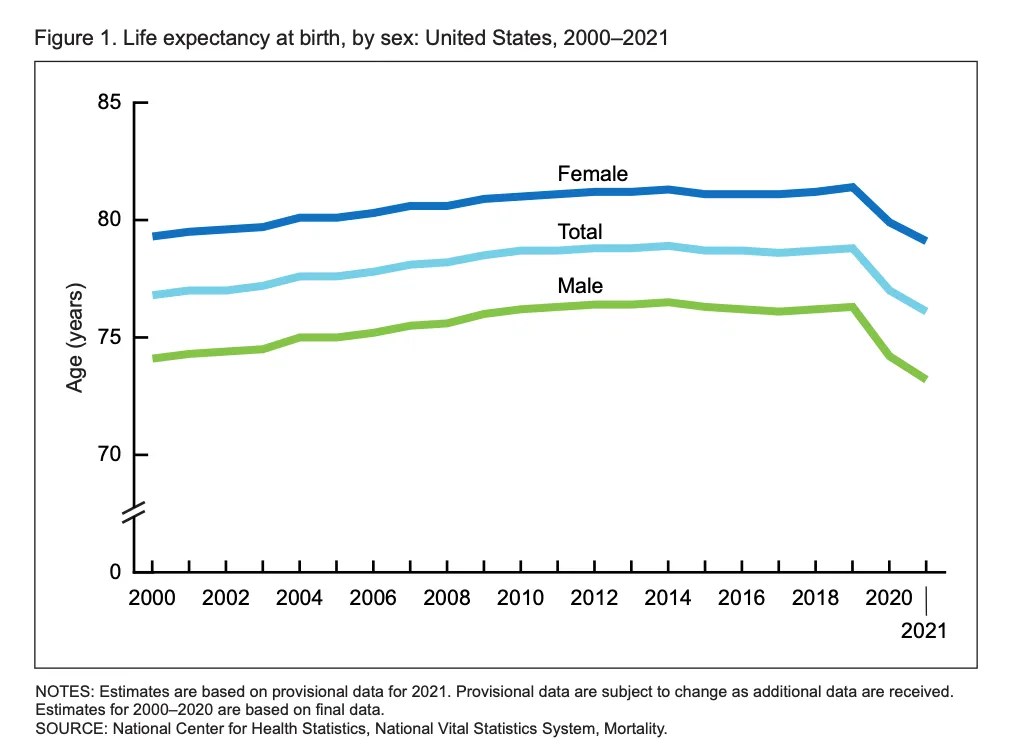
… and in the U.S., as Adam Tooze explains, we’re doing not so well of late…
In August America’s Center for Disease Control (CDC) published a set of data that ought to have brought political, economic and social debate to a standstill. If there is one question that should surely dominate public policy debate, it is the question of life and death. What did the Declaration of Independence promise, after all, if not “life, liberty and the pursuit of happiness”. But on that score the CDC in 2022 delivered alarming news. In the last three years, life expectancy in the United States has plunged in a way not seen at any point in recent history.
America is inured to bad news about its health. Life expectancy in the United States has stagnated since 2011, a trend which separates the United States not just from rich peer countries but from most other countries in the world, rich or poor.
Given economic growth and advances in medicine for life expectancy to stagnate requires serious headwinds. In the United States those headwinds include, homicides and suicides, the opioid epidemic (so-called deaths of despair) car accidents and obesity. As John Burn-Murdoch shows in the FT, without those factors the US would have tracked its peer societies much more closely…

But stagnation is one thing, the collapse since 2019 is a phenomenon of a different quality. It is a full measure of the disaster that was the COVID pandemic in the United States. Over a million Americans died of COVID, one of the worst outcomes on the planet.
…
…it is not only China that has overtaken the United States based on this metric. In 2021 Cuba has a higher life expectancy than the US. So does Albania.
In a society marked by inequality as deep as modern America’s, to speak in terms of national averages is not very meaningful. The circumstances of life and health outcomes are vastly different…

…One might think that faced with these stark facts all other subjects of political debate would pale into insignificance. Whatever else a society should do, whatever else a political system promises, it should ensure that its citizens have a healthy life expectancy commensurate with their nation’s overall level of economic development. An ambitious society should aim to do more, as Japan does for instance. Judged by this basic metric, the contemporary United States fails and for a substantial minority of its population, it fails spectacularly. And yet that extraordinary and shameful fact barely registers in political debate, a silence that is both symptom and cause.
“Life, liberty and the pursuit of happiness? How China, Cuba and Albania came to have higher life expectancy than the USA,” from @adam_tooze. Eminently worth reading in full.
For an example of the ways in which these wounds are self-inflicted: “The Human Psyche Was Not Built for This.”
* P. J. O’Rourke
###
As we ponder priorities, we might recall that it was on this date in 1892 that the first diagnostic public heath laboratory in the U.S. was founded by New York City (as its “Division of Pathology, Bacteriology and Disinfection”). Spurred by the cholera epidemic of the time, it soon took on the diagnosis and tracing of diphtheria and tuberculosis; in 1895, it began production of a smallpox vaccine.
The New York City public health laboratory became a model for other cities’ public health departments. Within a few years, similar labs had become essential components of an effective health departments across the nation.

“The welfare and the future of our societies depend on our capacity to remain mobilized so as to improve the health of every mother and child”*…

Preparing for a world post Roe v Wade…
The red states poised to ban or severely limit abortion already tend to have limited access to health care, poor health outcomes and fewer safety net programs in place for mothers and children.
If the U.S. Supreme Court overturns Roe v. Wade, as it’s expected to, the ensuing increase in births will likely leave families in tough circumstances and strain systems that are already hanging by a thread.
“What we’re facing as a country is hundreds of thousands of births, probably disproportionately located in the states that have been most limited in what they do for pregnant women, infants and children. So this is the great paradox that we are dealing with,” said Sara Rosenbaum, a health law and policy professor at George Washington University. “We have not ever designed these programs for a world without Roe,” she added. “You need a child welfare system, the likes of which we’ve never seen.”…
A growing shortage of obstetricians, higher maternal mortality rates and worse health care outcomes generally, increased pressure on U.S. foster and adoption systems— it all bodes ill…
We know from focus on health outcomes that kids born into poverty, kids born into unstable social circumstances, tend to have higher incidence of early onset chronic diseases,” Shannon said. “We also know that when those children are raised in unstable circumstances and have to be cared for in foster care, the outcomes there are really sobering.
Richard Shannon, chief quality officer for Duke Health
“Red states aren’t prepared for a post-Roe baby boom,” from Caitlin Owens (@caitlinnowens) in @axios.
* Jean Ping
###
As we contemplate care, we might sending healing birthday greetings to Thomas Huckle Weller; he was born on this date in 1915. A virologist, he developed a technique for cultivating poliomyelitis viruses in a test tube, using a combination of human embryonic skin and muscle tissue– which enabled the study of the virus “in the test tube,” a procedure that led to the development of polio vaccines. He was awarded the Nobel Prize in Physiology or Medicine in 1954.

You must be logged in to post a comment.