Posts Tagged ‘forecasting’
“Follow the money”*…
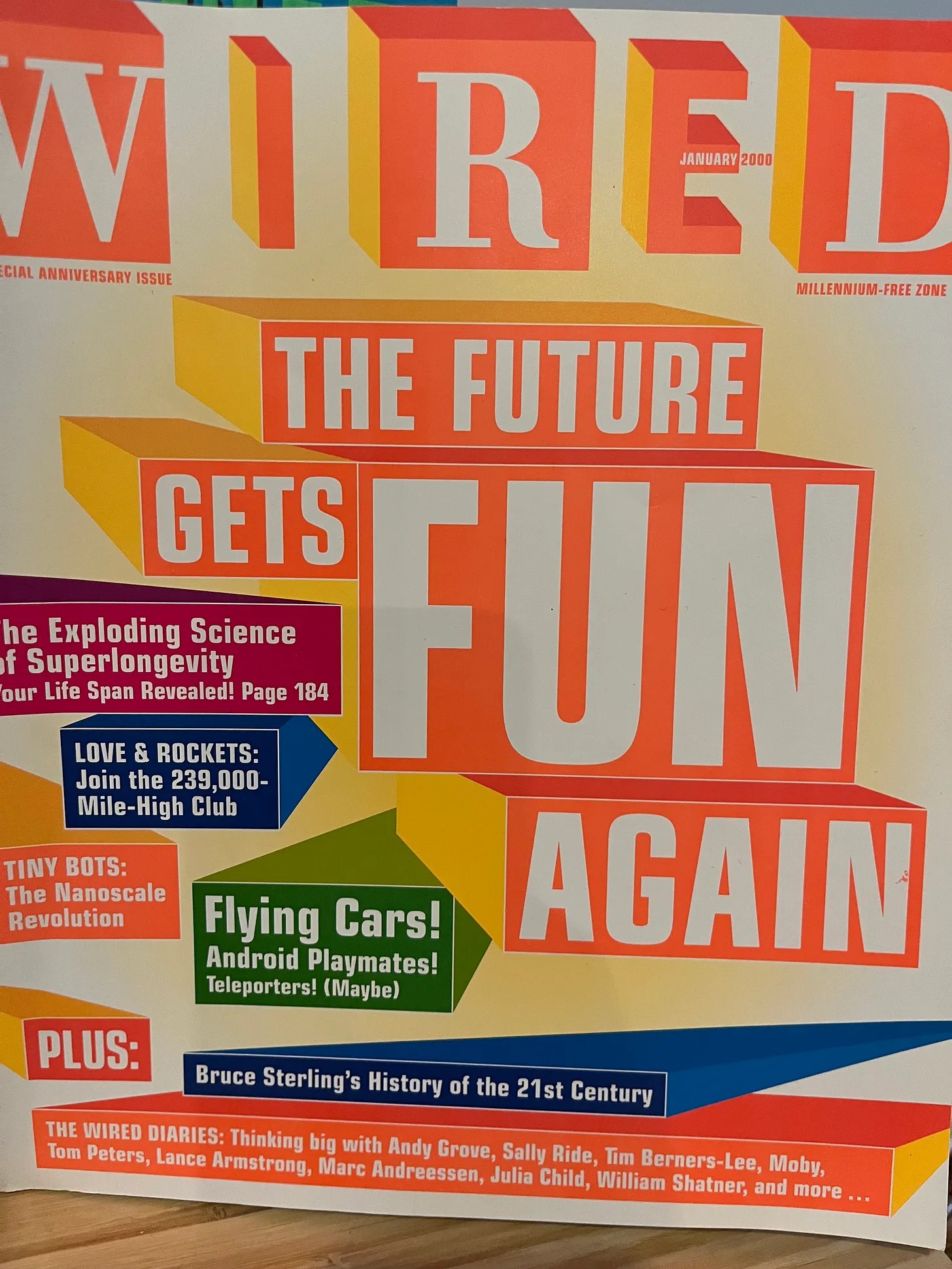
Professor and author Dave Karpf is re-reading the entire WIRED back catalog chronologically (for the second time) for a book project on the “history of the digital future.” A consideration of a 2000 issue devoted to the future has led him to a fascinating insight…
The January 2000 issue is themed around predictions. The magazine did the same thing in January 1999. They ask a ton of experts and celebrities to talk about what the future is going to be like. Some take it seriously, others make jokes. Some are prescient, others notsomuch. It’s a window into what the future looked like back then.
[Karpf reviews a number of the predictions, concluding with…]
…And then there’s this perfect Nathan Myrvhold quote “There won’t be TV per se in three decades. There will be video service over the Internet, but it will be as different from TV today as, say, MTV from the Milton Berle show of the 1950s or from radio plays of the 1940s.”
This is art. I want to frame Myrvhold’s quote and put it in a museum of lopsided tech futurist predictions.
The part that he gets right is the technological development curve. There he is, at the turn of the millennium, five years before the inception of YouTube, telling us that the future of television is going to be video service over the Internet. Yes, absolutely right!
But the part he gets wrong is the industrial, social, and economic impacts of this technological development. We’re seeing this right now, in 2023, as the various streaming services add advertising and strike content-sharing partnership deals with each other. We have these revolutionary new technological developments, and, for about a decade, they were supported by a stock market bonanza. But now that the stocks are no longer ridiculously overvalued, the companies driving these technological developments have settled on a vision of replacing old cable tv with new cable tv. (I wrote about this in July 2022, btw, back when this Substack had a much smaller readership. I think the piece holds up well.)
Technologically, it didn’t have to be this way. But, given all the existing incentive structures established by 21st century capitalism, it was all-but-certain that we would end up here.
I see this time and time again when reading predictions of social transformation from 90s- and 00s-era technologists [cough NicholasNegropontewasconstantlywrong cough]. And I see the same thing today, every time an artificial general intelligence true believer starts opining on the glorious future of education/entertainment/science/manufacturing/art.
I wrote about this phenomenon last year in The Atlantic, where I argued that we won’t be able to tell what the future of AI looks like until we have a sense of where the revenue streams come from. The trajectory of any emerging technology bends towards money.
…
I’m writing a whole book about the lopsided ways in which tech futurists always get their predictions wrong. And one major reason why is that they focus on what the technology could do, given time and mass adoption, rather than considering what capitalism will surely do to those technologies, unless we alter the incentives through regulations.
The trajectory of every emerging technology bends toward revenue streams. If you want to build a better future, you cannot ignore the shaping force of money…
A peek back at some tech predictions from January 2000: “From the WIRED archives: The trajectory of any emerging technology bends toward money,” by @davekarpf (referral account)
See also “The frantic battle over OpenAI shows that money triumphs in the end” (in which Robert Reich argues that, though the revenue streams aren’t yet obvious, protecting their emergence was at the core of the recent battle for control of what was, ostensibly, a not-for-profit) and the oddly apposite “Nerd culture is murdering intellectuals.”
And for more on Karpf’s march through WIRED’s history and what it can tell us about the ways that tech and our culture have changed, see “Notes from #WIRED30.”
* Deep Throat (as portrayed the film adaptation of All the President’s Men)
###
As we pay attention to the profit motive, we might recall that this is an important date in broadcast history. On this date in 1896, Guglielmo Marconi introduced “radio”: he amazed a group at Toynbee Hall in East London with a demonstration of wireless communication across a room. Every time Marconi hit a key beside him at the podium, a bell would ring from a box being carried around the room by William Henry Preece.
Then exactly five years later, on this date in 1901, Marconi confounded those who believed that the curvature of the earth would limit the effective range of radio waves when he broadcast a signal from Cornwall, England to Newfoundland, Canada– over 2,100 miles– and in so doing, demonstrated the viability of worldwide wireless communication.
In the earliest days of radio, when it was essentially a wireless telegraph, there were myriad predictions of what the technology might become– from an internet-like decentralized community of communicators to a provider of education, telemedicine, and other special services… in the event, of course, it followed the money.
“People overestimate what they can do in one year and underestimate what they can do in 10 years”*…

This is especially true, argue Sam Butler-Sloss and Kingsmill Bond of the Rocky Mountain Institute, when it comes to assessing our progress in addressing the challenges of climate change with renewable energy solutions…
The renewable revolution is advancing at remarkable speed. In fact, the speed of the renewable revolution has defied many leading energy commentators who have continuously underestimated its true trajectory. They have suffered from what statisticians call a systematic bias, that is, an error that consistently skews in one direction. Noise, or a random error, is inherent to forecasting; bias, however, requires a deeper explanation.
So why do so many intelligent people undersell the pace and dynamism of the renewable revolution? Leaving aside the inherent bias of those seeking to prop up the fossil fuel system in order to enjoy the largesse of its annual $2 trillion in rents, we identify eight deadly sins of the energy transition.
Whether intentional or unwitting, these eight general errors of perspective are holding back understanding, wasting time and capital, and fueling unproductive climate pessimism…
The renewable revolution is plainly gaining speed and impact. Read on to learn why are so many analysts so wrong about the pace and scale of innovation: “The Eight Deadly Sins of Analyzing the Energy Transition,” from @SamButl3r and @KingsmillBond at @RockyMtnInst. (TotH to friend MZ)
See also: “When Idiot Savants Do Climate Economics.”
* Bill Gates
###
As we contemplate compounding, we might recall that it was on this date in 1896 that Nikola Tesla and Westinghouse Electric achieved the first long-distance transmission of hydroelectricity: from the Niagara Falls Power Company to Buffalo, N.Y., 26 miles away.

“I’m playing both sides, so that I always come out on top”*…

A new database shows 1,500 US lobbyists working for fossil-fuel firms while representing green groups and other with similarly contradictory concerns…
More than 1,500 lobbyists in the US are working on behalf of fossil-fuel companies while at the same time representing hundreds of liberal-run cities, universities, technology companies and environmental groups that say they are tackling the climate crisis, the Guardian can reveal.
Lobbyists for oil, gas and coal interests are also employed by a vast sweep of institutions, ranging from the city governments of Los Angeles, Chicago and Philadelphia; tech giants such as Apple and Google; more than 150 universities; some of the country’s leading environmental groups – and even ski resorts seeing their snow melted by global heating.
The breadth of fossil fuel lobbyists’ work for other clients is captured in a new database of their lobbying interests which was published online on Wednesday.
It shows the reach of state-level fossil fuel lobbyists into almost every aspect of American life, spanning local governments, large corporations, cultural institutions such as museums and film festivals, and advocacy groups, grouping together clients with starkly contradictory aims…
Read on for chilling examples: “‘Double agents’: fossil-fuel lobbyists work for US groups trying to fight climate crisis,” from @olliemilman in @GuardianUS.
* “Mac,” It’s Always Sunny in Philadelphia
###
As we contemplate conflicts (and note that last Monday’s, then Tuesday’s “hottest day ever” records are sure to continue to be broken), we might spare a thought for Jacob Bjerknes; he died on this date in 1975. Son of Vilhelm Bjerknes, one of the pioneers of modern weather forecasting, Jacob is remembered for his seminal paper on the dynamics of the polar front, the mechanism for north-south heat transport, and for his contributions to the understanding of the weather phenomenon El Niño.

“They laughed at Columbus and they laughed at the Wright brothers. But they also laughed at Bozo the Clown.”*…

Most technologies that grow up to be important, Benedict Evans observes, start out looking like toys with little or no practical application.
Some of the most important things of the last 100 years or so looked like this. Aircraft, cars, telephones, mobile phones and personal computers were all dismissed as toys. “Well done Mr Wright – you flew over a few sand dunes. Why do we care?”
But on the other hand, plenty of things that looked like useless toys never did become anything more than that. The fact that people laughed at X and X then started working does not tell us that if people now laugh Y or Z, those will work too.
So, we have a pair of equal and opposite fallacies. There is no predictive value in saying ‘that doesn’t work’ or ‘that looks like a toy’, and there is also no predictive value in saying ‘people always say that.’ As [Wolfgang] Pauli put it, statements like this are ‘not even wrong’ – they give no insight into what will happen.
Instead, you have to go one level further. You need a theory for why this will get better, or why it won’t, and for why people will change their behaviour, or for why they won’t…
That’s to say, Evans suggests, you need to be able to envision a roadmap from “toy” to wide, practical use…
These roadmaps can come in steps. It took quite a few steps to get from the [Wright Flier, pictured above left] to something that made ocean liners obsolete, and each of those steps were useful. The PC also came in steps – from hobbyists to spreadsheets to web browsers. The same thing for mobile – we went from expensive analogue phones for a few people to cheap GSM phones for billions of people to smartphones that changed what mobile meant. But there was always a path. The Apple 1, Netscape and the iPhone all looked like impractical toys that ‘couldn’t be used for real work’, but there were obvious roadmaps to change that – not necessarily all the way to the future, but certainly to a useful next step.
Equally, sometimes the roadmap is ‘forget about this for 20 years’. The Newton or the IBM Simon were just too early, as was the first wave of VR in the 80s and 90s. You could have said, deterministically, that Moore’s Law would make VR or pocket computers useful at some point, so there was notionally a roadmap, but the roadmap told you to work on something else. This is different to the Rocket Belt [pictured above right], where there was no foreseeable future development that would make it work…
Much the same sort of questions apply to the other side of the problem – even if this did get very cheap and very good, who would use it? You can’t do a waterfall chart of an engineering roadmap here, but you can again ask questions – what would have to change? Are you proposing a change in human nature, or a different way of expressing it? What’s your theory of why things will change or why they won’t?
The thread through all of this is that we don’t know what will happen, but we do know what could happen – we don’t know the answer, but we can at least ask useful questions. The key challenge to any assertion about what will happen, I think, is to ask ‘well, what would have to change?’ Could this happen, and if it did, would it work? We’re always going to be wrong sometimes, but we can try to be wrong for the right reasons…
A practical approach to technology forecasting: “Not even wrong: predicting tech,” from @benedictevans.
* Carl Sagan
###
As we ponder prospects, we might send carefully-calculated birthday greetings to J. Presper Eckert; he was born on this date in 1919. An electrical engineer, he co-designed (with John Mauchly) the first general purpose computer, the ENIAC (see here and here) for the U.S. Army’s Ballistic Research Laboratory. He and Mauchy went on to found the Eckert–Mauchly Computer Corporation, at which they designed and built the first commercial computer in the U.S., the UNIVAC.

“It was impossible to tame, like leeches”*…

Or maybe just not worth it…
If you’re like me, one of the few remaining artifacts of the pre-Internet age that you’re able to regularly revel in is the mail order catalog. I particularly love the desk toys highlighted they show off—often, some of the most luxurious are vintage weather prediction devices. Today’s tedium is about the Victorian “Tempest Prognosticator,” a vintage weather forecast device you’re not likely to see as a desk toy any time soon—because maintaining one also means taking care of a dozen leeches…
George Merryweather, a member of Whitby, North Yorkshire’s then-thriving intellectual scene, masterminded the “Tempest Prognosticator” as a years-long hobby that culminated in its public display in 1851.
As a physician, Merryweather would already have been quite familiar with leeches, but in his essays, Merryweather said he was inspired by a poem, which spoke of how the common “medicinal leech” tends to move up in a jar of rainwater as a storm nears, then settle to the bottom in clear conditions…
To harness this instinct, Merryweather placed 12 leeches in their own jars of rainwater, arranged in a circle to keep each other company. Atop each jar, he rigged a piece of whale bone to a chain that, when yanked, would hit a bell he had placed in the center. As leeches rose to the top of their jars in advance of a storm, they would come into contact with the bone and sound the bell. The more bells that sounded, the more likely there was to be a storm, and the more intense it was likely to be…
At the time, consensus among the leech-invested appears to have emerged that these behaviors were due to the creatures’ innate ability to sense electromagnetic energy gathering in advance of a storm. Merryweather himself was a major proponent of this belief, dedicating a significant portion of his essays to reiterating Michael Faraday’s contemporary work on electromagnetism.
Unfortunately for him, we now know this acknowledgement was likely both unnecessary and uncalled-for. Leeches’ faculties for weather prediction turn out to actually be pretty patchy, and their “instincts” for this are far simpler than it seemed to him at the time. Leeches “breathe” through their body walls by absorbing the dissolved oxygen in the water they inhabit. When atmospheric pressure drops, a fractional amount less oxygen remains dissolved, and they move toward the surface, where the water is more oxygen-rich.
In effect, the “Tempest Prognosticator” was one of the world’s most elaborate barometers…
More of the remarkable story– and what it can teach us– at “The Leech Machine,” from Nathan Lawrence (@NathanBLawrence) in @ShortFormErnie‘s wonderful @readtedium.
* Daniel Handler (Lemony Snicket), Who Could That Be at This Hour?
###
As we consult the Almanac, we might recall that on this date in 1949, after two days in which a few flakes fell, Los Angeles “enjoyed” a real snow fall.

You must be logged in to post a comment.