Posts Tagged ‘Cosmology’
“Listening to both sides of a story will convince you that there is more to a story than both sides”*…
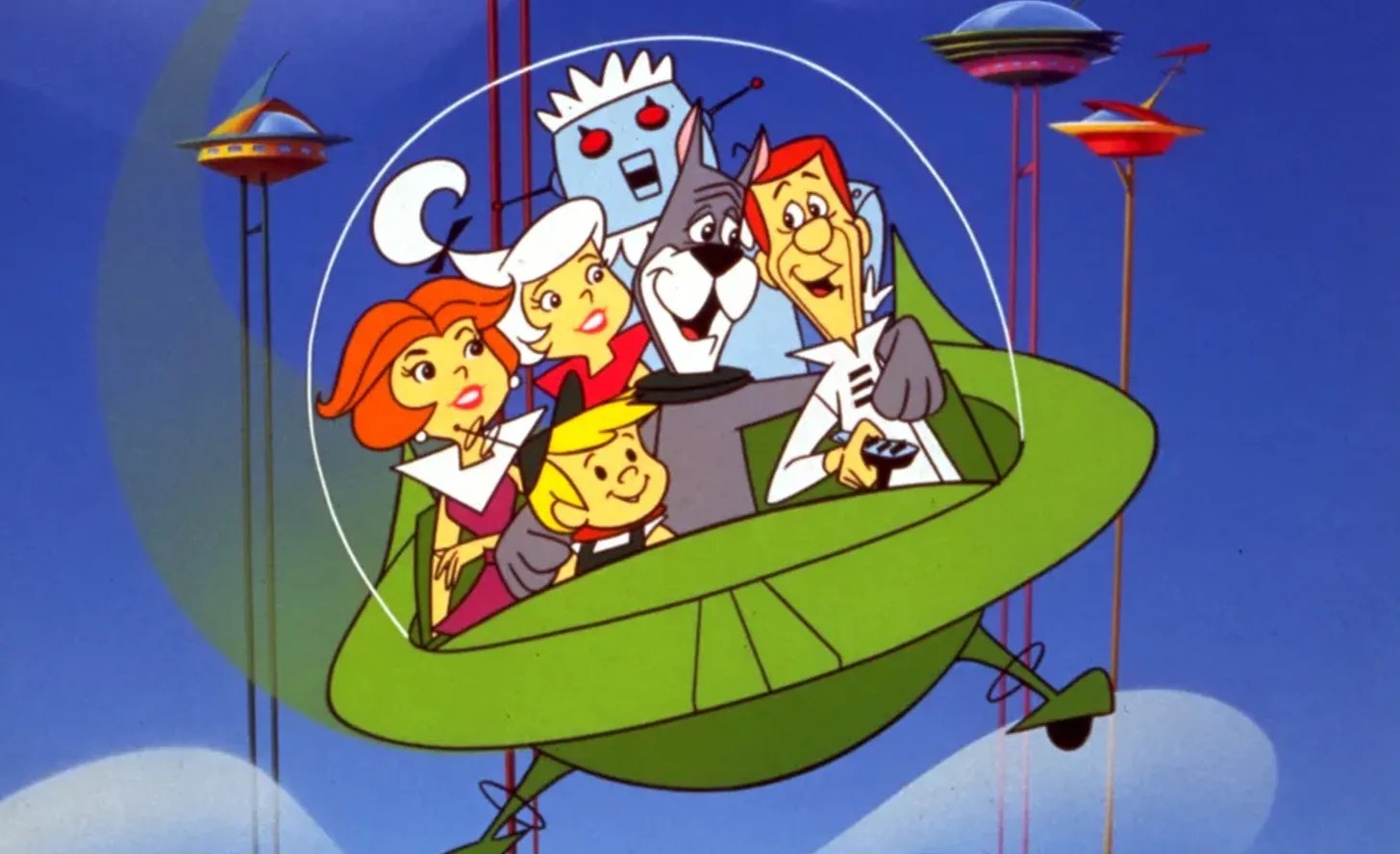
Regular readers will have deduced that I am something of a techno-optimist. While I worry that human misapplication (exploitation) of new technologies could create new dangers and/or further concentrate wealth and power in too few hands, I believe that emerging tech could– should– help humanity deal with many of its gravest challenges, certainly including climate change. At the same time, I am disposed to thinking about large issues/problems systemically.
Rianne Riemens shares neither of my enthusiasms; she sounds a critical note on techno-optimism, systems thinking– and more specifically, on the application of the latter to the former…
Today, American tech actors express optimistic ideas about how to fix the Earth and halt climate change. Such “green” initiatives have in common that they capture the world in systems and propose large systemic, and mostly technological, solutions. Because of their reliance on techno-fixes, representatives of Silicon Valley express an ideology of ecomodernism, which believes that human progress can be “decoupled” from environmental decline. In this article, I show how “whole-systems thinking” has become a key discursive element in today’s ecomodernist discourses. This discourse has developed from the 1960s onwards – inspired by cybernetic, ecological and computational theories – within the tech culture of California. This paper discusses three key periods in this development, highlighting key publications: the Whole Earth Catalog of the 1960s, the Limits to Growth report in 1972 and the cyberspace manifestoes of the mid 1990s. These periods are key to understand how techno-fixes became a popular answer to the climate crisis, eventually leading to a vision of the world as an ecosystem that can be easily controlled and manipulated, and of technological innovation as harmless and beneficial. I argue that “whole-systems” thinking offers a naive and misleading narrative about the development of the climate crisis, that offers a hopeful yet unrealistic perspective for a future threatened by climate change, built on a misconception of Earth as a datafied planet.
In “The Techno-Optimist Manifesto” (Citation2023) venture capitalist Marc Andreessen argues why we should all be techno-optimists, especially if we are worried about the future impact of the climate crisis. According to Andreessen, promoting unlimited technological progress is the only option: “there is no inherent conflict between the techno-capital machine and the natural environment”. If we generate unlimited clean energy, we can improve the natural environment, whereas a “technologically stagnant society ruins it” (Andreessen, Citation2023). This is possible, he writes, because technologies enable processes of dematerialization and will eventually lead to material abundance. And, “We believe the market economy is a discovery machine, a form of intelligence—an exploratory, evolutionary, adaptive system” (Andreessen, Citation2023). The manifesto thus conceptualizes technology as immaterial and the capitalist economy as an evolutionary system: it presents techno-fixes as a harmless form of environmental action, and economic growth as an inevitable process that political powers should not interfere with.
The “Techno-Optimist Manifesto” is an example of a form of techno-optimism that places full trust in the potential of capitalist tech companies to help humanity “innovate” its way out of a climate crisis. Andreessen (Citation2023) cites historical figures including Buckminster Fuller, Stewart Brand, Douglas Engelbart and Kevin Kelly as the inspiration for his manifesto, showing that the work of these figures and their communities is being remixed and reappropriated into the future visions of contemporary techno-optimists. In this article, I analyse how the belief in the environmental potential of techno-fixes is engrained in the ideology and history of “Silicon Valley” and is discursively constructed through a language of “whole-systems thinking”. I use the concept of whole-systems thinking as a lens to study how simplified notions taken from whole-systems theory and cybernetics played and still play a key role in techno-environmental discourse in the post-war era in the United States. I zoom in on three key events that help explain the origins and evolution of popular whole-systems thinking: the Whole Earth Catalog community led by Stewart Brand in the 1960s, the Limits to Growth report by the Club of Rome in the 1970s and the cyberlibertarian community in the 1990s. I will show how a new language emerged that used simplified notions of systems-thinking to promote the idea that technology would help understand, manage and save a planet in peril.
Through a discourse analysis of primary sources and literature review I present a critical reading of these events in the light of today’s techno-optimistic environmental discourse. My corpus exists of a number of primary sources, including the aforementioned “Techno-Optimist Manifesto” (2023), Limits to Growth report (Meadows et al., Citation1972), editions of the Whole Earth Catalog and CoEvolution Quarterly, Barlow’s Declaration of the Independence of Cyberspace (1996), texts by Kevin Kelly (Citation1998) and Stewart Brand (Citation2009) and An Ecomodernist Manifesto (Asafu-Adjaye et al., Citation2015). I have discursively analysed these sources for their discussion of systems thinking as well as environmental concerns. By analysing how whole-systems thinking became a popular way of addressing environmental issues, I aim to provide a “post-war genealogy” (Pedwell Citation2022) of the term and critique today’s promises about how tech can save the climate. As Johnston (Citation2020) has argued, tracing the development of a cultural perception of trust in techno-fixes reveals a complex and multi-sided history. I claim that the environmental dimension of techno-optimistic discourses requires a critical reconsideration of the ideological underpinnings of Silicon Valley, described as the “Californian Ideology” by Barbrook and Cameron (Citation1996). I will demonstrate how ecomodernism, including its belief that human progress can be “decoupled” from environmental decline, allows us to better understand, and critique, the environmental ideology of Silicon Valley.
I will first expand on contemporary ecomodernism and present my thesis that “decoupling” nature from culture has come to underlie whole-systems thinking in contemporary techno-optimistic discourse. In the following three sections, I highlight a few historical moments to demonstrate the development of the cultural perception of techno-fixes, specifically as a means of managing the environment. I show how whole-systems thinking became popularized by the Whole Earth community, got incorporated in environmental debates through the Limits to Growth report and is reflected in cyberutopian dreams about immaterial societies. Building on my necessarily brief history, I argue that techno-fixes can be strategically presented as ideal solutions if the world and environment are imagined as simple systems and technology as immaterial and harmless. Finally, I return to contemporary US tech culture and argue that it is shaped by, and co-shapes, the ideology of ecomodernism in which nature and culture are decoupled. I conclude that this worldview expresses itself today in corporate visions, resulting in a false hope about how to innovate our way out of the climate crisis…
Eminently worth reading in full (if in the end, as for me, less as a wholesale rejection of techno-optimism and systems thinking than as a cautionary counterweight): “Fixing the earth: whole-systems thinking in Silicon Valley’s environmental ideology,” from @WeAreTandF.
(image above: source)
###
As we tangle with tech, we might pause to remember a man who bridged our understanding of the systems of the world from one paradigm to another: Sir Arthur Stanley Eddington, OM, FRS; he died in this date in 1944. An astrophysicist, mathematician, and philosopher of science known for his work on the motion, distribution, evolution and structure of stars, Eddington is probably best remembered for his relationship to Einstein: he was, via a series of widely-published articles, the primary “explainer” of Einstein’s Theory of General Relativity to the English-speaking world; and he was, in 1919, the leader of the experimental team that used observations of a solar eclipse to confirm the theory.

“In the beginning the Universe was created. This has made a lot of people very angry and been widely regarded as a bad move.”*…

In the face of cosmologists who are trying to combine string theory with the theory of cosmic inflation to understand the universe-as-we-find-it, Neil Turok suggests a much simpler explanation. Frank Landymore reports…
Our understanding of the universe, as advanced as it is, remains riddled with paradoxes and huge question marks. Physicists have come up with some pretty heady ideas to explain them — we’ll get to those later — but there just might be a far “simpler” solution to all those holes in cosmology.
As Higgs Chair of Theoretical Physics at the University of Edinburgh Neil Turok explains in an essay for The Conversation, there could be a “mirror” universe that existed before the Big Bang and is a reflection of our own, moving backward in time.
It’s a trippy concept to wrap your head around, but simpler on the physics side of things. It would neatly balance out some of the asymmetries we observe in the universe, provide an answer to dark matter, and supplant some of what Turok would characterize as clumsier leading theories in cosmology, like cosmic inflation and string theory.
“Picturing the big bang as a mirror neatly explains many features of the universe which might otherwise appear to conflict with the most basic laws of physics,” wrote Turok, who published his team’s findings in the journal Annals of Physics. “The progress we have already made convinces me that, in all likelihood, there are alternatives to the standard orthodoxy — which has become a straitjacket we need to break out of.”
The physical laws of the universe should exhibit charge, parity, and time reversal — collectively known as CPT — symmetry, which essentially means every physical interaction can be mirrored. So to break down its implications: every particle should have an anti-particle of the opposite charge, every space has its inversion, and time can be reversed.
Except that’s not what we actually observe. Time only goes forward, and there are more particles than anti-matter particles. As far as we can tell, our universe is not symmetrical.
But: “Our mirror hypothesis restores the symmetry of the universe,” Turok argued. He compared it to looking at your reflection: “The combination of you and your mirror image are more symmetrical than you are alone.”
Extrapolating our universe backward in time through the Big Bang, “we found its mirror image, a pre-bang universe in which (relative to us) time runs backward and antiparticles outnumber particles,” Turok wrote.
This could also solve the mystery of dark matter, an invisible substance thought to make up 85 percent of all matter in the universe. Under the mirror hypothesis, weak, subatomic particles called neutrinos would be the ideal candidate to explain it.
Since we’ve only observed left-handed neutrinos, perhaps yet-unseen right-handed could even exist in the mirror universe.
What’s more, this could also tidily explain why the universe appears to be so uniform and flat. The prevailing theory is that a period of accelerated, faster-than-light expansion called cosmic inflation was responsible for shaping how the universe is today — but we’re yet to observe the large gravitational waves this would have produced.
With a handy mirror universe, however, “statistical arguments explain why the universe is flat and smooth and has a small positive accelerated expansion, with no need for cosmic inflation,” Turok wrote.
Of course, there’s a lot more needed to bear out this intriguing hypothesis. But Turok argues that, even if disproven, it demonstrates that there could be more straightforward explanations than what the Standard Model offers…
A mirror of our own, going backwards in time: “Physicist Says There’s Another Universe Hiding Behind the Big Bang,” from @futurism.
Turok’s full essay– longer and more detailed, but very accessible– is here.
* Douglas Adams, The Restaurant at the End of the Universe
###
As we size up symmetry, we might send lofty birthday greetings to another ponderer of the cosmos, Carl Edward Sagan; he was born on this date in 1934. An astronomer, cosmologist, astrophysicist, astrobiologist (his contributions were central to the discovery of the high surface temperatures of Venus), he is best remembered as a popularizer of science– via books like The Dragons of Eden, Broca’s Brain and Pale Blue Dot, and the award-winning 1980 television series Cosmos: A Personal Voyage (which he narrated and co-wrote), the most widely-watched series in the history of American public television (seen by at least 500 million people across 60 different countries).
He is also remembered for his contributions to the scientific research of extraterrestrial life, including experimental demonstration of the production of amino acids from basic chemicals by radiation.
(Readers can enjoy a loving riff on Cosmos here.)

“What happens when you get to the end of things?”*…

Charlie Wood introduces a remarkable new collection in Quanta…
A couple of years ago, I was chatting about black holes with Dan Harlow of the Massachusetts Institute of Technology when he made a casual comment that left a deep impression on me. I asked if some new work he’d been doing strengthened the case that space-time was “emergent.” Without missing a beat he replied, “Sure, if it needed strengthening.”
Harlow isn’t the only physicist with serious doubts about what reality is made of. For more than a decade now, Nima Arkani-Hamed of the Institute for Advanced Study has been delivering a polished lecture arguing that space-time is “doomed.” Time and again, I’ve heard theorists in high-energy physics make similar-sounding statements, and I’ve always been struck by their confidence. We don’t have the faintest idea what the next theory of physics will look like, whether it will involve strings, loops, triangles or something entirely new that no one has thought to propose. And yet so many theorists seem rather convinced that whatever it will be, it won’t involve space or time.
Why? What does that statement mean? What would it look like to do physics without referring to space or time? I’ve spent most of this year trying to find out. The results have just been published in “The Unraveling of Space-Time,” a massive package that includes articles, videos and interactive animations from me and my colleagues Mark Belan, Emily Buder, Amanda Gefter and Joseph Howlett.
Over the course of more than 40 interviews with nearly 30 physicists, I learned that there are many ways to define emergent space-time. But at the most basic level, “emergent space-time” means that space and time are the outputs of a theory instead of the inputs. A classic analogy is heat. To explain why a teacup cools, scientists of the 1700s put heat into their theory of the world as a substance that repels itself and naturally spreads out. But this “caloric theory” was ultimately replaced by thermodynamics, a theory where a primary input is molecules that buzz around with some energy. As molecules crash into each other, their energy spreads, and we now recognize this process as the origin of heat transfer. Heat is an output — a prediction — of thermodynamics. It is an emergent phenomenon.
Space-time is the ultimate input. If physics is largely about predicting what happens where and when, you need a stage upon which things can happen. Albert Einstein became a household name for revealing that this stage acts like a fabric that bends in ways we experience as gravity. He described in spectacular detail how space-time behaves, much as 19th-century scientists described how heat behaves with caloric theory. The idea that space-time is emergent is the idea that space-time will eventually go the way of heat, water, air and so many other substances before it; we will someday understand it to be the inevitable consequence of the behavior of simpler entities. Call them the “atoms” of space-time.This week’s series explores the mind-bending notion of emergent space-time from a number of angles. There is, of course, the why of it all. This mostly boils down to the strange things that happen when Einstein’s theory of space-time collides with quantum mechanics, the theory of the subatomic world. When we combine features from both theories, we see that any experiment that tries to probe reality a little too closely will get thwarted by the appearance of a black hole, an enigma that undermines the familiar picture of space-time in its own way.
For this and other reasons, physicists are pushing to escape our familiar space-time, often referred to as the “bulk,” in search of alien environments conducive to new ways of doing physics.
Where else might one do physics, if not in the bulk? A few ideas are being developed, including one that goes by the name of holography. This is roughly the idea that any gravitational system — even the entire universe — can have an alternative description as a collection of quantum particles moving around a flat surface. From these gravity-free surfaces, a bulk world with gravity somehow pops out. It’s a remarkable theoretical claim, and over the past few years, holographers have developed a suite of tools that have helped them decode the bulk from the behavior of these surface particles.Another research program, spearheaded by Arkani-Hamed, has even more ambitious aims — getting both space-time and quantum mechanics as outputs from even more alien inputs. His group has recently developed an entirely new language for making predictions, one that makes no reference to space-time. Instead, it uses only geometric shapes and primitive counting tasks.
Is space-time, at least in its current form, definitely doomed? The idea tortured one of the pioneers of gravitational theory, John Wheeler. And today, the end of space-time is even more widely accepted. Most of the theorists I spoke with struggled to think of colleagues in the quantum gravity community who would defend space-time as a fundamental ingredient of reality. However, some researchers are pursuing alternatives. I spoke at length with Latham Boyle about patterns in particle physics that have led him and his collaborators to the more conservative notion that space-time might come in two “sheets.”
The various proposals under development are unlikely to see experimental tests this century, so a conclusive answer doesn’t seem near. But if it were someday established that space-time does break down, what would that mean for us?
On a practical level, not much. Einstein’s fabric of space-time is so sturdy that little short of a black hole would put a noticeable dent in it. But at a conceptual level, it’s hard to imagine a more dramatic rethinking of reality. When Democritus suggested that matter emerges from tiny barbed “atoms” more than 2,000 years ago, he couldn’t possibly have foreseen that parts of his proposal would ultimately be realized in the form of quantum theory — a framework asserting that reality is an ocean of overlapping waves of possibility that resolve into fixed objects only in certain situations.
If the void itself emerges from something, that something will be at least as alien. Just as individual molecules don’t themselves have a well-defined notion of heat, the base level of reality could lack marquee features of our existence that we take for granted. Places. Times. The ability to influence only nearby objects. The requirement that causes precede effects. Physicists are already finding that these notions seem unlikely to be present in a more precise accounting of the world. They seem to be the approximate outputs of something stranger.“One of the most spectacular aspects of these new findings is the emergence of causality can only happen in the approximate description,” Elliott Gesteau, a quantum gravity researcher at the California Institute of Technology, told me over Zoom earlier this year. If there is gravity, he continued, “which is what we have in our world, then this causal structure is only approximate and must break down.”…
Are we on the verge of a new physics? “Why Space-Time Looks Doomed,” from @walkingthedot in @QuantaMagazine.
The full interactive collection is here, and eminently worth reading in full.
* John Wheeler
###
As we wrestle with reality, we might spare a thought for a physicist whose work helped move the questions we face forward– Max Karl Ernst Ludwig Planck; he died on this date in 1947. A theoretical physicist, he is best remembered as the originator of quantum theory. It was his discovery of energy quanta that won him the Nobel Prize in Physics in 1918.

“It is clear that there is no classification of the Universe that is not arbitrary and full of conjectures. The reason for this is very simple: we do not know what kind of thing the universe is.”*…

… Still, scientists try. Ethan Siegel on the current state of play– with special attention to whether or not our cosmic landscape is endless or not, and why the Universe is so uniform on large scales, but so non-uniform on smaller scales…
13.8 billion years ago, our Universe as we know it began with the hot Big Bang, which gave rise to a primordial soup of particles and antiparticles that led to the planets, stars, and galaxies we know today. The hot Big Bang itself was set up by a preceding phase known as cosmic inflation, but only the final tiny fraction-of-a-second gets imprinted onto our observable Universe. What we can observe about the Universe is finite, but what about the unobservable parts that lie beyond it: are they finite or infinite? What the data can tell us is limited, but here’s what we think and why…
Read on to find out: “Is the Universe finite or infinite?” from @StartsWithABang in @bigthink.
* Jorge Luis Borges, in “The Analytical Language of John Wilkins”
###
As we stargaze, we might send sunny birthday greetings to Herbert Friedman; he was born on this date in 1916. A physicist and astronomer, he made seminal contributions to the study of solar radiation. Friedman joined the Naval Research Laboratory in 1940 and developed defense-related radiation detection devices during WW II. In 1949, he obtained the first scientific proof that X rays emanate from the sun, when he directed the firing into space of a V-2 rocket carrying a detecting instrument. Through subsequent rocket astronomy, he also produced the first ultraviolet map of celestial bodies, and gathered information for the theory that stars are being continuously formed, on space radiation affecting Earth, and on the nature of gases in space. Friedman also made fundamental advances in the application of x rays to material analysis.

“A cosmic mystery of immense proportions, once seemingly on the verge of solution, has deepened and left astronomers and astrophysicists more baffled than ever. The crux … is that the vast majority of the mass of the universe seems to be missing”*…
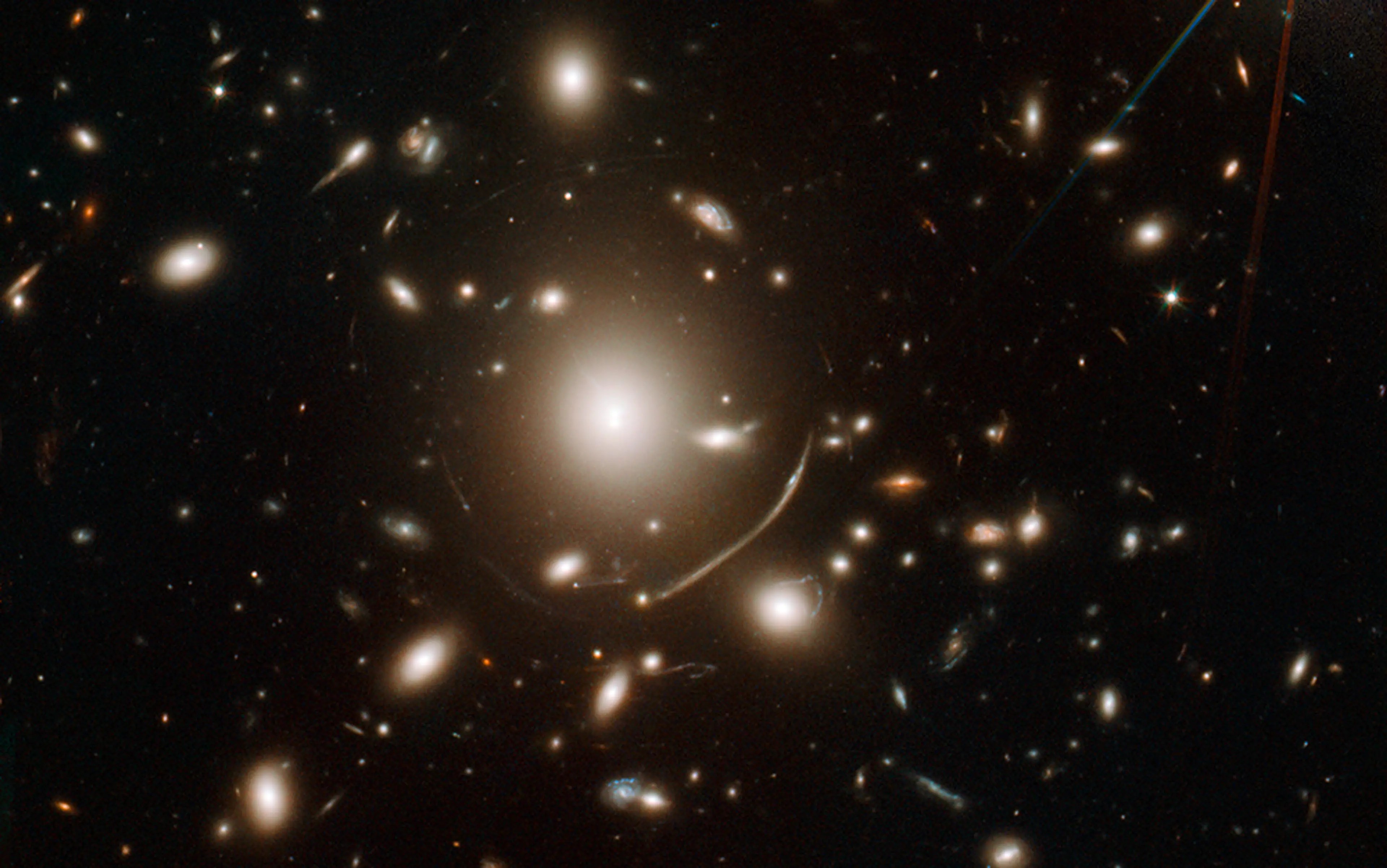
Quantum effects may not be just subatomic, Sabine Hossenfelder suggests; they might be expressed across galaxies, and solve the puzzle of dark matter…
Most of the matter in the Universe is invisible, composed of some substance that leaves no mark as it breezes through us – and through all of the detectors the scientists have created to catch it. But this dark matter might not consist of unseen particle clouds, as most theorists have assumed. Instead, it might be something even stranger: a superfluid that condensed to puddles billions of years ago, seeding the galaxies we observe today.
This new proposal has vast implications for cosmology and physics. Superfluid dark matter overcomes many of the theoretical problems with the particle clouds. It explains the long-running, increasingly frustrating failure to identify the individual constituents within these clouds. And it offers a concrete scientific path forward, yielding specific predictions that could soon be testable.
Superfluid dark matter has important conceptual implications as well. It suggests that the common picture of the Universe as a mass of individual particles bound together by forces – almost like a tinker toy model – misses much of the richness of nature. Most of the matter in the Universe might be utterly unlike the matter in your body: not composed of atoms, and not even built of particles as we normally understand them, but instead a coherent whole of vast extension…
Is dark matter composed of particles? Is it a fluid? Or is it both? Read On: “The superfluid Universe,” from @skdh in @aeonmag.
###
As we deconstruct the dark, we might spare a thought for Richard Philips Feynman; he died on this date in 1988. A theoretical physicist, Feynman was probably the most brilliant, influential, and iconoclastic figure in his field in the post-WW II era.
Richard Feynman was a once-in-a-generation intellectual. He had no shortage of brains. (Relevantly to the piece above, in 1965 he won the Nobel Prize in Physics for his work on quantum electrodynamics.) He had charisma. (Witness this outtake [below] from his 1964 Cornell physics lectures [available in full here].) He knew how to make science and academic thought available, even entertaining, to a broader public. (See, for example, these two public TV programs hosted by Feynman here and here.) And he knew how to have fun.
– From Open Culture (where one can also find Feynman’s elegant and accessible 1.5 minute explanation of “The Key to Science.”)
You must be logged in to post a comment.